



Job uncertainty makes people shy away from loans in India

October 16, 2013

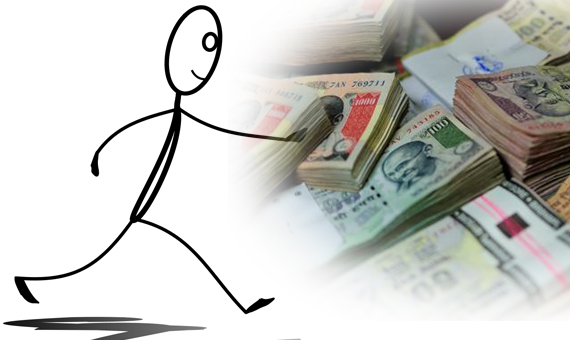
Running_for_moneyNew Delhi, Oct 16: People in India are increasingly shying away from taking bank loans on account of economic slowdown and scepticism arising out of job uncertainty, a survey by industry body Assocham said.

"In the wake of slowdown, while industrial growth and services are getting impacted, job uncertainty among the young spenders is working as a big dampener," the survey said.

Individual borrowers are adopting an extremely conservative approach when it comes to taking loans from banks against fixed deposits or shares and bonds.

According to the banking data, loans against fixed deposits have declined by 1.6 per cent in the current fiscal as against a growth of 20 per cent between August 2012 and August 2013.

Besides, credit card users are also avoiding taking loans as the interest rates charged on outstanding payments are prohibitively high. Those who have already taken loans are now more cautious and resorting to timely payments of their dues to avoid penalties.

"There is a feeling that credit card outstanding payments result in debt traps for the card-holders," the survey said.

A similar trend has been witnessed in individuals or entities seeking bank loans in return for mortgaging shares and bonds.

The amount deployed so far in the current fiscal under this head has shown a decline of 6.6 per cent, as against a growth of 8.8 per cent in the previous year, the survey said.

The reason cited for the cautious approach being adopted by borrowers as well as banks is the prevailing volatility in the share market.

"They (banks) perceive as risk great volatility in share prices, particularly if the share price of the mortgaged security has seen a sharp decline. The issue of Mark-to-Market risks act as hindrance," the survey said.

Besides, high interest rates offered by banks is also one of the main reasons for the trend, since deposit rates have been recently revised upwards in the wake of tight liquidity position.

Moreover, banks are also unwilling to lend to large corporates which are facing the liquidity problems arising from drying up of the corporate deposit (CDs) markets, according to the survey.

"Banks, bitten by a large increase in their NPAs (non-performing assets), are not too willing to lend to big corporates for meeting their working capital needs and want the companies to use the CD market, which, unfortunately, has gone dry," the survey said.

Comments

Add new comment

  • Coastaldigest.com reserves the right to delete or block any comments.
  • Coastaldigset.com is not responsible for its readers’ comments.
  • Comments that are abusive, incendiary or irrelevant are strictly prohibited.
  • Please use a genuine email ID and provide your name to avoid reject.
Agencies
June 12,2020

Mumbai, Jun 12: Following an overwhelming response for the mega rights issue of Mukesh Ambani-owned Reliance Industries, the partly paid-up rights shares are set to debut on stock exchanges on June 15.

The biggest ever Rs 53,124 crore rights issue was subscribed 1.59 times and received bids worth Rs 84,000 crore on June 3.

Reliance said the rights issue saw a huge investor interest, including from lakhs of small investors and thousands of institutional investors, both Indian and foreign.

In 2019, Ambani said in the Reliance's annual general meeting that the company will be net zero debt by March 2021. The company is on course to achieve its target ahead of the deadline.

"In spite of the COVID-19 crisis and the lockdowns, the due-diligence by Saudi Aramco for the planned investment in the O2C business is on track as both the parties are committed and actively engaged," he said recently.

"With a strong visibility to these equity infusions, Reliance is set to achieve net zero debt status ahead of its own aggressive timeline. We believe rights issue was a part of the company's strategy of deleveraging its balance sheet," said Ambani. 

Comments

Add new comment

  • Coastaldigest.com reserves the right to delete or block any comments.
  • Coastaldigset.com is not responsible for its readers’ comments.
  • Comments that are abusive, incendiary or irrelevant are strictly prohibited.
  • Please use a genuine email ID and provide your name to avoid reject.
Agencies
May 17,2020

As millions of people get hooked to online dating platforms, their proliferation has led to online romance scams becoming a modern form of fraud that have spread in several societies along with the development of social media like Facebook Dating, warn researchers.

For example, extra-marital dating app Gleeden has crossed 10 lakh users in India in COVID-19 times while dating apps like Tinder and Bumble have gained immense popularity.

According to researchers from University of Siena and Scotte University Hospital led by Dr Andrea Pozza, via a fictitious Internet profile, the scammer develops a romantic relationship with the victim for 6-8 months, building a deep emotional bond to extort economic resources in a manipulative dynamic.

"There are two notable features: on the one hand, the double trauma of losing money and a relationship, on the other, the victim's shame upon discovery of the scam, an aspect that might lead to underestimation of the number of cases," the authors wrote in a paper published in the journal Clinical Practice & Epidemiology in Mental Health.

Around 1,400 dating sites/chats have been created over the last decade in North America alone. In the UK, 23 per cent of Internet users have met someone online with whom they had a romantic relationship for a certain period and even 6 per cent of married couples met through the web.

"The online dating industry has given rise to new forms of pathologies and crime, said the authors.

The results showed that 63 per cent of social media users and 3 per cent of the general population reported having been a victim at least once.

Women, middle-aged people, and individuals with higher tendencies to anxiety, romantic idealization of affective relations, impulsiveness and susceptibility to relational addiction are at higher risk of being victims of the scam.

Online romance scams are, in other words, relationships constructed through websites for the purpose of deceiving unsuspecting victims in order to extort money from them.

The scammer always acts empathetically and attempts to create the impression in the victim that the two are perfectly synced in their shared view of life.

"The declarations of the scammer become increasingly affectionate and according to some authors, a declaration of love is made within two weeks from initial contact," the study elaborated.

After this hookup phase, the scammer starts talking about the possibility of actually meeting up, which will be postponed several times due to apparently urgent problems or desperate situations such as accidents, deaths, surgeries or sudden hospitalizations for which the unwitting victim will be manipulated into sending money to cover the momentary emergency.

Using the strategy of "testing-the-water", the scammer asks the victim for small gifts, usually to ensure the continuance of the relationship, such as a webcam, which, if successful, leads to increasingly expensive gifts up to large sums of money.

When the money arrives from the victim, the scammer proposes a new encounter.

The request for money can also be made to cover the travel costs involved in the illusory meeting. In this phase, the victim may start having second thoughts or showing doubt about the intentions of the partner and gradually decide to break off the relationship.

"In other cases, the fraudulent relationship continues or even reinforces itself as the victim, under the influence of ambivalent emotions of ardor and fear of abandonment and deception, denies or rationalizes doubts to manage their feelings," said the study.

In some cases, the scammer may ask the victim to send intimate body photos that will be used as a sort of implicit blackmail to further bind the victim to the scammer.

Once the scam is discovered, the emotional reaction of the victim may go through various phases: feelings of shock, anger or shame, the perception of having been emotionally violated (a kind of emotional rape), loss of trust in people, a sensation of disgust towards oneself or the perpetrator of the crime and a feeling of mourning.

"Understanding the psychological characteristics of victims and scammers will allow at-risk personality profiles to be identified and prevention strategies to be developed," the authors suggested.

Comments

Add new comment

  • Coastaldigest.com reserves the right to delete or block any comments.
  • Coastaldigset.com is not responsible for its readers’ comments.
  • Comments that are abusive, incendiary or irrelevant are strictly prohibited.
  • Please use a genuine email ID and provide your name to avoid reject.
Agencies
February 26,2020

Unnao, Feb 26: Ever heard of someone wishing a 'bright future' for the dead? In a bizarre incident in Uttar Pradesh's Unnao district, a village head issued a death certificate with the wish for an elderly man who had died last month.

The incident took place in the Sirwariya village in Asoha block where an elderly person Laxmi Shankar died after a prolonged illness on January 22.

His son went to the village head Babulal and requested him to issue a death certificate that he needed for some financial transactions.

Babulal not only issued the death certificate, but also 'wished' 'a bright future for the deceased' on the document.

The village head wrote in the death certificate -- "Main inke ujjwal bhavishya ki kaamna karta hoon (I wish him a bright future)."

The letter went viral on the social media on Monday after which the village head apologised for the error and issued a new death certificate.

Comments

Add new comment

  • Coastaldigest.com reserves the right to delete or block any comments.
  • Coastaldigset.com is not responsible for its readers’ comments.
  • Comments that are abusive, incendiary or irrelevant are strictly prohibited.
  • Please use a genuine email ID and provide your name to avoid reject.