



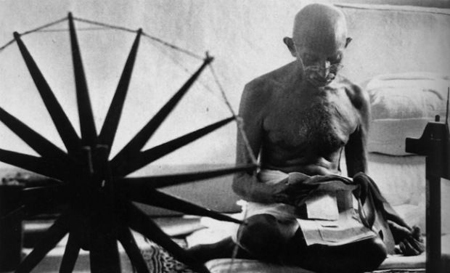
Gandhi's charkha sold for 110,000 pounds at UK auction

November 6, 2013

Gandhis_charkha

London, Nov 6: Mahatma Gandhi's over eight-decade old 'charkha', one of his most prized possessions that he used in Yerwada Jail during the 'Quit India Movement', was today auctioned in the UK for a whopping 110,000 pounds, nearly double the expected price.

Gandhi's last will also sold for 20,000 pounds at the specialist sale of historical documents and artefacts by the Mullock's Auction house in Shropshire.

"Gandhi's charkha (spinning wheel) was sold for 110,000 pounds at the auction while his last will fetched 20,000 pounds," Michael Morris, a Mullock's official, told PTI. The auction house refused to name the buyer.

Made of Indian teak, the charkha with a minimum bid of 60,000 pounds, was used by Gandhi while he was in the prison in Pune and was later gifted by him to American Free Methodist missionary Revd Floyd A Puffer in 1935.

The American was a pioneer in Indian educational and industrial cooperatives. He invented a bamboo plow that was later adopted by Gandhi.

Puffer and his wife worked as missionaries in India and in 1935 displayed Gandhi's spinning wheel at a number of talks and events.

Later, Puffer presented the charkha to fellow missionary Reverend Dr Frank J Kline in 1965. It has since passed through Kline's family to the present owner by descent.

One of the earliest known references to the charkha is an article in the December 1931 issue of the monthly Popular Science.

Gandhi's will was written in Gujarati at the Sabarmati Ashram and it supersedes the will dated 1921 that was sold at an earlier auction by Mullock's.

The later will provides a historic insight into Gandhi's thinking and his speculation for the future.

Mullock's has put under the hammer over 60 of Gandhi's most prized possessions, including the charkha, important documents, photographs and books.

The auction house's specialist Richard Westwood Brookes said: "The charkha is one of Gandhi's most prized possessions as he devised the workings of it himself. The charkha was used by him in Yerwada Jail whilst fighting for the rights and independence of India. It has impeccable provenance and is unquestionably the most important Gandhi artefact we have ever had for sale.

"The charkha was the physical embodiment and symbol of Mahatma Gandhi, he once said: 'In my dream, in my sleep, while eating, I think of the spinning wheel. The spinning wheel is my sword. To me it is the symbol of India's liberty," Brookes said highlighting the importance of the sale.

"The origins and operation of the Yerwada portable charkha are described in the American monthly Popular Science (December 1931): 'Mahatma Gandhi ... has devised a portable spinning wheel that folds into a bundle about the size of a portable typewriter and has a handle for carrying," Mullock's website said in its description of the sale item.

"When unfolded for use it is operated by turning a small crank which runs the two wheels and spindle of the device. Gandhi worked out the details of this machine it is reported while he was confined to the Yerwada jail in India. He often mentioned that his daily spinning was a form of meditation," it said.

Gandhi spent several years in Yerwada Jail during India's freedom struggle notably in 1932 and later in 1942 during the Quit India movement along with many other freedom fighters.

Comments

Jed
 - 
Wednesday, 1 Jun 2016

Hello, i think that i saw you visited my weblog thus i came to “return the favor”.I am trying to find things to enhance my site!I suppose its ok to use some
of your ideas!!

Visit my blog: Elizabeth: http://beanboss.moonfruit.com/

Add new comment

  • Coastaldigest.com reserves the right to delete or block any comments.
  • Coastaldigset.com is not responsible for its readers’ comments.
  • Comments that are abusive, incendiary or irrelevant are strictly prohibited.
  • Please use a genuine email ID and provide your name to avoid reject.
Agencies
June 22,2020

Chennai, Jun 22: Commuting the death sentence to life imprisonment for five convicts, the Madras High Court on Monday set free Chinnasamy, the main convict, who had also been sentenced to death in the Udumalpet Shankar honour killing case.

A Division Bench comprising Justice M. Sathyanarayanan and Justice M. Nirmal Kumar also dismissed the appeal by the state police against the acquittal of three persons by a lower court.

The Bench ordered the five convicts sentenced for life to undergo a jail term of not less than 25 years.

In 2016, V. Shankar, who had married C. Kausalya, was killed by a gang in Udumalpet in Tamil Nadu. The gang also injured Kausalya in the attack.

It was alleged the parents of Kausalya -- Chinnasamy, Annalakshmi -- were against the marriage.

P. Pandidurai, the uncle of Kausalya at the behest of Chinnasamy and Annalakshmi had hired a gang to kill Shankar.

The gang killed Shankar in broad daylight in a public place and Kausalya too got injured in the attack as she tried to save her husband.

The Principal District and Sessions Court in Tiruppur had convicted and sentenced to death six accused persons -- Chinnasamy, P. Jagadeesan, P. Selvakumar, M. Manikandan, M. Mathan alias Michael and P. Kalaithamilvaanan.

The court also sentenced two other accused, K. Dhanraj for life and Manikandan to a five year jail term, while acquitting Annalakshmi, Pandidurai and Prasanna.

The convicts had filed an appeal against their sentence in the Madras High Court while the police filed an appeal against the acquittal of three persons.

Comments

Add new comment

  • Coastaldigest.com reserves the right to delete or block any comments.
  • Coastaldigset.com is not responsible for its readers’ comments.
  • Comments that are abusive, incendiary or irrelevant are strictly prohibited.
  • Please use a genuine email ID and provide your name to avoid reject.
Agencies
June 19,2020

Denser places, assumed by many to be more conducive to the spread of the coronavirus that causes COVID-19, are not linked to higher infection rates, say researchers.

The study, led by Johns Hopkins University, published in the Journal of the American Planning Association, also found that dense areas were associated with lower COVID-19 death rates.

"These findings suggest that urban planners should continue to practice and advocate for compact places rather than sprawling ones, due to the myriad well-established benefits of the former, including health benefits," says study lead author Shima Hamidi from Johns Hopkins Bloomberg School of Public Health in the US.

For their analysis, the researchers examined SARS-CoV-2 infection rates and COVID-19 death rates in 913 metropolitan counties in the US.

When other factors such as race and education were taken into account, the authors found that county density was not significantly associated with county infection rate.

The findings also showed that denser counties, as compared to more sprawling ones, tended to have lower death rates--possibly because they enjoyed a higher level of development including better health care systems.

On the other hand, the research found that higher coronavirus infection and COVID-19 mortality rates in counties are more related to the larger context of metropolitan size in which counties are located.

Large metropolitan areas with a higher number of counties tightly linked together through economic, social, and commuting relationships are the most vulnerable to the pandemic outbreaks.

According to the researchers, recent polls suggest that many US citizens now consider an exodus from big cities likely, possibly due to the belief that more density equals more infection risk.

Some government officials have posited that urban density is linked to the transmissibility of the virus.

"The fact that density is unrelated to confirmed virus infection rates and inversely related to confirmed COVID-19 death rates is important, unexpected, and profound," said Hamidi.

"It counters a narrative that, absent data and analysis, would challenge the foundation of modern cities and could lead to a population shift from urban centres to suburban and exurban areas," Hamidi added.

The analysis found that after controlling for factors such as metropolitan size, education, race, and age, doubling the activity density was associated with an 11.3 per cent lower death rate.

The authors said that this is possibly due to faster and more widespread adoption of social distancing practices and better quality of health care in areas of denser population.

The researchers concluded that a higher county population, a higher proportion of people age 60 and up, a lower proportion of college-educated people, and a higher proportion of African Americans were all associated with a greater infection rate and mortality rate.

Comments

Add new comment

  • Coastaldigest.com reserves the right to delete or block any comments.
  • Coastaldigset.com is not responsible for its readers’ comments.
  • Comments that are abusive, incendiary or irrelevant are strictly prohibited.
  • Please use a genuine email ID and provide your name to avoid reject.
Agencies
January 16,2020

Claiming that e-commerce giants like Amazon import as much as 80 per cent of the items sold on their platforms, small manufacturers' body has said that their business models do not benefit local industry and are creating jobs of delivery boys only.

"Neither manufacturers nor traders are getting any benefit from the business models of Amazon and Flipkart because they largely import their products from China and Korea and sell here. Nearly 80 per cent of their products are imported," said Anil Bhardwaj, Secretary General, Federation of Indian Micro and Small & Medium Enterprises (FISME).

Bhardwaj said that the global e-commerce players generally source and sell products through their own preferred suppliers and as a result a large number of local manufacturers and traders get crowded out.

He listed out deep discounting and buying products from preferred companies as unfair practices.

"Even if they buy products from local suppliers the commission charged is very high," Bhardwaj said adding that the issues related to unfair practices have been raised with Commerce Ministry on multiple occasions.

FISME maintains that the technology-driven retail is way forward and one cannot be oblivious of the benefits it brings to consumers but at the same time the local industry can also not be ignored given its role in job creation.

"If both traders and local manufacturers are crowded out then how would the local industry survive and employment be generated?" asked Bhardwaj.

As Amazon Founder and CEO Jeff Bezos is currently on his three-day visit to India, the local traders are up in arms against the "unfair" trade practices of the tech giant. Delhi-based Confederation of All India Traders (CAIT) has launched a countrywide protest against the company and has organised protests across 300 cities.

In a setback to Amazon and Walmart-backed Flipkart, the fair market watchdog Competition Commission of India (CCI) has ordered probe into the business operations of both the companies on multiple counts including deep-discounts and exclusive tie-up with preferred sellers.

"For the first time some concrete step has been taken against Amazon and Flipkart who are continuously violating the FDI policy in indulging in a vicious racket of controlling and monopolising not only the e-commerce but even the retail trade as well," CAIT National Secretary General Praveen Khandelwal said after the CCI order.

Comments

Add new comment

  • Coastaldigest.com reserves the right to delete or block any comments.
  • Coastaldigset.com is not responsible for its readers’ comments.
  • Comments that are abusive, incendiary or irrelevant are strictly prohibited.
  • Please use a genuine email ID and provide your name to avoid reject.