



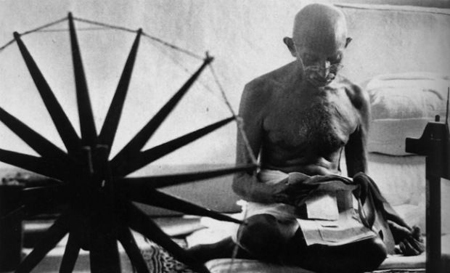
Gandhi's charkha sold for 110,000 pounds at UK auction

November 6, 2013

Gandhis_charkha

London, Nov 6: Mahatma Gandhi's over eight-decade old 'charkha', one of his most prized possessions that he used in Yerwada Jail during the 'Quit India Movement', was today auctioned in the UK for a whopping 110,000 pounds, nearly double the expected price.

Gandhi's last will also sold for 20,000 pounds at the specialist sale of historical documents and artefacts by the Mullock's Auction house in Shropshire.

"Gandhi's charkha (spinning wheel) was sold for 110,000 pounds at the auction while his last will fetched 20,000 pounds," Michael Morris, a Mullock's official, told PTI. The auction house refused to name the buyer.

Made of Indian teak, the charkha with a minimum bid of 60,000 pounds, was used by Gandhi while he was in the prison in Pune and was later gifted by him to American Free Methodist missionary Revd Floyd A Puffer in 1935.

The American was a pioneer in Indian educational and industrial cooperatives. He invented a bamboo plow that was later adopted by Gandhi.

Puffer and his wife worked as missionaries in India and in 1935 displayed Gandhi's spinning wheel at a number of talks and events.

Later, Puffer presented the charkha to fellow missionary Reverend Dr Frank J Kline in 1965. It has since passed through Kline's family to the present owner by descent.

One of the earliest known references to the charkha is an article in the December 1931 issue of the monthly Popular Science.

Gandhi's will was written in Gujarati at the Sabarmati Ashram and it supersedes the will dated 1921 that was sold at an earlier auction by Mullock's.

The later will provides a historic insight into Gandhi's thinking and his speculation for the future.

Mullock's has put under the hammer over 60 of Gandhi's most prized possessions, including the charkha, important documents, photographs and books.

The auction house's specialist Richard Westwood Brookes said: "The charkha is one of Gandhi's most prized possessions as he devised the workings of it himself. The charkha was used by him in Yerwada Jail whilst fighting for the rights and independence of India. It has impeccable provenance and is unquestionably the most important Gandhi artefact we have ever had for sale.

"The charkha was the physical embodiment and symbol of Mahatma Gandhi, he once said: 'In my dream, in my sleep, while eating, I think of the spinning wheel. The spinning wheel is my sword. To me it is the symbol of India's liberty," Brookes said highlighting the importance of the sale.

"The origins and operation of the Yerwada portable charkha are described in the American monthly Popular Science (December 1931): 'Mahatma Gandhi ... has devised a portable spinning wheel that folds into a bundle about the size of a portable typewriter and has a handle for carrying," Mullock's website said in its description of the sale item.

"When unfolded for use it is operated by turning a small crank which runs the two wheels and spindle of the device. Gandhi worked out the details of this machine it is reported while he was confined to the Yerwada jail in India. He often mentioned that his daily spinning was a form of meditation," it said.

Gandhi spent several years in Yerwada Jail during India's freedom struggle notably in 1932 and later in 1942 during the Quit India movement along with many other freedom fighters.

Comments

Jed
 - 
Wednesday, 1 Jun 2016

Hello, i think that i saw you visited my weblog thus i came to “return the favor”.I am trying to find things to enhance my site!I suppose its ok to use some
of your ideas!!

Visit my blog: Elizabeth: http://beanboss.moonfruit.com/

Add new comment

  • Coastaldigest.com reserves the right to delete or block any comments.
  • Coastaldigset.com is not responsible for its readers’ comments.
  • Comments that are abusive, incendiary or irrelevant are strictly prohibited.
  • Please use a genuine email ID and provide your name to avoid reject.
News Network
April 28,2020

Los Angeles, Apr 28: People who experience loss of smell as one of the COVID-19 symptoms are likely to have a mild to moderate clinical course of the disease, according to a study which may help health care providers determine which patients require hospitalisation.

The findings, published in the journal International Forum of Allergy & Rhinology, follows an earlier study that validated the loss of smell and taste as indicators of infection with the novel coronavirus, SARS-CoV-2.

According to the scientists from the University of California (UC) San Diego Health in the US, patients who reported loss of smell were 10 times less likely to be hospitalised for COVID-19 compared to those without the symptom.

"One of the immediate challenges for health care providers is to determine how to best treat persons infected by the novel coronavirus," said Carol Yan, first author of the current study and rhinologist from the UC San Diego Health.

"If they display no or mild symptoms, can they return home to self-quarantine or will they likely require hospitalisation? These are crucial questions for hospitals trying to efficiently and effectively allocate finite medical resources," Yan said.

The findings, according to the researchers, suggest that loss of smell may be predictive of a milder clinical course of COVID-19.

"What's notable in the new findings is that it appears that loss of smell may be a predictor that a SARS-CoV-2 infection will not be as severe, and less likely to require hospitalisation," Yan said.

"If an infected person loses that sense, it seems more likely they will experience milder symptoms, barring other underlying risk factors," she added.

Risk factors for COVID-19 previously reported by other studies include age, and underlying medical conditions, such as chronic lung disease, serious heart conditions, diabetes, and obesity.

In the current study, the scientists made a retrospective analysis between March 3 and April 8 including 169 patients who tested positive for COVID-19 at UC San Diego Health.

They assessed olfactory and gustatory data for 128 of the 169 patients, 26 of whom required hospitalisation.

According to the researchers, patients who were hospitalised for COVID-19 treatment were significantly less likely to report anosmia or loss of smell -- 26.9 per cent compared to 66.7 per cent for COVID-19-infected persons treated as outpatients.

Similar percentages were found for loss of taste, known as dysgeusia, they said.

"Patients who reported loss of smell were 10 times less likely to be admitted for COVID-19 compared to those without loss of smell," said study co-author Adam S. DeConde.

"Moreover, anosmia was not associated with any other measures typically related to the decision to admit, suggesting that it's truly an independent factor and may serve as a marker for milder manifestations of Covid-19," DeConde said.

The researchers suspect that the findings hint at some of the physiological characteristics of the infection.

"The site and dosage of the initial viral burden, along with the effectiveness of the host immune response, are all potentially important variables in determining the spread of the virus within a person and, ultimately, the clinical course of the infection," DeConde said.

If the SARS-CoV-2 virus initially concentrates in the nose and upper airway, where it impacts olfactory function, that may result in an infection that is less severe and sudden in onset, decreasing the risk of overwhelming the host immune response, respiratory failure, and hospitalisation, the scientists added.

"This is a hypothesis, but it's also similar to the concept underlying live vaccinations," DeConde explained.

"At low dosage and at a distant site of inoculation, the host can generate an immune response without severe infection," he added.

Loss of smell, according to the study, might also indicate a robust immune response which has been localised to the nasal passages, limiting effects elsewhere in the body.

Citing the limitations of the study, the scientists said they relied upon self-reporting of anosmia from participants, which posed a greater chance of recall bias among patients once they had been diagnosed with COVID-19.

They added that patients with more severe respiratory disease requiring hospitalisation may not be as likely to recognise or recall the loss of smell.

So the researchers said more expansive studies are needed for validating the results.

Comments

Add new comment

  • Coastaldigest.com reserves the right to delete or block any comments.
  • Coastaldigset.com is not responsible for its readers’ comments.
  • Comments that are abusive, incendiary or irrelevant are strictly prohibited.
  • Please use a genuine email ID and provide your name to avoid reject.
Agencies
May 19,2020

Cybersecurity researchers on Monday warned of a Trojan malware campaign which is targeting India's co-operative banks using COVID-19 as a bait.

Seqrite, the enterprise arm of IT security firm Quick Heal Technologies, detected the new wave of Adwind Java Remote Access Trojan (RAT) campaign.

Researchers at Seqrite warned that if attackers are successful, they can take over the victim's device to steal sensitive data like SWIFT logins and customer details and move laterally to launch large scale cyberattacks and financial frauds.

According to the researchers, the Java RAT campaign starts with a spear-phishing email which claims to have originated from either the Reserve Bank of India or a nationalised bank.

The content of the email refers to COVID-19 guidelines or a financial transaction, with detailed information in an attachment, which is a zip file containing a JAR based malware.

Upon further investigation, researchers at Seqrite found that the JAR based malware is a Remote Access Trojan that can run on any machine which has Java runtime enabled and hence it can impact a variety of endpoints, irrespective of their base operating system.

Once the RAT is installed, the attacker can take over the victim's device, send commands from a remote machine, and spread laterally in the network.

In addition, this malware can also log keystrokes, capture screenshots, download additional payloads, and extract sensitive user information, Seqrite said, adding that such attack campaigns can effectively jeopardise the privacy and security of sensitive data at the co-operative banks and result in large scale attacks and financial frauds.

To prevent such attacks, users need to exercise ample caution and avoid opening attachments and clicking on web links in unsolicited emails.

Banks should also keep their operating systems updated and have a full-fledged security solution installed on all the devices, Seqrite advised.

Comments

Add new comment

  • Coastaldigest.com reserves the right to delete or block any comments.
  • Coastaldigset.com is not responsible for its readers’ comments.
  • Comments that are abusive, incendiary or irrelevant are strictly prohibited.
  • Please use a genuine email ID and provide your name to avoid reject.
Agencies
March 12,2020

Thiruvananthapuram, Mar 12: In the wake of COVID-19 outbreak, Internet service providers in Kerala have agreed to step up the network capacity by 30 to 40 per cent of the present capacity to meet the demand, especially in view of the spurt in work-at-home mode.

"The decision was made at a meeting of representatives of various telecom service providers in Kerala circle and officials of the Telecommunication Department convened by the Secretary, Electronics and IT, following a direction by Chief Minister Pinarayi Vijayan to look into the issue," said a press release by the IT Department.

The decision will be beneficial for those working in IT institutions. The government has come out with a set of suggestions to avoid social gatherings at public places in view of coronavirus spread. Telecom service providers have assured the government that they are well equipped to face the current situation.

The major part of Internet consumption in Kerala is made available through local servers. Moreover, global Internet traffic is very low as compared to the overall consumption. So, increasing the capacity won't be difficult, service providers informed.

"Complaints regarding the low availability of the Internet due to the spurt in consumption of the Internet can be made to the service providers to their complaint redressal number or inform state government call centre (155300). But complaints regarding the insufficiency in the current network infrastructure should be strictly avoided," said the release.

The IT Department will also demand daily reports from various telecom service providers. By analysing these reports, steps for remedies will be taken after bringing the sudden increase in consumption to the service providers.

Comments

Add new comment

  • Coastaldigest.com reserves the right to delete or block any comments.
  • Coastaldigset.com is not responsible for its readers’ comments.
  • Comments that are abusive, incendiary or irrelevant are strictly prohibited.
  • Please use a genuine email ID and provide your name to avoid reject.