


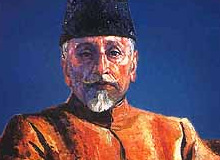
Maulana Abul Kalam Azad: 'The Great Akbar' of Independence struggle

[email protected] (Mushirul Hasan,The Hindu)
November 8, 2013

Maulana-abul-kalamNov 8: Height about 5' 5''; exceptionally thin; noticeably fair; age about 33 years; has practically no hair on his face though he does not shave; long sharp face with prominent nose. This is the “official” description of Maulana Abul Kalam Azad, the golden boy of the Independence struggle. With his confidence, charm and sincerity, Azad impressed people of his age group with his sharp and swift mind. Later in years, he especially cultivated a look of venerable age to give a suitable background to his learning. His genius and method were too individual to found a school, but his writings and lectures exerted a profound influence owing to the breadth of view and patient learning. Rajaji described him as 'The Great Akbar of Today'.

Unease with conformity

The study of Azad's early life is, however, hampered by a deficiency of data. But there is ample evidence to indicate his discomfort with the traditional order of things. This was enough to rouse his scorn. So is his unease with taqlid or conformity. Is Islamic doctrine so rigid and dogmatic that it leaves no room for intellectual creativity? With this bent of mind, he broke off the shackles of fossilised theology, and critiqued all those elements in theology that inhibited the progress of empirical science and the unlimited process of their utilisation. His views on the spread of a materialistic way of life and the stagnation and retardation of religious life became well-known, but this phase in his life — when he “saw in religion only ignorance” — proved to be momentary. Once he regained his faith, he worked out a synthesis between the reformist and orthodox philosophies. He did not go too far in this journey, but went far enough to disturb the status quo.

The awakening at Aligarh's M.A.O. College fostered ideas on reforms, interpretation, and innovation among the Muslim intelligentsia. Syed Ahmad Khan moulded young Azad's thinking. He did his very best to read his writings and admired them. He also admired Shibli Nomani, founder of the Nadwat al-ulama in Lucknow. And when the Nadwa alim turned pan-Islamist after the European intervention in the Balkan States, Azad too stressed that the bonding with the Turks was unique insofar as they were a part of the Islamic community as well as its last political centre.

One has only to cast a glance at some of Azad's early writings to realise that he entered the valley of doubts and uncertainties to demolish the suppositions that had guided theologians. He opposed the 'scripturalists' or the 'literalists,' because they advocated rigid adherence to the fundamentals of Islam, as literally interpreted from the Koran and the Sunna. His interest in the externals of religion, too, diminished. At the same time, he was consistent in his authentic inward piety. Just as he was ready to comprehend the whole Koran within the verses of the first Surah, so he conceived and pursued the politics of Islam within the Koran's dimension of piety.

The Muslim communities were divided by geographical situation, by differences of dialect and custom and, in some cases, by the deeper chasm of sectarianism, but pan-Islamism inflamed their passions, a feeling that, although they had been ground down under the wheels of history, they thought of themselves as a mighty society spread worldwide. Azad, for one, was attached to the common inheritance of Islamic culture and explored the treasures of thought and emotion which belonged to the umma. He proceeded naturally from the conviction that education, liberalism and faith in progress were requisites for Muslim empowerment.

Setting a great example of moral leadership during World War I, Azad became the soul of the Congress party. He opposed Partition heart and soul, while a great body of his compatriots clamoured for a Muslim nation. He could not conceal the contempt that he felt for them, and at no stage in his public career did he stoop to compromise. The spectacle of Indians working out a new way of life and boldly defying the accumulated prejudices and animus of the past was one which aroused his interest and curiosity. Without looking around to find a mirror that might reflect radical faces, he identified pluralism to be the weapon of the strong and the weak against the British. He preferred the conviction of Dara Shikoh, the eldest Mughal prince and a victim of Aurangzeb's conspiracy, that in the search for the ultimate Truth, mosques as well as temples validly mediate the one candle's light.

Harmonious and creative Islam

Azad's greatest gift was to postulate an equation between Islam and Indian nationalism on the one hand, and between Islam and the universal principles, on the other. He did so to enlarge our conception of what is possible, enrich our intellectual imagination, and diminish dogmatism which closes the mind to ijtehad. With his belief in an integrated, harmonious and creative Islam, he adumbrated the outlook of a religious humanist, very much in the line of the humanism embodied in the classical Persian Sufi poetical tradition. He envisaged an Islam not of sectarian belligerence but of confident partnership in a cultural and spiritual diversity where a strident divisiveness would be its betrayal.

Maulana Abul Kalam Azad, Minister of Education in free India and sponsor of an 'official' history of the 1857 Rebellion, referred to the two communities standing 'shoulder to shoulder' to liberate themselves from the British yoke. Why did Azad and others think that it was worth their while to make this point? Probably, to record the regret that “the British swept away and rooted out the late Mughals' pluralistic and philosophically composite nationalism,” and to bemoan that they ensured that common action by Hindus and Muslims would in future not be accomplished easily.

Shakespeare's view of life in one of his plays is that, “round the lonely great ones of this earth there is inevitably a conspiracy of envy and hatred, hatched by the base and common sort.” On December 30, 1941, the gates of Naini prison outside Allahabad opened for Azad; on August 9, 1942, the new gate of the old Ahmednagar Fort prison closed behind him.

Earlier, its mention would invariably bring to his mind several forgotten footprints of time and presented, page after page, six centuries of history. And yet, “in this world of thousand caprices and moods, so many doors are opened to be closed and so many are closed to be later thrown open.” Hence, between July 15 and August 5, 1942, he went around the country for consultation with the Congress leaders.

Azad spent a total of 10 years in jail. Thrown into a new world whose geography did not extend beyond a hundred yards and where the population was no more than 15 faces, he was overwhelmed by the morning sunlight and the evening darkness. Like Antonio Gramsci, Azad conceived of writing something that might absorb him and give a focus to his inner life. For this, he read a great deal. He drew the guidance and motivation from the reading of Scriptures. It is important to realise — and important particularly for the full knowledge and comprehension of times past — that internment kindled Azad's Islam into warmth and fervour. Like Aurobindo Ghose who found God as a result of the wrath of the government, he felt comforted and serene. And like the future sage of Pondicherry, he found it impossible to explain the love of motherland or sacrifice to the thick-skinned Britons in India.

Independence came with Nehru's 'tryst with destiny' speech, but Partition plunged Azad's spirits into depression. “There is no more certain test of statesmanship,” wrote H.A.L. Fisher in his History of Europe, “than the capacity to resist the political intoxication of victory.” Though hurt and wounded by a colossal tragedy, the otherwise distraught Azad carried his tribulations with a stoical dignity and pursued his active role through stresses of inner disquiet. Ultimately, he suffered for the sake of truth. He had noted in one of his many elegant passages that, “the flowering trees whose offspring once represented beauty and grace were now lying in a heap in a corner, like burnt out bushes and trampled up grass.” The story which opened with the bright colours of the Al-Hilal and Al-Balagh closed in deep shadow.

Like the Urdu poet, Mir Taqi Mir, Azad could only voice affirmation of the historical process or protest against the iniquities of time and the suffering it caused to the sensitive mind and soul. He had indeed no small talk, and no time for it, or for little human foibles, but in his famous speech after independence at the Red Fort in Delhi, he lambasted those Muslims who threw themselves more and more deeply into the communal vortex. At the same time it must be said to his credit that, in the turmoil raging around the Muslim communities, Azad secured them the comfort of peace and security. Lesser men found conflict in the rich variety of life, but Azad was big enough not only to see the essential unity behind all that diversity but also to realise that only in this unity can there be hope for India as a whole and for those great and varied currents of national life.

Comments

Add new comment

  • Coastaldigest.com reserves the right to delete or block any comments.
  • Coastaldigset.com is not responsible for its readers’ comments.
  • Comments that are abusive, incendiary or irrelevant are strictly prohibited.
  • Please use a genuine email ID and provide your name to avoid reject.
News Network
April 17,2020

Paris, Apr 17: Even as virologists zero in on the virus that causes COVID-19, a very basic question remains unanswered: do those who recover from the disease have immunity?

There is no clear answer to this question, experts say, even if many have assumed that contracting the potentially deadly disease confers immunity, at least for a while.

"Being immunised means that you have developed an immune response against a virus such that you can repulse it," explained Eric Vivier, a professor of immunology in the public hospital system in Marseilles.

"Our immune systems remember, which normally prevents you from being infected by the same virus later on."

For some viral diseases such a measles, overcoming the sickness confers immunity for life.

But for RNA-based viruses such as Sars-Cov-2 -- the scientific name for the bug that causes the COVID-19 disease -- it takes about three weeks to build up a sufficient quantity of antibodies, and even then they may provide protection for only a few months, Vivier told AFP.

At least that is the theory. In reality, the new coronavirus has thrown up one surprise after another, to the point where virologists and epidemiologists are sure of very little.

"We do not have the answers to that -- it's an unknown," Michael Ryan, executive director of the World Health Organization's Emergencies Programme said in a press conference this week when asked how long a recovered COVID-19 patient would have immunity.

"We would expect that to be a reasonable period of protection, but it is very difficult to say with a new virus -- we can only extrapolate from other coronaviruses, and even that data is quite limited."

For SARS, which killed about 800 people across the world in 2002 and 2003, recovered patients remained protected "for about three years, on average," Francois Balloux director of the Genetics Institute at University College London, said.

"One can certainly get reinfected, but after how much time? We'll only know retroactively."

A recent study from China that has not gone through peer review reported on rhesus monkeys that recovered from Sars-Cov-2 and did not get reinfected when exposed once again to the virus.

"But that doesn't really reveal anything," said Pasteur Institute researcher Frederic Tangy, noting that the experiment unfolded over only a month.

Indeed,several cases from South Korea -- one of the first countries hit by the new coronavirus -- found that patients who recovered from COVID-19 later tested positive for the virus.

But there are several ways to explain that outcome, scientists cautioned.

While it is not impossible that these individuals became infected a second time, there is little evidence this is what happened.

More likely, said Balloux, is that the virus never completely disappeared in the first place and remains -- dormant and asymptomatic -- as a "chronic infection", like herpes.

As tests for live virus and antibodies have not yet been perfected, it is also possible that these patients at some point tested "false negative" when in fact they had not rid themselves of the pathogen.

"That suggests that people remain infected for a long time -- several weeks," Balloux added. "That is not ideal."

Another pre-publication study that looked at 175 recovered patients in Shanghai showed different concentrations of protective antibodies 10 to 15 days after the onset of symptoms.

"But whether that antibody response actually means immunity is a separate question," commented Maria Van Kerhove, Technical Lead of the WHO Emergencies Programme.

"That's something we really need to better understand -- what does that antibody response look like in terms of immunity."

Indeed, a host of questions remain.

"We are at the stage of asking whether someone who has overcome COVID-19 is really that protected," said Jean-Francois Delfraissy, president of France's official science advisory board.

For Tangy, an even grimmer reality cannot be excluded.

"It is possible that the antibodies that someone develops against the virus could actually increase the risk of the disease becoming worse," he said, noting that the most serious symptoms come later, after the patient had formed antibodies.

For the moment, it is also unclear whose antibodies are more potent in beating back the disease: someone who nearly died, or someone with only light symptoms or even no symptoms at all. And does age make a difference?

Faced with all these uncertainties, some experts have doubts about the wisdom of persuing a "herd immunity" strategy such that the virus -- unable to find new victims -- peters out by itself when a majority of the population is immune.

"The only real solution for now is a vaccine," Archie Clements, a professor at Curtin University in Perth Australia, told AFP.

At the same time, laboratories are developing a slew of antibody tests to see what proportion of the population in different countries and regions have been contaminated.

Such an approach has been favoured in Britain and Finland, while in Germany some experts have floated the idea of an "immunity passport" that would allow people to go back to work.

"It's too premature at this point," said Saad Omer, a professor of infectious diseases at the Yale School of Medicine.

"We should be able to get clearer data very quickly -- in a couple of months -- when there will be reliable antibody tests with sensitivity and specificity."

One concern is "false positives" caused by the tests detecting antibodies unrelated to COVID-19.

The idea of immunity passports or certificates also raises ethical questions, researchers say.

"People who absolutely need to work -- to feed their families, for example -- could try to get infected," Balloux.

Comments

Add new comment

  • Coastaldigest.com reserves the right to delete or block any comments.
  • Coastaldigset.com is not responsible for its readers’ comments.
  • Comments that are abusive, incendiary or irrelevant are strictly prohibited.
  • Please use a genuine email ID and provide your name to avoid reject.
Agencies
January 16,2020

Claiming that e-commerce giants like Amazon import as much as 80 per cent of the items sold on their platforms, small manufacturers' body has said that their business models do not benefit local industry and are creating jobs of delivery boys only.

"Neither manufacturers nor traders are getting any benefit from the business models of Amazon and Flipkart because they largely import their products from China and Korea and sell here. Nearly 80 per cent of their products are imported," said Anil Bhardwaj, Secretary General, Federation of Indian Micro and Small & Medium Enterprises (FISME).

Bhardwaj said that the global e-commerce players generally source and sell products through their own preferred suppliers and as a result a large number of local manufacturers and traders get crowded out.

He listed out deep discounting and buying products from preferred companies as unfair practices.

"Even if they buy products from local suppliers the commission charged is very high," Bhardwaj said adding that the issues related to unfair practices have been raised with Commerce Ministry on multiple occasions.

FISME maintains that the technology-driven retail is way forward and one cannot be oblivious of the benefits it brings to consumers but at the same time the local industry can also not be ignored given its role in job creation.

"If both traders and local manufacturers are crowded out then how would the local industry survive and employment be generated?" asked Bhardwaj.

As Amazon Founder and CEO Jeff Bezos is currently on his three-day visit to India, the local traders are up in arms against the "unfair" trade practices of the tech giant. Delhi-based Confederation of All India Traders (CAIT) has launched a countrywide protest against the company and has organised protests across 300 cities.

In a setback to Amazon and Walmart-backed Flipkart, the fair market watchdog Competition Commission of India (CCI) has ordered probe into the business operations of both the companies on multiple counts including deep-discounts and exclusive tie-up with preferred sellers.

"For the first time some concrete step has been taken against Amazon and Flipkart who are continuously violating the FDI policy in indulging in a vicious racket of controlling and monopolising not only the e-commerce but even the retail trade as well," CAIT National Secretary General Praveen Khandelwal said after the CCI order.

Comments

Add new comment

  • Coastaldigest.com reserves the right to delete or block any comments.
  • Coastaldigset.com is not responsible for its readers’ comments.
  • Comments that are abusive, incendiary or irrelevant are strictly prohibited.
  • Please use a genuine email ID and provide your name to avoid reject.
Agencies
June 29,2020

New Delhi, Jun 29: Witnessing azure skies and breathable air for the last three months, Delhi on Monday recorded deterioration in its air quality, with particulate matter with diameter of 2.5 and 10 microns -- too small to be filtered out of the human body -- standing at 52 and 297 micrograms per cubic respectively.

Gufran Beig, Project Director of System of Air Quality Weather Forecasting and Research (SAFAR), said that the sudden spike in air pollution is due to a mild dust storm blowing from Rajasthan.

"Since the wind direction is changing and moist air is coming in, the air quality in Delhi will become better by tomorrow," Beig told IANS.

Central Pollution Control Board (CPCB) data showed that the overall air quality near Delhi Technical University (DTU) area stood at 326 micrograms per cubic, followed by 308 at Narela and 307 at Mundka.

Out of 36 stations, the AQI in as many as 30 stations was above 200 micrograms per cubic till 1 pm on Monday.

The System of Air Quality Weather Forecasting and Research categorises air quality in the 0-50 range as good, 51-100 as satisfactory, 101-200 as moderate, 201-300 as poor, 301-400 as very poor, and above 400 as severe.

According to SAFAR's website, "PM 10 (coarser dust particle) is the lead pollutant. AQI is likely to improve to moderate category by tomorrow, and further improvement is expected by July 1."

Researchers indicated that PM 10 and PM 2.5 will be 170 and 47 micrograms per cubic on Tuesday.

With no vehicles plying on the roads or industries shut due to the lockdown since March 25, Delhi's air quality had improved drastically.

According to a study conducted by the Indian Institute of Technology (IIT), Delhi, if the low levels of air pollution reached during the lockdown period are maintained, India's annual death toll could reduce by 6.5 lakh.

Comments

Add new comment

  • Coastaldigest.com reserves the right to delete or block any comments.
  • Coastaldigset.com is not responsible for its readers’ comments.
  • Comments that are abusive, incendiary or irrelevant are strictly prohibited.
  • Please use a genuine email ID and provide your name to avoid reject.