


Modi arrives in Myanmar, to step up engagement with ASEAN

November 11, 2014

Nay Pyi Taw, Nov 11: The 12th ASEAN-India summit kicks off tomorrow with Prime Minister Narendra Modi expected to make a strong pitch to step up engagement with the 10-nation bloc by improving regional connectivity to give a boost to trade and people-to-people contacts.
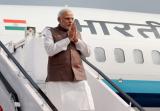
pmModi arrived in the Myanmarese capital this afternoon by a special Air India plane, starting his 10-day three-nation tour that will also take him to Australia for the G-20 Summit and bilateral talks with his Australian counterpart Tony Abbott and Fijian premier J V Bainimarama.

Modi was received by Myanmar Health Minister Than Aung at Nay Pyi Taw International Airport.

"Landed in Nay Pyi Taw, Myanmar to a very warm welcome! Great being in this beautiful country," Modi tweeted after his arrival.

The Prime Minister will attend the India-ASEAN and East Asia summits here.

Asserting that the Association of Southeast Asian Nations (ASEAN) is at the core of India's 'Act East' policy, the Prime Minister said before leaving for Myanmar that he was looking forward to discussing with ASEAN leaders how to take "our relationship to a new level, which will supplement our deepening bilateral ties with each member".

"ASEAN is at the core of our Act East Policy and at the centre of our dream of an Asian century, characterised by cooperation and integration and where India will play a crucial role, " Modi said, adding that ties with ASEAN are "deep rooted".

Modi expressed confidence that these meetings with leaders of ASEAN and East Asian blocs would be fruitful.

Indian officials said New Delhi is keen that the next ASEAN-India five-year plan of action starting 2016 should lay emphasis on enhancing people-to-people contacts, augmenting trade besides reinforcing the strategic and political engagement. The plan will also focus on security architecture in the region.

An ambitious project is underway to develop a 3,200-km highway linking India, Myanmar and Thailand. It was originally envisaged to be completed around 2017 but it is behind schedule and is now expected to be completed in 2018.

India and the 10-nation ASEAN bloc hope to dovetail the connectivity plans with this highway.

Officials said the free trade pact in services and investment between India and the ASEAN is expected to help the bilateral trade touch USD 100 billion by 2015.

The bilateral trade grew 4.6 per cent from USD 68.4 billion in 2011 to USD 71.6 billion in 2012.

ASEAN's exports were valued at USD 43.84 billion and imports from India amounted to USD 27.72 billion in 2012.

The ASEAN community has the third largest population, would be the seventh largest economy in the world and the third fastest growing economic unit this century.

It comprises Brunei, Cambodia, Indonesia, Laos, Malaysia, Myanmar, Singapore, Thailand, the Philippines and Vietnam

Modi will be also participating in the 18-nation EAST Asian Summit(EAS) on Thursday before leaving for Brisbane to attend the G20 Summit.

"At the East Asia Summit, I look forward to discussing with ASEAN and seven global leaders how we can strengthen regional institutions, international norms and regional cooperation in pursuit of peace, stability and prosperity," the Prime Minister said ahead of the deliberations.

The EAS comprises 10 ASEAN nations, Australia, China, India, Japan, New Zealand, South Korea, Russia and the US.

On the sidelines of the international summits in Myanmar, Modi is slated to meet Russian Prime Minister Dmitry Medvedev, South Korean President Park Geun-hye and Singapore President Tony Tan, besides the host President Thein Sein.

Comments

Add new comment

  • Coastaldigest.com reserves the right to delete or block any comments.
  • Coastaldigset.com is not responsible for its readers’ comments.
  • Comments that are abusive, incendiary or irrelevant are strictly prohibited.
  • Please use a genuine email ID and provide your name to avoid reject.
News Network
April 26,2020

Washington/Seoul, Apr 26: A special train possibly belonging to North Korean leader Kim Jong Un was spotted this week at a resort town in the country, according to satellite images reviewed by a Washington-based North Korea monitoring project, amid conflicting reports about Mr. Kim's health and whereabouts.

The monitoring project, 38 North, said in its report on Saturday that the train was parked at the “leadership station” in Wonsan on April 21 and April 23. The station is reserved for the use of the Kim family, it said.

Though the group said it was probably Kim Jong Un's train, Reuters has not been able to confirm that independently, or whether he was in Wonsan.

“The train's presence does not prove the whereabouts of the North Korean leader or indicate anything about his health but it does lend weight to reports that Kim is staying at an elite area on the country's eastern coast,” the report said.

Speculation about Mr. Kim's health first arose due to his absence from the anniversary of the birthday of North Korea's founding father and Mr. Kim's grandfather, Kim Il Sung, on April 15.

North Korea's state media last reported on Mr. Kim's whereabouts when he presided over a meeting on April 11.

China has dispatched a team to North Korea including medical experts to advise on Kim Jong Un, according to three people familiar with the situation.

A third-generation hereditary leader who came to power after his father's death in 2011, Kim has no clear successor in a nuclear-armed country, which could present major international risk.

On Thursday, U.S. President Donald Trump downplayed reports that Mr. Kim was ill. “I think the report was incorrect,” Mr. Trump told reporters, but he declined to say if he had been in touch with North Korean officials.

Mr. Trump has met Mr. Kim three times in an attempt to persuade him to give up a nuclear weapons program that threatens the United States as well as its Asian neighbors. While talks have stalled, Mr. Trump has continued to hail Mr. Kim as a friend.

Reporting from inside North Korea is notoriously difficult because of tight controls on information.

A Trump administration official said continuing days of North Korean media silence on Mr. Kim's whereabouts had heightened concerns about his condition, and that information remained scant from a country U.S. intelligence has long regarded as a ”black box.”

The U.S. State Department did not immediately respond to questions about the situation on Saturday.

Daily NK, a Seoul-based website that reports on North Korea, cited one unnamed source in North Korea on Monday as saying that Kim had undergone medical treatment in the resort county of Hyangsan north of the capital Pyongyang.

It said that Mr. Kim was recovering after undergoing a cardiovascular procedure on April 12.

Since then, multiple South Korean media reports have cited unnamed sources this week saying that Mr. Kim might be staying in the Wonsan area.

On Friday, local news agency Newsis cited South Korean intelligence sources as reporting that a special train for Mr. Kim's use had been seen in Wonsan, while Mr. Kim's private plane remained in Pyongyang.

Newsis reported Mr. Kim may be sheltering from COVID-19, the respiratory disease caused by the novel coronavirus.

Mr. Kim, believed to be 36, has disappeared from coverage in North Korean state media before. In 2014, he vanished for more than a month and North Korean state TV later showed him walking with a limp.

Speculation about his health has been fanned by his heavy smoking, apparent weight gain since taking power and family history of cardiovascular problems.

Comments

Add new comment

  • Coastaldigest.com reserves the right to delete or block any comments.
  • Coastaldigset.com is not responsible for its readers’ comments.
  • Comments that are abusive, incendiary or irrelevant are strictly prohibited.
  • Please use a genuine email ID and provide your name to avoid reject.
News Network
April 10,2020

Paris, Apr 10: French pharma major Sanofi said on Friday it has decided to donate 100 million doses of hydroxychloroquine, the anti-malaria drug which could be a potential weapon against novel coronavirus, across 50 countries.

The company has already doubled its incremental production capacity on top of the usual production for current indications across its eight hydroxychloroquine manufacturing sites worldwide and is on track to quadruple it by the summer.

"In this global health emergency, Sanofi stands ready to assist as many countries as possible, starting with countries where its medicine is registered for current approved indications as well as countries where there are no hydroxychloroquine suppliers or countries with underserved populations," it said in a statement.

Sanofi called for coordination among the entire hydroxychloroquine chain worldwide to ensure the continued supply of the medicine if proven to be a well-tolerated and effective treatment in COVID-19 patients.

"The COVID-19 pandemic is an unprecedented health and economic crisis which is shaking some of the very fundamentals of international solidarity and cooperation among countries," said Chief Executive Officer Paul Hudson. "This virus does not care about the concept of borders, so we should not either," he added.

"It is critical that international authorities, local governments, manufacturers and all other players involved in the hydroxychloroquine chain work together in a coordinated manner to ensure all patients who may benefit from this potential treatment can access it. If the trials prove positive, we hope our donation will play a critical role for patients," said Hudson.

While hydroxychloroquine is generating a lot of hope for patients around the world, said Sanofi, it should be remembered that there are no results from ongoing studies and the results may be positive or negative.

To date, there is insufficient clinical evidence to draw any conclusion over the safety and efficacy of hydroxychloroquine in the management of COVID-19 patients.

It is one of several medicines being investigated by the World Health Organisation (WHO) in its international clinical trial seeking a treatment solution for COVID-19. "Sanofi is supporting ongoing trials by providing the medicine to some participating investigator sites and other independent research centres," it said.

Comments

Add new comment

  • Coastaldigest.com reserves the right to delete or block any comments.
  • Coastaldigset.com is not responsible for its readers’ comments.
  • Comments that are abusive, incendiary or irrelevant are strictly prohibited.
  • Please use a genuine email ID and provide your name to avoid reject.
News Network
April 13,2020

Manila, Apr 13: The Asian Development Bank (ADB) on Monday tripled the size of its response to novel coronavirus disease (COVID-19) pandemic to 20 billion dollars and approved measures to streamline its operations for quicker and more flexible delivery of assistance.

The package expands ADB's 6.5 billion dollars initial response announced on March 18, adding 13.5 billion dollars in resources to help ADB's developing member countries counter the severe macroeconomic and health impacts caused by COVID-19.

The 20 billion dollar package includes about 2.5 billion dollars in concessional and grant resources.

"This pandemic threatens to severely set back economic, social, and development gains in Asia and the Pacific, reverse progress on poverty reduction and throw economies into recession," said ADB President Masatsugu Asakawa.

"Our expanded and comprehensive package of assistance, made possible with the strong support of our board, will be delivered more quickly, flexibly and forcefully to the governments and the private sector in our developing member countries to help them address the urgent challenges in tackling the pandemic and economic downturn," he said in a statement.

ADB's most recent assessment released on April 3 estimates the global impact of the pandemic at between 2.3 and 4.8 per cent of gross domestic product. Regional growth is forecast to decline from 5.2 per cent last year to 2.2 per cent in 2020.

The new package includes the establishment of a COVID-19 pandemic response option under ADB's countercyclical support facility.

Up to 13 billion dollars will be provided through this new option to help governments of developing member countries implement effective countercyclical expenditure programs to mitigate impacts of the COVID-19 pandemic, with a particular focus on the poor and the vulnerable.

Grant resources will continue to be deployed quickly for providing medical and personal protective equipment and supplies from expanded procurement sources.

Some 2 billion dollars from the 20 billion dollar package will be made available for the private sector. Loans and guarantees will be provided to financial institutions to rejuvenate trade and supply chains.

Enhanced microfinance loan and guarantee support and a facility to help liquidity-starved small and medium-sized enterprises, including those run by female entrepreneurs, will be implemented alongside direct financing of companies responding to or impacted by COVID-19.

The response package includes a number of adjustments to policies and business processes that will allow ADB to respond more rapidly and flexibly to the crisis. These include measures to streamline internal business processes, widen the eligibility and scope of various support facilities and make the terms and conditions of lending more tailored.

All support under the expanded package will be provided in close collaboration with international organisations, including the International Monetary Fund, World Bank Group, World Health Organisation, UNICEF, other UN agencies and the broader global community.

Comments

Add new comment

  • Coastaldigest.com reserves the right to delete or block any comments.
  • Coastaldigset.com is not responsible for its readers’ comments.
  • Comments that are abusive, incendiary or irrelevant are strictly prohibited.
  • Please use a genuine email ID and provide your name to avoid reject.