


Modi arrives in Myanmar, to step up engagement with ASEAN

November 11, 2014

Nay Pyi Taw, Nov 11: The 12th ASEAN-India summit kicks off tomorrow with Prime Minister Narendra Modi expected to make a strong pitch to step up engagement with the 10-nation bloc by improving regional connectivity to give a boost to trade and people-to-people contacts.
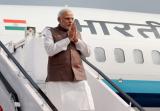
pmModi arrived in the Myanmarese capital this afternoon by a special Air India plane, starting his 10-day three-nation tour that will also take him to Australia for the G-20 Summit and bilateral talks with his Australian counterpart Tony Abbott and Fijian premier J V Bainimarama.

Modi was received by Myanmar Health Minister Than Aung at Nay Pyi Taw International Airport.

"Landed in Nay Pyi Taw, Myanmar to a very warm welcome! Great being in this beautiful country," Modi tweeted after his arrival.

The Prime Minister will attend the India-ASEAN and East Asia summits here.

Asserting that the Association of Southeast Asian Nations (ASEAN) is at the core of India's 'Act East' policy, the Prime Minister said before leaving for Myanmar that he was looking forward to discussing with ASEAN leaders how to take "our relationship to a new level, which will supplement our deepening bilateral ties with each member".

"ASEAN is at the core of our Act East Policy and at the centre of our dream of an Asian century, characterised by cooperation and integration and where India will play a crucial role, " Modi said, adding that ties with ASEAN are "deep rooted".

Modi expressed confidence that these meetings with leaders of ASEAN and East Asian blocs would be fruitful.

Indian officials said New Delhi is keen that the next ASEAN-India five-year plan of action starting 2016 should lay emphasis on enhancing people-to-people contacts, augmenting trade besides reinforcing the strategic and political engagement. The plan will also focus on security architecture in the region.

An ambitious project is underway to develop a 3,200-km highway linking India, Myanmar and Thailand. It was originally envisaged to be completed around 2017 but it is behind schedule and is now expected to be completed in 2018.

India and the 10-nation ASEAN bloc hope to dovetail the connectivity plans with this highway.

Officials said the free trade pact in services and investment between India and the ASEAN is expected to help the bilateral trade touch USD 100 billion by 2015.

The bilateral trade grew 4.6 per cent from USD 68.4 billion in 2011 to USD 71.6 billion in 2012.

ASEAN's exports were valued at USD 43.84 billion and imports from India amounted to USD 27.72 billion in 2012.

The ASEAN community has the third largest population, would be the seventh largest economy in the world and the third fastest growing economic unit this century.

It comprises Brunei, Cambodia, Indonesia, Laos, Malaysia, Myanmar, Singapore, Thailand, the Philippines and Vietnam

Modi will be also participating in the 18-nation EAST Asian Summit(EAS) on Thursday before leaving for Brisbane to attend the G20 Summit.

"At the East Asia Summit, I look forward to discussing with ASEAN and seven global leaders how we can strengthen regional institutions, international norms and regional cooperation in pursuit of peace, stability and prosperity," the Prime Minister said ahead of the deliberations.

The EAS comprises 10 ASEAN nations, Australia, China, India, Japan, New Zealand, South Korea, Russia and the US.

On the sidelines of the international summits in Myanmar, Modi is slated to meet Russian Prime Minister Dmitry Medvedev, South Korean President Park Geun-hye and Singapore President Tony Tan, besides the host President Thein Sein.

Comments

Add new comment

  • Coastaldigest.com reserves the right to delete or block any comments.
  • Coastaldigset.com is not responsible for its readers’ comments.
  • Comments that are abusive, incendiary or irrelevant are strictly prohibited.
  • Please use a genuine email ID and provide your name to avoid reject.
News Network
March 3,2020

Mar 3: Just hours after the ending of a week-long “reduction” in violence that was crucial for Donald Trump’s peace deal in Afghanistan, the Taliban struck again: On Monday, they killed three people and injured about a dozen at a football match in Khost province. This resumption of violence will not surprise anyone actually invested in peace for that troubled country. The point of the U.S.-Taliban deal was never peace. It was to try and cover up an ignominious exit for the U.S., driven by an election-bound president who feels no responsibility toward that country or to the broader region.

Seen from South Asia, every point we know about in the agreement is a concession by Trump to the Taliban. Most importantly, it completes a long-term effort by the U.S. to delegitimize the elected government in Kabul — and, by extension, Afghanistan’s constitution. Afghanistan’s president is already balking at releasing 5,000 Taliban prisoners before intra-Afghan talks can begin — a provision that his government did not approve.

One particularly cringe-worthy aspect: The agreement refers to the Taliban throughout  as “the Islamic Emirate of Afghanistan that is not recognized by the United States as a state and is known as the Taliban.” This unwieldy nomenclature validates the Taliban’s claim to be a government equivalent to the one in Kabul, just not the one recognised at the moment by the U.S. When read together with the second part of the agreement, which binds the U.S. to not “intervene in [Afghanistan’s] domestic affairs,” the point is obvious: The Taliban is not interested in peace, but in ensuring that support for its rivals is forbidden, and its path to Kabul is cleared.

All that the U.S. has effectively gotten in return is the Taliban’s assurance that it will not allow the soil of Afghanistan to be used against the “U.S. and its allies.” True, the U.S. under Trump has shown a disturbing willingness to trust solemn assurances from autocrats; but its apparent belief in promises made by a murderous theocratic movement is even more ridiculous. Especially as the Taliban made much the same promise to an Assistant Secretary of State about Osama bin Laden while he was in the country plotting 9/11.

Nobody in the region is pleased with this agreement except for the Taliban and their backers in the Pakistani military. India has consistently held that the legitimate government in Kabul must be the basic anchor of any peace plan. Ordinary Afghans, unsurprisingly, long for peace — but they are, by all accounts, deeply skeptical about how this deal will get them there. The brave activists of the Afghan Women’s Network are worried that intra-Afghan talks will take place without adequate representation of the country’s women — who have, after all, the most to lose from a return to Taliban rule.

But the Pakistani military establishment is not hiding its glee. One retired general tweeted: “Big victory for Afghan Taliban as historic accord signed… Forced Americans to negotiate an accord from the position of parity. Setback for India.” Pakistan’s army, the Taliban’s biggest backer, longs to re-install a friendly Islamist regime in Kabul — and it has correctly estimated that, after being abandoned by Trump, the Afghan government will have sharply reduced bargaining power in any intra-Afghan peace talks. A deal with the Taliban that fails also to include its backers in the Pakistani military is meaningless.

India, meanwhile, will not see this deal as a positive for regional peace or its relationship with the U.S. It comes barely a week after Trump’s India visit, which made it painfully clear that shared strategic concerns are the only thing keeping the countries together. New Delhi remembers that India is not, on paper, a U.S. “ally.” In that respect, an intensification of terrorism targeting India, as happened the last time the U.S. withdrew from the region, would not even be a violation of Trump’s agreement. One possible outcome: Over time the government in New Delhi, which has resolutely sought to keep its ties with Kabul primarily political, may have to step up security cooperation. Nobody knows where that would lead.

The irresponsible concessions made by the U.S. in this agreement will likely disrupt South Asia for years to come, and endanger its own relationship with India going forward. But worst of all, this deal abandons those in Afghanistan who, under the shadow of war, tried to develop, for the first time, institutions that work for all Afghans. No amount of sanctimony about “ending America’s longest war” should obscure the danger and immorality of this sort of exit.

Comments

Add new comment

  • Coastaldigest.com reserves the right to delete or block any comments.
  • Coastaldigset.com is not responsible for its readers’ comments.
  • Comments that are abusive, incendiary or irrelevant are strictly prohibited.
  • Please use a genuine email ID and provide your name to avoid reject.
News Network
April 6,2020

New Delhi, April 6: The United States has donated $2.9 million assistance package for India to help the Narendra Modi government brace itself against the coronavirus as countries across the world are coming together to combat the outbreak.

On March 28, the US government, via US Agency for International Development, announced $2.9 million to support India in its response to COVID-19.

"It builds on a foundation of over $1.4 billion in health assistance and nearly $3 billion in total assistance that the US provided to India over the last 20 years," the US Embassy in India said in a statement.

"These new funds will support two organisations, including $2.4 million for USAID's health strengthening project, implemented by Jhpiego, an international non-profit health organisation affiliated with Johns Hopkins University and $500,000 for the World Health Organization (WHO)," the statement said.

The funds will also help India combat the spread of COVID-19, provide care for the affected and support local communities with the tools needed to contain the disease, it added.

Moreover, being a global leader in health and humanitarian response to COVID-19, the US has provided approximately $18.3 million assistance package to ASEAN member countries to fight the contagion.

The funds will be used to prepare laboratories for large-scale testing for the lethal virus, infection prevention and control, enable risk communication, implement public-health emergency plans for border points of entry, activate case-finding and event-based surveillance for influenza-like illnesses, train and equip rapid-responders in investigation and contact-tracing and update training materials for health workers.

Comments

Add new comment

  • Coastaldigest.com reserves the right to delete or block any comments.
  • Coastaldigset.com is not responsible for its readers’ comments.
  • Comments that are abusive, incendiary or irrelevant are strictly prohibited.
  • Please use a genuine email ID and provide your name to avoid reject.
News Network
June 24,2020

Washington, Jun 24: An Indian restaurant in the Sante Fe City of New Mexico, owned by a Sikh, was broken into and vandalised with hate messages scrawled on its walls, a media report said Tuesday.

The damage caused to India Palace restaurant is estimated to be worth USD 100,000, local Santa Fe Reporter said adding that the vandalisation is being investigated by local police and the FBI.

Sikh American Legal Defense and Education Fund (SALDEF) has condemned the incident.

"This kind of hate and violence is unacceptable and swift action must be taken to ensure the safety and security of all Americans," said Kiran Kaur Gill SALDEF executive director.

According to the local daily, tables were overturned, glassware was smashed into piles on the floor, wine racks were emptied, a statue of a goddess was beheaded and computers were stolen.

The vandals also turned over and destroyed food warmers while the front desk area was devastated, plates smashed and the kitchen rendered completely unusable, it said.

"I walked into the kitchen, I saw everything and I was like, hold on, what? What is going on here?" owner Baljit Singh told Santa Fe Reporter. "White power," "Trump 2020," "go home," and far worse were spray-painted on walls, doors, counters and any other available surface.

"Some phrases contained threats of violence and derogatory racial slurs," the daily said.

"Santa Fe is a peaceful town, and the Sikh community has lived here, beautifully integrated, since the 60s," said SALDEF board member Simran Singh, who lives minutes away from the restaurant.

"Tensions have flared recently with the reinvigoration of the Black Lives Matter movement and the removal of statues associated with Spanish colonisers of this area, who committed a number of atrocities," he said.

"Nevertheless, we are seeing an outpouring of love and support around the city and in my experience, our neighbors love and appreciate us, as we love and appreciate them," he added.

SALDEF said that it has seen an unprecedented rise in hate crimes including the April 29 incident wherein a Sikh American Lakhwant Singh was brutally attacked by a man identified as Eric Breeman in Lakewood, Colorado.

Lakhwant Singh was told to "go back to your country," while being attacked. No formal hate crime charges have been brought against the attacker.

Comments

Add new comment

  • Coastaldigest.com reserves the right to delete or block any comments.
  • Coastaldigset.com is not responsible for its readers’ comments.
  • Comments that are abusive, incendiary or irrelevant are strictly prohibited.
  • Please use a genuine email ID and provide your name to avoid reject.