


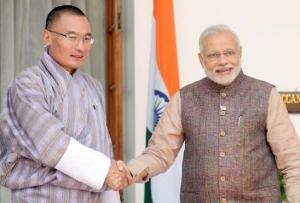
Modi a friendly person, visit to further strengthen ties: Bhutan PM

June 15, 2014

Bhutan PMThimphu, Jun 15: As Prime Minister Narendra Modi Sunday began a two-day visit to Bhutan, the Bhutanese leadership has described the Indian leader as "a friendly person and well disposed towards Bhutan" and as one who "gives a sense of purpose and hope".

Bhutanese Prime Minister Tshering Tobgay said that even though there are no specific issues to discuss during the meeting with Modi from Bhutan's side, all commitments made and the generous support that the government receives from India will be discussed, according to The Bhutanese daily.

Tobgay described the Indian prime minister as: "He is a friendly person and obviously very knowledgeable and well disposed towards Bhutan. He holds our kings in very high esteem. He is very aware of the details of the India-Bhutan relationship and overall gives a sense of purpose and hope."

Tobgay, in response to a question on hydropower, said that both the prime ministers would discuss the situation "which is good as of now".

Modi "had expressed his concerns over the delay in some hydropower projects. A concern which has gone well in Thimphu, as the government is anxious to start and complete the mega projects at the earliest dates possible," The Bhutanese quoted Tobgay as saying.

He said that "Bhutan looks forward to strengthening the economic partnership with India and to strengthen the Bhutanese economy. Tobgay said that the Indian assistance, in the form of Nu 45 bn or Rs.4,500 crore for Bhutan's 11th Plan would translate into more economic activities and growth for Bhutan".

While he was in Delhi last month for Modi's swearing in, Tobgay had met the chairman of the Confederation of Indian Industry (CII) and they had agreed that they should exchange visits and draw up a plan of action to encourage investments from India into Bhutan, he said.

According to him, a CII delegation would be coming to Bhutan, which already has a framework in place in the form of the Economic Development Policy.

He said that Indian companies are already investing in Bhutan and that Bhutan needs to fast track its work with the Indian private sector, The Bhutanese said.

Tobgay said Bhutan has made all arrangements to welcome Prime Minister Modi warmly, in keeping with the good ties between the two countries. He said the visit would take the friendship between two countries to further heights.

In an earlier interview to the daily, Tobgay had declared Modi's decision to visit Bhutan as being historic. He said that Bhutan was extremely happy and proud of the fact that Modi has chosen to visit Bhutan first, when not only the SAARC region, but the entire world was watching.

According to a Bhutanese foreign ministry press release, the visit is highly significant as it is Prime Minister Modi's first visit abroad after his swearing-in ceremony as the prime minister of India. The release says that the visit will further strengthen the unique and special ties of friendship and cooperation between Bhutan and India, said The Bhutanese.

Comments

Add new comment

  • Coastaldigest.com reserves the right to delete or block any comments.
  • Coastaldigset.com is not responsible for its readers’ comments.
  • Comments that are abusive, incendiary or irrelevant are strictly prohibited.
  • Please use a genuine email ID and provide your name to avoid reject.
News Network
July 11,2020

Geneva, Jul 11: The World Health Organization said Friday that it is still possible to bring coronavirus outbreaks under control, even though case numbers have more than doubled in the past six weeks.

WHO chief Tedros Adhanom Ghebreyesus said the examples of Italy, Spain, South Korea and India's biggest slum showed that however bad a outbreak was, the virus could still be reined in through aggressive action.

"In the last six weeks cases have more than doubled," Tedros told a virtual press conference in Geneva.

However, "there are many examples from around the world that have shown that even if the outbreak is very intense, it can still be brought back under control," said Tedros.

"And some of these examples are Italy, Spain and South Korea, and even in Dharavi -- a densely packed area in the megacity of Mumbai -- a strong focus on community engagement and the basics of testing, tracing, isolating and treating all those that are sick is key to breaking the chains of transmission and suppressing the virus."

The novel coronavirus has killed at least 555,000 people worldwide since the outbreak emerged in China last December, according to a tally from official sources compiled by AFP on Friday.

Nearly 12.3 million cases have been registered in 196 countries and territories.

"Across all walks of life, we are all being tested to the limit," Tedros said, "from countries where there is exponential growth, to places that are loosening restrictions and now starting to see cases rise.

"Only aggressive action combined with national unity and global solidarity can turn this pandemic around."

Comments

Add new comment

  • Coastaldigest.com reserves the right to delete or block any comments.
  • Coastaldigset.com is not responsible for its readers’ comments.
  • Comments that are abusive, incendiary or irrelevant are strictly prohibited.
  • Please use a genuine email ID and provide your name to avoid reject.
News Network
February 6,2020

Beijing, Feb 6: The number of confirmed fatalities from China's coronavirus outbreak rose to at least 560, after authorities in hardest-hit Hubei province reported 70 new deaths on February 6.

In its daily update, the health commission in Hubei also confirmed the number of confirmed infections in the outbreak has reached 28,018 nationwide with 3,694 new cases reported.

The epidemic, which has spiralled into a global health emergency, is believed to have emerged in December from a market that sold wild game in Hubei's capital Wuhan.

Hu Lishan, an official in Wuhan, warned Wednesday that despite building a hospital from scratch and converting public buildings to accommodate thousands of extra patients, there was still a "severe" lack of beds in the region.

There was also a shortage of "equipment and materials," he told reporters, adding that officials were looking to convert other hotels and schools in the city into treatment centres.

Authorities in several other cities in China have placed restrictions on the number of people allowed to leave their homes.

Global concerns have also risen about the virus, with cases confirmed in more than 20 countries.

Comments

Add new comment

  • Coastaldigest.com reserves the right to delete or block any comments.
  • Coastaldigset.com is not responsible for its readers’ comments.
  • Comments that are abusive, incendiary or irrelevant are strictly prohibited.
  • Please use a genuine email ID and provide your name to avoid reject.
News Network
February 26,2020

Feb 26: Looking out over the world’s largest cricket stadium, the seats jammed with more than 100,000 people, India’s prime minister heaped praise on his American visitor.

“The leadership of President Trump has served humanity,” Prime Minister Narendra Modi said Monday, highlighting Trump’s fight against terrorism and calling his 36-hour visit to India a watershed in India-U.S. relations.

The crowds cheered. Trump beamed.

“The ties between India and the U.S. are no longer just any other partnership,” Modi said. “It is a far greater and closer relationship.”

India, it seems, loves Donald Trump. It seemed obvious from the thousands who turned out to wave as his motorcade snaked through the city of Ahmedabad, and from the tens of thousands who filled the city’s new stadium. It seemed obvious from the hug that Modi gave Trump after he descended from Air Force One, and from the hundreds of billboards proclaiming Trump’s visit.

But it’s not so simple.

Because while Trump is genuinely popular in India, his clamorous and carefully choreographed welcome was also about Asian geopolitics, China’s growing power and a masterful Indian politician who gave his American visitor exactly what he wanted.

Modi “is doing this not necessarily because he loves Trump,” said Tanvi Madan, the director of the India Project at the Brookings Institution in Washington, D.C. “It’s very much about Trump as the leader of the U.S. and recognizing what it is that Trump himself likes.”

Trump likes crowds — big crowds — and the foot soldiers of India’s political parties have long known how to corral enough people to make any politician look popular. In a city like Ahmedabad, the capital of Modi’s home state of Gujarat and the center of his power base, it wouldn’t take much effort to fill a cavernous sports stadium. It was more surprising that a handful of seats remained empty, and that some in the stands had left even before Trump had finished his speech.

For India, good relations with the U.S. are deeply important: They signal that India is a serious global player, an issue that has long been important to New Delhi, and help cement an alliance that both nations see as a counterweight to China’s rise.

“For both countries, their biggest rival is China,” said John Echeverri-Gent, a professor at the University of Virginia whose research often focuses on India. “China is rapidly expanding its presence in the Indian Ocean, which India has long considered its backyard and its exclusive realm for security concerns.”

“It’s very clearly a major concern for both India and the United States,” he said.

Trump isn’t the first U.S. president that Modi has courted. In 2015, then-President Barack Obama was the first American chief guest at India’s Republic Day parade, a powerful symbolic gesture. Obama also got a Modi hug, and the media in both countries were soon writing about the two leaders’ “bromance.”

Trump is popular in India, even if some of that is simply because he’s the U.S. president. A 2019 Pew Research Center poll showed that 56% of Indians had confidence in Trump’s abilities in world affairs, one of only a handful of countries where he has that level of approval. But Obama was also popular: Before he left office, he had 58% approval in world affairs among Indians.

The Pew poll also indicated that Trump’s support was higher among supporters of Modi’s Hindu nationalist party.

That’s not surprising. Both men have fired up their nationalist bases with anti-Muslim rhetoric and government policies, from Trump’s travel bans to Modi’s crackdown in Kashmir, India’s only Muslim-majority state.

And Trump’s Indian support is far from universal. Protests against his trip roiled cities from New Delhi to Hyderabad to the far northeastern city of Gauhati, although those demonstrations were mostly overshadowed by protests over a new Indian citizenship law that Modi backs.

Modi, who is widely popular in India, has faced weeks of protests over the law, which provides fast track naturalization for some foreign-born religious minorities — but not Muslims. While Trump talked about ties with India on Tuesday, Hindus and Muslims fought in violent clashes that left at least 10 people dead over two days.

In some ways, Modi and Trump are powerful echoes of each other.

They have overlapping political styles. Both are populists who see themselves as brash, rule-breaking outsiders who disdain their countries’ traditional elites. Both are seen by their critics as having authoritarian leanings. Both surround themselves with officials who rarely question their decisions.

But are they friends?

Trump says yes. “Really, we feel very strongly about each other,” he said at a New Delhi press briefing.

But many observers aren’t so sure.

“The question is how much of this is real chemistry, as opposed to what I’d call planned chemistry” orchestrated for diplomatic reasons, said Madan. “It’s so hard to know if you’re not in the room.”

Certainly, Modi understands America’s importance to India. While the two countries continue to bicker about trade issues, the prime minister organized a welcome that impressed even India’s news media, which have watched countless choreographed mass political rallies.

“There is no other country for whose leader India would hold such an event, and for which an Indian prime minister would lavish such rhetoric,” the Hindustan Times said in an editorial.

“The spectacle and the sound were worth a thousand agreements.”

Comments

Add new comment

  • Coastaldigest.com reserves the right to delete or block any comments.
  • Coastaldigset.com is not responsible for its readers’ comments.
  • Comments that are abusive, incendiary or irrelevant are strictly prohibited.
  • Please use a genuine email ID and provide your name to avoid reject.