



Modi to meet Obama in September

June 5, 2014

New Delhi, Jun 5: In what is probably the most significant foreign policy decision taken since he became Prime Minister, Narendra Modi has confirmed to US President Barack Obama that he will have a bilateral meeting with him in Washington in the last week of September this year.

Obama had invited Modi to the US when he called up the PM to congratulate him. Significantly, the meeting won't happen on the sidelines of the United Nations general assembly in New York but in the form of a full-fledged bilateral summit in Washington.
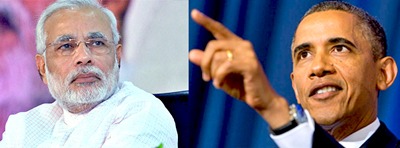
Modi Obama

The two sides are finalizing the date for the meeting which will be in the last week of September, it is learnt. The Modi-Obama summit promises to be one of the foremost international events of the year and will overshadow Modi's presence at UNGA, if he decides to go to New York too.

In taking the decision, Modi has shown that his own predilections, if any, won't come in the way of ties with the US.

He has, in fact, acted with alacrity and decisiveness on what many believe is going to be one of the biggest immediate challenges for India's foreign policy — that of mending India-US ties which had tapered off under UPA-2 and then nosedived with l'affaire Khobragade.

Modi's decision underlines the significance of the US in India's strategic matrix. There was speculation that Modi could focus more on China and South Korea for economic gains and on an improved security partnership with Japan but these are not likely to come at the expense of Washington.

Modi was thought to be inadequately equipped to mend India-US ties because — as some reckoned — he could find it difficult to come to terms with the US hostility towards him after the 2002 Gujarat riots, and the resultant revocation of his US visa. He remained the only person to be barred from traveling to the US for many years under the country's controversial International Religious Freedom Act.

While the UK and EU were quick off the blocks in reaching out to Modi, US was late in responding, but once it did in the form of a meeting former US ambassador Nancy Powell sought with him, Modi has been generous in his response.

In an interview , before he took over as PM, Modi had said that relations between the two countries cannot be allowed to be "even remotely" influenced by incidents related to individuals.

Describing the US as a natural ally, he said it was in the interest of both countries to further develop the relationship.

Modi's decision to confirm the Obama bilateral is also the second big surprise he has sprung on his detractors who thought he would be straightjacketed by his own election campaign, and the baggage he was supposed to have come with on relations with the US.

Despite Pakistan featuring in his speeches, and his admonition of UPA for its 'biryani' diplomacy, Modi successfully invited Pakistan PM Nawaz Sharif for his swearing in.

Comments

Add new comment

  • Coastaldigest.com reserves the right to delete or block any comments.
  • Coastaldigset.com is not responsible for its readers’ comments.
  • Comments that are abusive, incendiary or irrelevant are strictly prohibited.
  • Please use a genuine email ID and provide your name to avoid reject.
News Network
January 3,2020

Dhaka, Jan 3: Bangladesh's paramilitary force chief said on Thursday that a total of 445 Bangladeshi nationals returned from India in last two months following the publication of the National Register of Citizens (NRC) by the Indian government.

Border Guard Bangladesh (BGB) Director General Maj Gen Md Shafeenul Islam disclosed the figure during a press briefing here.

"About 1,000 people were arrested in 2019 for illegal border crossings from India to Bangladesh, with 445 of them returning home in November and December," he said.

After verifying their identities through local representatives, BGB came to know that all the intruders are Bangladeshis, Islam said, adding that 253 cases were lodged against them for illegal trespass, while initial investigations found that at least three of them were human traffickers.

The BGB Director said the trespassing did not create any tension between the border forces of Bangladesh and India.

Last week, Islam visited India where he said that the creation of the NRC is completely an "internal affair" of India and the cooperation between the border guarding forces of the two countries is very good.

He said the BGB will continue to do its work of preventing illegal border crossings as per its mandate.

A BGB delegation, led by Islam, was on a bilateral visit to India to hold DG-level border talks with its counterparts, the Border Security Force (BSF).

The talks took place from December 26-29, during which a host of issues related to cross-border smuggling and activities of criminals and others along the 4,096-km-long front were discussed.

Responding to a question, Islam said, "No discussion was held at the conference over the (NRC) issue".

He said during the five-day talks held in New Delhi, the BGB demanded that the BSF should take effective steps to prevent killings of Bangladeshis on frontiers as casualty figures sharply rose in 2019.

"The number of border killings in 2019 was highest in the last four years. As per our calculation, the number of such unexpected deaths was 35," the BGB chief said.

However, the BSF estimate of the casualty figure is much lower than our calculation, he said.

Islam said the BSF is following the policy of maintaining maximum restraint and minimal use of force even after being attacked by "armed border offenders".

A statement issued by the BSF last month in New Delhi after the conclusion of the DG-level talks said, "On the concern of the BGB regarding the death of Bangladeshi nationals on borders, it was informed to them that a non-lethal weapon policy is strictly followed by BSF personnel on borders.

"Firing is resorted to only in self-defence, when BSF patrols are gheraoed and attacked by ‘dah’ (a sharp-edged weapon) etc. It was specified that the BSF does not discriminate between criminals based on nationality," it said.

Comments

Add new comment

  • Coastaldigest.com reserves the right to delete or block any comments.
  • Coastaldigset.com is not responsible for its readers’ comments.
  • Comments that are abusive, incendiary or irrelevant are strictly prohibited.
  • Please use a genuine email ID and provide your name to avoid reject.
News Network
June 30,2020

New Delhi, Jun 30: With a spike of 18,522 COVID-19 cases in the last 24 hours, India's coronavirus count now stand at 5,66,840, said the Union Health and Family Welfare Ministry on Tuesday.

According to the Ministry, 418 deaths due to COVID-19 were reported in the last 24 hours. The number of deaths in the country now stands at 16,893.

There are 2,15,125 active coronavirus cases in the country while the number of cured/discharged patients stands at 3,34,821 and one patient migrated.

As per the Ministry, Maharashtra is the worst-hit state with regard to the COVID-19 cases and has reported 1,69,883 cases, including 73, 313 active cases 88,960 cured/discharged patients and 7,610 fatalities.

Tamil Nadu has a total of 86,224 cases including 1,141 deaths. Delhi's COVID-19 count stands at 85,161 cases and 2,680 fatalities.

The total number of samples tested up to 29 June is 86,08,654 of which 2,10,292 samples were tested yesterday, informed the Indian Council of Medical Research.

Comments

Add new comment

  • Coastaldigest.com reserves the right to delete or block any comments.
  • Coastaldigset.com is not responsible for its readers’ comments.
  • Comments that are abusive, incendiary or irrelevant are strictly prohibited.
  • Please use a genuine email ID and provide your name to avoid reject.
News Network
January 31,2020

New Delhi, Jan 31: Substantial competition and low tariff rates by telecom operators since 2016 have led to a financial stress in the sector, the Economic Survey said on Friday.

The data price in the country came down by over 99 per cent during 2016-2019, making it among the lowest tariff in the world, according to the survey.

"Since 2016, the sector has witnessed substantial competition and price cutting by the telecom service providers (TSPs), creating financial stress in the sector. As a result, the sector is experiencing consolidation. While some operators have filed for bankruptcy, others have merged, in their quest to improve viability," the survey report said.

In April-June 2019, the price of data was Rs 7.7 per gigabyte (GB) as compared to Rs 200 per GB in June 2016, it added.

"The Average Revenue Per User (ARPU) for GSM based mobile services has also gone down substantially from Rs 126 in June 2016 to Rs 74.30 in June 2019," the survey said.

The tariff war started in the market with entry of new telecom operator Reliance Jio in September 2016.

"BSNL and MTNL are also affected by the tariff war that has impacted their cash flow resulting in mounting losses," the survey said.

The financial health of the public sector telecom firms plummeted to a level where they have been finding hard to pay employees salaries in time.

The government has drawn up a plan to revive these PSUs which is still in works.

The revival plan consists of several measures, including reduction of staff cost through voluntary retirement scheme, allotment of spectrum for 4G services, monetisation of land and building, tower and fibre assets of BSNL and MTNL, debt restructuring through sovereign guarantee bonds and ''in-principle'' approval for merger of BSNL and MTNL.

The survey said that the wireless telephony now constitutes 98.27 per cent of all subscriptions whereas share of landline telephones now stands at only 1.73 per cent where market share is dominated by private sector players.

"The overall tele-density in India stands at 90.45 per cent, the rural tele-density being 57.35 per cent and urban teledensity being 160.71 per cent at the end of September 2019. The private sector dominates with a share of 88.81 per cent (106.06 crore connections) at the end of September, 2019 while the share of public sector was 11.19 per cent (13.36 crore connections)," the survey said.

The lower price of data has also lead in surge of broadband connections and average consumption of the internet.

Total broadband connections increased by about ten times, from 6.1 crore in 2014 to 59.46 crore in June 2019, the survey said.

The number of internet subscribers (both broadband and narrowband put together) stood at 66.53 crore at the end of June 2019 as compared to 25.16 crore in 2014.

The number of mobile internet subscribers was 64.36 lakh at the end of June 2019 while the number of wireline internet subscribers was 2.17 crore.

"India is now the global leader in monthly data consumption, with average consumption per subscriber per month increasing 157 times from 62 MB in 2014 to 9.8 GB in June 2019. The cost of data has also reduced substantially, enabling affordable internet access for millions of citizens," the survey said.

Comments

Add new comment

  • Coastaldigest.com reserves the right to delete or block any comments.
  • Coastaldigset.com is not responsible for its readers’ comments.
  • Comments that are abusive, incendiary or irrelevant are strictly prohibited.
  • Please use a genuine email ID and provide your name to avoid reject.