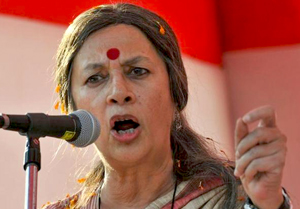
Modi playing up his humble background a hypocrisy: Brinda

January 20, 2014

BrindaLucknow, Jan 19: Calling him a “hypocrite,” CPI (M) Politburo member Brinda Karat on Sunday lashed out at the Bharatiya Janata Party’s prime ministerial candidate Narendra Modi for trumpeting his humble background as a tea-seller. Ms. Karat dared Mr. Modi to state a “single example” where he has issued license to a tea-vendor to run his shop without having to face police harassment.

“This is utter hypocrisy. On one hand he is talking of being a 'kaamdaar' and his background as a tea-seller, while on the other bulldozers are razing slums for the corporate. I dare him to name even a single policy that has benefitted the tea-sellers in Gujarat,” Ms. Karat told reporters here.

Ms. Karat was reacting to Mr. Modi’s speech at his party’s national council in Delhi. “The Gujarat government has razed jhuggis (shanties) to make way for the corporate and not rehabilitated the displaced,” Ms. Karat added. She said that the Gujarat Chief Minister was trying hard to get a “makeover” from communalism by talking of his ‘poor background and backward class.’

Crucially, in a bid to woo the OBC community, which leans towards the Samajwadi Party in UP, the BJP is scheduled to launch a month-long social justice programme in each district of the State on February 15.

The BJP hopes to makes the most of Mr. Modi’s tea-seller credentials as it will intensify the “Namo chai ki chaupal” campaign to gather support for the three remaining rallies in UP, in Gorakhpur, Meerut and Lucknow, party leaders say.

While Ms. Karat said her party, and other left parties, would be open to alliances in UP, she dismissed any coalition with the Aam Aadmi Party. “There is no question. The party has no ideology, on matters of national importance. We cannot support a party which does a u-turn.”

Addressing a seminar on communalism, Ms. Karat claimed that the RSS’ pretentions of a cultural organization not engaged in politics were exposed with the candidature of Mr. Modi. “The RSS has a direct role to play in the BJP’s election campaign and Modi is the face of that ideology. The RSS-BJP will contest with the dual agenda of Hinduvta and corporatism.”

The RSS front organizations want to communalize the atmosphere to polarise votes on religion, she added. She, however, added that the Congress and the BJP were two sides of the same coin. “Neo-liberal policies and communalism go together,” she said. Ms. Karat also said that for the upcoming elections the BJP had raised two other issues for its campaign: nationalism and the dignity of Hindu women. But it was ironic, that, Mr. Modi maintained silence on the rapes of women during the Muzafarrnagar riots, Ms. Karat said. She also accused the BJP of being two-faced on the issue of terror.

Comments

Add new comment

  • Coastaldigest.com reserves the right to delete or block any comments.
  • Coastaldigset.com is not responsible for its readers’ comments.
  • Comments that are abusive, incendiary or irrelevant are strictly prohibited.
  • Please use a genuine email ID and provide your name to avoid reject.
Agencies
May 23,2020

New Delhi, May 23: The nationwide lockdown will no longer help India in its fight against COVID-19, and in its place community-driven containment, isolation and quarantine strategies have to be brought into play, leading virologist Shahid Jameel said.

The recipient of Shanti Swarup Bhatnagar Prize for Science and Technology also stressed that testing should be carried out vigorously to identify coronavirus hotspots and isolate those areas.

"Our current testing rate at 1,744 tests per million population is one of the lowest in the world. We should deploy both antibody tests and confirmatory PCR tests. This will tell us about pockets of ongoing infection and past (recovered) infection. This will provide data to open up gradually and let economic activity resume," Jameel told PTI in an interview.

He stressed that testing has to be dynamic to continuously monitor red, orange and green zones and change these based on that data.

About community transmission of COVID-19 in India, Jameel said the country reached that stage long ago.

"We reached community transmission a long time ago. It's just that the health authorities are not admitting it. Even ICMR's own study of SARI (severe acute respiratory illness) showed that about 40 per cent of those who tested positive for SARS-CoV-2 did not have any history of overseas travel or contact to a known case. If this is not community transmission, then what is?" he posed.

Lockdown bought India time in its fight against coronavirus, but continuing it is unlikely to yield any further dividend, Jameel said.

"Instead, community-driven local lockdowns, isolations and quarantines have to come into play. Building trust is most important so that people follow rules. A public health problem cannot be dealt with as a law-and-order problem."

The nationwide lockdown, initially imposed from March 25 to April 14, has been extended thrice and will continue at least till May 31. The virus has claimed 3,720 lives and infected over 1.25 lakh people in the country so far.

Jameel has expertise in the fields of molecular biology, infectious diseases, and biotechnology. He is the CEO of Wellcome Trust/Department of Biotechnology's India Alliance and is best known for extensive research in Hepatitis E virus and HIV.

He said COVID-19 will eventually be controlled through herd immunity, which is acquired in two ways – when a sufficient fraction of the population gets infected and recovers, and with vaccination.

"It is estimated that for SARS-CoV-2 at least 60 per cent of the population would have to be infected and recovered, or vaccinated. This will happen over the course of the next few years," Jameel said.

Herd immunity is reached when the majority of a population becomes immune to an infectious disease, either because they have become infected and recovered, or through vaccination. When that happens, the disease is less likely to spread to people who aren't immune, because there just aren't enough infectious carriers.

"India has 1.38 billion people, a population density of about 400/sq km and a healthcare system ranked at 143 in the world. If we allow 60 per cent people to get infected quickly in the hopes of herd immunity, that would mean 830 million infections," Jameel said.

"If 15 per cent need hospitalization that means about 125 million isolation beds (we have 0.3 million). If five per cent need oxygen and ventilatory support, this amounts to about 42 million oxygen support and ICU beds; we have 0.1 million oxygen support beds and 34,000 ICU beds. This would overwhelm the healthcare system causing mayhem," he said.

Jameel said if the population level mortality is 0.5 per cent that would mean 40 lakh deaths. "Are we prepared to pay this price for herd immunity in the short term? Clearly not," he said.

He said it is unlikely that a vaccine would be available by the end of the year.

"Even then, we don't know yet how long it would give protection – weeks, months, one year, a few years? I don't think we will return to pre-coronavirus days for at least the next 3-5 years. This is also a chance to evaluate if we want to return to those unsustainable, environment-damaging ways. COVID-19 is a timely warning to reform our way of living," he said.

Jameel said it is hard to predict but plausible that COVID-19 would return in second or third wave.

"Later waves come when we don't understand the disease and become lax. A comparison to Spanish Flu is not entirely valid because in 1918 no one knew what caused it. No one had seen a virus till the mid-1930s as the electron microscope needed to view those was invented in 1931," he said.

"Today we know a lot more about the pathogen, its genetic makeup, how it transmits and how to prevent it. We need to be sensible and follow expert advice," he said.

If there is any scientific evidence linking deforestation, rapid urbanisation, climate change with pandemics like COVID-19, he said zoonotic viruses -- those that jump from animals to humans -- happen so when wild animal–human contacts increase.

"Deforestation destroys animal habitats bringing them closer to humans. When you cut forests, bats come to roost on trees closer to human habitations. Their viruses in secretions/stool get transmitted to domestic animals and on to humans. This happened clearly with Nipah virus outbreak in Malaysia in 1997-98 from fruit bats to pigs to humans," he said.

"COVID-19 possibly arose in wet animal markets due to dietary habits that bring all kinds of live and dead wild animals in close contact with humans," Jameel added.


Comments

Add new comment

  • Coastaldigest.com reserves the right to delete or block any comments.
  • Coastaldigset.com is not responsible for its readers’ comments.
  • Comments that are abusive, incendiary or irrelevant are strictly prohibited.
  • Please use a genuine email ID and provide your name to avoid reject.
News Network
July 26,2020

New Delhi, Jul 26: India reported a spike of 48,661 coronavirus cases in the last 24 hours, said the Union Ministry of Health and Family Welfare on Sunday.

The total COVID-19 positive cases stand at 13,85,522, including 4,67,882 active cases, 8,85,577 cured/discharged/migrated, it added.
With 705 deaths in the last 24 hours, the cumulative toll reached 32,063.

Maharashtra has reported 3,66,368 coronavirus cases, the highest among states and Union Territories in the country.

A total of 2,06,737 cases have been reported from Tamil Nadu till now, while Delhi has recorded a total of 1,29,531 coronavirus cases.

According to the Indian Council of Medical Research (ICMR), 4,42,263 samples were tested for coronavirus on Saturday and overall 1,62,91,331 samples have been tested so far.

Comments

Add new comment

  • Coastaldigest.com reserves the right to delete or block any comments.
  • Coastaldigset.com is not responsible for its readers’ comments.
  • Comments that are abusive, incendiary or irrelevant are strictly prohibited.
  • Please use a genuine email ID and provide your name to avoid reject.
Agencies
May 31,2020

New Delhi, May 31: The fourth phase of the coronavirus-triggered lockdown, which began on May 18, saw 85,974 COVID-19 cases till 8 am on Sunday, which is nearly half of the total cases reported in the country so far.

Lockdown 4.0, which will end on May 31 midnight, has accounted for 47.20 per cent of the total coronavirus infection cases, number crunching from the Union Health Ministry data reveals.

The lockdown, which was first clamped on March 25 and spanned for 21 days, had registered 10,877 cases, while the second phase of the curbs that began on April 15 and stretched for 19 days till May 3, saw 31,094 cases.

The third phase of the lockdown that was in effect for 14 days ending on May 17, recorded 53,636 cases till 8 am of May 18.

The country had registered 512 coronavirus infection cases till March 24.

India is the ninth worst-hit nation by the COVID-19 pandemic as of now.        

The first case of COVID-19 in India was reported on January 30 from Kerala after a medical student of Wuhan university, who had returned to India, tested  positive for the virus.

India registered its highest single-day spike of COVID-19 cases on Sunday, with 8,380 new infections reported in the last 24 hours, taking the country's tally to 1,82,143, while the death toll rose to 5,164, according to the Union Health Ministry.

The number of active COVID-19 cases stood to 89,995, while 86,983 people have recovered and one patient has migrated, it said.

"Thus, around 47.75 per cent patients have recovered so far," a senior Health Ministry official said.

With the fourth phase of lockdown ending on Sunday, the Home Ministry on Saturday said 'Unlock-1' will be initiated in the country from June 8 under which the nationwide lockdown will be relaxed to a great extent, including opening of shopping malls, restaurants and religious places, even as strict restrictions will remain in place till June 30 in the country's worst-hit areas.

While announcing the extension of the lockdown in containment zones across the country, the Home Ministry said temples, mosques, churches and other religious places and shopping malls will be allowed to open in a phased manner from June 8, while a decision on opening of schools and colleges will be taken in July in consultation with states.

Comments

Add new comment

  • Coastaldigest.com reserves the right to delete or block any comments.
  • Coastaldigset.com is not responsible for its readers’ comments.
  • Comments that are abusive, incendiary or irrelevant are strictly prohibited.
  • Please use a genuine email ID and provide your name to avoid reject.