



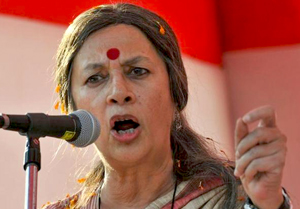
Modi playing up his humble background a hypocrisy: Brinda

January 20, 2014

BrindaLucknow, Jan 19: Calling him a “hypocrite,” CPI (M) Politburo member Brinda Karat on Sunday lashed out at the Bharatiya Janata Party’s prime ministerial candidate Narendra Modi for trumpeting his humble background as a tea-seller. Ms. Karat dared Mr. Modi to state a “single example” where he has issued license to a tea-vendor to run his shop without having to face police harassment.

“This is utter hypocrisy. On one hand he is talking of being a 'kaamdaar' and his background as a tea-seller, while on the other bulldozers are razing slums for the corporate. I dare him to name even a single policy that has benefitted the tea-sellers in Gujarat,” Ms. Karat told reporters here.

Ms. Karat was reacting to Mr. Modi’s speech at his party’s national council in Delhi. “The Gujarat government has razed jhuggis (shanties) to make way for the corporate and not rehabilitated the displaced,” Ms. Karat added. She said that the Gujarat Chief Minister was trying hard to get a “makeover” from communalism by talking of his ‘poor background and backward class.’

Crucially, in a bid to woo the OBC community, which leans towards the Samajwadi Party in UP, the BJP is scheduled to launch a month-long social justice programme in each district of the State on February 15.

The BJP hopes to makes the most of Mr. Modi’s tea-seller credentials as it will intensify the “Namo chai ki chaupal” campaign to gather support for the three remaining rallies in UP, in Gorakhpur, Meerut and Lucknow, party leaders say.

While Ms. Karat said her party, and other left parties, would be open to alliances in UP, she dismissed any coalition with the Aam Aadmi Party. “There is no question. The party has no ideology, on matters of national importance. We cannot support a party which does a u-turn.”

Addressing a seminar on communalism, Ms. Karat claimed that the RSS’ pretentions of a cultural organization not engaged in politics were exposed with the candidature of Mr. Modi. “The RSS has a direct role to play in the BJP’s election campaign and Modi is the face of that ideology. The RSS-BJP will contest with the dual agenda of Hinduvta and corporatism.”

The RSS front organizations want to communalize the atmosphere to polarise votes on religion, she added. She, however, added that the Congress and the BJP were two sides of the same coin. “Neo-liberal policies and communalism go together,” she said. Ms. Karat also said that for the upcoming elections the BJP had raised two other issues for its campaign: nationalism and the dignity of Hindu women. But it was ironic, that, Mr. Modi maintained silence on the rapes of women during the Muzafarrnagar riots, Ms. Karat said. She also accused the BJP of being two-faced on the issue of terror.

Comments

Add new comment

  • Coastaldigest.com reserves the right to delete or block any comments.
  • Coastaldigset.com is not responsible for its readers’ comments.
  • Comments that are abusive, incendiary or irrelevant are strictly prohibited.
  • Please use a genuine email ID and provide your name to avoid reject.
News Network
January 10,2020

Mumbai, Jan 10: India’s oil demand growth is set to overtake China by mid-2020s, priming the country for more refinery investment but making it more vulnerable to supply disruption in the Middle East, the International Energy Agency (IEA) said on Friday.

India’s oil demand is expected to reach 6 million barrels per day (bpd) by 2024 from 4.4 million bpd in 2017, but its domestic production is expected to rise only marginally, making the country more reliant on crude imports and more vulnerable to supply disruption in the Middle East, the agency said.

China’s demand growth is likely to be slightly lower than that of India by the mid-2020s, as per IEA’s China estimates given in November, but the gap would slowly become bigger thereafter.

“Indian economy is and will become even more exposed to risks of supply disruptions, geopolitical uncertainties and the volatility of oil prices,” the IEA said in a report on India’s energy policies.

Brent crude prices topped USD 70 a barrel on rising geopolitical tensions in the Middle East, putting pressure on emerging markets such as India. Like the rest of Asia, India is highly dependent on Middle East oil supplies with Iraq being its largest crude supplier.

India, which ranks No 3 in terms of global oil consumption after China and the United States, ships in over 80 per cent of its oil needs, of which 65 per cent is from the Middle East through the Strait of Hormuz, the IEA said.

The IEA, which coordinates release of strategic petroleum reserves (SPR) among developed countries in times of emergency, said it is important for India to expand its reserves.

REFINERY INVESTMENTS

India is the world’s fourth largest oil refiner and a net exporter of refined fuel, mainly gasoline and diesel.

India has drawn plans to lift its refining capacity to about 8 million bpd by 2025 from the current about 5 million bpd.

The IEA, however, forecasts India’s refining capacity to rise to 5.7 million bpd by 2024.

This would make “India a very attractive market for refinery investment,” IEA said.

Drawn to India’s higher fuel demand potential, global oil majors like Saudi Aramco, BP, Abu Dhabi National Oil Co and Total are looking at investing in India’s oil sector.

Saudi Aramco and ADNOC aim to own a 50 per cent stake in a planned 1.2-million bpd refinery in western Maharashtra state, for which land is yet to be acquired.

Comments

Add new comment

  • Coastaldigest.com reserves the right to delete or block any comments.
  • Coastaldigset.com is not responsible for its readers’ comments.
  • Comments that are abusive, incendiary or irrelevant are strictly prohibited.
  • Please use a genuine email ID and provide your name to avoid reject.
Agencies
February 25,2020

New Delhi, Feb 25: Union Home Minister Amit Shah on Tuesday called a meeting to discuss the prevailing situation in the national capital after violence in Northeast Delhi over the amended citizenship law left four people dead.

Delhi's Lieutenant Governor Anil Baijal, Chief Minister Arvind Kejriwal and representatives of different political parties were invited for the meeting.

Follow live updates of clashes among CAA protesters in Delhi here

The home minister has convened a meeting to discuss the current situation in Delhi, a Home Ministry official said.

The move came after the home minister reviewed the law and order situation in the national capital on Monday night as violence rocked Northeast Delhi.

Frenzied protesters torched houses, shops, vehicles and a petrol pump, besides hurling stones.

Comments

Add new comment

  • Coastaldigest.com reserves the right to delete or block any comments.
  • Coastaldigset.com is not responsible for its readers’ comments.
  • Comments that are abusive, incendiary or irrelevant are strictly prohibited.
  • Please use a genuine email ID and provide your name to avoid reject.
News Network
May 9,2020

Lucknow, May 9: The first patient to receive plasma therapy as an experimental treatment for coronavirus infection in Uttar Pradesh died following a heart attack on Saturday.

The patient, a 58-year-old doctor, was admitted at the King George’s Medical University (KGMU) here.

The doctor, who was on ventilator since the last 14 days, died on Saturday evening following a heart attack, KGMU Vice-Chancellor M L B Bhatt said.

Since he had high blood pressure and diabetes, he was under the continuous observation of doctors in the isolation ward, Bhatt said.

“The patient was in a stable condition. His lungs had improved, but he later developed urinary tract infection. Two reports of his samples came out as negative (for COVID-19) today,” the vice-chancellor said.

“He, however, suffered a heart attack around 5 pm. Despite all efforts, he could not be saved,” he said.

The doctor from Orai in Uttar Pradesh was administered plasma therapy at the state-run KGMU on April 26. He was administered the plasma donated by a doctor from Canada who was the first COVID-19 patient admitted at the hospital and later recovered.

Tulika Chandra of Blood Transfusion Department, KGMU said, "When the patient was given plasma therapy, his condition was very bad. His lungs, however, improved. But as he was an old patient with diabetes, he was kept on the ventilator.”

Convalescent Plasma Therapy is an experimental procedure for treating COVID-19 patients. In this treatment, plasma, a blood component, from a cured patient is transfused to a critically ill coronavirus patient.

The blood of a person who has recovered from COVID-19 develops antibodies to fight the virus. This therapy uses the antibodies from the blood of a cured patient to treat another critical patient.

The Union health ministry, however, had advised against considering the therapy to be a regular treatment for coronavirus, adding it should be used for research and trial purposes till there is a piece of robust scientific evidence to support its efficacy.

Comments

Add new comment

  • Coastaldigest.com reserves the right to delete or block any comments.
  • Coastaldigset.com is not responsible for its readers’ comments.
  • Comments that are abusive, incendiary or irrelevant are strictly prohibited.
  • Please use a genuine email ID and provide your name to avoid reject.