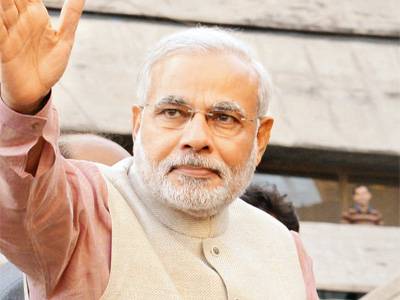
Modi to unveil top 10 policy priorities today

May 29, 2014

New Delhi, May 29: Prime Minister Narendra Modi is expected to unveil his top 10 policy priorities on Thursday, seeking to unblock an investment logjam and setting deadlines for action in order to revive the economy.

Modi  policy prioritiesA top aide flagged the action points ahead of a cabinet meeting at which Modi will begin the task of meeting the aspirations of voters who handed his Bharatiya Janata Party (BJP) the strongest electoral mandate in India in 30 years.

"The entire machinery will be geared up to fulfil the mandate of the new leader," Nripendra Misra, newly named as principal private secretary in the Prime Minister's Office, told The Hindu in an interview.

Misra said that Modi's policy priorities will "necessarily have to be implemented in a time-bound manner". They would focus on overcoming delays to major infrastructure projects and addressing why India has become a coal importer, he added.

Reuters reported exclusively last week that Modi was considering restructuring Coal India, the state-controlled mining behemoth, in a bid to halt a decline in output. [IN:nL3N0O6458]

The Prime Minister's Office is expected to become a powerful centre of policy making under Modi, who has named loyalists such as Arun Jaitley to key posts like finance but whose cabinet team lacks strength in depth.

Modi was due to chair a cabinet meeting at 11 a.m. (0530 GMT), his office said, with a briefing to follow afterwards.

Comments

Add new comment

  • Coastaldigest.com reserves the right to delete or block any comments.
  • Coastaldigset.com is not responsible for its readers’ comments.
  • Comments that are abusive, incendiary or irrelevant are strictly prohibited.
  • Please use a genuine email ID and provide your name to avoid reject.
News Network
January 31,2020

New Delhi, Jan 31: Chief Economic Adviser K V Subramanian on Friday said India's GDP is expected to grow at 6-6.5 per cent next fiscal as the economic slowdown has bottomed out.

As per the first advance estimates released by the National Statistical Organisation (NSO), the country's economic growth is likely to hit an 11-year low of 5 per cent in the current fiscal ending March 2020.

The Economic Survey 2019-20, prepared by a team lead by Subramanian, has projected the GDP to expand in the range of 6-6.5 per cent during 2020-21.

The Indian economy has hit the bottom and it will see an uptick from here, he said in a media briefing post the Economic Survey.

Amidst a weak environment for global manufacturing, trade and demand, the Indian economy slowed down with GDP growth moderating to 4.8 per cent in the first half of 2019-20, lower than 6.2 per cent in H2 of 2018-19.

Based on NSO's first advance estimates of GDP growth for 2019-20 at 5 per cent, an uptick in GDP growth is expected in the second half of the fiscal, it said.

According to it, the uptick in second half of 2019-20 would be mainly due to ten positive factors like picking up of Nifty India Consumption Index for the first time this year, an upbeat secondary market, higher FDI flows, build-up of demand pressure, positive outlook for rural consumption, rebound of industrial activity, steady improvement in manufacturing, growth in merchandise exports, higher build-up of foreign exchange reserves and positive growth rate of GST revenue collection.

The survey also emphasised that merger of public sector banks may increase the financial strength of the merged entities, lower the risk aversion and result in lowering of lending rates.

Further, as the implementation of GST further settles down, the increased unification of the domestic market may reduce business costs and facilitate fresh investment.

Reforms in land and labour market may further reduce business costs, said the survey, presented a day before Sitharaman's Union Budget 2020-21.

Comments

Add new comment

  • Coastaldigest.com reserves the right to delete or block any comments.
  • Coastaldigset.com is not responsible for its readers’ comments.
  • Comments that are abusive, incendiary or irrelevant are strictly prohibited.
  • Please use a genuine email ID and provide your name to avoid reject.
News Network
February 21,2020

Thiruvananthapuram, Feb 21: Hindu temples, dedicated to Lord Shiva, witnessed heavy rush on Friday as devotees celebrated Maha Shivratri festival with traditional zeal and religious fervour across Kerala.

Cutting across age barriers, devotees, including women and children, thronged small and big shrines since early morning to offer prayers and take part in special poojas and rituals on the occasion.

Devotees used to mark the auspicious occasion by observing 'orikkal' (fasting), dedicating the leaves of Koovalam plant, which is considered holy according to Hindu tradition, to the Lord and by abandoning their sleep chanting 'Om Nama Shivaya' mantras.

Ardent devotees even remain awake throughout the night and spend their whole day in temples.

The Sreekandeswaram Mahadeva Temple here, Vadakkunnathan temple in Thrissur and Maha Deva temple in Vaikom were among the major shrines which witnessed heavy rush since early morning.

Temple authorities, especially Devaswom Boards which manage many major shrines in the state, have made elaborate arrangements in Shiva temples to ensure smooth darshan for devotees.

All arrangements have been put in place on the banks of River Periyar in Aluva in Ernakulam for 'Balitharppanam', a ritual in which people pay obeisance to their ancestors.

Performing the ritual on the midnight of Shivratri is considered auspicious by devotees.

Hundreds of 'bali taras' (specially erected platforms) have been set up on the banks of the river to perform the ritual and a large number of priests have been deployed to assist devotees.

Thousands of police personnel were deployed in view of the large turnout of devotees.

Comments

Add new comment

  • Coastaldigest.com reserves the right to delete or block any comments.
  • Coastaldigset.com is not responsible for its readers’ comments.
  • Comments that are abusive, incendiary or irrelevant are strictly prohibited.
  • Please use a genuine email ID and provide your name to avoid reject.
News Network
January 1,2020

Jan 1: The ban on the practice of instant triple talaq, making it a penal offence and the increase in the strength of Supreme Court judges were two of the major achievements of the law ministry in 2019.

In July, Parliament gave its nod to The Muslim Women (Protection of Rights on Marriage) Bill, 2019. The new law makes talaq-e-biddat or any other similar form of talaq having the effect of instantaneous and irrevocable divorce pronounced by a Muslim husband void and illegal.

It makes it illegal to pronounce talaq three times in spoken, written or through SMS or WhatsApp or any other electronic chat in one sitting.

According to the new law, any Muslim who pronounces the illegal form of talaq upon his wife shall be punished with imprisonment for a term which may extend to three years, and shall also be liable to fine.

During the year, four new judges were appointed to the Supreme Court in September, taking its strength to 34, the highest-ever.

However, vacancies in high courts and lower courts are on the rise and convincing state governments and the 25 high courts to come on board to create an all-India judicial service to recruit judges for the subordinate courts tops the agenda of the Law Ministry in 2020.

Besides creating a consensus on setting up the All-India Judicial Services, the ministry will also have to focus on filling up vacancies in the high court. On an average, the vacancies stood at 400 throughout this year.

With more than 5,000 positions of judicial officers in district and subordinate courts lying vacant, the Law Ministry has pitched for setting up all-India judicial services.

The sanctioned strength of the judicial officers in district and subordinate courts was 22,644. The number of judicial officers in position and vacant posts is 17,509 and 5,135, respectively.

The government has proposed that while states and high courts can recruit judicial officers, the Union Public Service Commission (UPSC) can hold pan-India entrance tests.

The ministry has made it clear that such services would not encroach on the powers of the states.

As of now, the selection and appointment of judges in subordinate courts is the responsibility of the high courts and state governments concerned.

The Narendra Modi government has given a fresh push to the long-pending proposal to set up the new service to have a separate cadre for the lower judiciary in the country.

But there is a divergence of opinion among state governments and respective high courts on the constitution of the All India Judicial Service (AIJS).

One of the problems cited is that since several states have used powers under Code of Criminal Procedure (CrPC) and Code of Civil Procedure (CPC) to declare that the local language would be used in lower courts even for writing orders, a person say selected from Tamil Nadu may find it difficult to hold proceedings in states like Uttar Pradesh and Bihar.

The other point of opposition is that an all India service may hamper the career progression of state judicial services officers.

Another key issue the ministry has to handle in 2020 is vacancies in the 25 high courts.

Throughout 2019, on an average, the high courts faced a shortage of 400 judges.

According to Law Ministry data, as on September 1, the high courts had 414 vacant positions as compared to the sanctioned strength of 1,079 judges. The figure was 409 in August and 403 in July, as per the data.

A three-member Supreme Court collegium recommends the names of candidates for appointment as high court judges. In case of appointments to the Supreme Court, the collegium consists of five top judges of the top court.

High court collegiums shortlist candidates for their respective high courts and send the names to the law ministry.

The ministry, along with background check reports by the Intelligence Bureau, forwards it to the Supreme Court collegium for a final call.

The government has maintained that appointment of judges in the high courts is a "continuous collaborative process" between the Executive and the Judiciary, as it requires consultation and approval from various Constitutional authorities.

Vacancies keep arising on account of retirement, resignation or elevation of judges and increase in judges' strength. In June last year, the vacancy position stood at 399, while it was 396 in May.

In April, 399 posts of judges were vacant, while the figure was 394 in March. The vacancy position in February stood at 400 and in January, it was 392, according to the data collated by the Department of Justice.

Over 43 lakh cases are pending in the 25 high courts.

Another priority would be the finalisation of the memorandum of the procedure to guide the appointment and transfer of the Supreme Court and high court judges. The issue had now been pending for over two years now with the SC collegium and the government failing to reach a consensus.

Successive governments have also been working on making India a hub of international arbitration. It has taken several steps to change laws dealing with commercial disputes.


Comments

Add new comment

  • Coastaldigest.com reserves the right to delete or block any comments.
  • Coastaldigset.com is not responsible for its readers’ comments.
  • Comments that are abusive, incendiary or irrelevant are strictly prohibited.
  • Please use a genuine email ID and provide your name to avoid reject.