


Monica Lewinsky: My boss took advantage of me

May 7, 2014

Washington, May 7: Former White House intern Monica Lewinsky has broken her silence on her 1990s affair with then US President Bill Clinton, saying he took advantage of her even though it was a “consensual relationship”.
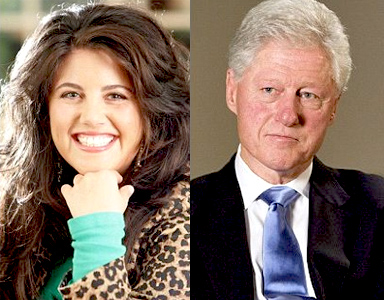
Monica_Clinton“I, myself, deeply regret what happened between me and President Clinton. Let me say it again: I. Myself. Deeply. Regret. What. Happened,” Ms. Lewinsky said in an exclusive article she wrote for Vanity Fair magazine.

In the article, Ms. Lewinsky said it is time to stop “tiptoeing around my past and other people's futures. I am determined to have a different ending to my story.”

“I've decided, finally, to stick my head above the parapet so that I can take back my narrative and give a purpose to my past. What this will cost me, I will soon find out,” she said.

Maintaining that her affair with Mr. Clinton was one between two consenting adults, Ms. Lewinsky wrote that it was the public humiliation she suffered in the wake of the scandal that permanently altered the direction of her life, according to Vanity Fair.

“Sure, my boss took advantage of me, but I will always remain firm on this point: it was a consensual relationship,” she said in the article.

“Any ‘abuse' came in the aftermath, when I was made a scapegoat in order to protect his powerful position...The Clinton administration, the special prosecutor's minions, the political operatives on both sides of the aisle, and the media were able to brand me. And that brand stuck, in part because it was imbued with power,” she wrote according to the excerpts.

“The buzz in some circles has been that the Clintons must have paid me off; why else would I have refrained from speaking out? I can assure you that nothing could be further from the truth,” Ms. Lewinsky, said.

Ms. Lewinsky said in the article that when the news of her affair with Mr. Clinton broke in 1998, not only was she arguably the most humiliated person in the world, but “thanks to the Drudge Report, I was also possibly the first person whose global humiliation was driven by the Internet.”

Her current goal, she said, “Is to get involved with efforts on behalf of victims of online humiliation and harassment and to start speaking on this topic in public forums.”

Comments

Add new comment

  • Coastaldigest.com reserves the right to delete or block any comments.
  • Coastaldigset.com is not responsible for its readers’ comments.
  • Comments that are abusive, incendiary or irrelevant are strictly prohibited.
  • Please use a genuine email ID and provide your name to avoid reject.
News Network
June 15,2020

Jun 15: Oil prices fell on Monday, with U.S. oil dropping more than 2%, as a spike in new coronavirus cases in the United States raised concerns over a second wave of the virus which would weigh on the pace of fuel demand recovery.

Brent crude futures fell 66 cents, or 1.7%, at $38.07 a barrel as of 0016 GMT, while U.S. West Texas Intermediate (WTI) crude futures fell 81 cents, or 2.2%, to $35.45 a barrel.

Both benchmarks ended down about 8% last week, their first weekly declines since April, hit by the U.S. coronavirus concerns: More than 25,000 new cases were reported on Saturday alone as more states, including Florida and Texas, reported record new infection highs.

"Concerns about the recent uptick in COVID-19 infections in the U.S. and a potential 'second wave' are weighing on oil at the moment," said Stephen Innes, chief global market strategist at AxiCorp.

Meanwhile, an OPEC-led monitoring panel will meet on Thursday to discuss ongoing record production cuts to see whether countries have delivered their share of the reductions, but will not make any decision, according to five OPEC+ sources.

The Organization of the Petroleum Exporting Countries (OPEC) and its allies, collectively known as OPEC+, have been reducing supplies by 9.7 million barrels per day (bpd), about 10% of pre-pandemic demand, and agreed in early June to extend the cuts for a month until end-July.

Iraq, one of the laggards in complying with the curbs, agreed with its major oil companies to cut crude production further in June, Iraqi officials working at the fields told Reuters on Sunday.

Comments

Add new comment

  • Coastaldigest.com reserves the right to delete or block any comments.
  • Coastaldigset.com is not responsible for its readers’ comments.
  • Comments that are abusive, incendiary or irrelevant are strictly prohibited.
  • Please use a genuine email ID and provide your name to avoid reject.
News Network
January 23,2020

Jan 23: Pakistan's Prime Minister Imran Khan called on Wednesday for the United Nations to help mediate between nuclear armed India and Pakistan over the disputed territory of Kashmir.

"This is a potential flashpoint," Khan said during a media briefing at the annual meeting of the World Economic Forum in Davos, Switzerland, adding that it was time for the "international institutions ... specifically set up to stop this" to "come into action".

The Indian government in August revoked the constitutional autonomy of Indian-administered Kashmir, splitting the Muslim-majority region into two federal territories in a bid to integrate it fully with the rest of the country.

Kashmir is claimed in full by both India and Pakistan. The two countries have gone to war twice over it, and both rule parts of it. India's portion has been plagued by separatist violence since the late 1980s.

Khan said his biggest fear was how New Delhi would respond to ongoing protests in India over a citizenship law that many feel targets Muslims.

"We're not close to a conflict right now ... What if the protests get worse in India, and to distract attention from that, what if ..."

The prime minister said he had discussed the prospect of war between his country and India in a Tuesday meeting with US President Donald Trump. Trump later said he had offered to help mediate between the two countries.

Khan said Pakistan and the United States were closer in their approach to the Taliban armed rebellion in Afghanistan than they had been for many years. He said he had never seen a military solution to that conflict.

"Finally the position of the US is there should be negotiations and a peace plan."

In a separate on-stage conversation later on Wednesday, Khan said he had told Trump in their meeting that a war with Iran would be "a disaster for the world". Trump had not responded, Khan said.

Khan made some of his most straightforward comments when asked why Pakistan has been muted in defence of Uighurs in China.

China has been widely condemned for setting up complexes in remote Xinjiang province that Beijing describes as "vocational training centres" to stamp out ""extremism and give people new skills.

The United Nations says at least one million ethnic Uighurs and other Muslims have been detained.

When pressed on China's policies, Khan said Pakistan's relations with Beijing were too important for him to speak out publicly.

"China has helped us when we were at rock bottom. We are really grateful to the Chinese government, so we have decided that any issues we have had with China we will handle privately."

Comments

Add new comment

  • Coastaldigest.com reserves the right to delete or block any comments.
  • Coastaldigset.com is not responsible for its readers’ comments.
  • Comments that are abusive, incendiary or irrelevant are strictly prohibited.
  • Please use a genuine email ID and provide your name to avoid reject.
News Network
February 19,2020

Washington, Feb 19: US President Donald Trump has said he is "saving the big deal" with India for later and he "does not know" if it will be done before the presidential election in November, clearly indicating that a major bilateral trade deal during his visit to Delhi next week might not be on the cards.

"We can have a trade deal with India. But I'm really saving the big deal for later," he told reporters at Joint Base Andrews Tuesday afternoon (local time).

The US and India could sign a "trade package" during the visit, according to media reports.

Asked whether he expects a trade deal with India before the visit, Trump said, "We're doing a very big trade deal with India. We'll have it. I don't know if it'll be done before the election, but we'll have a very big deal with India."

US Trade Representative Robert Lighthizer, the point-person for trade negotiations with India, is likely to not accompany Trump to India, sources said. However, officials have not ruled it out altogether.

In an apparent dissatisfaction over US-India trade ties, Trump said, "We're not treated very well by India." But he praised Prime Minister Narendra Modi and said he is looking forward to his visit to India.

"I happen to like Prime Minister Modi a lot," Trump said.

"He told me we'll have seven million people between the airport and the event. And the stadium, I understand, is sort of semi under construction, but it's going to be the largest stadium in the world. So it's going to be very exciting... I hope you all enjoy it," he told reporters.

Meanwhile, the US-India Strategic and Partnership Forum (USISPF) in a report said the latest quarterly data depict continuation of overall positive bilateral trade trends. The third quarter data reflects some downslide in growth rates.

"It may be due to several reasons, including the unexpected economic slowdown in India's economic growth, impact of US-China trade war, GSP withdrawal from the US side and retaliatory tariffs on specific US goods from the Indian side," USISPF said.

According to the report, the data available for the first three quarters of 2019 (January-September) pulled the overall growth rate in cumulative bilateral trade down to 4.5 percent from 8.4 percent registered for the first two quarters.

Goods and services trade performance in third quarter was dismal at -2.3 percent, in contrast with the impressive 9.6 percent growth witnessed for the first two quarters of the year; while trade in services was up two percent goods trade dropped five percent, the report said.

The cumulative US-India trade in goods and services (USD 110.9 billion) for the first three quarters of 2019 increased 4.5 percent with US exports and imports growing at four percent and five percent respectively.

The US exported USD 45.3 billion worth of goods and services to India in the first three quarters 2019, up 4 percent from the corresponding period in the previous year; and the US imported USD 65.6 billion worth of goods and services from India, up five percent from the previous year's USD 62.5 billion level for the same period, it said.

The USISPF has projected that the total bilateral trade can touch USD 238 billion by 2025 if the current 7.5 percent average annual rate of growth sustains; however, higher growth rates can result in bilateral trade in the range of USD 283 billion and USD 327 billion.

The US remains the top trading partner for India in terms of trade in goods and services, followed by China. While the bilateral trade between US and India is approximately 62 percent in goods and 38 percent in services, the bilateral trade between India and China is dominated by goods.

China had a huge trade surplus of USD 58 billion with India, indicating Beijing's strength in the Indian market, especially in sectors, such as electronics, machinery, organic chemicals, plastics and medical devices.

The US goods exports to India, in comparison, were mainly concentrated in mineral fuels, precious stones, and aircraft. The US faces tough competition with China in the Indian market in areas such as electronics, machinery, organic chemicals and medical devices.

Comments

Add new comment

  • Coastaldigest.com reserves the right to delete or block any comments.
  • Coastaldigset.com is not responsible for its readers’ comments.
  • Comments that are abusive, incendiary or irrelevant are strictly prohibited.
  • Please use a genuine email ID and provide your name to avoid reject.