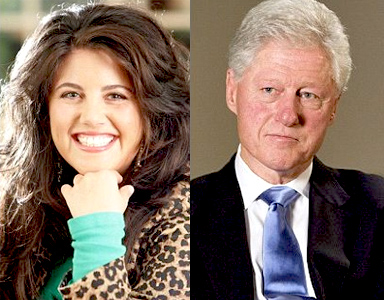
Monica Lewinsky: My boss took advantage of me

May 7, 2014

Washington, May 7: Former White House intern Monica Lewinsky has broken her silence on her 1990s affair with then US President Bill Clinton, saying he took advantage of her even though it was a “consensual relationship”.

Monica_Clinton“I, myself, deeply regret what happened between me and President Clinton. Let me say it again: I. Myself. Deeply. Regret. What. Happened,” Ms. Lewinsky said in an exclusive article she wrote for Vanity Fair magazine.

In the article, Ms. Lewinsky said it is time to stop “tiptoeing around my past and other people's futures. I am determined to have a different ending to my story.”

“I've decided, finally, to stick my head above the parapet so that I can take back my narrative and give a purpose to my past. What this will cost me, I will soon find out,” she said.

Maintaining that her affair with Mr. Clinton was one between two consenting adults, Ms. Lewinsky wrote that it was the public humiliation she suffered in the wake of the scandal that permanently altered the direction of her life, according to Vanity Fair.

“Sure, my boss took advantage of me, but I will always remain firm on this point: it was a consensual relationship,” she said in the article.

“Any ‘abuse' came in the aftermath, when I was made a scapegoat in order to protect his powerful position...The Clinton administration, the special prosecutor's minions, the political operatives on both sides of the aisle, and the media were able to brand me. And that brand stuck, in part because it was imbued with power,” she wrote according to the excerpts.

“The buzz in some circles has been that the Clintons must have paid me off; why else would I have refrained from speaking out? I can assure you that nothing could be further from the truth,” Ms. Lewinsky, said.

Ms. Lewinsky said in the article that when the news of her affair with Mr. Clinton broke in 1998, not only was she arguably the most humiliated person in the world, but “thanks to the Drudge Report, I was also possibly the first person whose global humiliation was driven by the Internet.”

Her current goal, she said, “Is to get involved with efforts on behalf of victims of online humiliation and harassment and to start speaking on this topic in public forums.”

Comments

Add new comment

  • Coastaldigest.com reserves the right to delete or block any comments.
  • Coastaldigset.com is not responsible for its readers’ comments.
  • Comments that are abusive, incendiary or irrelevant are strictly prohibited.
  • Please use a genuine email ID and provide your name to avoid reject.
News Network
May 5,2020

May 5: Global coronavirus deaths reached 250,000 on Monday after recorded infections topped 3.5 million, a news agency tally of official government data showed, although the rate of fatalities has slowed.

North America and European countries accounted for most of the new deaths and cases reported in recent days, but numbers were rising from smaller bases in Latin America, Africa and Russia.

Globally, there were 3,062 new deaths and 61,923 new cases over the past 24 hours, taking total cases to 3.58 million.

That easily exceeds the estimated 140,000 deaths worldwide in 2018 caused by measles, and compares with around 3 million to 5 million cases of severe illness caused annually by seasonal influenza, according to the World Health Organization (WHO).

While the current trajectory of COVID-19 falls far short of the 1918 Spanish flu, which infected an estimated 500 million people, killing at least 10% of patients, experts worry the available data is underplaying the true impact of the pandemic.

The concerns come as several countries begin to ease strict lockdowns that have been credited with helping contain the spread of the virus.

"We could easily have a second or a third wave because a lot of places aren't immune," Peter Collignon, an infectious diseases physician and microbiologist at Canberra Hospital, told Reuters. He noted the world was well short of herd immunity, which requires around 60% of the population to have recovered from the disease.

The first death linked to COVID-19 was reported on Jan. 10 in Wuhan, China after the coronavirus first emerged there in December. Global fatalities grew at a rate of 1-2% in recent days, down from 14% on March 21, according to the Reuters data.

DEATH RATE ANOMALIES

Mortality rates from recorded infections vary greatly from country to country.

Collignon said any country with a mortality rate of more than 2% almost certainly had underreported case numbers. Health experts fear those ratios could worsen in regions and countries less prepared to deal with the health crisis.

"If your mortality rate is higher than 2%, you've missed a lot of cases," he said, noting that countries overwhelmed by the outbreak were less likely to conduct testing in the community and record deaths outside of hospitals.

In the United States, around half the country's state governors partially reopened their economies over the weekend, while others, including New York Governor Andrew Cuomo, declared the move was premature.

In Britain, Prime Minister Boris Johnson, who battled COVID-19 last month, has said the country was over the peak but it was still too early to relax lockdown measures.

Even in countries where the suppression of the disease has been considered successful, such as Australia and New Zealand which have recorded low daily rates of new infections for weeks, officials have been cautious.

Australian Prime Minister Scott Morrison has predicated a full lifting of curbs on widespread public adoption of a mobile phone tracking app and increased testing levels.

Comments

Add new comment

  • Coastaldigest.com reserves the right to delete or block any comments.
  • Coastaldigset.com is not responsible for its readers’ comments.
  • Comments that are abusive, incendiary or irrelevant are strictly prohibited.
  • Please use a genuine email ID and provide your name to avoid reject.
News Network
May 8,2020

May 8: Thousands of migrants have been stranded “all over the world” where they face a heightened risk of COVID-19 infection, the head of the UN migration agency International Organization for Migration (IOM) has said.

IOM Director-General António Vitorino said that more onerous health-related travel restrictions might discriminate disproportionately against migrant workers in future.

“Health is the new wealth,” Vitorino said, citing proposals by some countries to introduce the so-called immunity passports and use mobile phone apps designed to prevent the spread of the new coronavirus.

“In lots of countries in the world, we already have a system of screening checks to identify the health of migrants, above all malaria, tuberculosis… HIV-AIDS, and now I believe that there will be increased demands in health controls for regular migrants,” he said on Thursday.

Travel restrictions to try to limit the spread of the pandemic has left people on the move more vulnerable than ever and unable to work to support themselves, Vitorino told journalists via videoconference.

“There are thousands of stranded migrants all over the world.

 “In South-East Asia, in East Africa, in Latin America, because of the closing of the borders and with the travel restrictions, lots of migrants who were on the move; some of them wanted to return precisely because of the pandemic,” he said.

They are blocked, some in large groups, some in small, in the border areas, in very difficult conditions without access to minimal care, especially health screening, Vitorino said.

“We have been asking the governments to allow the humanitarian workers and the health workers to have access to (them),” he said.

Turning to Venezuelan migrants, who are believed to number around five million amidst a worsening economic crisis in the country, the IOM chief said “thousands… have lost their jobs in countries like Ecuador and Colombia and are returning back to Venezuela in large crowds without any health screening and being quarantined when they go back”.

In a statement, the IOM highlighted the plight of migrants left stranded in the desert in west, central and eastern Africa, either after having been deported without the due process, or abandoned by the smugglers.

The IOM’s immediate priorities for migrants include ensuring that they have access to healthcare and other basic social welfare assistance in their host country.

Among the UN agency’s other immediate concerns is preventing the spread of new coronavirus infection in more than 1,100 camps that it manages across the world.

They include the Cox’s Bazar complex in Bangladesh, home to around one million mainly ethnic Rohingya from Myanmar, the majority having fled persecution.

So far, no cases of infection have been reported there, the IOM chief said, adding that preventative measures have been communicated to the hundreds of thousands of camp residents, while medical capacity has been boosted.

Beyond the immediate health threat of COVID-19 infection, migrants also face growing stigmatization from which they need protection, Vitorino said.

Allowing hate speech and xenophobic narratives to thrive unchallenged also threatens to undermine the public health response to COVID-19, he said, before noting that migrant workers make up a significant percentage of the health sector in many developed countries including the UK, the US and Switzerland.

Populist narratives targeting migrants as carriers of disease could also destabilise national security through social upheaval and countries’ post-COVID economic recovery by removing critical workers in agriculture and service industries, he said.

Remittances have already seen a 30 per cent drop during the pandemic, Vitorino said, citing the World Bank data, meaning that some USD 20 billion has not been sent home to families in countries where up to 15 per cent of their gross domestic product comes from pay packets earned abroad.

Vitorino, in a plea, urged to give the health of migrants as much attention as that of the host populations in all countries.

“It is quite clear that health is the new wealth and that health concerns will be introduced in the mobility systems - not just for migration - but as a whole; where travelling for business or professional reasons, health will be the new gamechanger in town.

“If the current pandemic leads to a two or even three-tier mobility system, then we will have to try to solve the problem – the problem of the pandemic - but at the same time we have created a new problem of deepening the inequalities,” he said.


Comments

Add new comment

  • Coastaldigest.com reserves the right to delete or block any comments.
  • Coastaldigset.com is not responsible for its readers’ comments.
  • Comments that are abusive, incendiary or irrelevant are strictly prohibited.
  • Please use a genuine email ID and provide your name to avoid reject.
News Network
May 12,2020

May 12: Several Indians in the US, either on the H-1B work visa or Green Card having children who are American citizens by birth, are being prevented from travelling to India aboard the special repatriation flights being run by Air India amidst the coronavirus-linked global travel restrictions.

According to the regulations issued by the Indian government last month and updated last week, visas of foreign nationals and OCI cards, that provide visa-free travel privileges to the people of Indian-origin, have been suspended as part of the new international travel restrictions.

For some of the Indian citizens like the Pandey couple in New Jersey (name and place changed at request), it's a double whammy. Having lost their H-1B job, they have to go back to India within the stipulated 60 days as required by law. The couple has two kids aged one and six years who are American citizens.

In the wee hours of Monday, they had to return from Newark airport as Air India refused to give their kids a ticket to fly to India along with them, despite them having a valid Indian visa. The young mother and father are Indian citizens.

They said that the officials from Air India and (Indian) Consulate (in New York) were very cooperative.

Also Read: COVID-19: Top senators urge Trump to temporarily suspend all new guest worker visas, including H-1B

But they could not do anything as their hands were tied by the latest regulation issued by the Indian government, a shocked Ratna Pandey told PTI.

"I would like to urge the Indian government to reconsider their decision on the humanitarian basis," said the Indian national who has lost her job but could not leave the US within the stipulated 60 days to avoid any future visa complications.

She now plans to make an appeal to the US Citizenship and Immigration Services (USCIS) to extend their stay.

Last month, H-1B visa holders, mostly Indians, launched a White House petition urging US President Donald Trump to extend their permissible stay from 60 to 180 days after job loss. However, there has been no decision from the White House so far.

While there is no official statistics of how many Indian H-1B visa holders have lost their jobs, it is believed to be substantial.

The US, due to the coronavirus pandemic, is experiencing an unprecedented unemployment rate and more than 33 million Americans have lost their jobs in the last two months. Given this massive job loss, Indians, who have lost their jobs, are unlikely to get one and thus many would have no other option but to travel back home.

In the case of single mother Mamta (name changed), the situation is graver as her son is just three-month old. Only she was given the ticket and the infant was not allowed to fly along with her because he carried an American passport.

"I would like to request the Indian government to let us fly back home. I don't want to stay in the US any longer," she told PTI hours after being prevented from boarding her hometown Ahmedabad-bound flight from Newark on Sunday.

"I am alone here. I don't have a relative here. It's a difficult situation," she said.

"Vande Bharat Mission is a humanitarian mission. But this is certainly inhuman," said Rakesh Gupta (name changed) from Washington DC.

An H-1B professional, Gupta has lost his job and needs to return to India within the stipulated 60 days. He and his wife, Geeta (name changed) being Indian citizens, received the confirmation of their seats in the flight but have been told that their two-and-a-half-year-old daughter cannot travel with them as she carried an OCI card.

"I don't believe this," he said.

Unlike the Pandey couple and Mamta, who had made the payment of USD 1,361 per ticket for their flight back home, Rakesh has not made the payment. Air India has said that the money would be refunded.

All the three Indian citizens requested the Indian government to help them travel back home by making necessary changes in the current regulations.

As per a recent government notification, all existing Indian visa holders, and visa-free travel facility, granted to OCI card holders who are not in India, have been suspended till restrictions on international air travel remains.

New York-based community leader Prem Bhandari said that the May 5 travel advisory has created multiple painful issues for the OCI card holders in the US and also to Indian citizens who are either on Green Card or H-1B visas and want to travel back home, but cannot leave their kids who are Americans by birth.

"We would like to express our disappointment with the discrimination between OCIs and citizens in respect of entering India at this critical stage when many OCIs have lawfully built their homes, families and businesses in India," Bhandari said in a letter to Union Home Secretary Ajay Kumar Bhalla on Monday.

Comments

Add new comment

  • Coastaldigest.com reserves the right to delete or block any comments.
  • Coastaldigset.com is not responsible for its readers’ comments.
  • Comments that are abusive, incendiary or irrelevant are strictly prohibited.
  • Please use a genuine email ID and provide your name to avoid reject.