



More than 100 hurt in New York train derailment

January 5, 2017

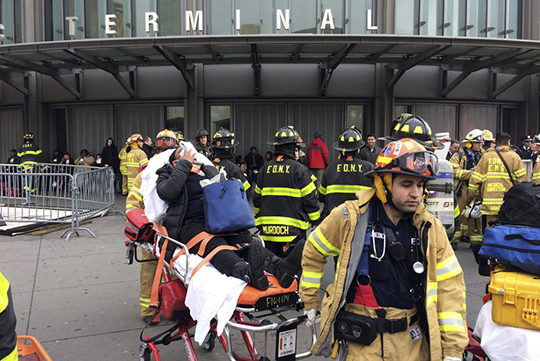
New York, Jan 5: A New York commuter train derailed Wednesday during the morning rush at a station in Brooklyn, leaving more than 100 people with mostly minor injuries and sparking travel delays, officials said.
ny

The accident at Atlantic Terminal in the heart of the New York borough comes less than four months after a fatal crash on another commuter line in New Jersey, when a train derailed as it entered a station.

On Wednesday, a Long Island Rail Road train crashed around 8:30 am (1330 GMT).

Passengers rushed out as smoke filled the tunnel. The impact bent the train's doors and smashed windows.

Some of the injured were brought out on stretchers.

Officials -- visibly relieved the toll was not higher -- said they were launching an investigation.

"103 injuries reported at scene of Atlantic Terminal LIRR train derailment, all non-life-threatening," the New York Fire Department said in a tweet.

A fire department official said the train carried 500 to 600 people, and the first two train cars were seriously damaged.

"We were lucky, it could have been quite a bit worse," the official said.

At least 11 people were taken to hospital, and were unable to walk, he added.

New York Governor Andrew Cuomo explained that the train was supposed to stop at a bumper but failed to do so, moving a few feet past it. He said the most serious injury was a possible broken leg.

"First concern is (for) the people on the train. There were a number of minor injuries," he told reporters.

"What happened with the operator, we don't know. And obviously there will be an investigation to find out exactly what happened, why the operator didn't stop the train before it hit the bumper block."

Explaining why it was difficult to pinpoint exactly how many people were injured, Cuomo added: "They were standing and they were getting ready to get off the train.

"The train has a sudden stop, they're not prepared for the sudden stop. They get knocked around, banged around, they hurt an arm, they hurt a leg."

Commuter Aaron Neufeld said on Twitter that the crash was "crazy," but added, "Seems only a few people are lightly injured."

New York's emergency notification system warned of traffic and transit delays and road closures in the area.

In September, a train derailed during rush hour as it entered the station in Hoboken, New Jersey. One person died and 114 were injured.

An investigation into that incident, in which the train entered the station at an unusually high speed, is ongoing.

Comments

Add new comment

  • Coastaldigest.com reserves the right to delete or block any comments.
  • Coastaldigset.com is not responsible for its readers’ comments.
  • Comments that are abusive, incendiary or irrelevant are strictly prohibited.
  • Please use a genuine email ID and provide your name to avoid reject.
News Network
February 24,2020

Beijing, Feb 24: The lockdown of Guo Jing's neighbourhood in Wuhan -- the city at the heart of China's new coronavirus epidemic -- came suddenly and without warning.

Unable to go out, the 29-year-old is now sealed inside her compound where she has to depend on online group-buying services to get food.

"Living for at least another month isn't an issue," Guo told news agency, explaining that she had her own stash of pickled vegetables and salted eggs.

But what scares her most is the lack of control -- first, the entire city was sealed off, and then residents were limited to exiting their compound once every three days.

Now even that has been taken away.

Guo is among some 11 million residents in Wuhan, a city in central Hubei province that has been under effective quarantine since January 23 as Chinese authorities race to contain the epidemic.

Since then, its people have faced a number of tightening controls over daily life as the death toll from the virus swelled to over 2,500 in China alone.

But the new rules this month barring residents from leaving their neighbourhoods are the most restrictive yet -- and for some, threaten their livelihoods.

"I still don't know where to buy things once we've finished eating what we have at home," said Pan Hongsheng, who lives with his wife and two children.

Some neighbourhoods have organised group-buying services, where supermarkets deliver orders in bulk.

But in Pan's community, "no one cares".

"The three-year-old doesn't even have any milk powder left," Pan told news agency, adding that he has been unable to send medicine to his in-laws -- both in their eighties -- as they live in a different area.

"I feel like a refugee."

The "closed management of neighbourhoods is bound to bring some inconvenience to the lives of the people", Qian Yuankun, vice secretary of Hubei's Communist Party committee, said at a press briefing last week.

Authorities on Monday allowed healthy non-residents of the city to leave if they never had contact with patients, but restrictions remained on those who live in Wuhan.

Demand for group-buying food delivery services has rocketed with the new restrictions, with supermarkets and neighbourhood committees scrambling to fill orders.

Most group-buying services operate through Chinese messaging app WeChat, which has ad-hoc chat groups for meat, vegetables, milk -- even "hot dry noodles", a famous Wuhan dish.

More sophisticated shops and compounds have their own mini-app inside WeChat, where residents can choose packages priced by weight before orders are sent in bulk to grocery stores.

In Guo's neighbourhood, for instance, a 6.5-kilogramme (14.3-pound) set of five vegetables, including potatoes and baby cabbage, costs 50 yuan ($7.11).

"You have no way to choose what you like to eat," Guo said. "You cannot have personal preferences anymore."

The group-buying model is also more difficult for smaller communities to adopt, as supermarkets have minimum order requirements for delivery.

"To be honest, there's nothing we can do," said Yang Nan, manager of Lao Cun Zhang supermarket, which requires a minimum of 30 orders.

"We only have four cars," she said, explaining that the store did not have the staff to handle smaller orders.

Another supermarket told AFP it capped its daily delivery load to 1,000 orders per day.

"Hiring staff is difficult," said Wang Xiuwen, who works at the store's logistics division, adding that they are wary about hiring too many outsiders for fear of infection.

Closing off communities has split the city into silos, with different neighbourhoods rolling out controls of varying intensity.

In some compounds, residents have easier access to food -- albeit a smaller selection than normal -- and one woman said her family pays delivery drivers to run grocery errands.

Her compound has not been sealed off either, the 24-year-old told AFP under condition of anonymity, though they are limited to one person leaving at a time.

Some districts have implemented their own rules, such as prohibiting supermarkets from selling to individuals, forcing neighbourhoods to buy in bulk or not at all.

"In the neighbourhood where I live, the reality is really terrible," said David Dai, who is based on the outskirts of Wuhan.

Though his apartment complex has organised group-buying, Dai said residents were unhappy with price and quality.

"A lot of tomatoes, a lot of onions -- they were already rotten," he told , estimating over a third of the food had to be thrown away.

His family must "totally depend" on themselves, added the 49-year-old, who has resorted to saving and drying turnip skins to add nutrients to future meals.

The uncertainty of not knowing when the controls will be lifted is also frustrating, said Ma Chen, a man in his 30s who lives alone.

"I have no way of knowing how much (food) I should buy."

Comments

Add new comment

  • Coastaldigest.com reserves the right to delete or block any comments.
  • Coastaldigset.com is not responsible for its readers’ comments.
  • Comments that are abusive, incendiary or irrelevant are strictly prohibited.
  • Please use a genuine email ID and provide your name to avoid reject.
News Network
February 6,2020

Beijing, Feb 6: The number of confirmed fatalities from China's coronavirus outbreak rose to at least 560, after authorities in hardest-hit Hubei province reported 70 new deaths on February 6.

In its daily update, the health commission in Hubei also confirmed the number of confirmed infections in the outbreak has reached 28,018 nationwide with 3,694 new cases reported.

The epidemic, which has spiralled into a global health emergency, is believed to have emerged in December from a market that sold wild game in Hubei's capital Wuhan.

Hu Lishan, an official in Wuhan, warned Wednesday that despite building a hospital from scratch and converting public buildings to accommodate thousands of extra patients, there was still a "severe" lack of beds in the region.

There was also a shortage of "equipment and materials," he told reporters, adding that officials were looking to convert other hotels and schools in the city into treatment centres.

Authorities in several other cities in China have placed restrictions on the number of people allowed to leave their homes.

Global concerns have also risen about the virus, with cases confirmed in more than 20 countries.

Comments

Add new comment

  • Coastaldigest.com reserves the right to delete or block any comments.
  • Coastaldigset.com is not responsible for its readers’ comments.
  • Comments that are abusive, incendiary or irrelevant are strictly prohibited.
  • Please use a genuine email ID and provide your name to avoid reject.
News Network
June 26,2020

Washington, Jun 26: The United States reported more than 39,000 new coronavirus cases on Thursday, its highest-ever single-day count as the government relaxed restrictions and is downplaying the threat of the deadly virus.

According to the Washington Post, experts believe there is a troubling lack of consistent, unified messaging from President Donald Trump and Vice President Mike Pence. They have downplayed the danger and denigrated effective disease defences such as mask-wearing, testing, and social distancing.

Churches, beaches, and bars are filling up with people and so are hospital beds, the report said.

The counties home to Dallas, Phoenix, and Tampa all reported record-high averages on at least 15 straight days in June.

The hardest-hit states are California, Texas, Florida and those that thought they had the virus under control, like Utah and Oregon.

"I think the politicians are in denial," said Kami Kim, director of the Division of Infectious Disease and International Medicine at the University of South Florida.

The chief of the Division of Pediatric Infectious Diseases at the University of Utah Health, Andrew T. Pavia, is of the view that the push to reopen quickly even as cases climb sends a dangerous and inaccurate message.

"On the one hand, you get messages from politicians and the business community that we have to go, go, go and open up," he said. "On the other hand, you're seeing epidemiological indicators that we still have to be very careful."

"It's cognitive dissonance," he added.

The Trump administration has tried to downplay the rising number. Pence called concerns about another surge of infections "overblown," the product of media "fearmongering."

Some governors have followed the administration's lead, blaming rising caseloads on more testing.

Testifying before a congressional committee this week, Anthony S. Fauci, the nation's top infectious-diseases expert, said the new cases were "a disturbing surge" spurred by community transmission rather than testing.

"That's something I'm really quite concerned about," Fauci said. "A couple of days ago, there were 30,000 new infections. That's very disturbing to me."

Several states like Arizona, Arkansas, the Carolinas, Mississippi, Tennessee, Texas and Utah have recently reported new highs in the number of coronavirus patients hospitalized.

"We're seeing a 40 per cent increase in the last two weeks in hospitalizations," said Dallas County Judge Clay Jenkins (D), the jurisdiction's top elected official. "We're by far at our record numbers, and we're at record numbers in north Texas. Houston is at a record, the state is at a record." The Texas Medical Center in Houston, a massive medical complex, reported Thursday that 100 per cent of the beds in its intensive care unit are occupied.

Comments

Add new comment

  • Coastaldigest.com reserves the right to delete or block any comments.
  • Coastaldigset.com is not responsible for its readers’ comments.
  • Comments that are abusive, incendiary or irrelevant are strictly prohibited.
  • Please use a genuine email ID and provide your name to avoid reject.