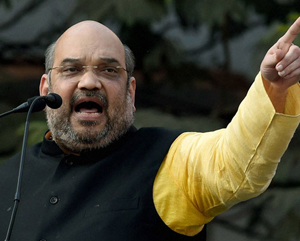
More lynching incidents happened under previous govts: Shah

Agencies
July 2, 2017

Panaji, Jul 2: BJP president Amit Shah has said that more incidents of lynching had occurred during the previous governments than during the three years of NDA rule, but no one had raised questions then.amitt

"I do not want to compare and undermine the current incidents of lynching. I am also serious about it. But there have been more lynching incidents in 2011, 2012 and 2013," Shah told a gathering of professionals in Goa last evening.

"There have been more lynchings each year in the past, compared to the total lynching incidents that have happened during our three-year-long tenure," the BJP leader said. The BJP-led government came to power at the Centre in May 2014.

Responding to a question about fears over the lynching incidents, he said there was no apprehension anywhere in the country.

"Do you know of any such incident where arrests have not been made? I do not have any answer to apprehensions. There is no apprehension anywhere in the country," he said.

Maintaining that law and order was a state subject, Shah said when Mohammad Akhlaq died, the Samajwadi Party-led government was in power in Uttar Pradesh, and it was its responsibility.

"But protests are held in Delhi in front of the Narendra Modi government. What is this fashion," he asked.

In September 2015, Akhlaq was dragged out of his house and killed by a mob at Dadri in UP on suspicion of storing and consuming beef.

Following several such lynching incidents, including those in Jharkhand, Haryana and UP, protests were held late last month at several cities across the country.

Comments

Ranjan shetty
 - 
Thursday, 6 Jul 2017

Chutiya bangladeshisare attacking Hindus in WB, where are those SOB's who did rally in the name of #notin my name ?

Umar Ashfaq
 - 
Thursday, 6 Jul 2017

Please qidmat k mauka de guzarish hogi

ABDUL AZIZ
 - 
Thursday, 6 Jul 2017

hang them till death , sharia law

Abdullah
 - 
Sunday, 2 Jul 2017

But who killed them????
You and your goons only.

Rikaz
 - 
Sunday, 2 Jul 2017

do not compare with previous government, it is your job to eliminate all sort of lynching around....take action on all who committed it as of now and make sure that it will not happen again....why it is happening only on muslims....there are people eating beef from other community.... and beef export factories exporting beef everyday basis with no problems...if you have guts stop it....

Thoushi
 - 
Sunday, 2 Jul 2017

True lynching was happening in previous government also and before since Gandhi's assassination , but Mr. Cha most all lynching was carried out by your OWN associated party(BJP) and wings (RSS)

Add new comment

  • Coastaldigest.com reserves the right to delete or block any comments.
  • Coastaldigset.com is not responsible for its readers’ comments.
  • Comments that are abusive, incendiary or irrelevant are strictly prohibited.
  • Please use a genuine email ID and provide your name to avoid reject.
News Network
July 10,2020

London, Jul 10: India's Reliance will load its first cargo of Venezuelan crude in three months this week in exchange for diesel under a swap deal the parties say is permitted under the US sanctions regime on the Latin American country, according to a Reliance source and a shipping document from state oil firm PDVSA.

Washington has exempted some Venezuelan oil trade from sanctions when transactions are in exchange for fuel and food or to repay debts rather than for cash. But that trade slowed as the US tightened restrictions and refiners, shippers and insurers have been steering clear of Venezuela to avoid any risk they may fall foul of sanctions.

Washington aims to deprive Venezuelan socialist President Nicolas Maduro of his main source of revenue with the sanctions, which have driven Venezuelan oil exports to their lowest level since the 1940s.

Reliance gave the US State Department and the Office of Foreign Assets Control (OFAC) notice of the diesel swap and received word back that the policies that allowed the transaction were still in place, the Reliance source told Reuters.

Reliance has previously said that its supplies of fuel to PDVSA in exchange for crude were permitted under sanctions.

An oil tanker named Commodore would load the cargo of crude in Venezuela and ship it to India, the tanker's manager NGM Energy said.

"All details of the transaction and transportation were shared with US authorities, who confirmed that the U.S. policy authorizing such transactions remained in place," NGM Energy said in a statement to Reuters.

"The shipment is made in connection with the humanitarian exchange of oil for diesel fuel."

The Commodore is loading a 1.9-million barrel cargo of crude for Reliance at Venezuela's main oil port of Jose, according to an internal PDVSA cargo schedule seen by Reuters.

The Liberian-flagged Commodore was at the Jose Terminal on Thursday, ship tracking data on Refinitiv Eikon showed.

The US State Department, Treasury's enforcement arm OFAC, and PDVSA did not immediately respond to a request for comment.

Reliance has a swap deal to provide diesel to Venezuela in exchange for fuel but has not received a cargo of crude since April. Sources at Indian refiners told Reuters earlier this year they planned to wind down their purchases of Venezuelan oil to avoid any problems with supply due to sanctions.

Other long-time customers of PDVSA, including Italy's Eni and Spain's Repsol, have continued taking cargoes of Venezuelan crude this year under permission granted by the US Treasury Department to exchange the oil for diesel supply as part of debt repayment deals, according to sources from the companies.

NGM Energy also manages the Voyager I tanker, which the United States removed from its list of sanctioned vessels last week after NGM and the ship's owner Sanibel Shiptrade said they would increase measures to ensure vessels complied with international sanctions.

"Last month, NGM Energy SA adopted a firm policy of not allowing vessels under its commercial management to trade to Venezuela, or to carry Venezuelan petroleum cargoes, absent US government authorization," NGM said.

"NGM continues to stand by that pledge."

Comments

Add new comment

  • Coastaldigest.com reserves the right to delete or block any comments.
  • Coastaldigset.com is not responsible for its readers’ comments.
  • Comments that are abusive, incendiary or irrelevant are strictly prohibited.
  • Please use a genuine email ID and provide your name to avoid reject.
News Network
January 20,2020

Davos, Jan 20: India's richest 1 per cent hold more than four-times the wealth held by 953 million people who make up for the bottom 70 per cent of the country's population, while the total wealth of all Indian billionaires is more than the full-year budget, a new study said on Monday.

Releasing the study 'Time to Care' here ahead of the 50th annual meeting of the World Economic Forum (WEF), rights group Oxfam also said the world's 2,153 billionaires have more wealth than the 4.6 billion people who make up 60 per cent of the planet's population.

The report flagged that global inequality is shockingly entrenched and vast and the number of billionaires has doubled in the last decade, despite their combined wealth having declined in the last year.

"The gap between rich and poor can't be resolved without deliberate inequality-busting policies, and too few governments are committed to these," said Oxfam India CEO Amitabh Behar, who is here to represent the Oxfam confederation this year.

The issues of income and gender inequality are expected to figure prominently in discussions at the five-day summit of the WEF, starting Monday. The WEF's annual global risks Report has also warned that the downward pressure on the global economy from macroeconomic fragilities and financial inequality continued to intensify in 2019.

Concern about inequality underlies recent social unrest in almost every continent, although it may be sparked by different tipping points such as corruption, constitutional breaches, or the rise in prices for basic goods and services, as per the WEF report.

Although global inequality has declined over the past three decades, domestic income inequality has risen in many countries, particularly in advanced economies and reached historic highs in some, the Global Risks Report flagged last week.

The Oxfam report further said "sexist" economies are fuelling the inequality crisis by enabling a wealthy elite to accumulate vast fortunes at the expense of ordinary people and particularly poor women and girls.

Regarding India, Oxfam said the combined total wealth of 63 Indian billionaires is higher than the total Union Budget of India for the fiscal year 2018-19 which was at Rs 24,42,200 crore.

"Our broken economies are lining the pockets of billionaires and big business at the expense of ordinary men and women. No wonder people are starting to question whether billionaires should even exist," Behar said.

As per the report, it would take a female domestic worker 22,277 years to earn what a top CEO of a technology company makes in one year.

With earnings pegged at Rs 106 per second, a tech CEO would make more in 10 minutes than what a domestic worker would make in one year.

It further said women and girls put in 3.26 billion hours of unpaid care work each and every day -- a contribution to the Indian economy of at least Rs 19 lakh crore a year, which is 20 times the entire education budget of India in 2019 (Rs 93,000 crore).

Besides, direct public investments in the care economy of 2 per cent of GDP would potentially create 11 million new jobs and make up for the 11 million jobs lost in 2018, the report said.

Behar said the gap between rich and poor cannot be resolved without deliberate inequality-busting policies, and too few governments are committed to these.

He said women and girls are among those who benefit the least from today's economic system.

"They spend billions of hours cooking, cleaning and caring for children and the elderly. Unpaid care work is the 'hidden engine' that keeps the wheels of our economies, businesses and societies moving.

"It is driven by women who often have little time to get an education, earn a decent living or have a say in how our societies are run, and who are therefore trapped at the bottom of the economy,” Behar added.

Oxfam said governments are massively under-taxing the wealthiest individuals and corporations and failing to collect revenues that could help lift the responsibility of care from women and tackle poverty and inequality.

Besides, the governments are also underfunding vital public services and infrastructure that could help reduce women and girls' workload, the report said.

As per the global survey, the 22 richest men in the world have more wealth than all the women in Africa.

Besides, women and girls put in 12.5 billion hours of unpaid care work each and every day -- a contribution to the global economy of at least USD 10.8 trillion a year, more than three times the size of the global tech industry.

Getting the richest one per cent to pay just 0.5 per cent extra tax on their wealth over the next 10 years would equal the investment needed to create 117 million jobs in sectors such as elderly and childcare, education and health.

Governments must prioritise care as being as important as all other sectors in order to build more human economies that work for everyone, not just a fortunate few, Behar said.

Oxfam said its calculations are based on the latest data sources available, including from the Credit Suisse Research Institute's Global Wealth Databook 2019 and Forbes' 2019 billionaires list.


Comments

Add new comment

  • Coastaldigest.com reserves the right to delete or block any comments.
  • Coastaldigset.com is not responsible for its readers’ comments.
  • Comments that are abusive, incendiary or irrelevant are strictly prohibited.
  • Please use a genuine email ID and provide your name to avoid reject.
Agencies
April 24,2020

New Delhi, Apr 24: The Jamia Coordination Committee (JCC) on Friday accused Delhi Police of framing two of its members - Meeran Haider, Safoora Zargar, along with student leader Umar Khalid, as part of "an imaginary conspiracy behind the recent North East Delhi riots".

While Haider was arrested on April 2, Zargar was taken in custody on April 10 for their alleged involvement in fuelling the riots.

"These arrests by the police have little ground, and the charges seem to have no rhyme or reason. Safoora was even granted bail in the case she was initially arrested in, following which she was arrested and had heavier charges placed against her," the JCC said in a statement.

Meeran, Safoora and Umar have been charged under the Unlawful Activities (Prevention) Act (UAPA), which allows curbing of fundamental rights in order to protect the sovereignty of India. The JCC, however, claimed that in this case, the Act is being used to suppress their voices.

"This Act has been used against many activists working to protect constitutional morality, a list which now includes members of the JCC, a wholly constitutionalist collective of students and alumni," the JCC said, defending its members.

JCC maintained it had no role in Delhi riots, but apprehended that more people will be arrested by the Delhi Police as part of its conspiracy against students and protestors.

"It is almost certain that more protesters will be framed and arrested in the conspiracy invented by the Delhi Police. JCC reiterates that it played no part in the riots, and this fact will be proved before any court of law," it said in a statement.

It also demanded political parties, and university administration take a stand for the two accused JCC members and student leader Umar Khalid.

The JCC came into existence after a violent face-off between Delhi Police and unruly anti-CAA protestors left Jamia Millia Islamia vandalised. It was after this, that a group of students from the Jamia Millia formed it to decide upon the future course of actions in protest against the CAA and the police action.

Comments

Add new comment

  • Coastaldigest.com reserves the right to delete or block any comments.
  • Coastaldigset.com is not responsible for its readers’ comments.
  • Comments that are abusive, incendiary or irrelevant are strictly prohibited.
  • Please use a genuine email ID and provide your name to avoid reject.