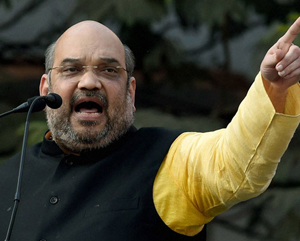
More lynching incidents happened under previous govts: Shah

Agencies
July 2, 2017

Panaji, Jul 2: BJP president Amit Shah has said that more incidents of lynching had occurred during the previous governments than during the three years of NDA rule, but no one had raised questions then.amitt

"I do not want to compare and undermine the current incidents of lynching. I am also serious about it. But there have been more lynching incidents in 2011, 2012 and 2013," Shah told a gathering of professionals in Goa last evening.

"There have been more lynchings each year in the past, compared to the total lynching incidents that have happened during our three-year-long tenure," the BJP leader said. The BJP-led government came to power at the Centre in May 2014.

Responding to a question about fears over the lynching incidents, he said there was no apprehension anywhere in the country.

"Do you know of any such incident where arrests have not been made? I do not have any answer to apprehensions. There is no apprehension anywhere in the country," he said.

Maintaining that law and order was a state subject, Shah said when Mohammad Akhlaq died, the Samajwadi Party-led government was in power in Uttar Pradesh, and it was its responsibility.

"But protests are held in Delhi in front of the Narendra Modi government. What is this fashion," he asked.

In September 2015, Akhlaq was dragged out of his house and killed by a mob at Dadri in UP on suspicion of storing and consuming beef.

Following several such lynching incidents, including those in Jharkhand, Haryana and UP, protests were held late last month at several cities across the country.

Comments

Ranjan shetty
 - 
Thursday, 6 Jul 2017

Chutiya bangladeshisare attacking Hindus in WB, where are those SOB's who did rally in the name of #notin my name ?

Umar Ashfaq
 - 
Thursday, 6 Jul 2017

Please qidmat k mauka de guzarish hogi

ABDUL AZIZ
 - 
Thursday, 6 Jul 2017

hang them till death , sharia law

Abdullah
 - 
Sunday, 2 Jul 2017

But who killed them????
You and your goons only.

Rikaz
 - 
Sunday, 2 Jul 2017

do not compare with previous government, it is your job to eliminate all sort of lynching around....take action on all who committed it as of now and make sure that it will not happen again....why it is happening only on muslims....there are people eating beef from other community.... and beef export factories exporting beef everyday basis with no problems...if you have guts stop it....

Thoushi
 - 
Sunday, 2 Jul 2017

True lynching was happening in previous government also and before since Gandhi's assassination , but Mr. Cha most all lynching was carried out by your OWN associated party(BJP) and wings (RSS)

Add new comment

  • Coastaldigest.com reserves the right to delete or block any comments.
  • Coastaldigset.com is not responsible for its readers’ comments.
  • Comments that are abusive, incendiary or irrelevant are strictly prohibited.
  • Please use a genuine email ID and provide your name to avoid reject.
News Network
May 28,2020

Bhopal, May 28: A Bhopal-based high net worth individual hired a 180-seater A320 plane of a private carrier to ferry four family members to New Delhi, in a bid to avoid crowd at the airport and in flight amid the COVID-19 outbreak, officials said on Thursday.

The person, who is a liquor baron, chartered the aircraft to send to Delhi his daughter, her two children and their maid, who were stuck in Bhopal since the last two months due to the coronavirus-induced lockdown, sources said.

The plane arrived here from Delhi on Monday with crew only and flew back with just four passengers for whom it was specially hired, they said.

"The A320 180-seater plane arrived here on May 25 to carry four members of a family, probably due to the coronavirus scare. It was chartered by someone and there was no medical emergency, an airline official said, refusing to divulge any further details.

Bhopals Rajabhoj Airport Director Anil Vikram could not be contacted for comments.

According to aviation experts, the cost of hiring an Airbus-320 is about Rs 20 lakh.

Domestic commercial flight services resumed from Monday, after a nearly two-month break due to the coronavirus-enforced lockdown.

Comments

Add new comment

  • Coastaldigest.com reserves the right to delete or block any comments.
  • Coastaldigset.com is not responsible for its readers’ comments.
  • Comments that are abusive, incendiary or irrelevant are strictly prohibited.
  • Please use a genuine email ID and provide your name to avoid reject.
News Network
June 11,2020

The Indian National Congress is considering to move court seeking action against operation lotus,  after an audio clip in which Madhya Pradesh chief minister Shivraj Singh Chouhan can be heard saying that the Central leadership of Bharatiya Janata Party wanted the Kamal Nath government to fall went viral.

Mr Chouhan is also heard saying in the purported 9.28-minute long audio clip that it was not possible to pull down the Kamal Nath government without the help of Jyotiraditya Scindia and his loyalist, former Congress MLA Tulsi Silawat.

The Congress, which has all along maintained that the BJP had hatched a conspiracy to pull down the 15-month-old Kamal Nath government to “capture” power in MP, threatened legal action.

“I have been maintaining from the very beginning that there was a conspiracy to pull down my duly elected government… The audio has established that the BJP’s Central leadership had conspired to pull down my government even though it enjoyed majority,” former chief minister and Congress veteran Kamal Nath said.

Working president of MP Pradesh Congress Committee (PCC) Jitu Patwari said his party may move court against the BJP for having plotted to dislodge an elected government following the expose in the purported audio.

Mr Chouhan was reportedly addressing BJP workers of Sanware Assembly constituency in Indore on Monday when he allegedly said in Hindi, “The Central leadership (of BJP) decided that the (Kamal Nath) government should fall. They (the Kamal Nath government) will ruin and destroy … Tell me, was it possible to dislodge the government without Jyotiraditya Scindia and Tulsi Bhai? There was no other way.”  

The “Tulsi Bhai” referred to in the clip is former health minister who joined the BJP along with Mr Scindia.

“In the coming bypoll if Tulsi Silawat doesn’t become MLA again, will I be able to remain CM, will the BJP government survive?” he allegedly said, exhorting BJP workers to overcome their differences and work for Mr Silawat’s victory in the upcoming by-elections in the Sanwer Assembly seat.

Twenty-two Congress MLAs, loyal to Mr Scindia, had resigned from the Assembly leading to the fall of the Kamal Nath government on March 20, paving the way for Mr Chouhan to return as chief minister for the fourth time.

All the 22 ex-Congress MLAs later joined the BJP with Mr Scindia. Two of them, Mr Silawat and Govind Singh Rajput, have been inducted into the Shivraj Singh Chouhan Cabinet.

The BJP has vehemently denied any role in the collapse of the Kamal Nath government. Neither the saffron party’s Central leadership nor Mr Chouhan have reacted to the audio clip yet

But the party’s state spokesperson Rajneesh Agrawal dismissed the charge that it had a hand in the fall of the Kamal Nath government.

“Infighting in Congress had led to the fall of the Kamal Nath government,” he said.

Comments

Add new comment

  • Coastaldigest.com reserves the right to delete or block any comments.
  • Coastaldigset.com is not responsible for its readers’ comments.
  • Comments that are abusive, incendiary or irrelevant are strictly prohibited.
  • Please use a genuine email ID and provide your name to avoid reject.
News Network
January 13,2020

Jan 13: For the first time in years, the government of India’s Prime Minister Narendra Modi is playing defense. Protests have sprung up across the country against an amendment to India’s laws — which came into effect on Friday — that makes it easier for members of some religions to become citizens of India. The government claims this is simply an attempt to protect religious minorities in the Muslim-majority countries that border India; but protesters see it as the first step toward a formal repudiation of India’s constitutionally guaranteed secularism — and one that must be resisted.

Modi was re-elected prime minister last year with an enhanced majority; his hold over the country’s politics is absolute. The formal opposition is weak, discredited and disorganized. Yet, somehow, the anti-Citizenship Act protests have taken hold. No political party is behind them; they are generally arranged by student unions, neighborhood associations and the like.

Yet this aspect of their character is precisely what will worry Modi and his right-hand man, Home Minister Amit Shah. They know how to mock and delegitimize opposition parties with ruthless efficiency. Yet creating a narrative that paints large, flag-waving crowds as traitors is not quite that easy.

For that is how these protests look: large groups of young people, many carrying witty signs and the national flag. They meet and read the preamble to India’s Constitution, into which the promise of secularism was written in the 1970’s.

They carry photographs of the Constitution’s drafter, the Columbia University-trained economist and lawyer B. R. Ambedkar. These are not the mobs the government wanted. They hoped for angry Muslims rampaging through the streets of India’s cities, whom they could point to and say: “See? We must protect you from them.” But, in spite of sometimes brutal repression, the protests have largely been nonviolent.

One, in Shaheen Bagh in a Muslim-dominated sector of New Delhi, began simply as a set of local women in a square, armed with hot tea and blankets against the chill Delhi winter. It has now become the focal point of a very different sort of resistance than what the government expected. Nothing could cure the delusions of India’s Hindu middle class, trained to see India’s Muslims as dangerous threats, as effectively as a group of otherwise clearly apolitical women sipping sweet tea and sharing their fears and food with anyone who will listen.

Modi was re-elected less than a year ago; what could have changed in India since then? Not much, I suspect, in most places that voted for him and his party — particularly the vast rural hinterland of northern India. But urban India was also possibly never quite as content as electoral results suggested. India’s growth dipped below 5% in recent quarters; demand has crashed, and uncertainty about the future is widespread. Worse, the government’s response to the protests was clearly ill-judged. University campuses were attacked, in one case by the police and later by masked men almost certainly connected to the ruling party.

Protesters were harassed and detained with little cause. The courts seemed uninterested. And, slowly, anger began to grow on social media — not just on Twitter, but also on Instagram, previously the preserve of pretty bowls of salad. Instagram is the one social medium over which Modi’s party does not have a stranglehold; and it is where these protests, with their photogenic signs and flags, have found a natural home. As a result, people across urban India who would never previously have gone to a demonstration or a political rally have been slowly politicized.

India is, in fact, becoming more like a normal democracy. “Normal,” that is, for the 2020’s. Liberal democracies across the world are politically divided, often between more liberal urban centers and coasts, and angrier, “left-behind” hinterlands. Modi’s political secret was that he was that rare populist who could unite both the hopeful cities and the resentful countryside. Yet this once magic formula seems to have become ineffective. Five of India’s six largest cities are not ruled by Modi’s Bharatiya Janata Party in any case — the financial hub of Mumbai changed hands recently. The BJP has set its sights on winning state elections in Delhi in a few weeks. Which way the capital’s voters will go is uncertain. But that itself is revealing — last year, Modi swept all seven parliamentary seats in Delhi.

In the end, the Citizenship Amendment Act is now law, the BJP might manage to win Delhi, and the protests might die down as the days get unmanageably hot and state repression increases. But urban India has put Modi on notice. His days of being India’s unifier are over: From now on, like all the other populists, he will have to keep one eye on the streets of his country’s cities.


Comments

Add new comment

  • Coastaldigest.com reserves the right to delete or block any comments.
  • Coastaldigset.com is not responsible for its readers’ comments.
  • Comments that are abusive, incendiary or irrelevant are strictly prohibited.
  • Please use a genuine email ID and provide your name to avoid reject.