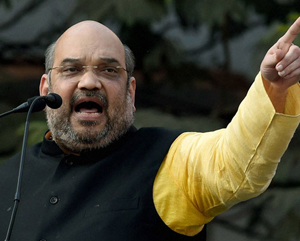
More lynching incidents happened under previous govts: Shah

Agencies
July 2, 2017

Panaji, Jul 2: BJP president Amit Shah has said that more incidents of lynching had occurred during the previous governments than during the three years of NDA rule, but no one had raised questions then.amitt

"I do not want to compare and undermine the current incidents of lynching. I am also serious about it. But there have been more lynching incidents in 2011, 2012 and 2013," Shah told a gathering of professionals in Goa last evening.

"There have been more lynchings each year in the past, compared to the total lynching incidents that have happened during our three-year-long tenure," the BJP leader said. The BJP-led government came to power at the Centre in May 2014.

Responding to a question about fears over the lynching incidents, he said there was no apprehension anywhere in the country.

"Do you know of any such incident where arrests have not been made? I do not have any answer to apprehensions. There is no apprehension anywhere in the country," he said.

Maintaining that law and order was a state subject, Shah said when Mohammad Akhlaq died, the Samajwadi Party-led government was in power in Uttar Pradesh, and it was its responsibility.

"But protests are held in Delhi in front of the Narendra Modi government. What is this fashion," he asked.

In September 2015, Akhlaq was dragged out of his house and killed by a mob at Dadri in UP on suspicion of storing and consuming beef.

Following several such lynching incidents, including those in Jharkhand, Haryana and UP, protests were held late last month at several cities across the country.

Comments

Ranjan shetty
 - 
Thursday, 6 Jul 2017

Chutiya bangladeshisare attacking Hindus in WB, where are those SOB's who did rally in the name of #notin my name ?

Umar Ashfaq
 - 
Thursday, 6 Jul 2017

Please qidmat k mauka de guzarish hogi

ABDUL AZIZ
 - 
Thursday, 6 Jul 2017

hang them till death , sharia law

Abdullah
 - 
Sunday, 2 Jul 2017

But who killed them????
You and your goons only.

Rikaz
 - 
Sunday, 2 Jul 2017

do not compare with previous government, it is your job to eliminate all sort of lynching around....take action on all who committed it as of now and make sure that it will not happen again....why it is happening only on muslims....there are people eating beef from other community.... and beef export factories exporting beef everyday basis with no problems...if you have guts stop it....

Thoushi
 - 
Sunday, 2 Jul 2017

True lynching was happening in previous government also and before since Gandhi's assassination , but Mr. Cha most all lynching was carried out by your OWN associated party(BJP) and wings (RSS)

Add new comment

  • Coastaldigest.com reserves the right to delete or block any comments.
  • Coastaldigset.com is not responsible for its readers’ comments.
  • Comments that are abusive, incendiary or irrelevant are strictly prohibited.
  • Please use a genuine email ID and provide your name to avoid reject.
News Network
June 27,2020

Jun 27: Alittle-known Indian IT firm offered its hacking services to help clients spy on more than 10,000 email accounts over a period of seven years.

New Delhi-based BellTroX InfoTech Services targeted government officials in Europe, gambling tycoons in the Bahamas, and well-known investors in the United States including private equity giant KKR and short seller Muddy Waters, according to three former employees, outside researchers, and a trail of online evidence.

Aspects of BellTroX's hacking spree aimed at American targets are currently under investigation by U.S. law enforcement, five people familiar with the matter told Reuters. The U.S. Department of Justice declined to comment.

Reuters does not know the identity of BellTroX's clients. In a telephone interview, the company's owner, Sumit Gupta, declined to disclose who had hired him and denied any wrongdoing.

Muddy Waters founder Carson Block said he was "disappointed, but not surprised, to learn that we were likely targeted for hacking by a client of BellTroX." KKR declined to comment.

Researchers at internet watchdog group Citizen Lab, who spent more than two years mapping out the infrastructure used by the hackers, released a report that BellTroX employees were behind the espionage campaign.

"This is one of the largest spy-for-hire operations ever exposed," said Citizen Lab researcher John Scott-Railton.

Although they receive a fraction of the attention devoted to state-sponsored espionage groups or headline-grabbing heists, "cyber mercenary" services are widely used, he said. "Our investigation found that no sector is immune."

A cache of data reviewed by Reuters provides insight into the operation, detailing tens of thousands of malicious messages designed to trick victims into giving up their passwords that were sent by BellTroX between 2013 and 2020. The data was supplied on condition of anonymity by online service providers used by the hackers after Reuters alerted the firms to unusual patterns of activity on their platforms.

The data is effectively a digital hit list showing who was targeted and when. Reuters validated the data by checking it against emails received by the targets.

On the list: judges in South Africa, politicians in Mexico, lawyers in France and environmental groups in the United States. These dozens of people, among the thousands targeted by BellTroX, did not respond to messages or declined comment.

Reuters was not able to establish how many of the hacking attempts were successful.

BellTroX's Gupta was charged in a 2015 hacking case in which two U.S. private investigators admitted to paying him to hack the accounts of marketing executives. Gupta was declared a fugitive in 2017, although the U.S. Justice Department declined to comment on the current status of the case or whether an extradition request had been issued.

Speaking by phone from his home in New Delhi, Gupta denied hacking and said he had never been contacted by law enforcement. He said he had only ever helped private investigators download messages from email inboxes after they provided him with login details.

"I didn't help them access anything, I just helped them with downloading the mails and they provided me all the details," he told Reuters. "I am not aware how they got these details but I was just helping them with the technical support."

Reuters could not determine why the private investigators might need Gupta to download emails. Gupta did not return follow-up messages. Spokesmen for Delhi police and India's foreign ministry did not respond to requests for comment.

HOROSCOPES AND PORNOGRAPHY

Operating from a small room above a shuttered tea stall in a west-Delhi retail complex, BellTroX bombarded its targets with tens of thousands of malicious emails, according to the data reviewed by Reuters. Some messages would imitate colleagues or relatives; others posed as Facebook login requests or graphic notifications to unsubscribe from pornography websites.

Fahmi Quadir's New York-based short selling firm Safkhet Capital was among 17 investment companies targeted by BellTroX between 2017 and 2019. She said she noticed a surge in suspicious emails in early 2018, shortly after she launched her fund.

Initially "it didn't seem necessarily malicious," Quadir said. "It was just horoscopes; then it escalated to pornography."

Eventually the hackers upped their game, sending her credible-sounding messages that looked like they came from her coworkers, other short sellers or members of her family. "They were even trying to emulate my sister," Quadir said, adding that she believes the attacks were unsuccessful.

U.S. advocacy groups were also repeatedly targeted. Among them were digital rights organizations Free Press and Fight for the Future, both of whom have lobbied for net neutrality. The groups said a small number of employee accounts were compromised, but the wider organizations' networks were untouched. The spying on those groups was detailed in a report by the Electronic Frontier Foundation in 2017, but has not been publicly tied to BellTroX until now.

Timothy Karr, a director at Free Press, said his organization "sees an uptick in breach attempts whenever we're engaged in heated and high-profile public policy debates." Evan Greer, deputy director of Fight for the Future, said: "When corporations and politicians can hire digital mercenaries to target civil society advocates, it undermines our democratic process."

While Reuters was not able to establish who hired BellTroX to carry out the hacking, two former employees said the company and others like it were usually contracted by private investigators on behalf of business rivals or political opponents.

Bart Santos of San Diego-based Bulldog Investigations was one of a dozen private detectives in the United States and Europe who told Reuters they had received unsolicited advertisements for hacking services out of India - including one from a person who described himself as a former BellTroX employee. The pitch offered to carry out "data penetration" and "email penetration."

Santos said he ignored those overtures, but could understand why some people didn't. "The Indian guys have a reputation for customer service," he said.


Comments

Add new comment

  • Coastaldigest.com reserves the right to delete or block any comments.
  • Coastaldigset.com is not responsible for its readers’ comments.
  • Comments that are abusive, incendiary or irrelevant are strictly prohibited.
  • Please use a genuine email ID and provide your name to avoid reject.
News Network
July 1,2020

New Delhi, Jul 1: 18,653 COVID-19 cases have been reported in India in the last 24 hours, taking the country's tally of coronavirus cases to 5,85,493, informed the Union Health and Family Welfare Ministry on Wednesday.

As per the Ministry, there are presently 2,20,114 active cases in the country. The number of patients cured/discharged and migrated stands at 3,47,979.

507 deaths due to COVID-19 were reported in the last 24 hours taking the total deaths due to the virus to 17,400.

According to the ministry, Maharashtra is the worst-affected state by the virus with 1,74,761 cases including 7,855 fatalities.

Tamil Nadu is the second worst-hit state with 90,167 cases including 1,201 deaths. Meanwhile, Delhi has a total of 87,360 cases.

The Indian Council of Medical Research said that a total number of 86,26,585 tested up to June 30 of which 2,17,931 samples were tested on Tuesday.

Comments

Add new comment

  • Coastaldigest.com reserves the right to delete or block any comments.
  • Coastaldigset.com is not responsible for its readers’ comments.
  • Comments that are abusive, incendiary or irrelevant are strictly prohibited.
  • Please use a genuine email ID and provide your name to avoid reject.
News Network
January 24,2020

Jan 24: India’s economy appears to be shaking off a slump, as activity in the services and manufacturing sectors expanded for a second straight month in December.

The needle on a gauge measuring so-called animal spirits signaled the economy may be taking a turn for the better, as five of the eight high-frequency indicators tracked by Bloomberg News came in stronger last month. The dial was last at the current position in August.

“Animal spirits” is a term coined by British economist John Maynard Keynes to refer to investors’ confidence in taking action, and the gauge uses the three-month weighted average to smooth out volatility in the single-month numbers.

The nascent recovery would need a helping hand, with expectations building that Finance Minister Nirmala Sitharaman will provide some stimulus when she presents the budget Feb. 1. Official forecasts show the economy is set to expand at 5% in the year ending March 2020 -- the weakest pace in more than a decade.

Here are the details of the dashboard:

Business Activity

The dominant services index rose to the highest level in five months in December as improving new work orders helped boost activity. The seasonally adjusted Markit India Services PMI index climbed to 53.3 from 52.7 in November, helping post a strong end to the calendar year.

India’s manufacturing PMI also rose -- to 52.7 from 51.2 a month ago -- boosted by the fastest increase in new orders since July. A reading above 50 means expansion while anything below that signals contraction.

The uptick in business confidence was accompanied by a rise in inflationary pressures, the survey showed. That trend may keep monetary policy makers from resuming interest-rate cuts anytime soon, leaving most of the heavy-lifting to boost growth with the government.

“The relative stability in macro indicators over the past two months suggests that the worst is behind, but the recovery is likely to be prolonged,” said Teresa John, an economist at Nirmal Bang Equities Pvt. in Mumbai. “Still, sluggish growth and rising inflation indicate that India may well remain in stagflation for most of 2020.”

Exports

Exports remained a laggard, falling 1.8% in December from a year ago. The drag was mainly because of a fall in export of engineering goods, which constitute a third of India’s non-oil exports.

Capital goods imports continued to contract and was lower by 16.5% year-on-year in December after a 22% drop in November. This was the seventh consecutive month of continuous decline, underscoring the weakness in the capex cycle, according to IDFC First Bank.

Consumer Activity

Weakness in demand for passenger vehicles persisted, with local sales falling 1.2% in December from a year ago, according to the Society of Indian Automobile Manufacturers. That capped the worst yearly passenger vehicle sales on record. A Nielsen study on demand for fast-moving consumer goods showed volume growth dropped to 3.5% in the last quarter of 2019 from 3.9% in the same period of 2018.

Funding conditions held out hope, showing considerable improvement in December, according to the Citi India Financial Conditions Index. Credit growth remained tardy though, with demand for loans rising at a slower 7.1% pace from a year ago compared with a nearly 8% growth in November.

Industrial Activity

Industrial output rose for the first time in four months in November. The pick up was broad-based, led by mining, manufacturing and electricity. Mining and manufacturing, in particular, posted a second month of sequential growth. Production of consumer goods also rose after a few months of contraction.

The index of eight core infrastructure industries, which feeds into the index of industrial production, however, declined 1.5% in November from a year ago -- the fourth straight month of contraction. That was on account of shrinking production of electricity, steel, coal, natural gas and crude oil. Both the core sector and industrial output numbers are reported with a one-month lag.

Comments

Add new comment

  • Coastaldigest.com reserves the right to delete or block any comments.
  • Coastaldigset.com is not responsible for its readers’ comments.
  • Comments that are abusive, incendiary or irrelevant are strictly prohibited.
  • Please use a genuine email ID and provide your name to avoid reject.