Mother Teresa declared saint by Pope Francis

September 4, 2016

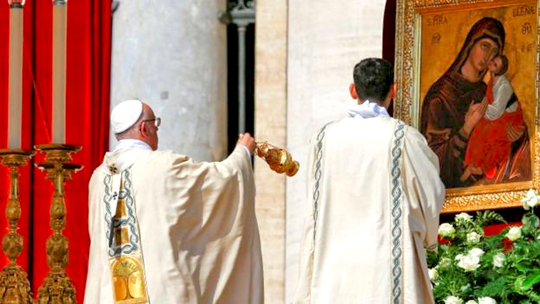
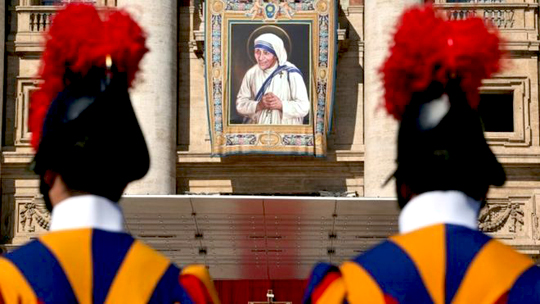
Vatican City, Sep 4: Pope Francis on Sunday declared revered nun Mother Teresa a saint in a canonization mass at St Peter's square.

"For the honour of the Blessed Trinity... we declare and define Blessed Teresa of Calcutta (Kolkata) to be a Saint and we enroll her among the Saints, decreeing that she is to be venerated as such by the whole Church," the pontiff said in Latin.

teresav 5

For Francis, Mother Teresa put into action his ideal of the church as a merciful "field hospital" for the poorest of the poor, those suffering both material and spiritual poverty.

The elevation of one of the icons of 20th Century Christianity came a day before the 19th anniversary of her death in Kolkata, where she spent nearly four decades working with the dying and the destitute.

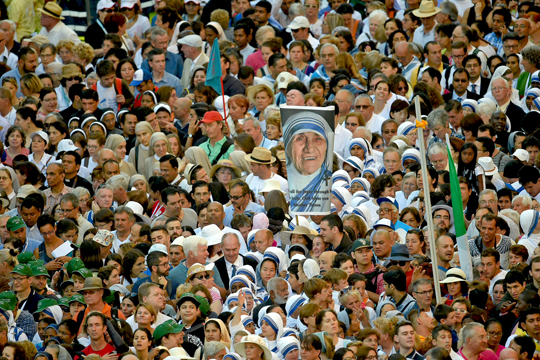
Tens of thousands of pilgrims — rich and poor, powerful and homeless — filled St. Peter's Square on Sunday for the canonization of Mother Teresa, the tiny nun who cared for the world's most destitute and became an icon of a Catholic Church that goes to the peripheries to find lost souls.

Throughout the night, pilgrims prayed at vigils in area churches and flocked before dawn to the Vatican to try to get a good spot for the Mass being celebrated under a searing hot sun and blue skies.

"Her heart, she gave it to the world," said Charlotte Samba, a 52-year-old mother of three who travelled with a church group from Gabon for the Mass. "Mercy, forgiveness, good works: It is the heart of a mother for the poor."

One group of 40 Indian nationals traveled from Macerata, Italy to honor a woman given India's highest civilian and humanitarian awards for her work in the slums of Kolkata. Another group of 100 drove from Kosovo toting a banner that read: "Mother Teresa: Pray for Us."

In addition, 13 heads of state and government led official delegations while 1,500 homeless people invited by Pope Francis had VIP seats and were going to be treated by the pope to a Neapolitan pizza lunch in the Vatican auditorium afterward.

While Francis is clearly keen to hold Mother Teresa up as a model for her joyful dedication to society's outcasts, he is also recognizing holiness in a nun who lived most of her adult life in spiritual agony sensing that God had abandoned her.

According to correspondence that came to light after she died in 1997, Mother Teresa experienced what the church calls a "dark night of the soul" — a period of spiritual doubt, despair and loneliness that many of the great mystics experienced. In Mother Teresa's case, it lasted for nearly 50 years — an almost unheard of trial.

For the Rev. Brian Kolodiejchuk, the Canadian priest who spearheaded Mother Teresa's saint-making campaign, the revelations were further confirmation of Mother Teresa's heroic saintliness. He said that by canonizing her, Francis is recognizing that Mother Teresa not only shared the material poverty of the poor but the spiritual poverty of those who feel "unloved, unwanted, uncared for."

"What she described as the greatest poverty in the world today (of feeling unloved) she herself was living in relationship with Jesus," he said in an interview on the eve of the canonization.

Francis has in many ways modeled his papacy on Mother Teresa's simple lifestyle and selfless service to the poor: He eschewed the Apostolic Palace for a hotel room, he has made welcoming migrants and the poor a hallmark and has fiercely denounced today's "throwaway" culture that discards the unborn, the sick and the elderly with ease.

Sunday's festivities honoring Mother Teresa weren't limited to Rome: In Kolkata, where Mother Teresa spent a lifetime dedicated to the poor, a special Sunday Mass was held at the order's Mother House. Volunteers and admirers converged on Mother House to watch the canonization ceremony, which was being broadcast on giant TV screens in Kolkata and elsewhere.

Sisters of Charity volunteers planned to distribute food to the poor nearby after the ceremony, and community meals were being served across Catholic parishes in India on Sunday — a symbolic reference to Mother Teresa's lifetime of service to humanity, said the Rev. Savarimuthu Sankar of the archdiocese of New Delhi.

"Let the example of Mother Teresa inspire all of us to dedicate ourselves to the welfare of mankind," said Indian President Pranab Mukherjee.

Ceremonies were also expected in Skopje, Macedonia, where Mother Teresa was born, and also in Albania and Kosovo, where people of her same ethnic Albanian background live.

Born Agnes Gonxhe Bojaxhiu on August 26, 1910, Mother Teresa came to India in 1929 as a sister of the Loreto order. In 1946, she received what she described as a "call within a call" to found a new order dedicated to caring for the most unloved and unwanted, the "poorest of the poor."

teresav 1

teresav 2

teresav 3

teresav 4

Comments

TRUE INDIAN
 - 
Sunday, 4 Sep 2016

Rss and sanghis exposed. Saint mother theresa and sita mata both used to wear hijab.

And hindus also put hijab on sita matas idols too.

MSS
 - 
Sunday, 4 Sep 2016

Recognizing sainthood is OK.

First of religion does not need innovation. Because the religion means to way of life as per the command of GOD(1 single God).

But why in the name of TRINITY, when there is only 1 God and none others have the capability of God. Jesus himself said, don't worship me. Then no question of duality of trinity. In trinity the other 2 for Christians are, Holy Spirirt and Jesus. Christians associated these 2 with the real God.
Both the 2 are most respected, but they don't at all equal to God.
Trinity is the invention of people, it is not by the God.

Therefore trinity does not deserve worship. They deserve definitely a worship. But one and only who deserve for worship is the God, who is the GOD for all religions.

Add new comment

  • Coastaldigest.com reserves the right to delete or block any comments.
  • Coastaldigset.com is not responsible for its readers’ comments.
  • Comments that are abusive, incendiary or irrelevant are strictly prohibited.
  • Please use a genuine email ID and provide your name to avoid reject.
News Network
May 31,2020

Bengaluru, May 31: Karnataka government on Sunday issued guidelines, which will come into force from June 1 and continue till June 30.

According to the new guidelines, religious places and places of worship for the public, hotels, restaurants and other hospitality services, and shopping malls will be permitted to open from June 8.

Union Ministry of Home Affairs (MHA) on Saturday announced new guidelines for phased re-opening of "all activities outside containment zones for the next one month beginning June 1.

In an order, Karnataka government said that phased re-opening of areas outside the containment zones, all activities will be permitted, except the following, which will be allowed, with the stipulation of following Standard Operating Procedures (SOPs) to be prescribed by the Ministry of Health and Family Welfare (MoHFW).

PHASE I

The activities will be allowed with effect from June 8 at religious places/places of worship for public, hotels, restaurants, and other hospitality services, shopping malls.

PHASE II

For the opening of schools, colleges, educational/training/ coaching institutions, the State government will hold consultations at the institution level with parents and other stakeholders. Based on the feedback, a decision on the re-opening of these institutions will be taken in the month of July.

PHASE III

Based on the assessment of the situation, dates for re-starting activities will be decided -- international air travel of passengers, except as permitted by MHA, Metro Rail, cinema halls, gymnasiums, swimming pools, entertainment parks, theatres, bars and auditoriums, assembly halls and similar places, social/political/spoils/ entertainment/academic/cultural/religious functions and other large congregations.

The State government said that it will follow the MHA's national directives for the coronavirus management, including compulsory use of face masks and social distancing norms.

"Face coverings are compulsory in public places, workplaces and during transport. Individuals must maintain a minimum distance of 6 feet in public places. Shops will ensure physical distancing among customers and will not allow more than 5 persons at a time," read the directives issued by the MHA.

In the order, State government has said that night curfew will continue to remain in force on the movement of individuals for all non-essential activities outside containment zones till June 30.

Lockdown limited to Containment Zones

* Lockdown shall continue to remain in force in the Containment Zones till June 30.

* Containment Zones will be demarcated by the district authorities after taking into consideration the guidelines of Department of Health and Family Welfare, Government of Karnataka.

* In the Containment Zones, only essential activities shall be allowed. There shall be strict perimeter control to ensure that there is no movement of people in or out of these zones, except for medical emergencies and for maintaining a supply of essential goods and services.

* In the Containment Zones, there shall be intensive contact tracing, house-to-house surveillance, and other clinical interventions, as required. Guidelines of the Department of Health and Family Welfare, Government of Karnataka shall be taken into consideration for the above purpose.

* District authorities/BBMP authorities may also identify buffer zones outside the Containment Zones, where new cases are more likely to occur. Within the buffer zones, restrictions, as considered necessary, may be put in place by the District authorities.

Movement of persons, goods

* There shall be no restriction on inter-State and intra-State movement of persons and goods. No separate permission/approval/e-permit will be required for such movements.

* Based on reasons of public health and assessment of the prevalence of Covid-19 in various States separate orders will be issued by the Health and Family Welfare Department regarding the inter-state movement of persons to Karnataka.

* Movement by passenger trains and Shramik special trains; domestic passenger air travel; movement of Indian Nationals stranded outside the country and of specified persons to travel abroad; evacuation of foreign nationals; and sign-on and sign-off of Indian seafarers will continue to be regulated as per SOPs issued.

The State Government in its guidelines advised persons above 65 years of age, persons with co-morbidities, pregnant women, and children below the age of 10 years, to stay at home, except for essential and health purposes.

Guidelines for Aarogya Setu App

* Aarogya Setu enables early identification of potential risk of infection, and thus acts as a shield for individuals and the community.

* With a view to ensuring safety in offices and workplaces, employers on best effort basis should ensure that Aarogya Sew is installed by all employees having compatible mobile phones.

* District authorities and BBMP Authorities may advise individuals to install the Aarogya Setu application on compatible mobile phones and regularly update their health status on the app. This will facilitate timely provision of medical attention to those individuals who are at risk.

Union Ministry of Home Affairs (MHA) on Saturday said that lockdown will continue in containment zones till June 30 and only essential activities will be allowed in those areas.

"Lockdown shall continue to remain in force in the containment zones till 30 June. In the containment zones, only essential activities shall be allowed. There shall be strict perimeter control to ensure that there is no movement of people in or out of these zones, except for medical emergencies and for maintaining the supply of essential goods and services. In the containment zones, there shall be intensive contact tracing, house-to-house surveillance, and other clinical interventions, as required," MHA said in its guidelines for #Unlock1.

It also issued new guidelines for phased re-opening of "all activities outside containment zones for the next one month beginning June 1."

Comments

Add new comment

  • Coastaldigest.com reserves the right to delete or block any comments.
  • Coastaldigset.com is not responsible for its readers’ comments.
  • Comments that are abusive, incendiary or irrelevant are strictly prohibited.
  • Please use a genuine email ID and provide your name to avoid reject.
News Network
March 25,2020

Bengaluru, Mar 25: Bengaluru Police Commissioner Bhaskar Rao on Wednesday called a meeting of online, e-commerce food, medicine, groceries or animal products delivery aggregators at his office in wake of situation arising out of lockdown imposed in the entire country due to coronavirus epidemic.

The Police Commissioner has appealed one representative from each agency to join him in the meeting at 7 pm.

"I have called a meeting of online, e-commerce food, medicine, groceries, vegetables/fruits or animal products delivery aggregators today at 7 pm at my office at Infantry Road, Bengaluru," said Rao.

"One representative from each agency may please come. We promise all cooperation, please come," he said.
The Indian Council of Medical Research (ICMR) on Wednesday confirmed 539 positive cases of coronavirus in the country.

Prime Minister Narendra Modi had on Tuesday announced a 21-day lockdown in the entire country effective from midnight to deal with the spread of coronavirus, saying that "social distancing" is the only option to deal with the disease, which spreads rapidly.

Comments

Add new comment

  • Coastaldigest.com reserves the right to delete or block any comments.
  • Coastaldigset.com is not responsible for its readers’ comments.
  • Comments that are abusive, incendiary or irrelevant are strictly prohibited.
  • Please use a genuine email ID and provide your name to avoid reject.
News Network
February 22,2020

Bengaluru, Feb 22: Thanks to joint efforts by the Protector of Emigrants in Bengaluru and Indian Embassy in Qatar, a 26-year-old woman from Karnataka who had been kept in confinement in Qatar has been rescued and brought back to India.

Anupama (name changed) from Holenarasipura in Hassan district arrived in Bengaluru on Thursday night. She was allegedly locked up in a house for 14 days, restrained from using a mobile and wasn't fed. There were three other women with her. On the midnight of February 12, they broke the window panes and fled before contacting local police.

Anupama, a diploma graduate in computer science, was jobless and her friend working in Kuwait suggested she try for a job abroad. She contacted an agency based in Chikkamagaluru which offered her a nanny's job in Qatar. After document verification, the agency demanded she pay Rs 2 lakh but she said she didn't have that kind of money.

The agency sent Anupama on a visitor visa but told her if questioned by immigration officials, she must claim she was visiting her sister. They also gave her a return ticket.

As Anupama was travelling abroad for the first time, she said she was ignorant about several things.

On January 12, Anupama left Bengaluru. But as she reached Qatar, all her documents, including passport, were confiscated by the agency. Her return ticket was cancelled and she was sent to a house to work as babysitter-cum-cook for Rs 30,000. She lived with four other maids in the same house, where they were made to work for 16-18 hours a day.

"I used to wake up around 5.30am every day and had to prepare breakfast for the employers by 6.30am. My work would end around 11pm every day. We never even got time to eat," Anupama told media on Friday. Four days into work, Anupama's nose started bleeding. However, the employers cared little and insisted she continue to work. After 18 days, she requested her employers that she be relieved.

The agency sent her to a house where three women were already present and locked her up with them. "They used to give us a glass of raw rice, an onion, tomato and potato to cook for ourselves. While we got rice every day, we had to use the vegetables for three days. We were not supposed to use mobiles or go out. Two people were monitoring us," she recalled.

Anupama and the others decided to approach police but for that they needed to escape. Around 1.30am on February 12, the four women managed to break window panes and jumped out. They ran for more than a kilometre and managed to approach police, who summoned the agency and got the women to speak to their families.

Anupama called her brother-in-law, who approached the Protector of Emigrants office in Koramangala, Bengaluru. Shubham Singh, PoE in Bengaluru, said they took up the issue with the Indian Embassy in Qatar, which immediately got in touch with Qatar police. Anupama said, "We were kept in prison for a couple of days and were sent to the deportation centre later."

Meanwhile, the Indian embassy got the agency to return the women's documents. However, the agents did not pay their salaries. Two of the women were sent to Hyderabad and the third to Kerala. On Friday, Anupama met Singh at his office, where her statement was recorded. "We have started the process of initiating action against the agency in India," he said.

Comments

Add new comment

  • Coastaldigest.com reserves the right to delete or block any comments.
  • Coastaldigset.com is not responsible for its readers’ comments.
  • Comments that are abusive, incendiary or irrelevant are strictly prohibited.
  • Please use a genuine email ID and provide your name to avoid reject.