Mother Teresa declared saint by Pope Francis

September 4, 2016

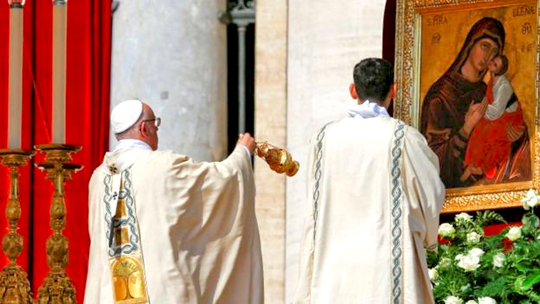
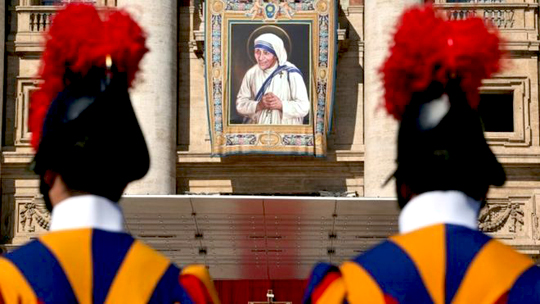
Vatican City, Sep 4: Pope Francis on Sunday declared revered nun Mother Teresa a saint in a canonization mass at St Peter's square.

"For the honour of the Blessed Trinity... we declare and define Blessed Teresa of Calcutta (Kolkata) to be a Saint and we enroll her among the Saints, decreeing that she is to be venerated as such by the whole Church," the pontiff said in Latin.

teresav 5

For Francis, Mother Teresa put into action his ideal of the church as a merciful "field hospital" for the poorest of the poor, those suffering both material and spiritual poverty.

The elevation of one of the icons of 20th Century Christianity came a day before the 19th anniversary of her death in Kolkata, where she spent nearly four decades working with the dying and the destitute.

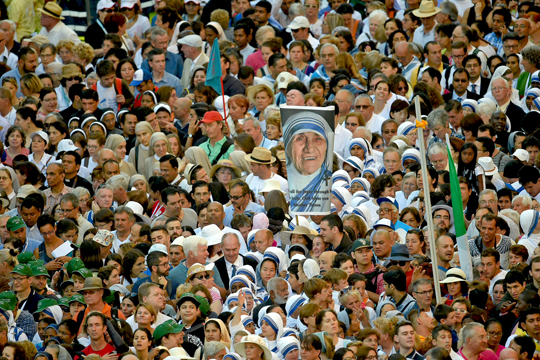
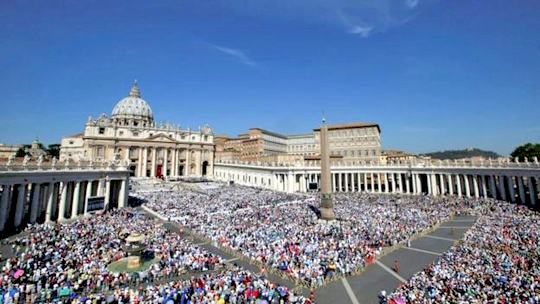
Tens of thousands of pilgrims — rich and poor, powerful and homeless — filled St. Peter's Square on Sunday for the canonization of Mother Teresa, the tiny nun who cared for the world's most destitute and became an icon of a Catholic Church that goes to the peripheries to find lost souls.

Throughout the night, pilgrims prayed at vigils in area churches and flocked before dawn to the Vatican to try to get a good spot for the Mass being celebrated under a searing hot sun and blue skies.

"Her heart, she gave it to the world," said Charlotte Samba, a 52-year-old mother of three who travelled with a church group from Gabon for the Mass. "Mercy, forgiveness, good works: It is the heart of a mother for the poor."

One group of 40 Indian nationals traveled from Macerata, Italy to honor a woman given India's highest civilian and humanitarian awards for her work in the slums of Kolkata. Another group of 100 drove from Kosovo toting a banner that read: "Mother Teresa: Pray for Us."

In addition, 13 heads of state and government led official delegations while 1,500 homeless people invited by Pope Francis had VIP seats and were going to be treated by the pope to a Neapolitan pizza lunch in the Vatican auditorium afterward.

While Francis is clearly keen to hold Mother Teresa up as a model for her joyful dedication to society's outcasts, he is also recognizing holiness in a nun who lived most of her adult life in spiritual agony sensing that God had abandoned her.

According to correspondence that came to light after she died in 1997, Mother Teresa experienced what the church calls a "dark night of the soul" — a period of spiritual doubt, despair and loneliness that many of the great mystics experienced. In Mother Teresa's case, it lasted for nearly 50 years — an almost unheard of trial.

For the Rev. Brian Kolodiejchuk, the Canadian priest who spearheaded Mother Teresa's saint-making campaign, the revelations were further confirmation of Mother Teresa's heroic saintliness. He said that by canonizing her, Francis is recognizing that Mother Teresa not only shared the material poverty of the poor but the spiritual poverty of those who feel "unloved, unwanted, uncared for."

"What she described as the greatest poverty in the world today (of feeling unloved) she herself was living in relationship with Jesus," he said in an interview on the eve of the canonization.

Francis has in many ways modeled his papacy on Mother Teresa's simple lifestyle and selfless service to the poor: He eschewed the Apostolic Palace for a hotel room, he has made welcoming migrants and the poor a hallmark and has fiercely denounced today's "throwaway" culture that discards the unborn, the sick and the elderly with ease.

Sunday's festivities honoring Mother Teresa weren't limited to Rome: In Kolkata, where Mother Teresa spent a lifetime dedicated to the poor, a special Sunday Mass was held at the order's Mother House. Volunteers and admirers converged on Mother House to watch the canonization ceremony, which was being broadcast on giant TV screens in Kolkata and elsewhere.

Sisters of Charity volunteers planned to distribute food to the poor nearby after the ceremony, and community meals were being served across Catholic parishes in India on Sunday — a symbolic reference to Mother Teresa's lifetime of service to humanity, said the Rev. Savarimuthu Sankar of the archdiocese of New Delhi.

"Let the example of Mother Teresa inspire all of us to dedicate ourselves to the welfare of mankind," said Indian President Pranab Mukherjee.

Ceremonies were also expected in Skopje, Macedonia, where Mother Teresa was born, and also in Albania and Kosovo, where people of her same ethnic Albanian background live.

Born Agnes Gonxhe Bojaxhiu on August 26, 1910, Mother Teresa came to India in 1929 as a sister of the Loreto order. In 1946, she received what she described as a "call within a call" to found a new order dedicated to caring for the most unloved and unwanted, the "poorest of the poor."
teresav 1

teresav 2

teresav 3

teresav 4

Comments

TRUE INDIAN
 - 
Sunday, 4 Sep 2016

Rss and sanghis exposed. Saint mother theresa and sita mata both used to wear hijab.

And hindus also put hijab on sita matas idols too.

MSS
 - 
Sunday, 4 Sep 2016

Recognizing sainthood is OK.

First of religion does not need innovation. Because the religion means to way of life as per the command of GOD(1 single God).

But why in the name of TRINITY, when there is only 1 God and none others have the capability of God. Jesus himself said, don't worship me. Then no question of duality of trinity. In trinity the other 2 for Christians are, Holy Spirirt and Jesus. Christians associated these 2 with the real God.
Both the 2 are most respected, but they don't at all equal to God.
Trinity is the invention of people, it is not by the God.

Therefore trinity does not deserve worship. They deserve definitely a worship. But one and only who deserve for worship is the God, who is the GOD for all religions.

Add new comment

  • Coastaldigest.com reserves the right to delete or block any comments.
  • Coastaldigset.com is not responsible for its readers’ comments.
  • Comments that are abusive, incendiary or irrelevant are strictly prohibited.
  • Please use a genuine email ID and provide your name to avoid reject.
News Network
March 14,2020

Mangaluru, Mar14 (UNI) In view of prevailing Global situation, Coast Guard Karnataka took initiatives for creating awareness among the CG Personnel, Civilian Staff and Families on precautions so that the contagious Coronavirus be prevented.

For the benefit of CG personnel posters have been displayed at entrance and prominent places in office premises and residential areas including the CG KG School.

All CG Personnel and their families were advised to frequently wash their hands with sanitiser or soap and water at regular intervals. They are also requested to cover their nose and mouth with handkerchief or tissue while coughing or sneezing. It is advised to consult doctor if there is fever, difficulty in breathing, coughing, all being symptoms of Corona Virus.

Comments

Add new comment

  • Coastaldigest.com reserves the right to delete or block any comments.
  • Coastaldigset.com is not responsible for its readers’ comments.
  • Comments that are abusive, incendiary or irrelevant are strictly prohibited.
  • Please use a genuine email ID and provide your name to avoid reject.
Muhammad Abdullah Javed
May 20,2020

One of the distinguish features of the Noble Quran is that it presents different sorts of classifications. It is quite evident as one of the names of the Quran is Furqan that is it differentiates between things through its unique style of classification. The Quran openly proclaims the difference between right and wrong, truth and falsehood, literate and illiterate, light and darkness and so on. The system of Quranic taxonomy has a pivotal element with regard to ranking of human beings. It classifies them into two groups, one, who is honorable in the sight of their Creator and the second, disliked by Him.

This Quranic approach of classification is quite genuine, void of all sorts of bias. Since humans have no say in their birth, color or region, therefore the Quran doesn’t recognize these parameters to classify two groups of people.

The crux of Quranic taxonomy rests with the human ability which has been equally distributed among all humans. In terms of abilities to perform, barring those tasks performed with exceptional talents, all humans are equal. This is where Quran draws a line and specify who is most honorable in the sight of their Creator, it says:

 O mankind, We created you from one man and one woman, and then divided you into nations and tribes so that you may recognize one another. Indeed, the most honorable among you in the sight of Allah is he who is the most pious of you. Surely, Allah is All-knowing, All-Wise. (Chapter 49, Verse 13).

Criterion of judgement

To be most righteous in the sight of God, one has to be of pious nature. The Quran uses term Taqwa (a sense of distinguishing between right and wrong, piety) to exemplify the pious nature. It further specifies that the source of pious nature - Taqwa is an inherent quality of human beings. Along with the faculties of hearing, seeing and speaking they have been bestowed with (Taqwa) the criterion of distinguishing between virtues and vices, it has been mentioned in the Quran as:

And by the human self and by Him Who balanced it, then inspired it with its wickedness and piety (Chapter 91, Verses 7 & 8).

Good deeds and human nature

With the advent of human race on earth, the equation has been set in simple terms. Humans have to be obedient to their Creator by means of using their intellect, smart enough to use their ability to judge between right and wrong and spend their lives in performing good deeds. For this very reason God has created life and death:

Who created death and life that He may try you to see which of you is best in deeds, and He is All-Mighty as well as All-Forgiving (Chapter 67, Verse 2)

Since life is all about performing good deeds, the ability to perform any good action has been made as natural as recognizing any color with naked eyes. It is within the reach of a person to identify the difference between colors, so is his criterion of judgement that tells what to perform and what to refrain from?

Good actions have been synchronized with human nature whereas evil deeds are quite detrimental, that’s why there is a universal consensus over the conception of virtues and vices. No one can dare to differ with virtues like truth, justice and honesty etc, and no one appreciates vices like falsehood, violations and corruption. With this inherent ability of humans to identify good and bad, the concept of virtues and vices has been described with the same bent of human intellect, there is no philosophical and ideological kind of description to tell what truth and falsehood are, it is as simple as this:

Prophet Muhammad (peace be upon him) said: Give up what is doubtful to you for that which is not doubtful; for truth is peace of mind and falsehood is doubt (Tirmidhi)

Highway of actions

The Quran presents a highway of actions for everyone who believes in it and intend to be most honorable in the sight of the Creator. For each and every day, there is a definite plan of action to go ahead with it to please the Creator. Again, for every week and month, there are clear specifications with regard to individual and collective actions. So no place for claims and reservations, no place for any excuse either, things have been made clear. For a person to be honored, he has to be man of deeds, that’s it. Every person has fair chances of performing better, as the life has been given, criterion of judgement between right and wrong has been given, and plan of action has been provided with. Now one has to energize himself for everyday action and try to set right the intention.

Difference in human efficiencies

No doubt there are differences in human abilities and efficiencies, one may argue about the quality and magnitude of actions. Those who are of high efficiency may perform well and those who are inefficient may not? True, to convince what Quran emphasizes is, God doesn’t look at the magnitude of an action, rather He sees with what intention in what circumstances it has been performed? If any person keep fast in scorching heat for more than 16 hours a day will get high rewards compare to the one who fast less than 10 hours a day at a cold place. Again, if the intention is to please the God, than every action, no matter how small or big it is in its scale, will fetch rich dividends. A poor’s donation of few rupees will be equal in rewards as compare to what a millionaire gets by donating thousands of rupees from his enormous wealth. The act of charity has demanded sacrifice; both of them have sacrificed in accordance with their capacities. Therefore upon asking whose charity is noble in the sight of God, the Prophet Muhammad (pbuh) said: The charity of poor person who tries hard to get few rupees from his hard earn money to donate in the way of God (NasaiBook of Hadith).

The Quranic taxonomy of human is quite justifiable as every human bear testimony to its genuine and unbiased classification through what we term as actions. Therefore the world has to witness a race between men and women to see who can compete with others in order to please their Creator?

Whosoever acts righteously – whether a man or a woman and embraces belief, We will surely grant him a good life; and will surely grant such persons their reward according to the best of their deeds. (Chapter 16, Verse 97)

God-oriented actions, privilege for the Humanity

It’s very unpleasant to notice that in today’s world the parameters like statuses, resources and wealth have been regarded as privilege and honor for both humans and their societies. No doubt they are, but not at the cost of losing the very essence of human nature and sacrificing its interest. Today’s advancements speak of this dark phase where the height of inventions and discoveries touching the skies while the dignity and honor of humans have gone to the lowest of the low. The ever increasing poverty, hunger, untimely deaths, different forms of corruption in the land, violation of human rights are just to remind a few. The presence of rich and poor, highs and lows in the society speaks of disparity of actions, lack of selfless service and hearts void of God’s love and fear.

The beauty of humanity is to remain in the service of God and always stand on the toes to help those who are in need. This God-oriented action enables every doer to be dear to his God as the classification of good and the bad is purely based on the actions performed for the sake of the Creator:

Everyone is assigned a rank according to his deed. Your Lord is not heedless of what they do (Chapter 6, Verse 132).


Muhammad Abdullah Javed is the Director of AJ Academy for Research & Development. He can be reached at [email protected]

Comments

Add new comment

  • Coastaldigest.com reserves the right to delete or block any comments.
  • Coastaldigset.com is not responsible for its readers’ comments.
  • Comments that are abusive, incendiary or irrelevant are strictly prohibited.
  • Please use a genuine email ID and provide your name to avoid reject.
News Network
January 17,2020

New Delhi, Jan 17: The Supreme Court on Friday closed the monitoring of the killing of rationalist M M Kalburgi in 2015 in Dharwad.

A bench of Justices R F Nariman and S Ravindra Bhat noted that the charge sheet has already been filed and the matter was assigned to the sessions court. The court, however, noted two accused had absconded and could not be arrested till date, according to reports.

Senior advocate Devadatt Kamat, appearing for the Karnataka government, submitted that the High Court had also stopped monitoring of the matter.

The top court had in early last year directed that the Karnataka High Court's Dharwad bench to monitor the probe. The Karnataka police SIT, which investigated Gauri Lankesh case and filed the charge sheet, was allowed to take over the Kalburgi case.

Umadevi, in her 2017 plea, drew a parallel between Kalburgi's murder and killings of Narendra Dabholkar and Comrade Govind Pansare in Maharashtra and sought an SIT probe by a retired Supreme Court or a High Court judge. She urged the top court to monitor the probe till it reached its logical conclusion as there was no progress in the investigation conducted so far by the Karnataka police.

The court had earlier sought to know if there was a "common thread" in murder cases of Communist leader Pansare and rationalist Dabholkar in Maharashtra, and Kannada writer Kalburgi and journalist-activist Gauri Lankesh in Karnataka.

Comments

Add new comment

  • Coastaldigest.com reserves the right to delete or block any comments.
  • Coastaldigset.com is not responsible for its readers’ comments.
  • Comments that are abusive, incendiary or irrelevant are strictly prohibited.
  • Please use a genuine email ID and provide your name to avoid reject.