Mother Teresa declared saint by Pope Francis

September 4, 2016

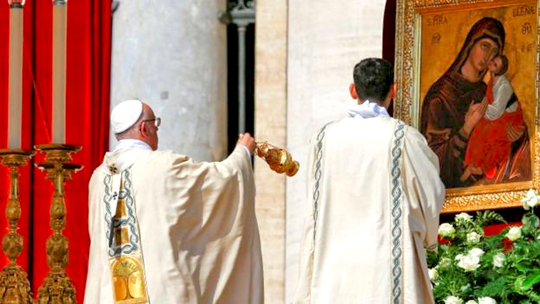
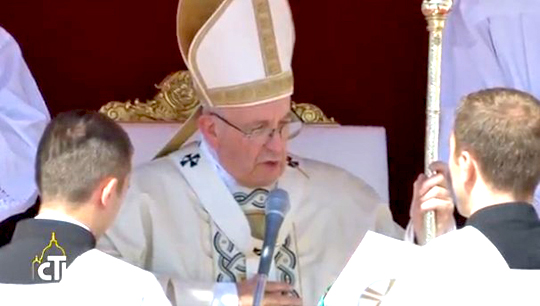
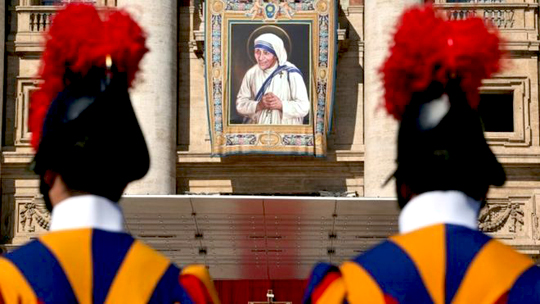
Vatican City, Sep 4: Pope Francis on Sunday declared revered nun Mother Teresa a saint in a canonization mass at St Peter's square.

"For the honour of the Blessed Trinity... we declare and define Blessed Teresa of Calcutta (Kolkata) to be a Saint and we enroll her among the Saints, decreeing that she is to be venerated as such by the whole Church," the pontiff said in Latin.
teresav 5

For Francis, Mother Teresa put into action his ideal of the church as a merciful "field hospital" for the poorest of the poor, those suffering both material and spiritual poverty.

The elevation of one of the icons of 20th Century Christianity came a day before the 19th anniversary of her death in Kolkata, where she spent nearly four decades working with the dying and the destitute.

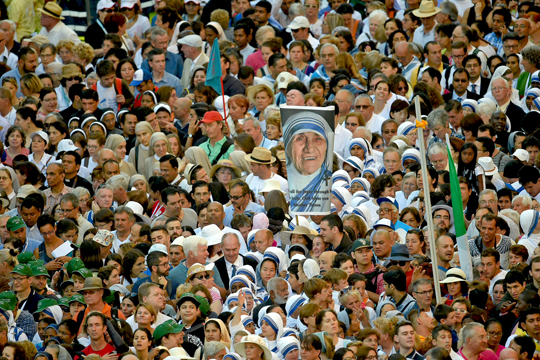
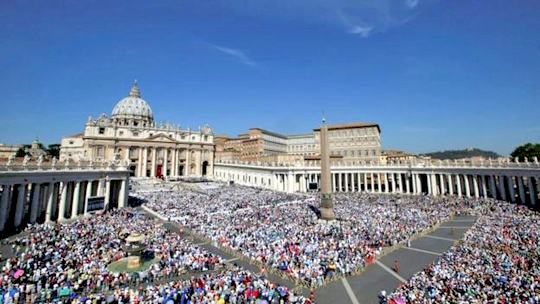
Tens of thousands of pilgrims — rich and poor, powerful and homeless — filled St. Peter's Square on Sunday for the canonization of Mother Teresa, the tiny nun who cared for the world's most destitute and became an icon of a Catholic Church that goes to the peripheries to find lost souls.

Throughout the night, pilgrims prayed at vigils in area churches and flocked before dawn to the Vatican to try to get a good spot for the Mass being celebrated under a searing hot sun and blue skies.

"Her heart, she gave it to the world," said Charlotte Samba, a 52-year-old mother of three who travelled with a church group from Gabon for the Mass. "Mercy, forgiveness, good works: It is the heart of a mother for the poor."

One group of 40 Indian nationals traveled from Macerata, Italy to honor a woman given India's highest civilian and humanitarian awards for her work in the slums of Kolkata. Another group of 100 drove from Kosovo toting a banner that read: "Mother Teresa: Pray for Us."

In addition, 13 heads of state and government led official delegations while 1,500 homeless people invited by Pope Francis had VIP seats and were going to be treated by the pope to a Neapolitan pizza lunch in the Vatican auditorium afterward.

While Francis is clearly keen to hold Mother Teresa up as a model for her joyful dedication to society's outcasts, he is also recognizing holiness in a nun who lived most of her adult life in spiritual agony sensing that God had abandoned her.

According to correspondence that came to light after she died in 1997, Mother Teresa experienced what the church calls a "dark night of the soul" — a period of spiritual doubt, despair and loneliness that many of the great mystics experienced. In Mother Teresa's case, it lasted for nearly 50 years — an almost unheard of trial.

For the Rev. Brian Kolodiejchuk, the Canadian priest who spearheaded Mother Teresa's saint-making campaign, the revelations were further confirmation of Mother Teresa's heroic saintliness. He said that by canonizing her, Francis is recognizing that Mother Teresa not only shared the material poverty of the poor but the spiritual poverty of those who feel "unloved, unwanted, uncared for."

"What she described as the greatest poverty in the world today (of feeling unloved) she herself was living in relationship with Jesus," he said in an interview on the eve of the canonization.

Francis has in many ways modeled his papacy on Mother Teresa's simple lifestyle and selfless service to the poor: He eschewed the Apostolic Palace for a hotel room, he has made welcoming migrants and the poor a hallmark and has fiercely denounced today's "throwaway" culture that discards the unborn, the sick and the elderly with ease.

Sunday's festivities honoring Mother Teresa weren't limited to Rome: In Kolkata, where Mother Teresa spent a lifetime dedicated to the poor, a special Sunday Mass was held at the order's Mother House. Volunteers and admirers converged on Mother House to watch the canonization ceremony, which was being broadcast on giant TV screens in Kolkata and elsewhere.

Sisters of Charity volunteers planned to distribute food to the poor nearby after the ceremony, and community meals were being served across Catholic parishes in India on Sunday — a symbolic reference to Mother Teresa's lifetime of service to humanity, said the Rev. Savarimuthu Sankar of the archdiocese of New Delhi.

"Let the example of Mother Teresa inspire all of us to dedicate ourselves to the welfare of mankind," said Indian President Pranab Mukherjee.

Ceremonies were also expected in Skopje, Macedonia, where Mother Teresa was born, and also in Albania and Kosovo, where people of her same ethnic Albanian background live.

Born Agnes Gonxhe Bojaxhiu on August 26, 1910, Mother Teresa came to India in 1929 as a sister of the Loreto order. In 1946, she received what she described as a "call within a call" to found a new order dedicated to caring for the most unloved and unwanted, the "poorest of the poor."
teresav 1

teresav 2

teresav 3

teresav 4

Comments

TRUE INDIAN
 - 
Sunday, 4 Sep 2016

Rss and sanghis exposed. Saint mother theresa and sita mata both used to wear hijab.

And hindus also put hijab on sita matas idols too.

MSS
 - 
Sunday, 4 Sep 2016

Recognizing sainthood is OK.

First of religion does not need innovation. Because the religion means to way of life as per the command of GOD(1 single God).

But why in the name of TRINITY, when there is only 1 God and none others have the capability of God. Jesus himself said, don't worship me. Then no question of duality of trinity. In trinity the other 2 for Christians are, Holy Spirirt and Jesus. Christians associated these 2 with the real God.
Both the 2 are most respected, but they don't at all equal to God.
Trinity is the invention of people, it is not by the God.

Therefore trinity does not deserve worship. They deserve definitely a worship. But one and only who deserve for worship is the God, who is the GOD for all religions.

Add new comment

  • Coastaldigest.com reserves the right to delete or block any comments.
  • Coastaldigset.com is not responsible for its readers’ comments.
  • Comments that are abusive, incendiary or irrelevant are strictly prohibited.
  • Please use a genuine email ID and provide your name to avoid reject.
News Network
June 18,2020

Bengaluru, Jun 18: The Karnataka police has arrested a German national wanted for kidnapping and causing bodily harm to a person in his home country, an official said on Wednesday. The person was also found to be overstaying on an expired visa, which police said that it appeared that the visa had been tampered with to look more current.

"On receipt of credible information by the CID Interpol Division officers, the Red Corner Notice subject, the German national Alexander Bruno Wehnelt, was traced at Hulimangala village," a police official told media persons.

Hulimangala is on the outskirts of Bengaluru city.

Alexander, 55, escaped from Germany and took shelter in Bengaluru.

The Interpol Division of CBI NCB (Central Bureau of Intelligence, Narcotics Control Bureau) in New Delhi had communicated to the Interpol liaison officer in Karnataka's Criminal Investigation Department (CID) about Alexander, directing extensive search measures to trace the criminal at large.

The Narcotics Control Bureau of Wiesbaden in Germany was on the hunt for Wehnelt for the crimes he committed in 2015, and have finally found him five years later.

"A special team of officers was constituted by the CID - Interpol division under the supervision of ADGP (Additional Director General of Police) B. Dayananda and the Interpol liaison officer and efforts were made to trace the subject," said the official.

On Monday, the police received credible information leading to his arrest.

"It was learnt that his visa had expired in 2016 and he tried to show a visa which was issued in December 2019 which had expired on Saturday, June 13," said the official.

Prima facie, it appeared that Alexander had tampered with his visa and the police are probing on that front as well.

He was handed over to Hebbagodi Police Station in Bengaluru Urban, for his overstay and a criminal case has been registered against him, under the Foreigners Act.

Comments

Add new comment

  • Coastaldigest.com reserves the right to delete or block any comments.
  • Coastaldigset.com is not responsible for its readers’ comments.
  • Comments that are abusive, incendiary or irrelevant are strictly prohibited.
  • Please use a genuine email ID and provide your name to avoid reject.
News Network
May 27,2020

In a development which highlights the diversity in the United Kingdom’s legal system, a 40-year-old Muslim woman has become the first hijab-wearing judge in the country.

Raffia Arshad, a barrister, was appointed a deputy district judge on the Midlands circuit last week after 17-year career in law.  

She said her promotion was great news for diversity in the world’s most respected legal system. She hopes to be an inspiration to young Muslims.

Ms Arshad, who grew up in Yorkshire, north England, has wanted to work in law since she was 11.

Ms Arshad said the judicial office was looking to promote diversity, but when they appointed her they did not know that she wore the hijab.

‘It’s definitely bigger than me,” she told Metro newspaper. "I know this is not about me.

"It’s important for all women, not just Muslim women, but it is particularly important for Muslim women."

Ms Arshad, a mother of three, has been practising private law dealing with children, forced marriage, female genital mutilation and other cases involving Islamic law for the past 17 years.

She was the first in her family to go to university and has also written a leading text on Islamic family law.

Although the promotion by the Lord Chief Justice was welcome news for her, Ms Arshad said the happiness from other people sharing the news was “far greater”.

“I’ve had so many emails from people, men and women," she said.

"It’s the ones from women that stand out, saying that they wear a hijab and thought they wouldn’t even be able to become a barrister, let alone a judge."

Ms Arshad is regularly the subject of discrimination in the courtroom because of her choice to wear the hijab.

She is sometimes mistaken for a court worker or a client.

Ms Arshad said that recently she was asked by an usher whether she was a client, an interpreter, and even if she were on work experience.

“I have nothing against the usher who said that but it reflects that as a society, even for somebody who works in the courts, there is still this prejudicial view that professionals at the top end don’t look like me,” she said.

A family member once advised her to not wear a hijab at an interview for a scholarship at the Inns of Court School of Law in 2001, warning that it would affect her chances of landing the role.

“I decided that I was going to wear my headscarf because for me it’s so important to accept the person for who they are," Ms Arshad said.

"And if I had to become a different person to pursue my profession, it’s not something I wanted.”

The joint heads of St Mary’s Family Law Chambers said they were “delighted” to hear the news of her appointment.

“Raffia has led the way for Muslim women to succeed in the law and at the bar, and has worked tirelessly to promote equality and diversity in the profession,” Vickie Hodges and Judy Claxton said.

“It is an appointment richly deserved and entirely on merit, and all at St Mary’s are proud of her and wish her every success.”

Comments

Add new comment

  • Coastaldigest.com reserves the right to delete or block any comments.
  • Coastaldigset.com is not responsible for its readers’ comments.
  • Comments that are abusive, incendiary or irrelevant are strictly prohibited.
  • Please use a genuine email ID and provide your name to avoid reject.
News Network
January 26,2020

New Delhi, Jan 26: On the occasion of the 71st Republic Day, Karnataka state's tableau depicted the philosophy of Basaveshwara and the concept of Anubhava Mantapa (Centre for Experience), which was the socio-religious centre that existed in the present-day Basava Kalyana of Bidar district in Karnataka.

It is regarded as the first religious parliament in the history of mankind.

This 12th-century centre has a special significance in the history of humanity, as it represents composite culture, philosophy, spirituality, equality among other universal human values.

These values were propagated by the saint and social reformer- Basaveshwara and other sharanas- followers of Basava philosophy of the socio-religious movement.

It is significant that representatives of Anubhava Mantapa were nominated based on their spiritual attainment, regardless of caste, class and sect they belonged and thus discarded the differentiation of human beings as higher or lower, on the basis of birth, occupation and gender.

The front part of the tableau has the replica of Basaveshwara preaching his most cherished value - "Work is Worship".

For Republic Day Parade 2020, a total of 56 tableaux proposals (32 from states/UTs and 24 from Ministries/Departments) were received. Out of these, 22 were shortlisted for participation in the Republic Day Parade 2020.

Comments

Add new comment

  • Coastaldigest.com reserves the right to delete or block any comments.
  • Coastaldigset.com is not responsible for its readers’ comments.
  • Comments that are abusive, incendiary or irrelevant are strictly prohibited.
  • Please use a genuine email ID and provide your name to avoid reject.