Mumbai gets world class airport terminal

January 11, 2014

airport-mumbai

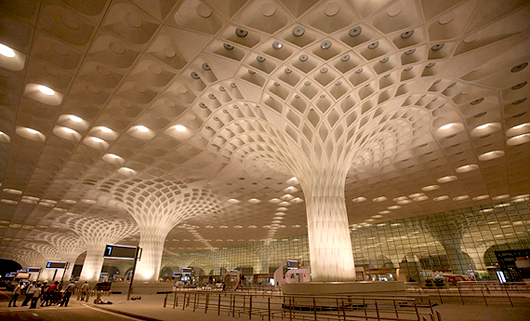
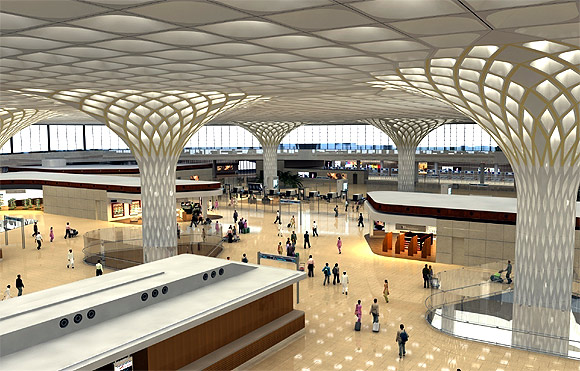
Mumbai, Jan 11: The swanky world class terminal T2 at the Chhatrapati Shivaji International Airport here boasts of arguably the largest art gallery at such a facility, depicting the vibrant mosaic of the country's cultural heritage and varied collage of the city's life.

The four-storey glass marvel, whose design is inspired by a dancing peacock and built at a cost of a whopping Rs 9,800 crore, was today dedicated to the nation by Prime Minister Manmohan Singh.

"This shows our ability to build world class infrastructure. The T2 is truly first class terminal," he said after inaugurating the opulent terminal which would become operational next month.

"It marks the beginning of a new chapter in the growth of civil aviation sector in the country," he said.

The terminal, sprawling across an area of 4.39 lakh sq m, is home to thousands of artefacts and paintings that stretch along a 3-km art wall, aptly named "Jaya He", an eulogy to the rich kaleidoscope of Indian culture.

"Jaya He" gives the visitors a peep into the country's diverse cultural heritage with rows of murals, statues and paintings behind a glass wall. Sparkling fountains and classy installations welcome them.

An attempt has also been made to capture Mumbai's life showcasing its large migrant population hoping to make a living in the city of their dreams.

Another artwork "Tincity", in which a collage of photography and corrugated metal sheets, which dot the city's landscape across numerous slum clusters, have been used, reflects the tenacity of the migrant community living in the bustling city's dark underbelly.

The dancing peacock-themed facility's peacock feather- styled roof leaves one awestruck with special dichroic lights that move with the changing direction of the sun reflecting an array of colours onto the check-in hall's floor.

The new terminal can accommodate 9,900 passengers and has 7 lakh square feet of space for retail, lounges and other travel services.

There are 8 check-in islands, 60 emigration and 72 immigration counters, 52 boarding bridges, 162 lifts, escalators and travellators and landscaping has been done in two lakh sq ft. Besides, it has the largest multi-level covered car parking in the country with a capacity to accommodate 5,000 vehicles.

Shiny granite has been used is 1.85 lakh sq m, large enough to accommodate 25 football pitches.

Mumbai_Airport

Comments

Add new comment

  • Coastaldigest.com reserves the right to delete or block any comments.
  • Coastaldigset.com is not responsible for its readers’ comments.
  • Comments that are abusive, incendiary or irrelevant are strictly prohibited.
  • Please use a genuine email ID and provide your name to avoid reject.
coastaldigest.com web desk
June 16,2020

New Delhi, Jun 16: Despite Prime Minister Narendra Modi led government’s attempt to downplay the border dispute with China, matters have heated up unprecedentedly along the Line of Actual Control (LAC)- the effective Sino-India border in Eastern Ladakh. 

The country has lost three precious lives – an army officer and two soldiers. The last time blood was spilled on the LAC, before the latest episode, was 45 years ago when the Chinese ambushed an Assam Rifles patrol in Tulung La.

India had lost four soldiers on October 20, 1975 in Tulung La, the last time bullets were fired on the India-China border though both the countries witnessed bitter stand-offs later at Sumdorong Chu valley in 1987, Depsang in 2013, Chumar in 2014 and Doklam in 2017.

Between 1962 and 1975, the biggest clash between India and China took place in Nathu La pass in 1967 when reports suggest that around 80 Indian soldiers were killed and many more Chinese personnel.

While three soldiers, including a Commanding Officer, were killed in the latest episode in Galwan Valley, the government describes it as a "violent clash" and does not mention opening fire.

New Delhi described the locality where the 1975 incident took place as "well within" its territory only to be rebuffed by Beijing as "sheer reversal of black and white and confusion of right and wrong".

The Ministry of External Affairs had then said that the Chinese had crossed the LAC and ambushed the soldiers while Beijing claimed the Indians entered their territory and did not return despite warnings.

The Indian government maintained that the ambush on the Assam Rifles' patrol in 1975 took place "500 metres south of Tulung" on the border between India and Tibet and "therefore in Indian territory". It said Chinese soldiers "penetrating" Indian territory implied a "change in China's position" on the border question but the Chinese denied this and blamed India for the incident.

The US diplomatic cables quoted an Indian military intelligence officer saying that the Chinese had erected stone walls on the Indian side of Tulung La and from these positions fired several hundred rounds at the Indian patrol.

"Four of the Indians had gone into a leading position while two (the ones who escaped) remained behind. The senior military intelligence officer emphasised that the soldiers on the Indian patrol were from the area and had patrolled that same region many times before," the cable said.

One of the US cables showed that former US Secretary of State and National Security Adviser Henry Kissinger sought details of the October 1975 clash "without approaching the host governments on actual location of October 20 incident". He also wanted to know what ground rules were followed regarding the proximity of LAC by border patrols.

A cable sent from the US mission in India on November 4, 1975 appeared to have doubts about the Chinese account saying it was "highly defensive".

"Given the unsettled situation on the sub-continent, particularly in Bangladesh, both Chinese and Indian authorities have authorised stepped up patrols along the disputed border. The clash may well have ensued when two such patrols unexpectedly encountered each other," it said.

Another cable from China on the same day quoted another October 1974 cable, which spoke about Chinese officials being concerned for long that "some hotheaded person on the PRC (People's Republic of China) might provoke an incident that could lead to renewed Sino-Indian hostilities. It went on to say that this clash suggested that "such concerns and apprehensions are not unwarranted".

According to the United States diplomatic cables, Chinese Foreign Ministry on November 3, 1975 disputed the statement of the MEA spokesperson, who said the incident took place inside Indian territory.

The Chinese had said "sheer reversal of black and white and confusion of right and wrong". In its version of the 1975 incident, they said Indian troops crossed the LAC at 1:30 PM at Tulung Pass on the Eastern Sector and "intruded" into their territory when personnel at the Civilian Checkpost at Chuna in Tibet warned them to withdraw.

Ignoring this, they claimed, Indian soldiers made "continual provocation and even opened fire at the Chinese civilian checkpost personnel, posing a grave threat to the life of the latter. The Chinese civilian checkpost personnel were obliged to fire back in self defence."

The Chinese Foreign Ministry spokesperson had also said they told the Indian side that they could collect the bodies "anytime" and on October 28, collected the bodies, weapons and ammunition and "signed a receipt".

The US cables from the then USSR suggested that the official media carried reports from Delhi on the October 1975 incident and they cited only Indian accounts of the incident "ridiculing alleged Chinese claims that the Indians crossed the line and opened fire first".


Comments

Add new comment

  • Coastaldigest.com reserves the right to delete or block any comments.
  • Coastaldigset.com is not responsible for its readers’ comments.
  • Comments that are abusive, incendiary or irrelevant are strictly prohibited.
  • Please use a genuine email ID and provide your name to avoid reject.
Agencies
March 12,2020

Mumbai, Mar 12: In what appears to be the worst trading session in the Indian stock markets, the benchmark BSE Sensex crashed over 2900 points to end below the 33,000-mark.

The Sensex crashed 2,919.26 points to end at 32,778.14. So far it has touched an intra-day low of 32,530.05 points.

The Nifty50 on the National Stock Exchange also lost nearly 850 points so far. It plunged 868.25 points to 9,590.15.

The plunge was in line with the global markets as all Asian indices also traded in the red after the World Health Organization (WHO) declared coronavirus a global pandemic following which the Dow Jones Industrial Average also slumped significantly on Wednesday.

The bear run in both the global and domestic markets has continued off late on concerns of the coronavirus outbreak severely impacting the global economy. It has also raised calls for government intervention and support.

Central banks in several countries, including the US Federal Reserve have announced emergency rate cuts to boost sentiments. However, the concerns have only deepened in the past few days as the number of COVID-19 cases across the world has increased.

Further, following the rout in the global markets oil prices also fell on Thursday with the Brent crude trading around $34 per barrel.

The Indian rupee also felt the pressure and touched a 17-month low of 74.34 per dollar in its initial trade.

Comments

Add new comment

  • Coastaldigest.com reserves the right to delete or block any comments.
  • Coastaldigset.com is not responsible for its readers’ comments.
  • Comments that are abusive, incendiary or irrelevant are strictly prohibited.
  • Please use a genuine email ID and provide your name to avoid reject.
News Network
April 11,2020

New Delhi, Apr 11: Calling upon chief ministers to popularise Aarogya Setu app, Prime Minister Narendra Modi on Saturday said it will an essential tool in India's fight against coronavirus and referred to the possibility of the app being an "e-pass which could subsequently facilitate travel from one place to other".

Interacting with chief ministers through video conference, the Prime Minister mentioned how South Korea and Singapore had got success in contact tracing and said India has made its own effort through the app amid efforts to contain the spread of coronavirus.

A PMO release said that the Prime Minister spoke about popularizing the Aarogya Setu app to ensure downloads in greater numbers.

"He referred to how South Korea and Singapore got success in contact tracing. Based on those experiences, India has made its own effort through the app which will be an essential tool in India's fight against the pandemic, he said. He also referred to the possibility of the app being an e-pass which could subsequently facilitate travel from one place to another," the release said.

The Prime Minister had earlier this week urged people to download the app saying it is an important step in the fight against COVID-19 and its effectiveness will increase as more people use it.

"Aarogya Setu is an important step in our fight against COVID-19. By leveraging technology, it provides important information. As more and more people use it, it's effectiveness will increase. I urge you all to download it," he had said in a tweet.

The app launched earlier this month in public-private partnership enables people to themselves assess the risk for their catching the coronavirus infection.

The app makes its calculations based on a person's interaction with others, using Bluetooth technology, algorithms and artificial intelligence.

Comments

Add new comment

  • Coastaldigest.com reserves the right to delete or block any comments.
  • Coastaldigset.com is not responsible for its readers’ comments.
  • Comments that are abusive, incendiary or irrelevant are strictly prohibited.
  • Please use a genuine email ID and provide your name to avoid reject.