Muslim clerics denounce attacks on Tunisia, Kuwait, France

June 27, 2015

Cairo, Jun 27: Muslim clerics condemned three militant attacks in Tunisia, Kuwait and France today that killed dozens of people including holidaymakers.

kuwait-cityAl-Azhar, a leading Sunni Muslim institution based in Egypt, said the "heinous" shooting at a Tunisian coastal resort which killed 28 people, mostly Europeans, was a "violation of all religious and humanitarian norms".

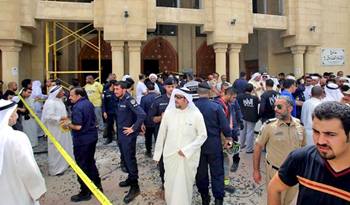
In a statement, it also condemned a suicide bombing at a Kuwaiti Shiite mosque that killed at least 25 worshippers in an attack claimed by the Islamic State group.

Al-Azhar, one of the oldest centres of Sunni Muslim learning, also denounced a suspected Islamist attack in France in which a man was beheaded.

"Al-Azhar calls on the international community to defeat this terrorist group though all available means," it said in a statement referring to IS.

The jihadist group, which controls parts of Syria and Iraq and commands affiliates in several other countries, had called for attacks during the Muslim holy month of Ramadan which began more than a week ago.

A task force against extremism set up by Egypt's mufti, the government's interpreter of Islamic law, also denounced the attacks.

"What the (Islamic State) has done to malign the image of Islam is far more than what anyone else has done, whether Muslim or non-Muslim," it said in a statement.

Comments

Add new comment

  • Coastaldigest.com reserves the right to delete or block any comments.
  • Coastaldigset.com is not responsible for its readers’ comments.
  • Comments that are abusive, incendiary or irrelevant are strictly prohibited.
  • Please use a genuine email ID and provide your name to avoid reject.
News Network
April 30,2020

Los Angeles, Apr 30: Los Angeles will begin offering coronavirus">coronavirus testing for free to all citizens regardless of whether they have symptoms, Mayor Eric Garcetti said on Wednesday, adding that LA is the first major US city to take such an initiative.

During the press conference, Garcetti announced that all county residents can now get free coronavirus">coronavirus testing. 

He said the announcement will only apply to city residents for now, but that a similar plan is in development for Los Angeles County,
Garcetti also took to Twitter to announce the same. "Announcing that L.A. is now the first major city in America to offer free COVID-19 testing to all residents. 

While priority will still be given to those with symptoms, individuals without symptoms can also be tested. Sign up at Coronavirus.LACity.org/Testing," he said
Under the new guidelines, priority for the same- or next-day testing will still be given to people with symptoms, such as a fever, cough, and shortness of breath. The free testing will also be prioritized for certain critical frontline workers who interact with the public.

Until now, only residents with symptoms as well as essential workers and those in institutional settings like nursing homes could be tested.

On Wednesday, the LA County reported 1,541 new cases, bringing the total to 22,485 - a seven per cent increase since yesterday.

This includes a backlog of cases that were processed. In the city, there were 683 new cases on Wednesday, bringing the total to 10,380 -- a 7 percent increase since yesterday.

Comments

Add new comment

  • Coastaldigest.com reserves the right to delete or block any comments.
  • Coastaldigset.com is not responsible for its readers’ comments.
  • Comments that are abusive, incendiary or irrelevant are strictly prohibited.
  • Please use a genuine email ID and provide your name to avoid reject.
Agencies
January 20,2020

For the first time in the 15 years of the Global Risks Report, the climate change and environment risk has occupied all the top five slots.

According to the 15th edition of the World Economic Forum's (WEF) Global Risks Report, the top five risks in terms of likelihood are extreme weather, climate action failure, natural disasters, biodiversity loss and human-made environmental disasters. They all fall in the one category of climate change and related environmental disasters.

WEF President Borge Brende said the world was feeling long-mounting and interconnected risks.

The report also points to how citizens are protesting across the world as discontent rises with failed systems that are creating inequality. The citizens' discontent had hardened with systems that had failed to promote advancement, it said.

"Disapproval of how governments are addressing profound economic and social issues has sparked protests throughout the world, potentially weakening the ability of governments to take decisive action should a downturn occur. Without economic and social stability, countries could lack the financial resources, fiscal margin, political capital or social support needed to confront key global risks," it said.

Listing the grim scenario, Borge said the global economy was faced with "synchronised slowdown", the past five years had been the warmest on record and cyber attacks were expected to increase this year.

The report warns that while the myriad risks were rising, time was running out on how to prevent them.

Borge said the growing palpability of shared economic, environmental and societal risks indicated that the horizon had shortened for preventing "or even mitigating" some of the direst consequences of global risks.

"It's sobering that in the face of this development, when the challenges before us demand immediate collective action, fractures within the global community appear to only be widening," he said.

The report points to grave concern about the consequences of continued environmental degradation, including the record pace of species decline.

Pointing to an unsettled geopolitical environment, the report said today's risk landscape was one in which new centres of power and influence were forming and old alliance structures and global institutions were being tested.

"While these changes can create openings for new partnership structures in the immediate term, they are putting stress on systems of coordination and challenging norms around shared responsibility. Unless stakeholders adapt multilateral mechanisms for this turbulent period, the risks that were once on the horizon will continue to arrive," it said.

Calling it a "an unsettled world", the WEF report notes that powerful economic, demographic and technological forces were shaping a new balance of power. "The result is an unsettled geopolitical landscape in which states are increasingly viewing opportunities and challenges through unilateral lenses," it said.

"What were once givens regarding alliance structures and multilateral systems no longer hold as states question the value of long-standing frameworks, adopt more nationalist postures in pursuit of individual agendas and weigh the potential geopolitical consequences of economic decoupling. Beyond the risk of conflict, if stakeholders concentrate on immediate geo-strategic advantage and fail to re-imagine or adapt mechanisms for coordination during this unsettled period, opportunities for action on key priorities may slip away," the WEF said.

In a chapter on risks to economic stability and social cohesion, it said a challenging economic climate might persist this year and members of the multi-stakeholder community saw "economic confrontations" and "domestic political polarisation" as the top risks in 2020.

The report also warned of downward pressure on the global economy from macroeconomic fragilities and financial inequality. These pressures continued to intensify in 2019, increasing the risk of economic stagnation.

Low trade barriers, fiscal prudence and strong global investment, once seen as fundamentals for economic growth, are fraying as leaders advance nationalist policies. The margins for monetary and fiscal stimuli are also narrower than before the 2008-2009 financial crisis, creating uncertainty about how well countercyclical policies will work.

The strategic partners for the WEF report included Marsh & McLennan and Zurich Insurance Group. The academic advisers were National University of Singapore, Oxford Martin School, University of Oxford and Wharton Risk Management and Decision Processes Center, University of Pennsylvania.

Comments

Add new comment

  • Coastaldigest.com reserves the right to delete or block any comments.
  • Coastaldigset.com is not responsible for its readers’ comments.
  • Comments that are abusive, incendiary or irrelevant are strictly prohibited.
  • Please use a genuine email ID and provide your name to avoid reject.
Agencies
April 25,2020

From loudspeakers on the roof of a Minnesota mosque, the Islamic call to prayer echoed for the first time ever throughout a Minneapolis neighbourhood late on Thursday as the Muslim community there prepared to begin the holy month of Ramadan.

It echoed again on Friday morning and will continue five times a day during the holy month. 

The simple, short call - known as the adhan - marked an historical moment for Minneapolis and major cities across the United States, community members said. While the adhan is commonly broadcast throughout the Middle East, North Africa and other places, for many Muslims in the US, it is only heard inside mosques or community centres.

"There's definitely a lot of excitement," said Imam Abdisalam Adam, who is on the board of the Dar al-Hijrah mosque, from where the adhan will be broadcast.
"Some people see it as historic," Adam told Al Jazeera. "To the point ... that they're not doing it, able to see it in their lifetime." 

Recited by different representatives from mosques around the city, the call to prayer is expected to reach thousands in the Cedar-Riverside neighbourhood in Minneapolis, according to Jaylani Hussein, the executive director of Minnesota's Council on American-Islamic Relations (CAIR).

While Hussein says the community had discussed broadcasting the call for years, it became even more pressing this year when the coronavirus pandemic forced mosques to shut their doors and residents to stay inside. The coronavirus has infected more than 870,000 people nationwide and killed at least 50,000.
"We wanted to touch those individuals who frequent this mosque and this community," Hussein said. "If we cannot be physically together, at least this echo, this voice, this call to prayer can be an extension of us being together at this difficult time. To give some people some solace."
Ramadan - Minnesota.

The Dar al-Hijrah mosque in the Cedar-Riverside neighbourhood of Minneapolis, Minnesota [Courtesy of Abdisalem Adam] 
Ramadan is traditionally a time when Muslims worldwide regularly attend mosques for daily prayers and break their fasts together. But this year, most have been told to pray at home and forgo community iftars in favour of staying safe from the COVID-19 crisis.

Adam, the imam, said while the Muslim community is experience loss this Ramadan, they hope the call to prayer broadcast will create a "semblance of normalcy".

"With the loss of Friday prayers and the regular congregational prayers, we are hoping that this will give a sense of solace and connection to the spiritual needs of community members," he added. 

An avenue to greater investment?

The Cedar-Riverside neighbourhood is a densely populated area of Minneapolis that has historically been an entry point for many immigrants and today is home to large Somali and Oromo communities.

Ramla Bile, a Somali American who lives in a neighbourhood adjacent to Cedar-Riverside, has been active in the community for years. She welcomed the broadcast of the call to prayer, saying it will help people "feel the spirit of Ramadan in a way that is meaningful".

But she also hopes the city of Minneapolis, which provided the noise permit for the broadcast, will make bigger strides to invest in the community in even more tangible ways.

"There's been a lot of need and a lot hurt in the community in light of the COVID-19 pandemic. And then there's the ongoing conversation you've been having," she said, pointing to deep-seated Islamophobia, systemic racism and the need for infrastructure projects like sprinkler systems in high-rise buildings. 

"We need to see greater investments to support the most vulnerable members of our community," Bile said referring to the neighbourhood's elders, undocumented individuals, low-income families and others.

"Right now, we're waiting for a bailout for our micro-businesses who comprise our Somali malls, or a rent freeze for neighbourhood residents," she added.

For CAIR's Hussein and Imam Adam, they hope this Ramadan's call to prayer helps encourage other communities around the US to take similar steps.

"This will hopefully inspire others … to think about what could happen in future Ramadans and beyond," Hussein said.

Adam added that while the virus has devastated communities and upended daily life, it has also shown that "we're in this together".

"It just shows the significance of the global village and how interconnected and interdependent we are as a world community," he said. "I think that there will be a lot of change in our way of life for the better. I hope so."


 

Comments

Add new comment

  • Coastaldigest.com reserves the right to delete or block any comments.
  • Coastaldigset.com is not responsible for its readers’ comments.
  • Comments that are abusive, incendiary or irrelevant are strictly prohibited.
  • Please use a genuine email ID and provide your name to avoid reject.