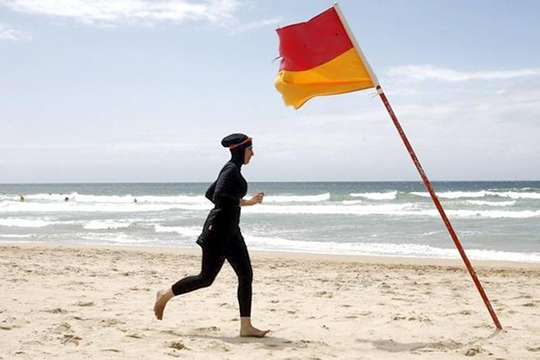
Muslim swimmers allowed to race wearing 'burkinis' in England

March 5, 2017

London, Mar 5: Muslim women swimmers have won the right to race in loose-fitting full body outfits or 'burkinis' while taking part in amateur swimming competitions in England.

burkinis

On a request from the Muslim Women's Sport Foundation, the Amateur Swimming Association (ASA) has relaxed its swimsuit regulations to allow women to wear loose-fitting full body outfits.

Until now, full body suits like those worn by Olympians have been banned, as they help streamline the shape of the body and have performance-enhancing characteristics.

The new guidance, which will only apply to amateur competitions in England, states that competitors will not be allowed to wear any suit that a competition referee believes will increase performance, The Telegraph reported.

Photographs published by the governing body suggested that loose-fitting outfits would be permissible, while specifically excluding body suits similar to those worn by elite competitors.

"Swimmers wishing to swim in such a suit shall present the suit to the event referee for inspection prior to their swim," the guidance states.

"Once the referee has been informed of a swimmer wishing to wear a suit, as described above, there is no requirement for the referee to question the swimmer further, the ASA swimming management group do not want athletes being asked why they wish to wear the suit," it says.

Chris Bostock, chairman of the ASA sport governing board, termed the move as a "very positive step forward" for competitive swimming in England and one that he hoped would encourage many more people to take part.

"We want everyone to be able to reach their potential. Representing your club at a national swimming competition is very special. By changing these rules we hope to encourage a new generation of swimmers," he was quoted as saying.

Rimla Akhtar, from the Muslim Women's Sport Foundation, said, "Participation in sport amongst Muslim women is increasing at a rapid pace. It is imperative that governing bodies adapt and tailor their offerings to suit the changing landscape of sport, including those who access their sport."

"The MWSF is glad to have requested a review of competition laws in relation to full body suits by the ASA and are extremely pleased at the outcome," she said.

Comments

Add new comment

  • Coastaldigest.com reserves the right to delete or block any comments.
  • Coastaldigset.com is not responsible for its readers’ comments.
  • Comments that are abusive, incendiary or irrelevant are strictly prohibited.
  • Please use a genuine email ID and provide your name to avoid reject.
News Network
April 2,2020

United Nations, Apr 2: The global economy could shrink by up to one per cent in 2020 due to the coronavirus pandemic, a reversal from the previous forecast of 2.5 per cent growth, the UN has said, warning that it may contract even further if restrictions on the economic activities are extended without adequate fiscal responses.

The analysis by the UN Department of Economic and Social Affairs (DESA) said the COVID-19 pandemic is disrupting global supply chains and international trade. With nearly 100 countries closing national borders during the past month, the movement of people and tourism flows have come to a screeching halt.

"Millions of workers in these countries are facing the bleak prospect of losing their jobs. Governments are considering and rolling out large stimulus packages to avert a sharp downturn of their economies which could potentially plunge the global economy into a deep recession. In the worst-case scenario, the world economy could contract by 0.9 per cent in 2020," the DESA said, adding that the world economy had contracted by 1.7 per cent during the global financial crisis in 2009.

It added that the contraction could be even higher if governments fail to provide income support and help boost consumer spending.

The analysis noted that before the outbreak of the COVID-19, world output was expected to expand at a modest pace of 2.5 per cent in 2020, as reported in the World Economic Situation and Prospects 2020.

Taking into account rapidly changing economic conditions, the UN DESA's World Economic Forecasting Model has estimated best and worst-case scenarios for global growth in 2020.

In the best-case scenario with moderate declines in private consumption, investment and exports and offsetting increases in government spending in the G-7 countries and China global growth would fall to 1.2 per cent in 2020.

"In the worst-case scenario, the global output would contract by 0.9 per cent instead of growing by 2.5 per cent in 2020," it said, adding that the scenario is based on demand-side shocks of different magnitudes to China, Japan, South Korea, the US and the EU, as well as an oil price decline of 50 per cent against our baseline of USD 61 per barrel.

The severity of the economic impact will largely depend on two factors - the duration of restrictions on the movement of people and economic activities in major economies; and the actual size and efficacy of fiscal responses to the crisis.

A well-designed fiscal stimulus package, prioritising health spending to contain the spread of the virus and providing income support to households most affected by the pandemic would help to minimise the likelihood of a deep economic recession, it said.

According to the forecast, lockdowns in Europe and North America are hitting the service sector hard, particularly industries that involve physical interactions such as retail trade, leisure and hospitality, recreation and transportation services. Collectively, such industries account for more than a quarter of all jobs in these economies.

The DESA said as businesses lose revenue, unemployment is likely to increase sharply, transforming a supply-side shock to a wider demand-side shock for the economy.

Against this backdrop, the UN-DESA is joining a chorus of voices across the UN system calling for well-designed fiscal stimulus packages which prioritize health spending and support households most affected by the pandemic.

Urgent and bold policy measures are needed, not only to contain the pandemic and save lives, but also to protect the most vulnerable in our societies from economic ruin and to sustain economic growth and financial stability, Under-Secretary-General for Economic and Social Affairs Liu Zhenmin said.

The analysis also warns that the adverse effects of prolonged economic restrictions in developed economies will soon spill over to developing countries via trade and investment channels.

A sharp decline in consumer spending in the European Union and the United States will reduce imports of consumer goods from developing countries.

Developing countries, particularly those dependent on tourism and commodity exports, face heightened economic risks. Global manufacturing production could contract significantly, and the plummeting number of travellers is likely to hurt the tourism sector in small island developing States, which employs millions of low-skilled workers, it said.

Meanwhile, the decline in commodity-related revenues and a reversal of capital flows are increasing the likelihood of debt distress for many nations. Governments may be forced to curtail public expenditure at a time when they need to ramp up spending to contain the pandemic and support consumption and investment.

UN Chief Economist and Assistant Secretary-General for Economic Development Elliot Harris said the collective goal must be a resilient recovery which puts the planet back on a sustainable track. We must not lose sight how it is affecting the most vulnerable population and what that means for sustainable development, he said.

The alarms raised by UN-DESA echo another report, released on March 31, in which UN experts issued a broad appeal for a large-scale, coordinated, comprehensive multilateral response amounting to at least 10 per cent of global gross domestic product (GDP).

According to estimates by the Johns Hopkins University, confirmed coronavirus cases across the world now stand at over 932,600 and over 42,000 deaths.


Comments

Add new comment

  • Coastaldigest.com reserves the right to delete or block any comments.
  • Coastaldigset.com is not responsible for its readers’ comments.
  • Comments that are abusive, incendiary or irrelevant are strictly prohibited.
  • Please use a genuine email ID and provide your name to avoid reject.
News Network
February 19,2020

London, Feb 19: UK Home Secretary Priti Patel today announced the launch of the Britain's new points-based visa system, aimed at attracting the "brightest and the best" from the world, including from India, and cutting down numbers of cheap, low-skilled workers coming to the country.

The new system will come into force from January 1, 2021 at the end of the transition period after the UK's exit from the European Union (EU) last month, which will formally end free movement of people within the economic bloc for the UK as a non-member.

The new post-Brexit system, which will apply equally to the EU and non-EU countries like India, is based on assigning points for specific skills, qualifications, salaries and professions, with visas only awarded to those who gain enough points.

"Today is a historic moment for the whole country. We're ending free movement, taking back control of our borders and delivering on the people's priorities by introducing a new UK points-based immigration system, which will bring overall migration numbers down," said Ms Patel, the senior-most Indian-origin Cabinet minister.

"We will attract the brightest and the best from around the globe, boosting the economy and our communities, and unleash this country's full potential," Ms Patel, in charge of the UK's visa and immigration system, said.

The UK Home Office said the new system is a direct response to the 2016 referendum in favour of Brexit, which was seen as a vote to end the country's reliance on cheap migrant labour and reduce overall levels of migration with tighter security.

"The new single global system will treat the EU and non-EU citizens equally. It will give top priority to those with the highest skills and the greatest talents, including scientists, engineers and academics," the Home Office said.

The Global Talent Scheme, a fast-track visa to be in operation from Friday, will also apply to the EU citizens from next year to allow highly-skilled scientists and researchers to come to the UK without a job offer.

Professor Alice Gast, President of Imperial College London, said: "British science is global. The new post-study work and Global Talent visas will help us to attract the world's brightest students and researchers, wherever they come from."

"From the race to develop a coronavirus vaccine to clean energy, British science's international collaborations drive innovation and excellence."

The government said the points threshold for the new system will be carefully set to attract the talent the UK needs. Skilled workers will need to meet a number of relevant criteria, including specific skills and the ability to speak English, to be able to work in the UK. All applicants will be required to have a job offer and, in line with the Migration Advisory Committee''s (MAC) recommendations, the minimum salary threshold will be set at 25,600 pounds - lower than the previous 30,000 pounds level for Tier 2 work visas.

The new points-based system will also expand the skills threshold for skilled workers.

Those looking to live and work in the UK will need to be qualified up to A-level or equivalent, rather than degree-level under the current system. This will provide greater flexibility and ensure UK business has access to a wide pool of skilled workers, the Home Office said.

In line with the British Prime Minister Boris Johnson's manifesto commitment in the December 2019 General Election, there will be no specific route for low-skilled workers.

"It is estimated 70 per cent of the existing EU workforce would not meet the requirements of the skilled worker route, which will help to bring overall numbers down in future," the Home Office said.

Student visa routes will also be points-based and be opened up to EU citizens from next year.

Those wishing to study in the UK will need to demonstrate that they have an offer from an approved educational institution, that they can support themselves financially and that they speak English.

To address the specific labour concerns of the agricultural sector reliant on seasonal workers from the EU, the Seasonal Workers Pilot will be expanded in time for the 2020 harvest from 2,500 to 10,000 places.

EU citizens and other non-visa nationals will not require a visa to enter the UK when visiting the UK for up to six months.

However, the use of national identity cards will be phased out for travel to the UK and the Home Office highlighted that as part of its post-Brexit offer, those EU citizens resident in the UK by December 31 2020 can still apply to settle in the UK through the EU Settlement Scheme until June 2021.

Comments

Add new comment

  • Coastaldigest.com reserves the right to delete or block any comments.
  • Coastaldigset.com is not responsible for its readers’ comments.
  • Comments that are abusive, incendiary or irrelevant are strictly prohibited.
  • Please use a genuine email ID and provide your name to avoid reject.
Agencies
June 8,2020

China is aggressively pursuing a diverse range of tactics -- from cyber-attacks to recruiting insiders for economic espionage, Indian security agencies have warned. The specific alert circulated among key stakeholders suggests that Chinese operatives are not only planning to steal classified cutting-edge defense technology but also eyeing to recruit best academicians and researchers around the globe, especially from the US.

Sources said they have noticed that China has authorized an "aggressive program of stealing US science and technology information by recruiting Americans in the technology sector with access to trade secrets".

In the technology sector of the US, many Indians scientists are working at the forefront. "This is a serious matter for Indian government and security establishments," said a top source further adding that Chinese always pursue economic espionage because it suits their low cost manufacturing sector on the basis of stolen research and costly design developed by top companies across the globe.

"An alert was also issued in early January about Chinese cyber intrusion attempts at several companies where Indian researchers are working. The espionage attempt was to target UAV technology and certain top-end military equipment designs. After stealing the techniques and design, China starts producing these equipment domestically and sells at a cheaper rate, inflicting irreparable damage to the original equipment manufacturers," the sources in the security establishment observed.

Recently, the US accused China for targeting academia by sending researchers to American labs and using talent recruitment programme to steal scientific analysis. The US has also found that young recruits of the People's Liberation Army posing as students are entering into various universities across the globe to get research papers and recruit academia.

Earlier this year, the US charged a former Boston University student of visa fraud for failing to disclose the status as a lieutenant in the China's People's Liberation Army.

The US intelligence agencies have found that their "universities have become a soft target in the global espionage war with China".

In January this year, the US Department of Justice charged a leading academician at the Harvard University for hiding his alleged role in a Chinese government programme.

In July last year, the Federal Bureau of Investigation (FBI) Director Christopher Wray had revealed that the FBI is probing nearly 1,000 cases of economic espionage and attempted intellectual property theft, nearly all of them leading back to China.

Accordingly, Indian Missions have been informed about the threats being posed by Chinese spies and attempts to recruit Indian scientists and technologists working in the US and other parts of the world.

Sources further stated that security establishments in India have informed the scientist fraternity to be on alert amid threat posed by Chinese spies.

The Chinese had earlier recruited a personnel, Dongfan Chung, working at Boeing for economic espionage. Chung had stolen secret technology to benefit Chinese government and during the raid at his house more than 2.5 lakh classified pages related to Boeing were recovered.

"There has been intense debate on the international platforms regarding Chinese-sponsored theft of intellectual property. American agencies have gone on record to say that China was targeting trade secrets. In the backdrop of pandemic and global health crisis, Indian establishments in defence and technology sectors have been told to be extra cautious as China is planning to become the most advanced economy while the other countries are crippled by the highly contagious virus," the sources further added.

Comments

Add new comment

  • Coastaldigest.com reserves the right to delete or block any comments.
  • Coastaldigset.com is not responsible for its readers’ comments.
  • Comments that are abusive, incendiary or irrelevant are strictly prohibited.
  • Please use a genuine email ID and provide your name to avoid reject.