Nabatean-Arabic missing link: ‘Oldest’ inscription found in Najran

August 4, 2014

Nabatean-Arabic

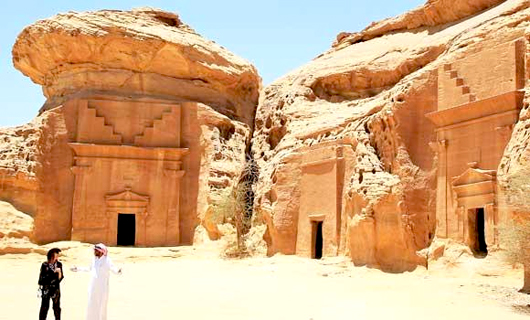
Jeddah, Aug 4: A Saudi-French archaeological team has unearthed in Najran what might be considered the oldest inscription in the Arabic alphabet, said a spokesman from the French Foreign Ministry.

“The epigrapher Frédéric Imbert, a professor at the University of Aix-Marseille, found the Nabatean Arabic inscription about 100 km north of Najran near the Yemeni border,” said the spokesman. “The first thing that makes this find significant is that it is a mixed text, known as Nabatean Arabic, the first stage of Arabic writing,” he said.

This script had previously only ever been seen north of Hejaz, in the Sinai and in the Levant. The second is the fact that these inscriptions are dated. The period indicated corresponds to the years 469-470 AD. This is the oldest form of Arabic writing known to date, the “missing link” between Nabatean and Arabic writing, he added.

This discovery, which is important to the history of the Arabian Peninsula and language, represents a success for the network of archaeological missions funded by the French Ministry of Foreign Affairs and International Development, which executed 148 projects this year in more than 60 countries worldwide. It is also an excellent example of cooperation between Saudi Arabia and France, the official said.

Many examples of graffiti and inscriptions, largely of names and greetings, are a testament to widespread literacy within Nabatean culture, which extended as far north as the north end of the Dead Sea.

No Nabatean literature has survived with the exception of a few letters.

Comments

Add new comment

  • Coastaldigest.com reserves the right to delete or block any comments.
  • Coastaldigset.com is not responsible for its readers’ comments.
  • Comments that are abusive, incendiary or irrelevant are strictly prohibited.
  • Please use a genuine email ID and provide your name to avoid reject.
Agencies
July 31,2020

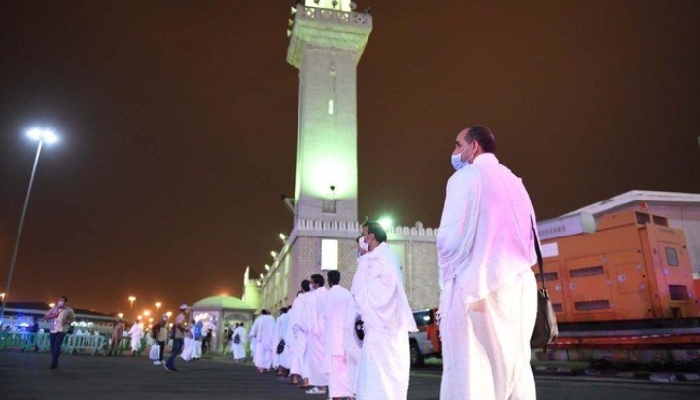
Jeddah, Jul 31: Hajj 2020 pilgrims arrived in Muzdalifah Thursday night to rest after spending the day in Arafat.

Earlier, the pilgrims scaled Mount Arafat to pray and repent, as a highly unusual Hajj approached its climax. They listened to a sermon delivered by Sheikh Abdullah Al-Manea and prayed Dhuhr and Asr prayers together at the Al-Namirah Mosque in Arafat.

This year’s pilgrimage is the smallest in modern times, after the number of participants was greatly restricted to prevent the spread of the coronavirus. 

Tight security was in place around the foot of the rocky hill outside Makkah, also known as Jabal Al-Rahma or Mount of Mercy, in preparation for the high point of the annual ritual.

Video footage shown on state television showed the pilgrims setting off on their climb to the summit. They wore face masks and observed strict social-distancing rules imposed by Saudi authorities.As sprinklers sprayed water on them to provide relief from the summer desert heat, the pilgrims raised their palms as they climbed the slopes of the hill — the site of Prophet Muhammad’s last sermon. When they reached the top they recited holy verses and prayed for forgiveness for their sins.

Earlier, the pilgrims were taken in buses from Mina to Mount Arafat. Strict precautionary measures were in place, with each group accompanied by security teams, ambulances and civil defense vehicles. 

When they arrived, their temperatures were checked before they entered Namirah Mosque to hear a sermon that was translated into 10 languages.

“The camps were set up for pilgrims in Arafat early on,” said Minister of Hajj and Umrah Muhammad Salih Bentin. The sermon at Namirah Mosque was delivered by Sheikh Abdullah Al-Manea, who led the pilgrims in noon and afternoon prayers.

“During Hajj this year, we reiterate that it is essential for pilgrims, as well as everyone assisting them, to adhere to the precautionary regulations that have been implemented,” Al-Manea, a member of the Council of Senior Scholars, said during his sermon. “This is to be done for their own safety.

“Precautions have been put in place to protect lives against the damage that the pandemic can cause, and also to actualize Islam’s teachings pertaining to safeguarding human life by Allah’s permission.”

The stay in Arafat is described as the pinnacle of Hajj and Muslims around the world reflect the actions of pilgrims by asking for forgiveness and praying for their deepest desires.
Pilgrims left Arafat in coaches for Muzdalifah after sunset and will pray the Maghrib and Isha prayers there.

After sunset prayers, the pilgrims made their way down Mount Arafat to Muzdalifah, where they will spend the night before the final Hajj ritual, the symbolic stoning of the devil. 

This year, each pilgrim received sanitized pebbles in advance of the event on Friday, which is the first day of Eid Al-Adha.
This year the Kingdom faced the unprecedented challenge of ensuring pilgrims attending Hajj were protected as much as possible from the risks of the coronavirus.

They will then sleep, pray the Fajr prayer there tomorrow and then leave for Mina.

Comments

Add new comment

  • Coastaldigest.com reserves the right to delete or block any comments.
  • Coastaldigset.com is not responsible for its readers’ comments.
  • Comments that are abusive, incendiary or irrelevant are strictly prohibited.
  • Please use a genuine email ID and provide your name to avoid reject.
News Network
July 23,2020

Beirut, Jul 23: The pandemic will exact a heavy toll on Arab countries, causing an economic contraction of 5.7% this year, pushing millions into poverty and compounding the suffering of those affected by armed conflict, a U.N. report said Thursday.

The U.N.'s Economic and Social Commission for Western Asia expects some Arab economies to shrink by up to 13%, amounting to an overall loss for the region of $152 billion.

Another 14.3 million people are expected to be pushed into poverty, raising the total number to 115 million — a quarter of the total Arab population, it said. More than 55 million people in the region relied on humanitarian aid before the COVID-19 crisis, including 26 million who were forcibly displaced.

Arab countries moved quickly to contain the virus in March by imposing stay-at-home orders, restricting travel and banning large gatherings, including religious pilgrimages.

Arab countries as a whole have reported more than 830,000 cases and at least 14,717 deaths. That equates to an infection rate of 1.9 per 1,000 people and 17.6 deaths per 1,000 cases, less than half the global average of 42.6 deaths, according to the U.N.

But the restrictions exacted a heavy economic toll, and authorities have been forced to ease them in recent weeks. That has led to a surge in cases in some countries, including Lebanon, Iraq and the Palestinian territories.

Wealthy Gulf countries were hit by the pandemic at a time of low oil prices, putting added strain on already overstretched budgets. Middle-income countries like Jordan and Egypt have seen tourism vanish overnight and a drop in remittances from citizens working abroad.

War-torn Libya and Syria have thus far reported relatively small outbreaks. But in Yemen, where five years of civil war had already generated the world's worst humanitarian crisis, the virus is running rampant in the government-controlled south while rebels in the north conceal its toll.

Rola Dashti, the head of the U.N. commission, said Arab countries need to “turn this crisis into an opportunity” and address longstanding issues, including weak public institutions, economic inequality and over-reliance on fossil fuels.

“We need to invest in survival, survival of people and survival of businesses,” she said.

Comments

Add new comment

  • Coastaldigest.com reserves the right to delete or block any comments.
  • Coastaldigset.com is not responsible for its readers’ comments.
  • Comments that are abusive, incendiary or irrelevant are strictly prohibited.
  • Please use a genuine email ID and provide your name to avoid reject.
News Network
March 6,2020

Riyadh, Mar 6: Saudi Arabia on Thursday emptied Islam's holiest site for sterilisation over fears of the new coronavirus, an unprecedented shutdown state media said will last while the year-round Umrah pilgrimage is suspended.

The kingdom halted the pilgrimage for its own citizens and residents on Wednesday, on top of restrictions announced last week on foreign pilgrims to stop the disease from spreading.

State television relayed images of an empty white-tiled area surrounding the Kaaba -- a large black cube structure inside Mecca's Grand Mosque -- which is usually packed with tens of thousands of pilgrims.

As a "precautionary measure", the area will remain closed as long as the umrah suspension lasts but prayers will be allowed inside the mosque, state-run Saudi Press Agency cited a mosque official as saying.

Additionally, the Grand Mosque and the Prophet's Mosque in the city of Medina will be closed an hour after the evening "Isha" prayer and will reopen an hour before the dawn "Fajr" prayer to allow cleaning and sterilisation, the official added.

A group of cleaners was seen scrubbing and mopping the tiles around the Kaaba, a structure draped in gold-embroidered gold cloth towards which Muslims around the world pray.

A Saudi official told news agency the decision to close the area was "unprecedented".

On Wednesday, Saudi Arabia suspended the umrah for its own citizens and residents over fears of the coronavirus spreading to Islam's holiest cities.

The move came after authorities last week suspended visas for the umrah and barred citizens from the six-nation Gulf Cooperation Council from entering Mecca and Medina.

Saudi Arabia on Thursday declared three new coronavirus cases, bringing the total number of reported infections to five.

The umrah, which refers to the Islamic pilgrimage to Mecca that can be undertaken at any time of year, attracts millions of Muslims from across the globe annually.

The decision to suspend the umrah mirrors a precautionary approach across the Gulf to cancel mass gatherings from concerts to sporting events.

It comes ahead of the holy fasting month of Ramadan starting in late April, which is a favoured period for pilgrimage.

It is unclear how the coronavirus will affect the hajj, due to start in late July.

Some 2.5 million faithful travelled to Saudi Arabia from across the world in 2019 to take part in the hajj, which is one of the five pillars of Islam as Muslim obligations are known.

The event is a massive logistical challenge for Saudi authorities, with colossal crowds cramming into relatively small holy sites, making attendees vulnerable to contagion.

Already reeling from slumping oil prices, the kingdom risks losing billions of dollars annually from religious tourism as it tightens access to the sites.

Comments

Add new comment

  • Coastaldigest.com reserves the right to delete or block any comments.
  • Coastaldigset.com is not responsible for its readers’ comments.
  • Comments that are abusive, incendiary or irrelevant are strictly prohibited.
  • Please use a genuine email ID and provide your name to avoid reject.