Nabatean-Arabic missing link: ‘Oldest’ inscription found in Najran

August 4, 2014

Nabatean-Arabic

Jeddah, Aug 4: A Saudi-French archaeological team has unearthed in Najran what might be considered the oldest inscription in the Arabic alphabet, said a spokesman from the French Foreign Ministry.

“The epigrapher Frédéric Imbert, a professor at the University of Aix-Marseille, found the Nabatean Arabic inscription about 100 km north of Najran near the Yemeni border,” said the spokesman. “The first thing that makes this find significant is that it is a mixed text, known as Nabatean Arabic, the first stage of Arabic writing,” he said.

This script had previously only ever been seen north of Hejaz, in the Sinai and in the Levant. The second is the fact that these inscriptions are dated. The period indicated corresponds to the years 469-470 AD. This is the oldest form of Arabic writing known to date, the “missing link” between Nabatean and Arabic writing, he added.

This discovery, which is important to the history of the Arabian Peninsula and language, represents a success for the network of archaeological missions funded by the French Ministry of Foreign Affairs and International Development, which executed 148 projects this year in more than 60 countries worldwide. It is also an excellent example of cooperation between Saudi Arabia and France, the official said.

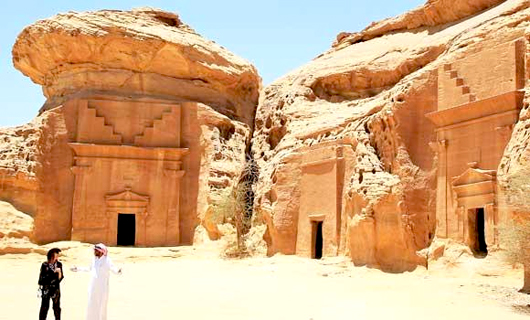
Many examples of graffiti and inscriptions, largely of names and greetings, are a testament to widespread literacy within Nabatean culture, which extended as far north as the north end of the Dead Sea.

No Nabatean literature has survived with the exception of a few letters.

Comments

Add new comment

  • Coastaldigest.com reserves the right to delete or block any comments.
  • Coastaldigset.com is not responsible for its readers’ comments.
  • Comments that are abusive, incendiary or irrelevant are strictly prohibited.
  • Please use a genuine email ID and provide your name to avoid reject.
KT
May 18,2020

May 18: As the UAE authorities have asked all residents to avoid gatherings, it is clear that - for the first time - it's going to be a #StayHome Eid. But experts say that although it will be different, the celebration will be just as meaningful.

It is important to remember that the Eid prayer can be performed at home either individually or with family members under the sane roof, said Dr Mohammed Eyada Ayoub Alkobaisi, a Grand Mufti with the Islamic Affairs and Charitable Activities Department in Dubai.

Dr Alkobaisi said this prayer is a highly recommended Sunnah or practice urged by the Prophet Muhammad (Peace be upon him).

"Eid Prayer must be performed openly, unless we are prevented for an acceptable reason, such as fear for self, wellbeing, property, etc." Under the current circumstances, prayers can be offered from home, he said.

But what the faithful will likely miss is listening to the khutbah or the sermon of Eid with a crowd. The sight of people pouring out into the streets and coming together for prayer and worship would not be unfolding this time.

Dr Sheikh Mohamed Ashmawy, an Islamic researcher, said that in this time of Covid, doing away with several Eid traditions would be necessary for everyone's safety.

"The ban is is line with the ongoing preventive measures to curb the spread of Covid-19," he said.

However, it doesn't mean people can't celebrate and exchange heartfelt greetings, he added.

"We can greet each other remotely on the phone or via social media networks."

Islamic researcher Sheikh Mohamed Wasfi said audio-visual smart apps have made communication much easier, even bringing people closer than before.

"Of course, families and friends wish to hug, shake hands and see each other personally, but this will be a big risk these days," he said.

Sheikh Asadullah Del Mohamed, an imam, reminded that banquets, parties and visits are discouraged to avoid crowds and gathering.

Recently, 30 people from two families tested positive for the virus after breaking social distancing rules and holding a gathering.

Faithful's sentiments

Ibrahim Abdelkader, an Egyptian auditor, said that while it would be sad to spend Eid Al Fitr at home, he understood that it is for everyone's safety.

"Better to stay home than be sorry," said Ahmad Jamil, a Syrian resident.

Rashid Saeed, an Emirati national, said people are advised to just check on each other by phone or video and voice call apps.

"While Eid prayers is banned in congregation, it's not acceptable at all for some people to carelessly gather and exchange visits," he said.

Abdullah Al Saleh, an Emirati national, said he and all his relatives used to gather for breakfast after the Eid prayer - but this time, they are ready to do it in their own homes.

Mohamed Ibrahim, another Emirati, said he would surely miss seeing his kids happily prancing around with their new clothes and enjoying the outdoors like every year.

"But, I agree as it is for their health, safety and wellbeing," he said.

THINGS TO REMEMBER IN CELEBRATING EID THIS YEAR

>Perform the Eid prayer at home, individually or with family members living with you

>Exchange greetings with loved ones and friends via phone calls or online

>No hugs

>No handshakes

>No gatherings

>No visits to other homes

Comments

Add new comment

  • Coastaldigest.com reserves the right to delete or block any comments.
  • Coastaldigset.com is not responsible for its readers’ comments.
  • Comments that are abusive, incendiary or irrelevant are strictly prohibited.
  • Please use a genuine email ID and provide your name to avoid reject.
News Network
April 27,2020

Riyadh, Apr 27: The government of Saudi Arabia has signed a SR995 million (approx. Dh972m) contract with China to provide Covid-19 tests for nine million people in the Kingdom.

The Saudi Press Agency, SPA, reported that the decision came "as a result of a phone call made today (Sunday) between the Custodian of the Two Holy Mosques King Salman bin Abdulaziz Al Saud and Chinese President Xi Jinping."

The contract includes providing necessary equipment and supplies, making available of 500 Chinese specialists and technicians who are specialised in performing tests, establishing six large regional laboratories throughout the Kingdom; including a mobile laboratory with a capacity of performing 10,000 tests per day. Saudi cadres will also be trained to conduct daily tests and comprehensive field tests, under the new agreement

The contract was co-signed by the National Unified Procurement Company and Chinese company Huo-yan Laboratories by Dr. Abdullah Al Rabeeah, Advisor at the Royal Court, on behalf of the Government of Saudi Arabia, and Chinese Ambassador to the Kingdom Chen Weiqing, as a representative of the Chinese Government.

The contract is one of the largest contracts that will provide diagnostic tests for the novel Coronavirus.

Tests were also purchased from several other companies from the United States, Switzerland and South Korea, bringing the number of available tests to 14.5 million, covering around 40 percent of Saudi Arabia's population, SPA added.

Comments

Add new comment

  • Coastaldigest.com reserves the right to delete or block any comments.
  • Coastaldigset.com is not responsible for its readers’ comments.
  • Comments that are abusive, incendiary or irrelevant are strictly prohibited.
  • Please use a genuine email ID and provide your name to avoid reject.
News Network
March 25,2020

Riyadh, Mar 25: A 46-year-old man died of coronavirus in Saudi Arabia, becoming the Kingdom’s second death, according to a health ministry’s spokesman.

The health ministry recorded 133 new infections, bringing the total to 900.

Of those newly confirmed cases, 18 are associated with recent travel, and were placed in quarantine upon their arrival in the Kingdom, the spokesman said.

Comments

Add new comment

  • Coastaldigest.com reserves the right to delete or block any comments.
  • Coastaldigset.com is not responsible for its readers’ comments.
  • Comments that are abusive, incendiary or irrelevant are strictly prohibited.
  • Please use a genuine email ID and provide your name to avoid reject.