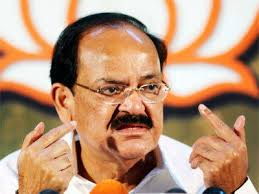
Naidu hits out at Censor board members for attacking NDA govt

January 18, 2015

Venkaiah Naidu

Chennai, Jan 18: In a sharp attack on Censor Board members who quit the film certification body alleging government interference, Union Minister Venkaiah Naidu today if there was something wrong, they should blame themselves as they were in power.

He also slammed the Congress, saying it was the UPA Government that "politicised" the Central Board of Film Certification.

"They were in power till yesterday and if something was wrong in Censor Board, they should blame themselves," he told reporters at the airport here.

"This board was politicised by UPA Government and they (board members) cannot blame the present newly formed government", the Urban Development Minister said.

Naidu was responding to questions on the resignation of CBFC Chairperson Leela Samson and 12 other members protesting alleged government interference in the past couple of days amid the controversy surrounding clearance of film "Messenger of God" featuring Dera Saccha Sauda chief Gurmeet Ram Rahim Singh by the film tribunal.

Information and Broadcasting minister Arun Jaitley had yesterday rejected the charge by the members and said the government maintains an "arm's length distance" in film certification matters.

Comments

Add new comment

  • Coastaldigest.com reserves the right to delete or block any comments.
  • Coastaldigset.com is not responsible for its readers’ comments.
  • Comments that are abusive, incendiary or irrelevant are strictly prohibited.
  • Please use a genuine email ID and provide your name to avoid reject.
Agencies
February 25,2020

New Delhi, Feb 25: Union Home Minister Amit Shah on Monday told a meeting of Delhi Lieutenant Governor Anil Baijal, Chief Minister Arvind Kejriwal and party leaders that "professional assessment" is that the violence in north-east Delhi has been "spontaneous".

He also said adequate forces have been already deployed in affected areas even as he urged political parties to avoid provocative speeches and statements which could flare up the situation and desist from rumour-mongering. He also instructed Delhi Police Commissioner Amulya Patnaik to re-activate local peace committees. 

"Shah noted that the professional assessment is that the violence in the capital has been spontaneous. He expressed confidence in Delhi Police and said that the force has shown maximum restraint to get the situation under control," a statement issued by the Ministry of Home Affairs (MHA) said.

However, on Monday, government sources had claimed that violence in the national capital "appeared to be orchestrated" to coincide with the high-profile visit. A PTI report from Hyderabad on Tuesday also quoted Minister of State for Home G Kishan Reddy as saying that the violence in Delhi has been perpetrated intentionally and the Narendra Modi government would not tolerate such incidents. 

While Shah said adequate forces have been deployed, there were also reports that the Delhi Police Commissioner told MHA top brass that it did not have adequate forces to control the violence that erupted in north-east Delhi. However, Delhi Police later tweeted that the Commissioner has denied that "no such information was given to MHA" and such reports were "totally baseless". 

Urging parties to avoid provocative speeches and statements which could flare up the situation, the statement said, Shah expressed confidence in Delhi Police and said that the force has shown maximum restraint to get the situation under control.

Appealing to all to maintain restraint and desist from rumour-mongering while instructing the Delhi Police Commissioner to re-activate local peace committees, Shah said Delhi's borders with Uttar Pradesh and Haryana have been under surveillance for the last three days. 

Shah also urged parties to ask their local leaders to hold meetings in sensitive areas and instructed senior police officers to visit vulnerable police stations at the earliest

Comments

Add new comment

  • Coastaldigest.com reserves the right to delete or block any comments.
  • Coastaldigset.com is not responsible for its readers’ comments.
  • Comments that are abusive, incendiary or irrelevant are strictly prohibited.
  • Please use a genuine email ID and provide your name to avoid reject.
Agencies
May 1,2020

New Delhi, May 1: The Centre has finalsed the criteria for delimitation of various zones after May 3. It has identified at least 130 districts as red zones, 284 orange zones and 319 green zones.

According to a letter written by Health Secretary Preeti Sudan to the Chief Secretaries of all States and UTs, all the states have to delineate the containment areas and buffer zones in the identified red and orange zone districts and notify the same.

The letter said, the national capital has at least 11 red zones, Uttar Pradesh 19 red zones, 36 orange zones and 20 green zones while, the state of Haryana has 2 red zones, 18 orange zones and 2 green zones.

The Gautam Buddha Nagar in Uttar Pradesh has been identified as a red zone district while, Ghaziabad has been designated as an orange zone. The national capital has no orange and green zone; there are only red zones according to the letter.

In Maharashtra, Mumbai, Pune, Thane, Nashik come in the red zone.

In West Bengal, Kolkata, Howrah, 24 Parganas -- both North and South have been identified as red zones while Hooghly, Nadia, Murshidabad etc have been marked as orange zones.

In the southern part of India, Kerala has 2 red zones and 10 orange zones, while Tamil Nadu has 12 red zones and 24 orange zones.

The Health Secretary said that the list will be revised on a weekly basis or earlier and communicated to states for further follow-up action in consonance with the directions issued by the Ministry of Home Affairs under the Disaster Management Act, 2005 based on field feedback and additional analysis at state level, states may designate additional red or orange zones as appropriate.

However, states may not relax the zonal classification of districts classified as red or orange as communicated by the Ministry. This classification is multi-factorial and takes into consideration incidence of cases, doubling rate, extent of testing and surveillance feedback to classify the districts.

A district will be considered under green zone, if there are no confirmed cases so far or there is no reported case since the last 21 days in the district.

Comments

Add new comment

  • Coastaldigest.com reserves the right to delete or block any comments.
  • Coastaldigset.com is not responsible for its readers’ comments.
  • Comments that are abusive, incendiary or irrelevant are strictly prohibited.
  • Please use a genuine email ID and provide your name to avoid reject.
News Network
January 1,2020

Jan 1: The ban on the practice of instant triple talaq, making it a penal offence and the increase in the strength of Supreme Court judges were two of the major achievements of the law ministry in 2019.

In July, Parliament gave its nod to The Muslim Women (Protection of Rights on Marriage) Bill, 2019. The new law makes talaq-e-biddat or any other similar form of talaq having the effect of instantaneous and irrevocable divorce pronounced by a Muslim husband void and illegal.

It makes it illegal to pronounce talaq three times in spoken, written or through SMS or WhatsApp or any other electronic chat in one sitting.

According to the new law, any Muslim who pronounces the illegal form of talaq upon his wife shall be punished with imprisonment for a term which may extend to three years, and shall also be liable to fine.

During the year, four new judges were appointed to the Supreme Court in September, taking its strength to 34, the highest-ever.

However, vacancies in high courts and lower courts are on the rise and convincing state governments and the 25 high courts to come on board to create an all-India judicial service to recruit judges for the subordinate courts tops the agenda of the Law Ministry in 2020.

Besides creating a consensus on setting up the All-India Judicial Services, the ministry will also have to focus on filling up vacancies in the high court. On an average, the vacancies stood at 400 throughout this year.

With more than 5,000 positions of judicial officers in district and subordinate courts lying vacant, the Law Ministry has pitched for setting up all-India judicial services.

The sanctioned strength of the judicial officers in district and subordinate courts was 22,644. The number of judicial officers in position and vacant posts is 17,509 and 5,135, respectively.

The government has proposed that while states and high courts can recruit judicial officers, the Union Public Service Commission (UPSC) can hold pan-India entrance tests.

The ministry has made it clear that such services would not encroach on the powers of the states.

As of now, the selection and appointment of judges in subordinate courts is the responsibility of the high courts and state governments concerned.

The Narendra Modi government has given a fresh push to the long-pending proposal to set up the new service to have a separate cadre for the lower judiciary in the country.

But there is a divergence of opinion among state governments and respective high courts on the constitution of the All India Judicial Service (AIJS).

One of the problems cited is that since several states have used powers under Code of Criminal Procedure (CrPC) and Code of Civil Procedure (CPC) to declare that the local language would be used in lower courts even for writing orders, a person say selected from Tamil Nadu may find it difficult to hold proceedings in states like Uttar Pradesh and Bihar.

The other point of opposition is that an all India service may hamper the career progression of state judicial services officers.

Another key issue the ministry has to handle in 2020 is vacancies in the 25 high courts.

Throughout 2019, on an average, the high courts faced a shortage of 400 judges.

According to Law Ministry data, as on September 1, the high courts had 414 vacant positions as compared to the sanctioned strength of 1,079 judges. The figure was 409 in August and 403 in July, as per the data.

A three-member Supreme Court collegium recommends the names of candidates for appointment as high court judges. In case of appointments to the Supreme Court, the collegium consists of five top judges of the top court.

High court collegiums shortlist candidates for their respective high courts and send the names to the law ministry.

The ministry, along with background check reports by the Intelligence Bureau, forwards it to the Supreme Court collegium for a final call.

The government has maintained that appointment of judges in the high courts is a "continuous collaborative process" between the Executive and the Judiciary, as it requires consultation and approval from various Constitutional authorities.

Vacancies keep arising on account of retirement, resignation or elevation of judges and increase in judges' strength. In June last year, the vacancy position stood at 399, while it was 396 in May.

In April, 399 posts of judges were vacant, while the figure was 394 in March. The vacancy position in February stood at 400 and in January, it was 392, according to the data collated by the Department of Justice.

Over 43 lakh cases are pending in the 25 high courts.

Another priority would be the finalisation of the memorandum of the procedure to guide the appointment and transfer of the Supreme Court and high court judges. The issue had now been pending for over two years now with the SC collegium and the government failing to reach a consensus.

Successive governments have also been working on making India a hub of international arbitration. It has taken several steps to change laws dealing with commercial disputes.


Comments

Add new comment

  • Coastaldigest.com reserves the right to delete or block any comments.
  • Coastaldigset.com is not responsible for its readers’ comments.
  • Comments that are abusive, incendiary or irrelevant are strictly prohibited.
  • Please use a genuine email ID and provide your name to avoid reject.