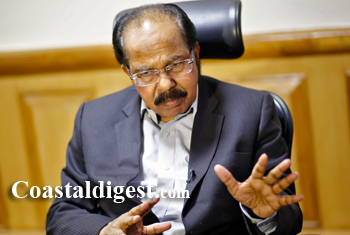
Narendra Modi is a blotted figure: Veerappa Moily

January 24, 2014

Moily_on_ModiNew Delhi, Jan 24: Union Petroleum and Natural Gas Minister, Dr. Veerappa Moily said that prime ministerial candidate of Bharatiya Janata Party (BJP), Narendra Modi, had deliberately shielded the 2002 'genocide' in Gujarat, ruling out his chances of becoming country's next PM.

Slamming him for Gujarat riots, Moily said that Modi believes in disintegrating the country, and has actually disrupted the society in Gujarat, where he had been the state chief for three consecutive terms.

In an interview to Reuters, Moily said that Modi could become a cause for country's disintegration, if appointed as the Prime Minister.

Calling Modi a 'blotted figure', Moily said that people would not support him because they might not take the risk of venturing into his politics of disintegration.

"Mr. Modi is a blotted figure and ultimately when it comes down to realities, you know, I don't think, you know, he will be a figure, will be counted for the country, forget about becoming the Prime Minister, he cannot contribute any value to the BJP," Moily said.

Referring to Modi's shortcomings, Moily also said that he was responsible for taking no action against the 'genocide' in Gujarat.

"Genocide has gone in. More than 2,000 people died and killed on the streets when Modi was the Chief Minister and they always wanted to, even Modi wanted to shield those people. He didn't, you know, prosecute them," he said.

In the speech on Thursday, Modi had said to the people of Uttar Pradesh, "You give me 60 months and I will give you a life of peace. I have come here to make this promise.

He also said that the Congress continues to mock the poor and could not tolerate a onetime seller of tea becoming the nation's prime minister.

He had further said that it was the poor who had to suffer and die due to the ignorance of the government and that he Congress considered Scheduled Castes important only while elections.

Comments

Add new comment

  • Coastaldigest.com reserves the right to delete or block any comments.
  • Coastaldigset.com is not responsible for its readers’ comments.
  • Comments that are abusive, incendiary or irrelevant are strictly prohibited.
  • Please use a genuine email ID and provide your name to avoid reject.
Agencies
May 27,2020

New Delhi, May 27: India’s fourth recession since Independence, first since liberalisation, and perhaps the worst to date is here, according to rating agency, Crisil.

CRISIL sees the Indian economy shrinking 5 per cent in fiscal 2021 (on-year), because of the Covid-19 pandemic. The first quarter will suffer a staggering 25 per cent contraction.

About 10 per cent of gross domestic product (GDP) in real terms could be permanently lost. "So going back to the growth rates seen before the pandemic is unlikely in the next three fiscals", Crisil said.

Crisil has revised its earlier forecast downwards. "Earlier, on April 28, we had slashed our prediction to 1.8 per cent growth from 3.5 per cent growth. Things have only gone downhill since", it said.

While we expect non-agricultural GDP to contract 6 per cent, agriculture could cushion the blow by growing at 2.5 per cent.

In the past 69 years, India has seen a recession only thrice as per available data in fiscals 1958, 1966 and 1980. The reason was the same each time a monsoon shock that hit agriculture, then a sizeable part of the economy.

"The recession staring at us today is different," it added. For one, agriculture could soften the blow this time by growing near its trend rate, assuming a normal monsoon. Two, the pandemic-induced lockdowns have affected most non-agriculture sectors. And three, the global disruption has upended whatever opportunities India had on the exports front.

Economic conditions have slid precipitously since the April-end forecast of 1.8 per cent GDP growth for fiscal 2021 (baseline), Crisil said.

On the lockdown extension, it said that the government has extended the lockdown four times to deal with the rising number of cases, curtailing economic activity severely (lockdown 4.0 is ending on May 31).

The first quarter of this fiscal will be the worst affected. June is unlikely to see major relaxations as the Covid-19 affliction curve is yet to flatten in India.

"Not only will the first quarter be a washout for the non-agricultural economy, services such as education, and travel and tourism among others, could continue to see a big hit in the quarters to come. Jobs and incomes will see extended losses as these sectors are large employers," Crisil said.

CRISIL also foresees economic activity in states with high Covid-19 cases to suffer prolonged disruption as restrictions could continue longer.

A rough estimate based on a sample of eight states, which contribute over half of India's GDP, shows that their 'red zones' (as per lockdown 3.0) contributed 42 per cent to the state GDP on average regardless of the share of such red zones.

On average, the orange zones contribute 46 per cent, while the green zones where activity is allowed to be close to normal contribute only 12 per cent to state GDP.

The economic costs are higher than earlier expectations, according to Crisil. The economic costs now beginning to show up in the hard numbers are far worse than initial expectations.

Industrial production for March fell by over 16%. The purchasing managers indices for the manufacturing and services sectors were at 27.4 and 5.4, respectively, in April, implying extraordinary contraction. That compares with 51.8 and 49.3, respectively, in March.

Exports contracted 60.3 per cent in April, and new telecom subscribers declined 35 per cent, while railway freight movement plunged 35 per cent on-year.

"Indeed, given one of the most stringent lockdowns in the world, April could well be the worst performing month for India this fiscal," it said.

Added to that is the economic package without enough muscle. The government recently announced a Rs 20.9 lakh crore economic relief package to support the economy. The package has some short-term measures to cushion the economy, but sets its sights majorly on reforms, most of which will have payoffs only over the medium term.

"We estimate the fiscal cost of this package at 1.2 per cent of GDP, which is lower than what we had assumed in our earlier estimate (when we foresaw a growth in GDP)," it said.

"We believe a catch-up to the pre-crisis trend level of GDP growth will not be possible in the next three fiscals despite policy support. Under the base case, we estimate a 10 per cent permanent loss to real GDP (from the decadal-trend level), assuming average growth of about 7 per cent between fiscals 2022 and 2024," Crisil said.

Interestingly, after the Global Financial Crisis (GFC), a sharp growth spurt helped catch up with the trend within two years. GDP grew 8.2 per cent on average in the two fiscals following the GFC. Massive fiscal spending, monetary easing and swift global recovery played a role in a V-shaped recovery.

To catch-up would require average GDP growth to surge to 11 per cent over the next three fiscals, something that has never happened before.

The research said that successive lockdowns have a non-linear and multiplicative effect on the economy a two-month lockdown will be more than twice as debilitating as a one-month imposition, as buffers keep eroding.

Partial relaxations continue to be a hindrance to supply chains, transportation and logistics. Hence, unless the entire supply chain is unlocked, the impact of improved economic activity will be subdued.

Therefore, despite the stringency of lockdown easing a tad in the third and the fourth phases, their negative impact on GDP is expected to massively outweigh the benefits from mild fiscal support and low crude oil prices, especially in the April-June quarter. "Consequently, we expect the current quarter's GDP to shrink 25 per cent on-year," it said.

Counting lockdown 4.0, Indians have had 68 days of confinement. S&P Global estimates that one month of lockdown shaves 3 per cent off annual GDP on average across Asia-Pacific.

Since India's lockdown has been the most stringent in Asia, the impact on economic growth will be correspondingly larger.

Google's Community Mobility Reports show a sharp fall in movement of people to places of recreation, retail shops, public transport and workplace travel. While data for May shows some improvement in India, mobility trends are much below the average or baseline, and lower compared with countries such as the US, South Korea, Brazil and Indonesia.


Comments

Add new comment

  • Coastaldigest.com reserves the right to delete or block any comments.
  • Coastaldigset.com is not responsible for its readers’ comments.
  • Comments that are abusive, incendiary or irrelevant are strictly prohibited.
  • Please use a genuine email ID and provide your name to avoid reject.
News Network
January 15,2020

Jan 15: Amazon.com Inc Chief Executive Officer Jeff Bezos is facing a bitter welcome during his India visit this week as the country’s antitrust regulator initiated a formal investigation just hours before his arrival and trader bodies comprising millions of infuriated small store owners announced demonstrations.

Bezos is in New Delhi for the Smbhav summit, an Amazon India event for small and medium businesses. The billionaire is scheduled to conduct a fireside chat with Amazon India chief Amit Agarwal, anchoring an event that also features Infosys Ltd. co-founder Narayana Murthy and retail billionaire Kishore Biyani, who recently sold a stake in his retail group to Amazon. Ahead of the event, Bezos paid his respects at Mahatma Gandhi’s memorial, wearing a white tunic and a rust-colored Indian vest.

The small businesses that Amazon’s CEO is hoping to endear himself to, however, are organizing in opposition. The Confederation of All India Traders announced that members of its affiliate bodies across the country would stage sit-ins and public rallies in 300 cities to raise a war cry against the world’s largest online retailer. In a letter to Prime Minister Narendra Modi last week, the confederation’s Secretary General Praveen Khandelwal alleged that Amazon, much like Walmart Inc.-owned Flipkart, was an “economic terrorist” who engaged in predatory pricing that deprived the government of tax revenue and “compelled the closure of thousands of small traders.”

India’s e-commerce market is projected to grow to $150 billion by 2022, according to a 2018 report by software industry group Nasscom and consulting firm PwC India. Competition for this rapidly expanding sector is intensifying as Asia’s richest man, Mukesh Ambani, prepares to go live with JioMart, an online shopping platform challenging Amazon and Walmart directly. The latter’s Flipkart Online Services Pvt is also delving deeper into the countryside in its pursuit for more customers. Amazon, for its part, opened a huge office complex in the southern city of Hyderabad in September, underscoring its commitment to the country.

The Competition Commission of India said it would probe the deep discounts, preferential listings and exclusionary tactics that Amazon and Flipkart are alleged to have used as anti-competitive levers. India’s trade bodies have long argued that both retail giants were flouting rules by promoting sales and discounts through their favoured sellers, many of whom they have preexisting commercial arrangements. The regulator has ordered for the investigation to be completed within two months.

Bezos last visited India in 2014 under starkly different circumstances. During that trip, the Amazon founder wore local festive garb, rode atop a festooned truck for a photo opp and presented Amazon’s Indian unit with a giant check for $2 billion. Since then, Amazon has pledged a further $3.5 billion to expand in the country.

Comments

Add new comment

  • Coastaldigest.com reserves the right to delete or block any comments.
  • Coastaldigset.com is not responsible for its readers’ comments.
  • Comments that are abusive, incendiary or irrelevant are strictly prohibited.
  • Please use a genuine email ID and provide your name to avoid reject.
News Network
June 11,2020

The Indian National Congress is considering to move court seeking action against operation lotus,  after an audio clip in which Madhya Pradesh chief minister Shivraj Singh Chouhan can be heard saying that the Central leadership of Bharatiya Janata Party wanted the Kamal Nath government to fall went viral.

Mr Chouhan is also heard saying in the purported 9.28-minute long audio clip that it was not possible to pull down the Kamal Nath government without the help of Jyotiraditya Scindia and his loyalist, former Congress MLA Tulsi Silawat.

The Congress, which has all along maintained that the BJP had hatched a conspiracy to pull down the 15-month-old Kamal Nath government to “capture” power in MP, threatened legal action.

“I have been maintaining from the very beginning that there was a conspiracy to pull down my duly elected government… The audio has established that the BJP’s Central leadership had conspired to pull down my government even though it enjoyed majority,” former chief minister and Congress veteran Kamal Nath said.

Working president of MP Pradesh Congress Committee (PCC) Jitu Patwari said his party may move court against the BJP for having plotted to dislodge an elected government following the expose in the purported audio.

Mr Chouhan was reportedly addressing BJP workers of Sanware Assembly constituency in Indore on Monday when he allegedly said in Hindi, “The Central leadership (of BJP) decided that the (Kamal Nath) government should fall. They (the Kamal Nath government) will ruin and destroy … Tell me, was it possible to dislodge the government without Jyotiraditya Scindia and Tulsi Bhai? There was no other way.”  

The “Tulsi Bhai” referred to in the clip is former health minister who joined the BJP along with Mr Scindia.

“In the coming bypoll if Tulsi Silawat doesn’t become MLA again, will I be able to remain CM, will the BJP government survive?” he allegedly said, exhorting BJP workers to overcome their differences and work for Mr Silawat’s victory in the upcoming by-elections in the Sanwer Assembly seat.

Twenty-two Congress MLAs, loyal to Mr Scindia, had resigned from the Assembly leading to the fall of the Kamal Nath government on March 20, paving the way for Mr Chouhan to return as chief minister for the fourth time.

All the 22 ex-Congress MLAs later joined the BJP with Mr Scindia. Two of them, Mr Silawat and Govind Singh Rajput, have been inducted into the Shivraj Singh Chouhan Cabinet.

The BJP has vehemently denied any role in the collapse of the Kamal Nath government. Neither the saffron party’s Central leadership nor Mr Chouhan have reacted to the audio clip yet

But the party’s state spokesperson Rajneesh Agrawal dismissed the charge that it had a hand in the fall of the Kamal Nath government.

“Infighting in Congress had led to the fall of the Kamal Nath government,” he said.

Comments

Add new comment

  • Coastaldigest.com reserves the right to delete or block any comments.
  • Coastaldigset.com is not responsible for its readers’ comments.
  • Comments that are abusive, incendiary or irrelevant are strictly prohibited.
  • Please use a genuine email ID and provide your name to avoid reject.