



Narendra Modi has given land equal to Vadodara to Adani, says Rahul Gandhi

April 13, 2014

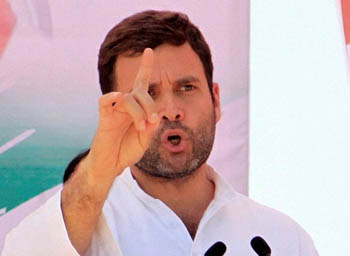
Modi_RahulNew Delhi, Apr 13: In a strong attack on Adani group perceived to be close to Narendra Modi, Rahul Gandhi said that he had been given land equal to the size of Vadodara at throwaway prices and also the Gujarat coastline of the size of Mumbai coastline.

Without explicitly mentioning the group by name, the Congress vice president alluded to it when he said, "land equal to Vadodara was given to him. Do you know for how much? For Rs 300 crore. Coastline equal to Mumbai was also given to him."

He was asked specifically during the interview to a news channel whether he was referring to the Adani group to which he said he would not like to name anybody.

Vadodara has an area of 149 square kilometers and the Mumbai coastline is 167 km long.

"When Gujarat grew, it was because of the small industries, because of movements like Amul and that is its strength. Now you see the Gujarat model, the turnover of one industrialist has grown from Rs 3,000 crore to Rs 40,000 crore," the Congress Vice President said.

He went on to add that Modi's economic model is that the "entire money of the state should be given to two-three persons. This mindset is also dangerous for the country. I keep fighting against such mindset."

Though he did not name the Adani group, Rahul has in the recent days been attacking it.

Slamming Modi's development model, he said "the reality of Gujarat is that two-three industrialists are prospering" while people are dying in the state.

"Their (Modi's) focus is on benefitting three-four industrialists so that there is trickle-down effect. Trickle-down effect happened in the US also and it has gone bust," the Congress leader said.

He insisted that UPA government headed by Manmohan Singh had performed better than NDA even though there was slowdown in growth briefly because of global recession.

While listing a number of programmes and achievements of the UPA government, he said, "The reality is that we have been in power for 10 years... There will be little bit of anti-incumbency."

When pointed out that the election campaign had become personal, Rahul said he has "no interest in personal attacks and I don't indulge in that."

He added, "Narendra Modiji is a person. He has his issues. I have nothing to do with that. But he represents an ideology. This ideology pits one Indian against another Indian. That is dangerous for the country. My fight is against this ideology."

On the issue of corruption, he said it is a "reality" but it is time to stop talking and start action against it by building institutional frameworks.

He insisted that the UPA government and he himself had been working in this direction through initiatives like RTI, Lokpal, Land Acquisition Bill and MNREGA.

Targeting BJP in this regard, he said its manifesto talks about corruption but "show me one line which says what it will do.... Talking is one thing, doing is another thing."

Comments

Add new comment

  • Coastaldigest.com reserves the right to delete or block any comments.
  • Coastaldigset.com is not responsible for its readers’ comments.
  • Comments that are abusive, incendiary or irrelevant are strictly prohibited.
  • Please use a genuine email ID and provide your name to avoid reject.
Agencies
June 30,2020

United Nations, Jun 30: India accounts for 45.8 million of the world's 142.6 million "missing females" over the past 50 years, a report by the United Nations said on Tuesday, noting that the country along with China form the majority of such women globally.

The State of World Population 2020 report released on Tuesday by the United Nations Population Fund (UNFPA), the world organisation's sexual and reproductive health agency, said that the number of missing women has more than doubled over the past 50 years - from 61 million in 1970 to a cumulative 142.6 million in 2020.

Of this global figure, India accounted for 45.8 million missing females as of 2020 and China accounted for 72.3 million.

Missing females are women missing from the population at given dates due to the cumulative effect of postnatal and prenatal sex selection in the past, the agency said.

Between 2013 and 2017, about 460,000 girls in India were missing' at birth each year. According to one analysis, gender-biased sex selection accounts for about two-thirds of the total missing girls, and post-birth female mortality accounts for about one-third, the report said.

Citing data by experts, it said that China and India together account for about 90-95 per cent of the estimated 1.2 million to 1.5 million missing female births annually worldwide due to gender-biased (prenatal) sex selection.

The two countries also account for the largest number of births each year, it said.

The report cites data by Alkema, Leontine and others, 2014 National, Regional, and Global Sex Ratios of Infant, Child, and under-5 Mortality and Identification of Countries with Outlying Ratios: A Systematic Assessment' from The Lancet Global Health.

According to their analysis, India has the highest rate of excess female deaths, 13.5 per 1,000 female births, which suggests that an estimated one in nine deaths of females below the age of 5 may be attributed to postnatal sex selection.

The report notes that governments have also taken action to address the root causes of sex selection. India and Vietnam have included campaigns that target gender stereotypes to change attitudes and open the door to new norms and behaviours.

They spotlight the importance of daughters and highlight how girls and women have changed society for the better. Campaigns that celebrate women's progress and achievements may resonate more where daughter-only families can be shown to be prospering, it said.

The report said that successful education-related interventions include the provision of cash transfers conditional on school attendance; or support to cover the costs of school fees, books, uniforms and supplies, taking note of successful cash-transfer initiatives such as Apni Beti Apna Dhan' in India.

It said that preference for a male child manifested in sex selection has led to dramatic, long-term shifts in the proportions of women and men in the populations of some countries.

This demographic imbalance will have an inevitable impact on marriage systems. In countries where marriage is nearly universal, many men may need to delay or forego marriage because they will be unable to find a spouse, the report said.

This so-called "marriage squeeze", where prospective grooms outnumber prospective brides, has already been observed in some countries and affects mostly young men from lower economic strata.

"At the same time, the marriage squeeze could result in more child marriages, the report said citing experts.

Some studies suggest that the marriage squeeze will peak in India in 2055. The proportion of men who are still single at the age of 50 is forecast to rise after 2050 in India to 10 per cent, it said.

The UN report said that every year, millions of girls globally are subjected to practices that harm them physically and emotionally, with the full knowledge and consent of their families, friends and communities.

At least 19 harmful practices, ranging from breast ironing to virginity testing, are considered human rights violations, according to the UNFPA report, which focuses on the three most prevalent ones: female genital mutilation, child marriage, and extreme bias against daughters in favour of sons.

Harmful practices against girls cause profound and lasting trauma, robbing them of their right to reach their full potential, says UNFPA Executive Director Dr. Natalia Kanem.

This year, an estimated 4.1 million girls will be subjected to female genital mutilation. Today, 33,000 girls under age 18 will be forced into marriages, usually to much older men and an extreme preference for sons over daughters in some countries has fuelled gender-biased sex selection or extreme neglect that leads to their death as children, resulting in the 140 million missing females.

The report said that ending child marriage and female genital mutilation worldwide is possible within 10 years by scaling up efforts to keep girls in school longer and teach them life skills and to engage men and boys in social change.

Investments totalling USD 3.4 billion a year through 2030 would end these two harmful practices and end the suffering of an estimated 84 million girls, it said.

A recent analysis revealed that if services and programmes remain shuttered for six months due to the COVID-19 pandemic, an additional 13 million girls may be forced into marriage and 2 million more girls may be subjected to female genital mutilation between now and 2030.

The pandemic both makes our job harder and more urgent as so many more girls are now at risk, Kanem said.

Comments

Add new comment

  • Coastaldigest.com reserves the right to delete or block any comments.
  • Coastaldigset.com is not responsible for its readers’ comments.
  • Comments that are abusive, incendiary or irrelevant are strictly prohibited.
  • Please use a genuine email ID and provide your name to avoid reject.
News Network
February 9,2020

Feb 9: The Electronic Voting Machines (EVMs) used in Delhi Assembly polls are kept under tight security, in the 'Strong Room' located at Atal Adarsh Bengali Balika Vidyalaya in Gol Market.

Voting for Delhi Assembly elections took place on Saturday with voters turnout well short of the 2015 election mark.

Counting of the votes will be on February 11.

Earlier, Deputy Election Commissioner Sudip Jain had said the Delhi elections took place peacefully and smoothly.

Comments

Add new comment

  • Coastaldigest.com reserves the right to delete or block any comments.
  • Coastaldigset.com is not responsible for its readers’ comments.
  • Comments that are abusive, incendiary or irrelevant are strictly prohibited.
  • Please use a genuine email ID and provide your name to avoid reject.
News Network
July 23,2020

New Delhi, Jul 23: With the highest single-day spike of 45,720 cases, India's coronavirus count crossed 12 lakh mark on Thursday.

The Union Ministry of Health and Family Welfare informed that 1,129 deaths were recorded in the last 24 hours.

The total number of coronavirus cases stand at 12,38,635 including 4,26,167 active cases, 7,82,606 cured/discharged/migrated. The cumulative toll has reached 29,861 deaths.

Maharashtra has reported 3,37,607 cases, highest in the country followed by Tamil Nadu with 1,86,492 cases. Delhi coronavirus count has reached 1,26,323 cases.

According to the Indian Council of Medical Research (ICMR), 1,50,75,369 samples were tested till July 22 out of which 3,50,823 samples were tested yesterday.

Comments

Add new comment

  • Coastaldigest.com reserves the right to delete or block any comments.
  • Coastaldigset.com is not responsible for its readers’ comments.
  • Comments that are abusive, incendiary or irrelevant are strictly prohibited.
  • Please use a genuine email ID and provide your name to avoid reject.