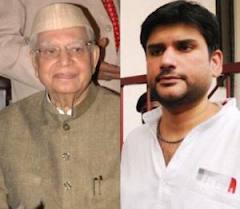
ND Tiwari is biological father of Rohit Shekhar: DNA test

July 27, 2012

ND

New Delhi, July 27: In an embarrassment to veteran Congress leader N D Tiwari, a DNA test has confirmed that he is the biological father of Rohit Shekhar.

Earlier, the Delhi high court on Friday rejected his plea not to open his DNA report before a single judge bench, adjudicating the paternity suit of a city youth, who claims to be his son.

The court allowed Justice Reva Khetrapal, who has decided to open Tiwari's DNA report along with those of paternity suit petitioner Rohit Shekhar and his mother Ujjwala Sharma at 2.30 pm today, to declare the DNA test result in open court, but asked her not to give its copies to any party to the case.

Dismissing Tiwari's appeal against Justice Khetrapal's July 19 decision, a division bench of Acting Chief Justice A K Sikri and Justice Rajiv Sahai Endlaw said, "Not opening the DNA report may lead to a lengthy process".

Concurring with the single judge's observation on Supreme Court's direction to maintain confidentiality on Tiwari's DNA profile, the bench said, "We are in agreement with the single judge that nowhere the Supreme Court in its order stated that the DNA profile shall be kept in a sealed cover till the conclusion of trial. This DNA report is a piece of evidence.."

"The purpose was to cut short the controversy and to avoid an unnecessarily prolonged trial. If the sample is not opened now, it may lead to unnecessary cross-examination of the witnesses. We do not find merit in the petition, so it is dismissed," the bench added.

Tiwari's counsel and senior advocate Mukul Gupta had sought quashing of the single judge's order or to provide protection till the Supreme Court clarifies its May 24 order on the issue of confidentiality.

The senior lawyer submitted to the bench that after the single judge dismissed their plea to conduct the trial in-camera and also to keep the DNA report confidential, they have filed an application before the apex court, which is yet to hear their plea.


Comments

Add new comment

  • Coastaldigest.com reserves the right to delete or block any comments.
  • Coastaldigset.com is not responsible for its readers’ comments.
  • Comments that are abusive, incendiary or irrelevant are strictly prohibited.
  • Please use a genuine email ID and provide your name to avoid reject.
Agencies
June 29,2020

From March through May, around 1 crore migrant workers fled India’s megacities, afraid to be unemployed, hungry and far from family during the world’s biggest anti-Covid-19 lockdown.

Now, as Asia’s third-largest economy slowly reopens, the effects of that massive relocation are rippling across the country. Urban industries don’t have enough workers to get back to capacity, and rural states worry that without the flow of remittances from the city, already poor families will be even worse off -- and a bigger strain on state coffers.

Meanwhile, migrant workers aren’t expected to return to the cities as long as the virus is spreading and work is uncertain. States are rolling out stimulus programs, but India’s economy is hurtling for its first contraction in more than 40 years, and without enough jobs, a volatile political climate gets more so.

“This will be a huge economic shock, especially for households of short-term, cyclical migrants, who tend to come from vulnerable, poor and low-caste and tribal backgrounds,” said Varun Aggarwal, a founder of India Migration Now, a research and advocacy group based in Mumbai.

In the first 15 days of India’s lockdown, domestic remittances dropped by 90%, according to Rishi Gupta, chief executive officer of Mumbai-based Fino Paytech Ltd., which operates the country’s biggest payments bank.

By the end of May, remittances were back to around 1750 rupees ($23), about half the pre-Covid average. Gupta’s not sure how soon it’ll fully recover. “Migrants are in no hurry to come back,” Gupta said. “They’re saying that they’re not thinking of going back at all.”

If workers stay in their home states long term, policymakers will have more than remittances to worry about. If consumption falls and the new surplus of labor drives wages down, Agarwal said, “there will also be a second-order shock to the local economy. Overall, not looking good.”

India announced a $277 billion stimulus package in May and followed it up with a $7 billion program aimed at creating jobs for 125 days for migrants in villages across 116 districts. Separately, local authorities are also looking for solutions.

Officials in Bihar have identified 2,500 acres of land that could be made available to investors, said Sushil Modi, deputy chief minister of Bihar, a state in east India. “We can use this crisis as an opportunity to speed up reforms,” he said.

The investors haven’t materialised yet, and in the meanwhile, state governments are relying on the national cash-for-work program that guarantees 100 days worth of wages per household.

Skilled workers don’t want to do manual labor offered through the program, and even if they did, says Amitabh Kundu of RIS, many think of it as beneath their station. “There will be an increase in social tensions,” he predicts. “Caste may again start playing a role. It’s absolute chaos.”

For skilled workers, initiatives vary:

* Uttar Pradesh, which received 3.2 million people, is compiling lists of skilled workers who need employment and trying to place them with local manufacturing and real estate industry associations. So far, the government says, it’s placed 300,000 people with construction and real estate firms.

* Bihar has placed returners in state-run infrastructure projects and hired others to stitch uniforms and make furniture for government-run schools, even as they waited in quarantine centres, said Pratyay Amrit, head of the state’s disaster management department.

* The eastern state of Odisha announced an urban wage employment program aimed at putting as many as 450,000 day labourers to work through September. Some 25,000 people have been employed, so far, under the scheme, G. Mathivathanan, principal secretary for housing and urban development said.

Attracting Investments

It’s not clear any of this will be enough to make a dent, says Ravi Srivastava, professor at New Delhi-based Institute of Human Development, adding that the states don’t have much of a track record on economic development.

“It was the failure of these states to improve governance and put development plans in place that led to the out-migration in the first place,” he said.

But officials and workers’ rights advocates see opportunity. Uttar Pradesh has established liaisons to encourage companies from the US, Japan and South Korea to establish manufacturing in the state. There and in Madhya Pradesh and Rajasthan, the government has made labour laws more friendly to employers, making it easier to hire and fire workers.

Modi, the minister from Bihar, said the migration may also give workers--historically a disenfranchised group--new power, particularly as urban centres struggle. “The way industries treated workers during the lockdown -- didn’t pay them, the living conditions were poor -- now these industries will realize the value of this force,” Modi said.

“In the days to come, labour will emerge as a force that can’t be ignored anymore,” he added. “That’s the new normal. We will work out how to ensure dignity, rights to our people who are going to work in other states.”

Bihar is due for elections by November, a vote that could be an early test of the mass migration’s political consequences. The state is currently governed by a coalition that includes Prime Minister Narendra Modi’s Bharatiya Janata Party. Amitabh Kundu, a fellow at the Research and Information System for Developing Countries, a New Delhi-based government think-tank, said migrant workers are likely to be angry voters.

“Chief ministers are telling these migrants that they will not have to go back for work,” he said. “But their capacity to do something miraculous in the next four to five months is doubtful. If they can retain even one-fourth of the migrants, I would call it a success.”


Comments

Add new comment

  • Coastaldigest.com reserves the right to delete or block any comments.
  • Coastaldigset.com is not responsible for its readers’ comments.
  • Comments that are abusive, incendiary or irrelevant are strictly prohibited.
  • Please use a genuine email ID and provide your name to avoid reject.
News Network
April 28,2020

New Delhi, Apr 28: Outstanding loans amounting to Rs 68,607 crore of top 50 wilful bank loan defaulters in the country including firms of Mehul Choksi and Vijay Mallya have been technically written off till September 30, 2019, the Reserve Bank of India said in a RTI reply.

Absconding dimantaire Choksi's company Gitanjali Gems tops the list of these defaulters with a whopping amount of Rs 5,492 crore, according to the list.

This is followed by REI Agro with Rs 4,314 crore and Winsome Diamonds with Rs 4,076 crore.

Rotomac Global Private Limited has funded advances of Rs 2,850 crore which have been technically written off and Kudos Chemie Ltd with Rs 2,326 crore, Ruchi Soya Industries Limited, now owned by Ramdev's Patanjali, with Rs 2,212 crore and Zoom Developers Pvt Ltd with Rs 2,012 crore being the other companies.

Mallya's Kingfisher Airlines figures in the list at number 9, with outstanding of Rs 1943 crore which have been technically written off by the banks.

Forever Precious Jewellery and Diamonds Private Limited has loans of Rs 1,962 crore written off while Deccan Chronicle Holdings Limited have Rs 1915 crore written off loans.

Choksi's other firms Gili India and Nakshatra Brands also have loans of Rs 1,447 and Rs 1109 crore respectively written off.

REI Agro of Jhunjhunwala brothers is already under the scanner of ED. The CBI and ED are also probing alleged fraud by the owners of Winsome Diamonds.

Vikram Kothari's Rotomac is the fourth in the list. He and his son Rahul Kothari were arrested by the CBI for bank loan default.

In the last Parliament session, Rahul Gandhi had asked the government to provide a list of top 50 bank loans defaulters in the country, leading to sharp exchanges and uproar in the Lok Sabha.

"The information on top 50 wilful defaulters and their sum of funded amount outstanding and amount technically/prudentially written off as on September 30, 2019 reported in CRILC by banks, is provided," the RBI said in its written response dated April 24.

In his application, RTI activist Saket Gokhale had sought the list of defaulters as on February 16, but the RBI said the requested information is not available.

The RBI said that according to section 8 (1)(a) of RTI Act 2005 read with para 77 of Supreme Court judgement of December 16, 2015 in Jayantilal N Mistry case, information on overseas borrowers is exempted from public disclosure.

"Data is as reported by banks and RBI will not be held responsibly or accountable for any misreporting and/or incorrect reporting by the reporting entities," the RBI said in the written reply to the RTI query.

Comments

Add new comment

  • Coastaldigest.com reserves the right to delete or block any comments.
  • Coastaldigset.com is not responsible for its readers’ comments.
  • Comments that are abusive, incendiary or irrelevant are strictly prohibited.
  • Please use a genuine email ID and provide your name to avoid reject.
News Network
February 4,2020

New Delhi, Feb 4: Uttar Pradesh Chief Minister Yogi Adityanath on Monday accused Arvind Kejriwal of having a "partnership" with Pakistan and appealed to the people in Delhi to not vote for the AAP chief as it will make Pakistan happy.

Ramping up his attack on the Shaheen Bagh protest, Adityanath said that the protest against the Citizenship Amendment Act (CAA) is merely an excuse for people to vent their anger against the scrapping of Article 370.

"You must have seen their partnership on 370. Arvind Kejriwal used to speak in the same voice as Imran Khan on Article 370. You must have heard it.

"Now when elections are taking place in Delhi, who is speaking in favour of Arvind Kejriwal? It is the ministers of Pakistan. They are aware that Kejriwal is feeding 'biryani to protesters at Shaheen Bagh'," he said, referring to Pakistan minister Fawad Chaudhry's tweet asking Indians to defeat Prime Minister Narendra Modi.

Adityanath addressed three rallies on Monday in the national capital ahead of assembly elections.

"Will Pakistan decide who Indians should vote for. If voting for Kejriwal will make Pakistan happy, should it be done," he asked at a rally in Mehrauli.

Adityanath said his Delhi counterpart Kejriwal has become a "toy in the hands of anti-social and anti-India elements".

Addressing a rally in Vikaspuri in west Delhi, he said that Kejriwal is not bothered about key issues such as providing clean drinking water but is concerned about Shaheen Bagh, the anti-citizenship amendment act protest site.

At another rally in Uttam Nagar in west Delhi, Adityanath said Kejriwal has played with the emotions of the people of Delhi for the last five years.

"He obstructed the development of Delhi. And knowingly and unknowingly, he became a toy in the hands of anti-social and anti-India elements," Adityanath said.

The protest at Shaheen Bagh, he said, has disrupted traffic across the capital.

"A guest with an appointment to meet him at 9.30 am could only reach at 11. He told me he had left as early as 7 am but got stuck because of the traffic in Shaheen Bagh," he said.

The Uttar Pradesh chief minister also slammed Kejriwal for "sympathising" with elements who he said gave anti-India slogans in Jawaharlal Nehru University.

Comments

Add new comment

  • Coastaldigest.com reserves the right to delete or block any comments.
  • Coastaldigset.com is not responsible for its readers’ comments.
  • Comments that are abusive, incendiary or irrelevant are strictly prohibited.
  • Please use a genuine email ID and provide your name to avoid reject.