Nepal's death toll soars to 3,815

April 27, 2015

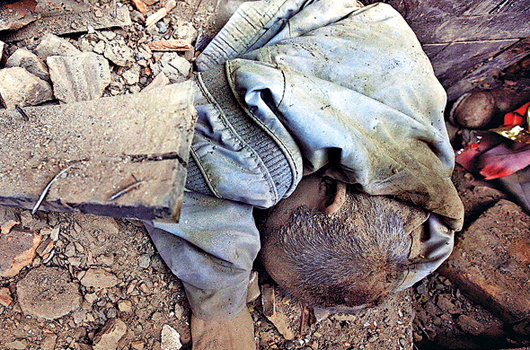
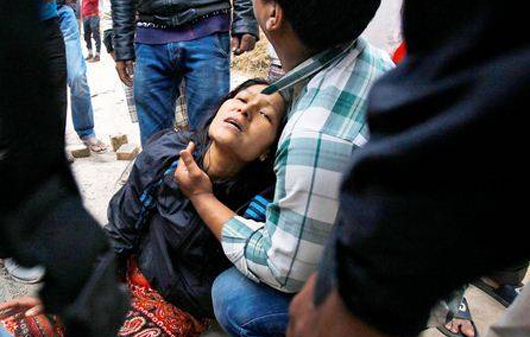
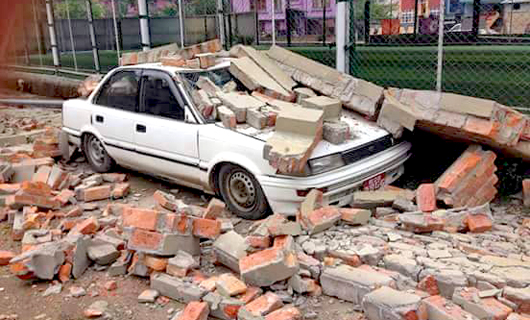
Kathmandu, Apr 27: The death toll from the 7.9 magnitude temblor that struck Nepal was on Monday placed at 3,815, with Kathmandu accounting for nearly 1,000 deaths.

The home ministry said in a statement another 6,515 people had been injured. The Saturday earthquake, the worst to hit Nepal after 1934, had its epicentre in Gorkha district.

The highest death toll of 1,021 among all districts was reported from Sindhupalchowk, about 65 km from here. Kathmandu, where damage to property was maximum, saw 920 fatalities.

Nuwakot district accounted for 422 deaths, Dhading 299, Bhaktapur 240, Gorkha 223, Kavre 193, Lalitpur 157 and Rasuwa district 150.

The other fatalities were reported from Dolakha (46), Makawanpur (33), Ramechap (26), Solu (21), Okhaldunga (16), Sindhuli (9), Sunsari (7), Chitwan and Bara (5 each), Lamjung (4), Parsa (3), Kaski, Bhojpur and Mornag (2 each) and Saptari, Dhanusha, Taplegunj, Sarhahi, Rauthat,

nepal tent

Earlier

Nepal earthquake toll rises above 3,600

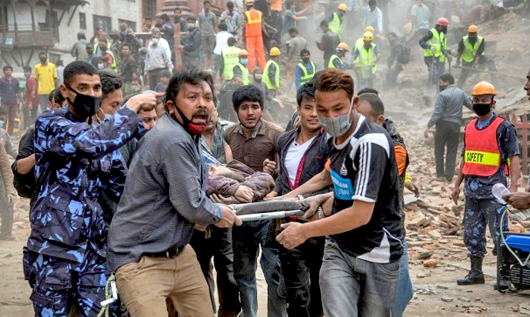
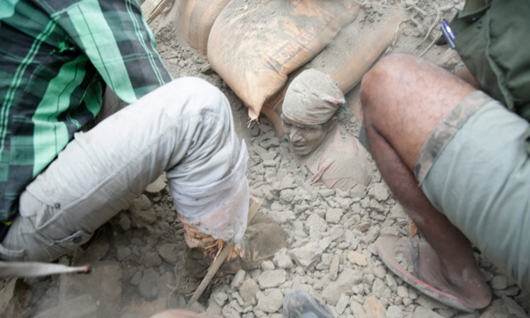
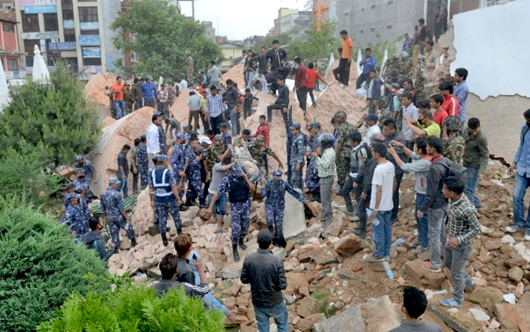
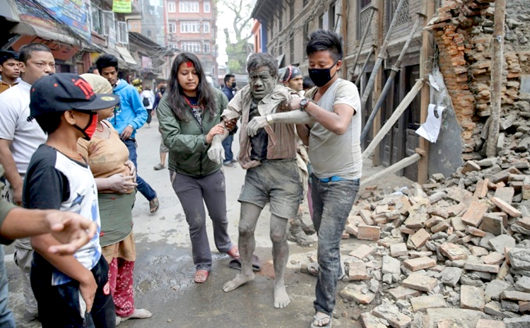
Kathmandu, Apr 27: Rescue workers today intensified efforts to locate survivors trapped under tonnes of rubble of flattened homes and buildings in earthquake-hit Nepal amid concerns that death toll could rise from more than 3,600 with rescue teams reaching remote mountainous areas.

Racing against time, multi-national rescue teams with sniffer dogs and advanced equipment are desperately trying to locate survivors as hundreds of people are still missing.
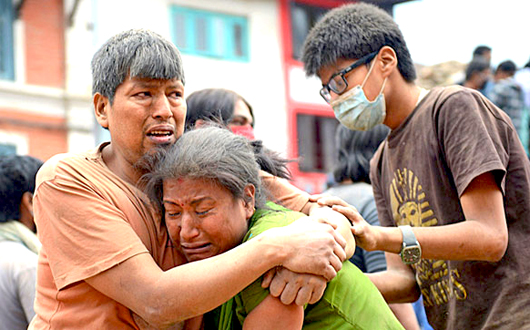
aftershock

More than 700 disaster relief experts drawn from the National Disaster Relief Force have been deployed by India.

In a statement, Nepalese police today said the death toll had risen to 3,617 people. That does not include the 22 people killed in the avalanche on Mount Everest.

Nepalese Home ministry's national disaster management division said more than 6,830 people were injured.

1,053 people are reported killed in the Kathmandu Valley alone and 875 in Sindhupalchowk, it said.

Officials and aid agencies have warned that the casualties could rise as rescue teams reach remote mountainous areas of western Nepal.

"Villages are routinely affected by landslides, and it's not uncommon for entire villages of 200, 300, up to 1,000 people to be completely buried by rock falls," aid agency World Vision spokesman Matt Darvas said.

The blocked roads, downed power lines and overcrowded hospitals along with fresh tremors are hampering rescue efforts to locate survivors of the Saturday's 7.8 magnitude quake that had its impact in several cities in Bihar, West Bengal and UP northeast India.

It was also felt in Southern and Western parts of India, China, Bhutan and as far as Pakistan and Bangladesh.

Officials said five Indians, including the daughter of an Indian embassy employee, were among those killed in the quake.

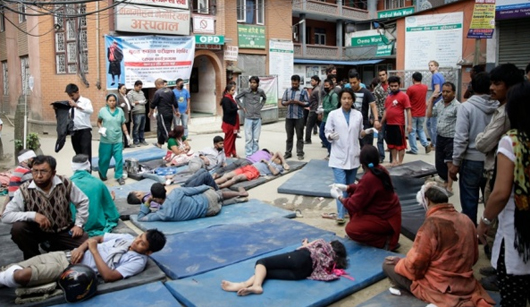
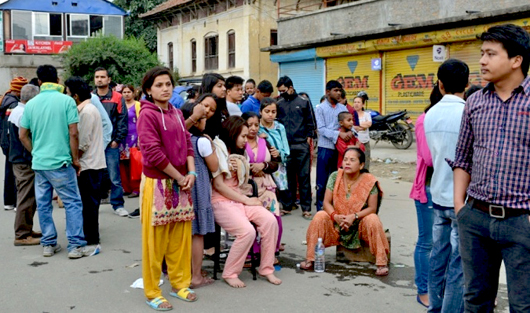
Tens of thousands of people were forced to spend the two consecutive nights sleeping in open in makeshift plastic tents barely shielding them from the pouring rain.

Earlier:

Nepal quake: Death toll crosses 3,200; sick and wounded lay out in the open

Kathmandu, Apr 27: Thousands of desperate Nepalese huddled under tents and sought scarce food and medical supplies on Monday, two days after a massive quake killed more than 3,200 people and overwhelmed authorities struggled to cope with the disaster.

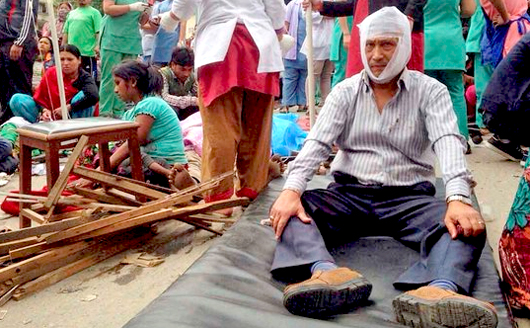
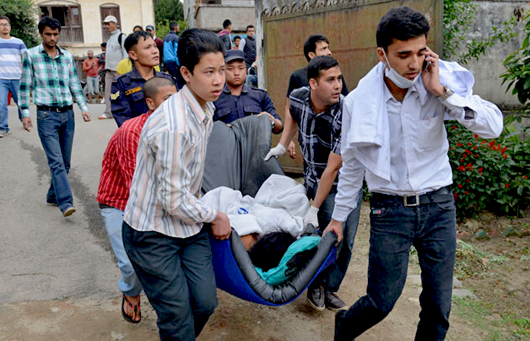
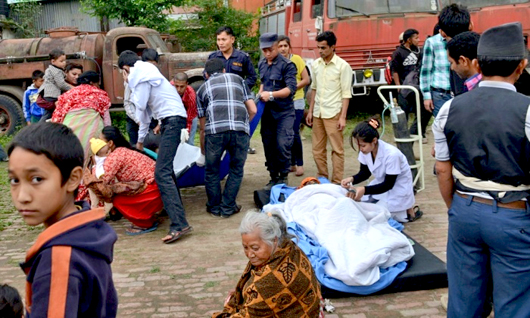
The sick and wounded lay out in the open in the capital, Kathmandu, unable to find beds in the devastated city's hospitals. Surgeons set up an operating theater inside a tent in the grounds of Kathmandu Medical College.

"We are overwhelmed with rescue and assistance requests from all across the country," said Deepak Panda, a member of the country's disaster management.

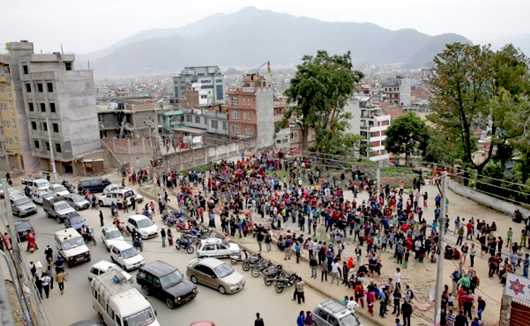
Across Kathmandu and beyond, exhausted families whose homes were either flattened or at risk of collapse laid mattresses out on streets and erected tents to shelter from rain.

People queued for water dispensed from the back of trucks, while the few stores still open had next to nothing on their shelves. Crowds jostled for medicine at one pharmacy.

High in the Himalayas, hundreds of foreign and Nepalese climbers remained trapped after a huge avalanche ripped through the Mount Everest base camp, killing 17 people in the single worst disaster to hit the world's highest mountain.

A total of 3,218 people were confirmed killed in the 7.9 magnitude quake, a police official said on Monday, the worst in Nepal since 1934 when 8,500 died. More than 6,500 were injured.

Another 66 were killed across the border in India and at least another 20 in Tibet, China's state news agency said.

The toll is likely to climb as rescuers struggle to reach remote regions in the impoverished, mountainous country of 28 million people and as bodies buried under rubble are recovered.

"The rescue workers are in a really bad shape. We are all about to collapse. We have worked two straight nights," said home ministry official Laxmi Prasad Dhakal.

With so many people sleeping in the open with no power or water and downpours forecast, fears mounted of major food and water shortages. Across Nepal, hundreds of villages have been left to fend for themselves.

"There is no electricity, no water. Our main challenge and priority is to restore electricity and water," Dhakal said.

"The next big challenge is the supply of food. Shopkeepers are unable to go in and open their shops. So people are facing difficulty buying food."Several countries rushed to send aid and personnel.

India flew in medical supplies and members of its National Disaster Response Force. China sent a 60-strong emergency team. Pakistan's army said it was sending four C-130 aircraft with a 30-bed hospital, search and rescue teams and relief supplies.

A Pentagon spokesman said a U.S. military aircraft with 70 personnel left the United States on Sunday and was due in Kathmandu on Monday. Australia, Britain and New Zealand said they were sending specialist urban search-and-rescue teams to Kathmandu at Nepal's request.

Britain, which believes several hundred of its nationals are in Nepal, was also delivering supplies and medics.

However, there has been little sign of international assistance on the ground so far, with some aid flights prevented from landing by aftershocks that closed Kathmandu's main airport several times on Sunday.

AVALANCHE TERROR

In the Himalayas, hundreds of climbers felt tremors on Sunday powerful enough to send snow and boulders cascading towards them. Another was felt early on Monday.

The huge and deadly avalanche on Saturday triggered by the earthquake caused panic at the Everest base camp, a sprawling "city" of tents from where mountaineers set off for the world's highest peak.

"It was a monstrous sound, like the demons had descended on the mountain," Khile Sherpa, a Nepalese guide, told Reuters, recalling the moment the avalanche hit.

He was one of the lucky few airlifted to the relative safety of Kathmandu but the disaster has underlined the woeful state of Nepal's medical facilities.

Nepal has only 2.1 physicians and 50 hospital beds for every 10,000 people, according to a 2011 World Health Organization report.

"The earthquake has exposed that Nepal's best public hospital infrastructure has crumbled at a time when it should serve more people in a hurry," said Sarvendra Moongla, a senior surgeon at Bir Hospital's Trauma Center in Kathmandu, which opened in February.

At the Tribhuvan University Teaching Hospital, bodies, including that of a boy aged about seven, were heaped in a dark room. The stench of death was overpowering.

Rajiv Biswas, Asia Pacific chief economist at business research firm IHS, said long-term reconstruction costs in Nepal using proper building standards for an earthquake zone could be more than $5 billion, or around 20 percent of the country's GDP.

"With housing construction standards in Nepal being extremely low ... the impact of the earthquake has been devastating based on initial reports," he said in an early analysis of the likely damage.

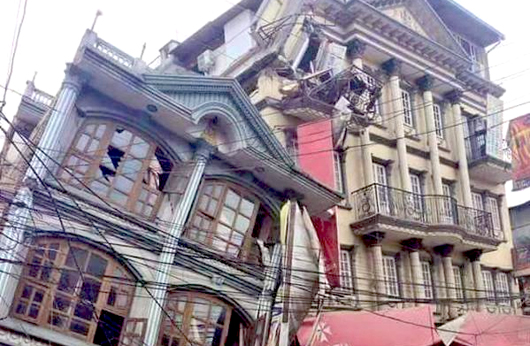
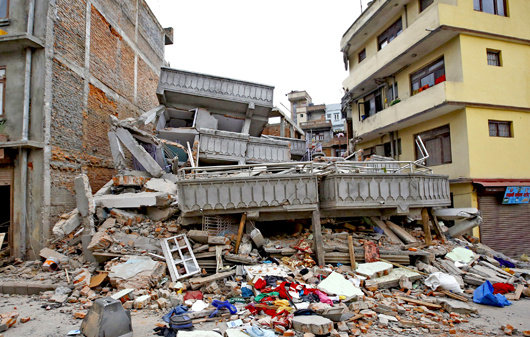
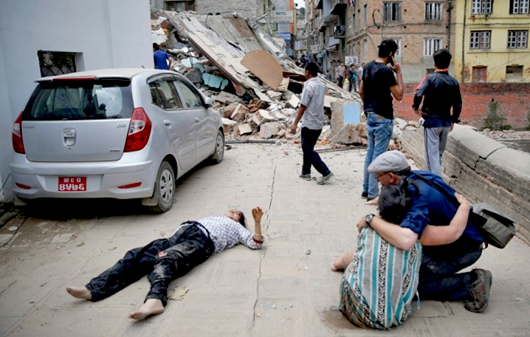
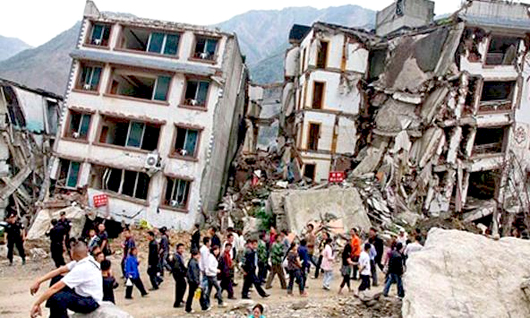
In crowded Kathmandu, many buildings were flattened or badly damaged.

Among the capital's landmarks destroyed in the earthquake was the 60-metre (200-foot) Dharahara Tower, built in 1832 for the queen of Nepal.
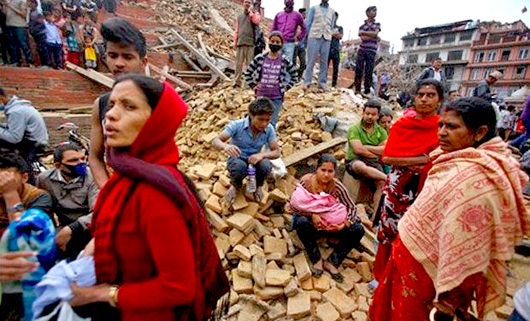
Nepal quake1

Earlier post:

Death toll crosses 2,000 in Nepal quake as fresh jolts felt

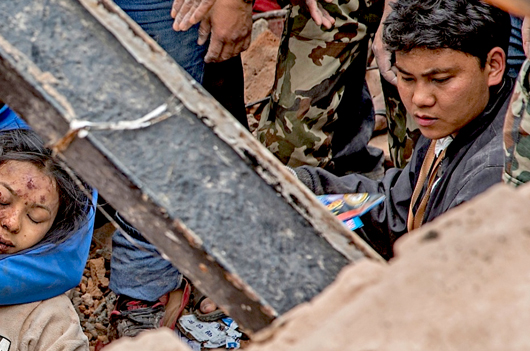
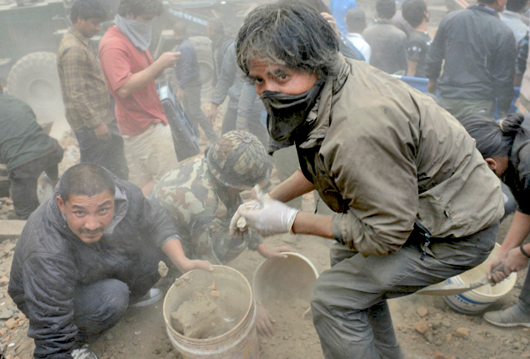
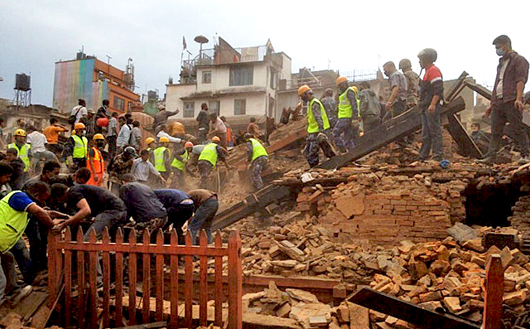
Kathmandu, Apr 26: Rescuers today dug with bare hands and heavy equipment through tonnes of rubble for survivors as toll from the devastating temblor crossed the 2,000-mark in Nepal's worst quake in over 80 years, with fresh aftershocks triggering panic and hampering relief efforts.

A strong 6.7-magnitude aftershock sent people running for open spaces as they struggled with the devastation caused by yesterday's massive 7.9-magnitude temblor that displaced and injured thousands besides causing a deadly avalanche on the Mount Everest claiming 17 lives.

"The latest figure says more than 2,000 people have died and several thousands have been wounded and more counts are coming," said Narayan Khatkar, Nepal's Urban Development Minister.

A police official told media here that 2,123 people were killed.Over 5,000 people were also injured in the earthquake and the dozen aftershocks that continued till today, with the strongest measuring 6.7 on the Richter Scale.Climbers on Mount Everest said they saw fresh series of avalanches and a big landslide in the base camp.

International teams, including from India, have touched down quake-hit Nepal that has declared a state of emergency in the wake of the disaster caused, the worst in over 80 years of Nepal's recorded history.

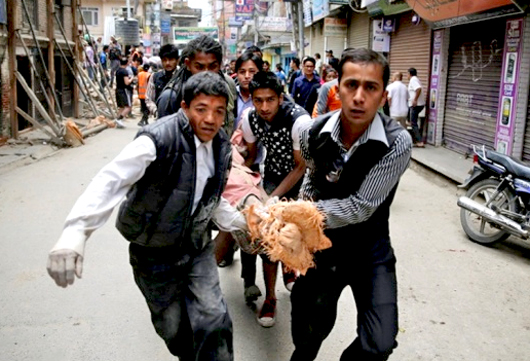
Rescuers have been hunting for survivors under heaps of debris with bare hands as well as heavy equipment though the efforts have been hampered due to fresh tremors and thunderstorms.

Locals and tourists sifted through mounds of debris for survivors. Cheers rose when people were found alive, thought mostly bodies were pulled out.

The earthquake and the aftershocks left behind a trail of death and destruction, flattening houses and buildings, including the iconic Dharhara tower and the landmark Darbar Square in the heart of the capital, trapping scores of people.

Thousands of people spent last night in the open in chilly weather, anticipating more aftershocks.

1,053 people are reported killed in the Kathmandu Valley alone. Officials fear the death toll could rise as desperate search for survivors continued.

According to initial reports related to today's aftershock, a tunnel caved in at the Trishuli Hydel Project and around 60 labourers are feared trapped.

MI-17 helicopters of the Indian Air Force (IAF) have carried out five casualty evacuation sorties and the injured have been moved to military hospitals.
nepal9

As many as 17 Mount Everest climbers, including foreigners, were reportedly killed in an avalanche triggered by the earthquake.

The latest aftershock hit at a shallow depth of 10 kilometres at 12:39 IST, according to the US Geological Survey.

The aftershock was registered 17 kilometres south of Kodari - 114 kilometres north of here - near the Tibet Autonomous Region of China.

The tremors - that were felt also in India including its national capital - sent people running for open spaces.

According to reports, the route to the base camp has been destroyed and the IAF choppers were trying to rescue the survivors, around 100 in number including foreigners who were said to be safe.

A climber Jim Davidson said he felt the aftershock at Camp One on Mount Everest.

"Just had our biggest aftershock yet here at C1 on Everest. Smaller than original quake but glacier shook & avalanches," he tweeted.

An Indian attempting to climb all the highest peaks in the seven continents, 54-year-old Ankur Bahl is also stuck at Camp II on Mount Everest along with 11 other fellow climbers.

Bahl had moved to Camp II from Camp I yesterday but is now stranded due to the earthquake, his friends in New Delhi said.

Two Indians, including the daughter of an Indian embassy employee, were among those killed in the powerful earthquake, an Indian embassy official said.

A house in the Indian Embassy complex collapsed, killing the daughter of a CPWD employee. Death of another Indian was reported at Bir Hospital here.

Over 550 Indians have been evacuated by the IAF from earthquake-hit Nepal even as India stepped up its relief and rescue mission with 10 flights and 12 helicopters scheduled to carry specialists and equipment to Kathmandu today.

The Tribhuvan International Airport, that was closed down yesterday following the quake, was opened briefly, only to be shut down again due to fresh tremors.

IndiGo, SpiceJet flights could not land here and were forced to return as Air Traffic Control personnel at the airport were evacuated following fresh aftershocks.

Many hospitals in Nepal are struggling to cope with the large number of injured.

Nepal Prime Minister Sushil Koirala, who was on a visit to Indonesia, had to cut short his trip in the wake of the disaster.

The Nepalese government has declared a national crisis and established a fund of Rs 500 million for the reconstruction of the damaged infrastructure.

Many areas in the country have no electricity for the past 24 hours and authorities say the situation is likely to continue for the next few days.

Offers of help poured in from around the world, with the US, the European Union as well the United States saying they were sending in disaster response teams.

"The United Nations is supporting the Government of Nepal in coordinating international search and rescue operations and is preparing to mount a major relief effort," UN Secretary- General Ban said in a statement today.
nepal2

nepal1

nepal3

nepal4

nepal5

nepal6

nepal7

Nepal earthquake

nepal8

nepal10

nepal11

nepal12

nepal13

nepal14

nepal15

nepal16

nepal17

nepal18

nepal19

nepal20

Comments

Add new comment

  • Coastaldigest.com reserves the right to delete or block any comments.
  • Coastaldigset.com is not responsible for its readers’ comments.
  • Comments that are abusive, incendiary or irrelevant are strictly prohibited.
  • Please use a genuine email ID and provide your name to avoid reject.
News Network
May 15,2020

May 15: Global tensions simmered over the race for a coronavirus vaccine Thursday, as the United States and China traded jabs, and France slammed pharmaceuticals giant Sanofi for suggesting the US would get any eventual vaccine first.

Scientists are working at breakneck speed to develop a vaccine for COVID-19, the disease caused by the virus, which has killed more than 300,000 people worldwide and pummelled economies.

From the US to Europe to Asia, national and local governments are easing lockdown orders to get people back to work -- while fretting over a possible second wave of infections.

Increased freedom of movement means an increased risk of contracting the virus, and so national labs and private firms are labouring to find the right formula for a vaccine.

The European Union's medicines agency offered some hope when it said one could be ready in a year, based on data from clinical trials already underway.

But Marco Cavaleri, the EMA's head of vaccines strategy, acknowledged that timeline was a "best-case scenario," and cautioned that "there may be delays."

The race for a vaccine has exposed a raw nerve in relations between the United States and China, where the virus was first detected late last year in the central city of Wuhan.

Two US agencies warned Wednesday that Chinese hackers were trying to steal COVID-19 vaccine research -- a claim Beijing rejected as "smearing" its reputation.

US President Donald Trump, who has ratcheted up the rhetoric against China, said he doesn't even want to engage with Chinese leader Xi Jinping -- potentially imperilling a trade deal between the world's top two economies.

"I'm very disappointed in China. I will tell you that right now," he said in an interview with Fox Business.

"There are many things we could do. We could do things. We could cut off the whole relationship."

On Capitol Hill, an ousted US health official told Congress that the Trump government had no strategy in place to find and distribute a vaccine to millions of Americans, warning of the "darkest winter" ahead.

"We don't have a single point of leadership right now for this response, and we don't have a master plan," said Rick Bright, who was removed last month as head of the US agency charged with developing a coronavirus vaccine.

The United States has registered nearly 86,000 deaths linked to COVID-19 -- the highest toll of any nation.

World leaders were among 140 signatories to a letter published Thursday saying any vaccine should not be patented and that the science should be shared among nations.

"Governments and international partners must unite around a global guarantee which ensures that, when a safe and effective vaccine is developed, it is produced rapidly at scale and made available for all people, in all countries, free of charge," it said.

But a row erupted in France after drugmaker Sanofi said it would reserve first shipments of any vaccine it discovered to the United States.

The comments prompted a swift rebuke from the French government -- President Emmanuel Macron's office said any vaccine should be treated as "a global public good, which is not submitted to market forces."

Sanofi chief executive Paul Hudson said the US had a risk-sharing model that allowed for manufacturing to start before a vaccine had been finally approved -- while Europe did not.

"The US government has the right to the largest pre-order because it's invested in taking the risk," Hudson told Bloomberg News.

Macron's top officials are scheduled to meet with Sanofi executives about the issue next week.

The search for a vaccine became even more urgent after the World Health Organization said the disease may never go away and the world would have to learn to live with it for good.

"This virus may become just another endemic virus in our communities and this virus may never go away," said Michael Ryan, the UN body's emergencies director.

The prospect of the disease lingering leaves governments facing a delicate balancing act between suppressing the pathogen and getting their economies up and running.

In the US, more grim economic data emerged Thursday, with nearly three million more Americans applying for unemployment benefits.

That takes the overall total to 36.5 million -- more than 10 percent of the US population.

Further signs of the damage to businesses emerged when Lloyd's of London forecast the pandemic will cost the global insurance industry about $203 billion.

European markets closed down, but Wall Street rallied despite the new jobless claims. In a sign of progress, the New York Stock Exchange trading floor was due to reopen on May 26.

The reopening of economies continued in earnest across Europe, where the EU has set out proposals for a phased restart of travel and the eventual lifting of border controls.

"Maybe it's a mistake, but we have no choice. Without tourists, we won't get by!" Enrico Facchetti, a 61-year-old former goldsmith, said of Venice's reopening.

Japan -- the world's third largest economy -- lifted a state of emergency across most of the country except for Tokyo and Osaka.

And Canadian Prime Minister Justin Trudeau said national parks would partially reopen on June 1.

But in Latin America, the virus continued to surge, with a 60 percent leap in cases in the Chilean capital of Santiago.

Authorities said 2,000 new graves were being dug at the main cemetery.

South Sudan reported its first COVID-19 death on Thursday.

And in Bangladesh, the first case was confirmed in the teeming Rohingya refugee camps in Bangladesh, which are home to nearly one million people.

Comments

Add new comment

  • Coastaldigest.com reserves the right to delete or block any comments.
  • Coastaldigset.com is not responsible for its readers’ comments.
  • Comments that are abusive, incendiary or irrelevant are strictly prohibited.
  • Please use a genuine email ID and provide your name to avoid reject.
News Network
May 8,2020

May 8: Thousands of migrants have been stranded “all over the world” where they face a heightened risk of COVID-19 infection, the head of the UN migration agency International Organization for Migration (IOM) has said.

IOM Director-General António Vitorino said that more onerous health-related travel restrictions might discriminate disproportionately against migrant workers in future.

“Health is the new wealth,” Vitorino said, citing proposals by some countries to introduce the so-called immunity passports and use mobile phone apps designed to prevent the spread of the new coronavirus.

“In lots of countries in the world, we already have a system of screening checks to identify the health of migrants, above all malaria, tuberculosis… HIV-AIDS, and now I believe that there will be increased demands in health controls for regular migrants,” he said on Thursday.

Travel restrictions to try to limit the spread of the pandemic has left people on the move more vulnerable than ever and unable to work to support themselves, Vitorino told journalists via videoconference.

“There are thousands of stranded migrants all over the world.

 “In South-East Asia, in East Africa, in Latin America, because of the closing of the borders and with the travel restrictions, lots of migrants who were on the move; some of them wanted to return precisely because of the pandemic,” he said.

They are blocked, some in large groups, some in small, in the border areas, in very difficult conditions without access to minimal care, especially health screening, Vitorino said.

“We have been asking the governments to allow the humanitarian workers and the health workers to have access to (them),” he said.

Turning to Venezuelan migrants, who are believed to number around five million amidst a worsening economic crisis in the country, the IOM chief said “thousands… have lost their jobs in countries like Ecuador and Colombia and are returning back to Venezuela in large crowds without any health screening and being quarantined when they go back”.

In a statement, the IOM highlighted the plight of migrants left stranded in the desert in west, central and eastern Africa, either after having been deported without the due process, or abandoned by the smugglers.

The IOM’s immediate priorities for migrants include ensuring that they have access to healthcare and other basic social welfare assistance in their host country.

Among the UN agency’s other immediate concerns is preventing the spread of new coronavirus infection in more than 1,100 camps that it manages across the world.

They include the Cox’s Bazar complex in Bangladesh, home to around one million mainly ethnic Rohingya from Myanmar, the majority having fled persecution.

So far, no cases of infection have been reported there, the IOM chief said, adding that preventative measures have been communicated to the hundreds of thousands of camp residents, while medical capacity has been boosted.

Beyond the immediate health threat of COVID-19 infection, migrants also face growing stigmatization from which they need protection, Vitorino said.

Allowing hate speech and xenophobic narratives to thrive unchallenged also threatens to undermine the public health response to COVID-19, he said, before noting that migrant workers make up a significant percentage of the health sector in many developed countries including the UK, the US and Switzerland.

Populist narratives targeting migrants as carriers of disease could also destabilise national security through social upheaval and countries’ post-COVID economic recovery by removing critical workers in agriculture and service industries, he said.

Remittances have already seen a 30 per cent drop during the pandemic, Vitorino said, citing the World Bank data, meaning that some USD 20 billion has not been sent home to families in countries where up to 15 per cent of their gross domestic product comes from pay packets earned abroad.

Vitorino, in a plea, urged to give the health of migrants as much attention as that of the host populations in all countries.

“It is quite clear that health is the new wealth and that health concerns will be introduced in the mobility systems - not just for migration - but as a whole; where travelling for business or professional reasons, health will be the new gamechanger in town.

“If the current pandemic leads to a two or even three-tier mobility system, then we will have to try to solve the problem – the problem of the pandemic - but at the same time we have created a new problem of deepening the inequalities,” he said.

Comments

Add new comment

  • Coastaldigest.com reserves the right to delete or block any comments.
  • Coastaldigset.com is not responsible for its readers’ comments.
  • Comments that are abusive, incendiary or irrelevant are strictly prohibited.
  • Please use a genuine email ID and provide your name to avoid reject.
News Network
June 9,2020

Washington, Jun 9: The defacement of Mahatma Gandhi's statue by unknown miscreants was a "disgrace", US President Donald Trump has said, days after it was vandalised with graffiti and spray painting during the nationwide protests against the custodial killing of African-American George Floyd.

The statue, which is across the road from the Indian Embassy, was vandalised on the intervening night of June 2 and 3, prompting the Indian embassy to register a complaint with the local law enforcement agencies.

The incident happened during the week of nationwide protests against the custodial killing of Floyd in Minneapolis on May 25.

"It was a disgrace," Trump made the brief comment at the White House on Monday when asked about the incident.

The Indian Embassy here has taken up the matter with the US Department of State for early investigation into the matter, as also with the Metropolitan Police and National Park Service.

It is working with the US Department of State, Metropolitan Police and National Park Service for expeditious restoration of the statue at the park.

The US president and First Lady Melania Trump, during their visit to India in February, had spent considerable time at the Gandhi Ashram in Ahmedabad. Prime Minister Narendra Modi had personally given them a tour of the historic place.

"The First Lady and I have just had a pleasure of visiting Mahatma Gandhi's Ashram, a few miles from here, where he launched the famous Salt March," Trump had said during his address at the Namaste Trump rally at the Motera Stadium in Ahmedabad on February 24. A day later, Trump and the first lady also laid a wreath at Raj Ghat in New Delhi.

Pictures of Trump and the first lady with Gandhi's spinning wheel during their visit to the Sabarmati Ashram in Ahmedabad are seen hanging on the walls of the White House.

Last week, top US lawmakers and the Trump Campaign condemned the vandalisation of the statue.

"Very disappointing," tweeted Kimberly Guilfoyle, advisor to Donald J Trump for President Inc. and National Chair of the Trump Victory Finance Committees.

North Carolina Senator Tom Tillis said, "It's disgraceful to see the defacing of the Gandhi statue" in Washington DC.

"Gandhi was a pioneer of peaceful protesting, demonstrating the great change it can bring. Rioting, looting and vandalising do not bring us together, he said.

Senator Marco Rubio said, "more evidence that violent radicals and run of the mill crazies have hijacked legitimate protests to create anarchy or for their own purposes."

Protests against the custodial killing of Floyd turned violent in the US and prestigious monuments were damaged. In Washington DC, protestors burnt a historic church and damaged monuments like the Lincoln Memorial.

US Ambassador to India Ken Juster apologised for the incident.

"So sorry to see the desecration of the Gandhi statue in Wash, DC. Please accept our sincere apologies," he said.

"Appalled as well by the horrific death of George Floyd and the awful violence and vandalism. We stand against prejudice & discrimination of any type. We will recover and be better," he said in a tweet last week.

One of the few statues of a foreign leader on a federal land in Washington DC, the statue of Gandhi was dedicated by former prime minister Atal Bihari Vajpayee in the presence of the then US president Bill Clinton on September 16, 2000, during his state visit to the US.

Comments

Add new comment

  • Coastaldigest.com reserves the right to delete or block any comments.
  • Coastaldigset.com is not responsible for its readers’ comments.
  • Comments that are abusive, incendiary or irrelevant are strictly prohibited.
  • Please use a genuine email ID and provide your name to avoid reject.