Nepal's death toll soars to 3,815

April 27, 2015

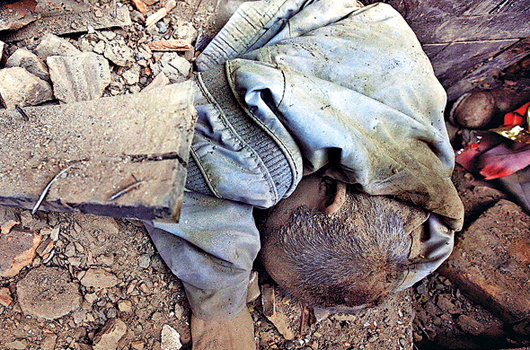
Kathmandu, Apr 27: The death toll from the 7.9 magnitude temblor that struck Nepal was on Monday placed at 3,815, with Kathmandu accounting for nearly 1,000 deaths.

The home ministry said in a statement another 6,515 people had been injured. The Saturday earthquake, the worst to hit Nepal after 1934, had its epicentre in Gorkha district.

The highest death toll of 1,021 among all districts was reported from Sindhupalchowk, about 65 km from here. Kathmandu, where damage to property was maximum, saw 920 fatalities.

Nuwakot district accounted for 422 deaths, Dhading 299, Bhaktapur 240, Gorkha 223, Kavre 193, Lalitpur 157 and Rasuwa district 150.

The other fatalities were reported from Dolakha (46), Makawanpur (33), Ramechap (26), Solu (21), Okhaldunga (16), Sindhuli (9), Sunsari (7), Chitwan and Bara (5 each), Lamjung (4), Parsa (3), Kaski, Bhojpur and Mornag (2 each) and Saptari, Dhanusha, Taplegunj, Sarhahi, Rauthat,

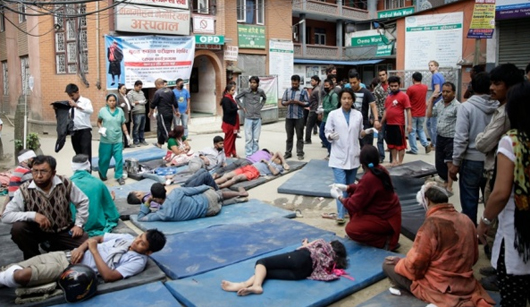
nepal tent

Earlier

Nepal earthquake toll rises above 3,600

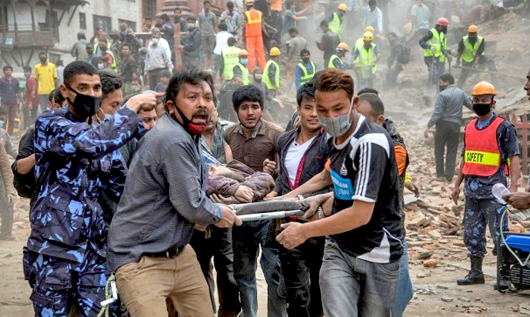
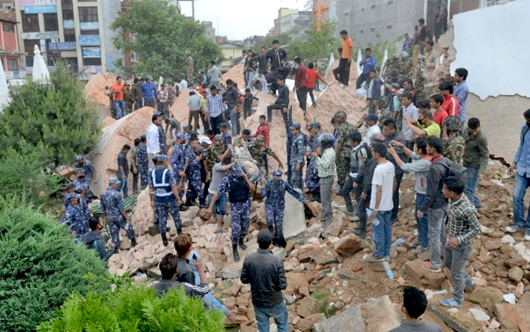
Kathmandu, Apr 27: Rescue workers today intensified efforts to locate survivors trapped under tonnes of rubble of flattened homes and buildings in earthquake-hit Nepal amid concerns that death toll could rise from more than 3,600 with rescue teams reaching remote mountainous areas.

Racing against time, multi-national rescue teams with sniffer dogs and advanced equipment are desperately trying to locate survivors as hundreds of people are still missing.
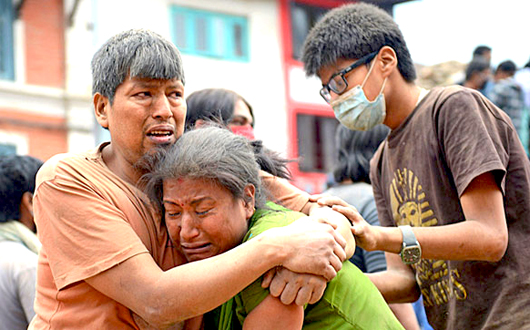
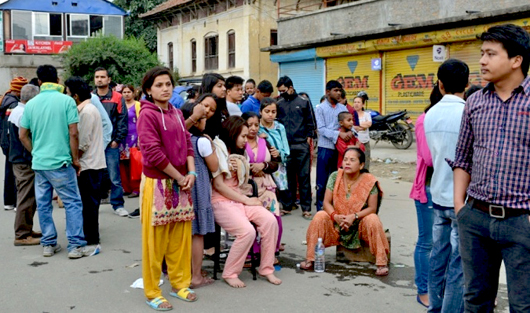
aftershock

More than 700 disaster relief experts drawn from the National Disaster Relief Force have been deployed by India.

In a statement, Nepalese police today said the death toll had risen to 3,617 people. That does not include the 22 people killed in the avalanche on Mount Everest.

Nepalese Home ministry's national disaster management division said more than 6,830 people were injured.

1,053 people are reported killed in the Kathmandu Valley alone and 875 in Sindhupalchowk, it said.

Officials and aid agencies have warned that the casualties could rise as rescue teams reach remote mountainous areas of western Nepal.

"Villages are routinely affected by landslides, and it's not uncommon for entire villages of 200, 300, up to 1,000 people to be completely buried by rock falls," aid agency World Vision spokesman Matt Darvas said.

The blocked roads, downed power lines and overcrowded hospitals along with fresh tremors are hampering rescue efforts to locate survivors of the Saturday's 7.8 magnitude quake that had its impact in several cities in Bihar, West Bengal and UP northeast India.

It was also felt in Southern and Western parts of India, China, Bhutan and as far as Pakistan and Bangladesh.

Officials said five Indians, including the daughter of an Indian embassy employee, were among those killed in the quake.

Tens of thousands of people were forced to spend the two consecutive nights sleeping in open in makeshift plastic tents barely shielding them from the pouring rain.

Earlier:

Nepal quake: Death toll crosses 3,200; sick and wounded lay out in the open

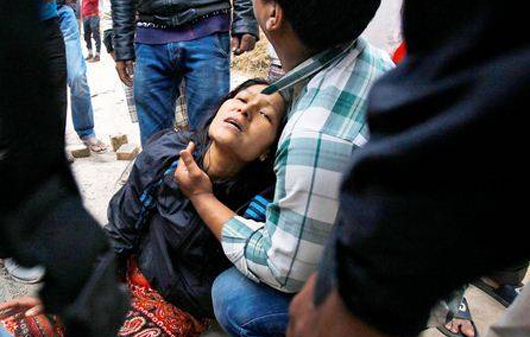
Kathmandu, Apr 27: Thousands of desperate Nepalese huddled under tents and sought scarce food and medical supplies on Monday, two days after a massive quake killed more than 3,200 people and overwhelmed authorities struggled to cope with the disaster.

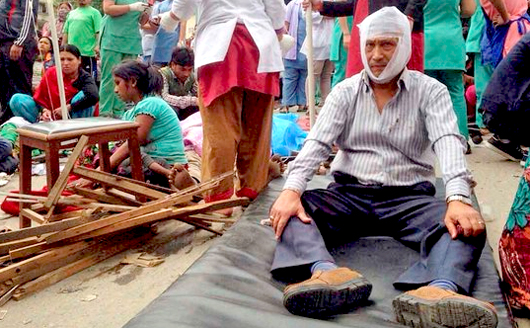
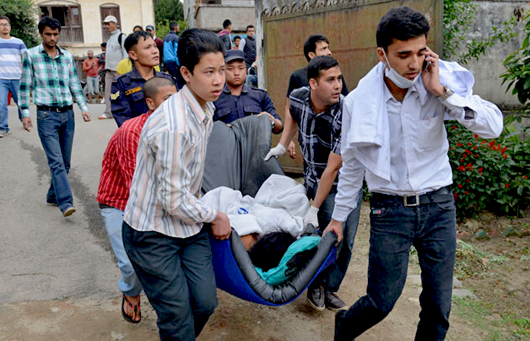
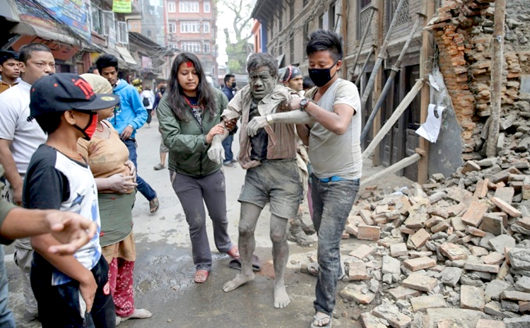
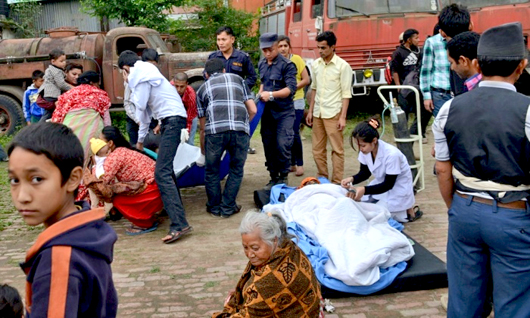
The sick and wounded lay out in the open in the capital, Kathmandu, unable to find beds in the devastated city's hospitals. Surgeons set up an operating theater inside a tent in the grounds of Kathmandu Medical College.

"We are overwhelmed with rescue and assistance requests from all across the country," said Deepak Panda, a member of the country's disaster management.

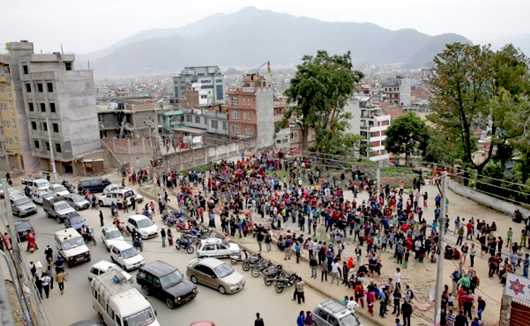
Across Kathmandu and beyond, exhausted families whose homes were either flattened or at risk of collapse laid mattresses out on streets and erected tents to shelter from rain.

People queued for water dispensed from the back of trucks, while the few stores still open had next to nothing on their shelves. Crowds jostled for medicine at one pharmacy.

High in the Himalayas, hundreds of foreign and Nepalese climbers remained trapped after a huge avalanche ripped through the Mount Everest base camp, killing 17 people in the single worst disaster to hit the world's highest mountain.

A total of 3,218 people were confirmed killed in the 7.9 magnitude quake, a police official said on Monday, the worst in Nepal since 1934 when 8,500 died. More than 6,500 were injured.

Another 66 were killed across the border in India and at least another 20 in Tibet, China's state news agency said.

The toll is likely to climb as rescuers struggle to reach remote regions in the impoverished, mountainous country of 28 million people and as bodies buried under rubble are recovered.

"The rescue workers are in a really bad shape. We are all about to collapse. We have worked two straight nights," said home ministry official Laxmi Prasad Dhakal.

With so many people sleeping in the open with no power or water and downpours forecast, fears mounted of major food and water shortages. Across Nepal, hundreds of villages have been left to fend for themselves.

"There is no electricity, no water. Our main challenge and priority is to restore electricity and water," Dhakal said.

"The next big challenge is the supply of food. Shopkeepers are unable to go in and open their shops. So people are facing difficulty buying food."Several countries rushed to send aid and personnel.

India flew in medical supplies and members of its National Disaster Response Force. China sent a 60-strong emergency team. Pakistan's army said it was sending four C-130 aircraft with a 30-bed hospital, search and rescue teams and relief supplies.

A Pentagon spokesman said a U.S. military aircraft with 70 personnel left the United States on Sunday and was due in Kathmandu on Monday. Australia, Britain and New Zealand said they were sending specialist urban search-and-rescue teams to Kathmandu at Nepal's request.

Britain, which believes several hundred of its nationals are in Nepal, was also delivering supplies and medics.

However, there has been little sign of international assistance on the ground so far, with some aid flights prevented from landing by aftershocks that closed Kathmandu's main airport several times on Sunday.

AVALANCHE TERROR

In the Himalayas, hundreds of climbers felt tremors on Sunday powerful enough to send snow and boulders cascading towards them. Another was felt early on Monday.

The huge and deadly avalanche on Saturday triggered by the earthquake caused panic at the Everest base camp, a sprawling "city" of tents from where mountaineers set off for the world's highest peak.

"It was a monstrous sound, like the demons had descended on the mountain," Khile Sherpa, a Nepalese guide, told Reuters, recalling the moment the avalanche hit.

He was one of the lucky few airlifted to the relative safety of Kathmandu but the disaster has underlined the woeful state of Nepal's medical facilities.

Nepal has only 2.1 physicians and 50 hospital beds for every 10,000 people, according to a 2011 World Health Organization report.

"The earthquake has exposed that Nepal's best public hospital infrastructure has crumbled at a time when it should serve more people in a hurry," said Sarvendra Moongla, a senior surgeon at Bir Hospital's Trauma Center in Kathmandu, which opened in February.

At the Tribhuvan University Teaching Hospital, bodies, including that of a boy aged about seven, were heaped in a dark room. The stench of death was overpowering.

Rajiv Biswas, Asia Pacific chief economist at business research firm IHS, said long-term reconstruction costs in Nepal using proper building standards for an earthquake zone could be more than $5 billion, or around 20 percent of the country's GDP.

"With housing construction standards in Nepal being extremely low ... the impact of the earthquake has been devastating based on initial reports," he said in an early analysis of the likely damage.

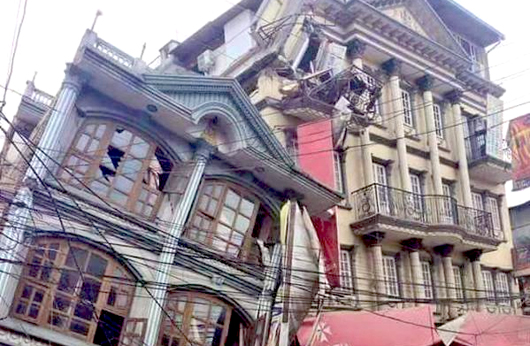
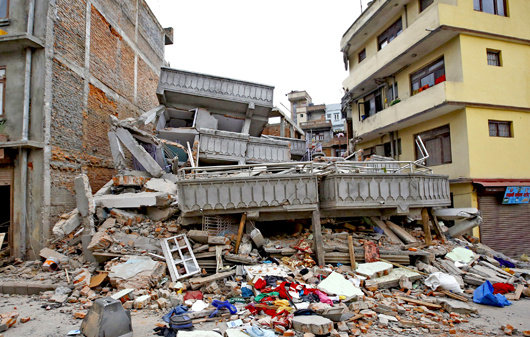
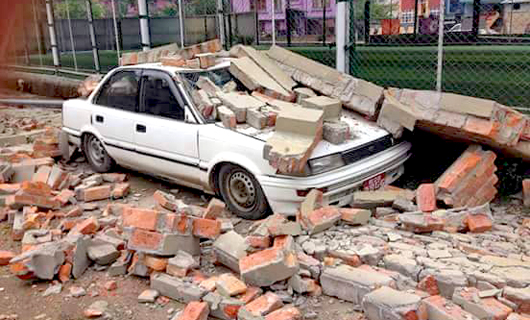
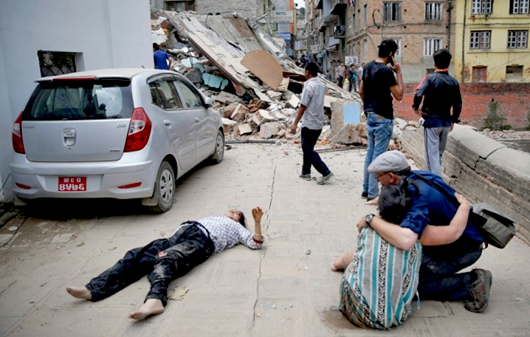
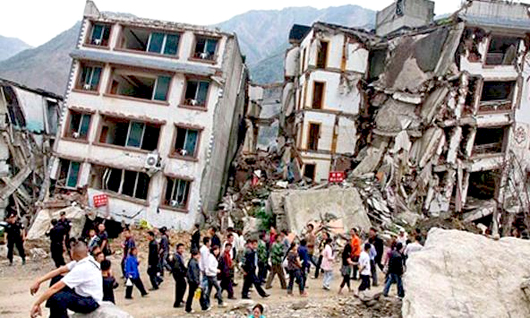
In crowded Kathmandu, many buildings were flattened or badly damaged.

Among the capital's landmarks destroyed in the earthquake was the 60-metre (200-foot) Dharahara Tower, built in 1832 for the queen of Nepal.
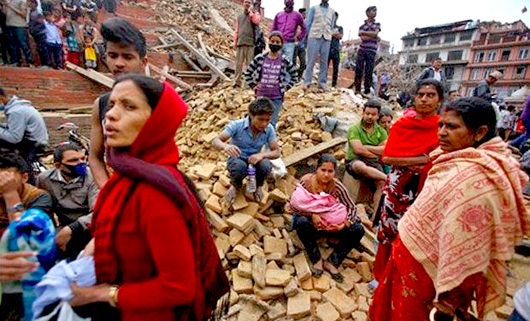
Nepal quake1

Earlier post:

Death toll crosses 2,000 in Nepal quake as fresh jolts felt

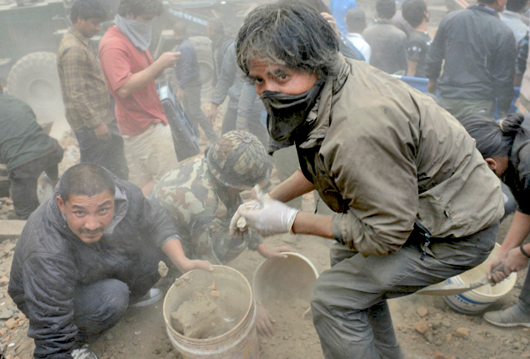
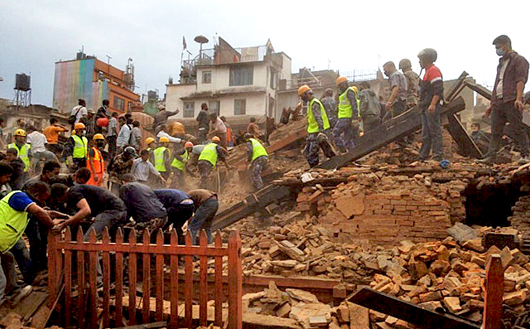
Kathmandu, Apr 26: Rescuers today dug with bare hands and heavy equipment through tonnes of rubble for survivors as toll from the devastating temblor crossed the 2,000-mark in Nepal's worst quake in over 80 years, with fresh aftershocks triggering panic and hampering relief efforts.

A strong 6.7-magnitude aftershock sent people running for open spaces as they struggled with the devastation caused by yesterday's massive 7.9-magnitude temblor that displaced and injured thousands besides causing a deadly avalanche on the Mount Everest claiming 17 lives.

"The latest figure says more than 2,000 people have died and several thousands have been wounded and more counts are coming," said Narayan Khatkar, Nepal's Urban Development Minister.

A police official told media here that 2,123 people were killed.Over 5,000 people were also injured in the earthquake and the dozen aftershocks that continued till today, with the strongest measuring 6.7 on the Richter Scale.Climbers on Mount Everest said they saw fresh series of avalanches and a big landslide in the base camp.

International teams, including from India, have touched down quake-hit Nepal that has declared a state of emergency in the wake of the disaster caused, the worst in over 80 years of Nepal's recorded history.

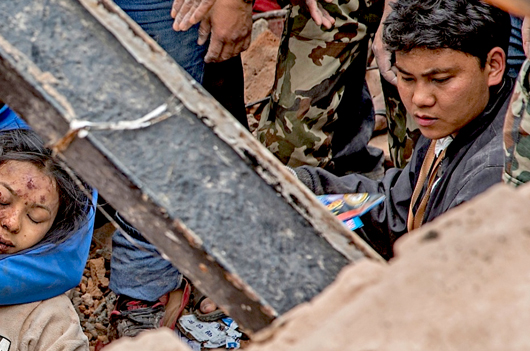
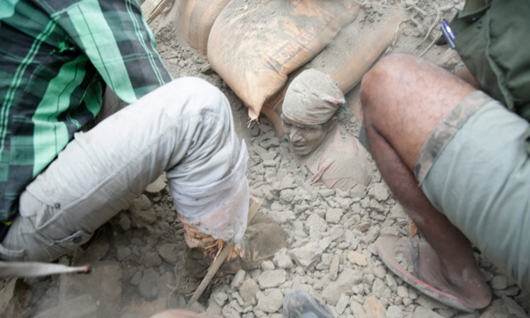
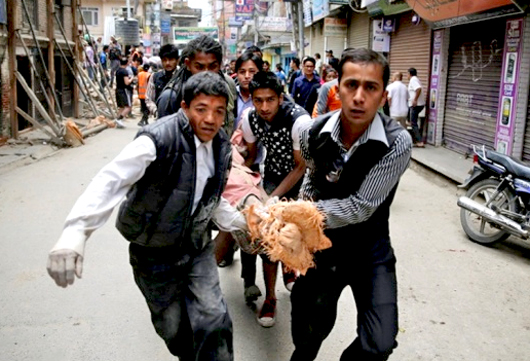
Rescuers have been hunting for survivors under heaps of debris with bare hands as well as heavy equipment though the efforts have been hampered due to fresh tremors and thunderstorms.

Locals and tourists sifted through mounds of debris for survivors. Cheers rose when people were found alive, thought mostly bodies were pulled out.

The earthquake and the aftershocks left behind a trail of death and destruction, flattening houses and buildings, including the iconic Dharhara tower and the landmark Darbar Square in the heart of the capital, trapping scores of people.

Thousands of people spent last night in the open in chilly weather, anticipating more aftershocks.

1,053 people are reported killed in the Kathmandu Valley alone. Officials fear the death toll could rise as desperate search for survivors continued.

According to initial reports related to today's aftershock, a tunnel caved in at the Trishuli Hydel Project and around 60 labourers are feared trapped.

MI-17 helicopters of the Indian Air Force (IAF) have carried out five casualty evacuation sorties and the injured have been moved to military hospitals.
nepal9

As many as 17 Mount Everest climbers, including foreigners, were reportedly killed in an avalanche triggered by the earthquake.

The latest aftershock hit at a shallow depth of 10 kilometres at 12:39 IST, according to the US Geological Survey.

The aftershock was registered 17 kilometres south of Kodari - 114 kilometres north of here - near the Tibet Autonomous Region of China.

The tremors - that were felt also in India including its national capital - sent people running for open spaces.

According to reports, the route to the base camp has been destroyed and the IAF choppers were trying to rescue the survivors, around 100 in number including foreigners who were said to be safe.

A climber Jim Davidson said he felt the aftershock at Camp One on Mount Everest.

"Just had our biggest aftershock yet here at C1 on Everest. Smaller than original quake but glacier shook & avalanches," he tweeted.

An Indian attempting to climb all the highest peaks in the seven continents, 54-year-old Ankur Bahl is also stuck at Camp II on Mount Everest along with 11 other fellow climbers.

Bahl had moved to Camp II from Camp I yesterday but is now stranded due to the earthquake, his friends in New Delhi said.

Two Indians, including the daughter of an Indian embassy employee, were among those killed in the powerful earthquake, an Indian embassy official said.

A house in the Indian Embassy complex collapsed, killing the daughter of a CPWD employee. Death of another Indian was reported at Bir Hospital here.

Over 550 Indians have been evacuated by the IAF from earthquake-hit Nepal even as India stepped up its relief and rescue mission with 10 flights and 12 helicopters scheduled to carry specialists and equipment to Kathmandu today.

The Tribhuvan International Airport, that was closed down yesterday following the quake, was opened briefly, only to be shut down again due to fresh tremors.

IndiGo, SpiceJet flights could not land here and were forced to return as Air Traffic Control personnel at the airport were evacuated following fresh aftershocks.

Many hospitals in Nepal are struggling to cope with the large number of injured.

Nepal Prime Minister Sushil Koirala, who was on a visit to Indonesia, had to cut short his trip in the wake of the disaster.

The Nepalese government has declared a national crisis and established a fund of Rs 500 million for the reconstruction of the damaged infrastructure.

Many areas in the country have no electricity for the past 24 hours and authorities say the situation is likely to continue for the next few days.

Offers of help poured in from around the world, with the US, the European Union as well the United States saying they were sending in disaster response teams.

"The United Nations is supporting the Government of Nepal in coordinating international search and rescue operations and is preparing to mount a major relief effort," UN Secretary- General Ban said in a statement today.
nepal2

nepal1

nepal3

nepal4

nepal5

nepal6

nepal7

Nepal earthquake

nepal8

nepal10

nepal11

nepal12

nepal13

nepal14

nepal15

nepal16

nepal17

nepal18

nepal19

nepal20

Comments

Add new comment

  • Coastaldigest.com reserves the right to delete or block any comments.
  • Coastaldigset.com is not responsible for its readers’ comments.
  • Comments that are abusive, incendiary or irrelevant are strictly prohibited.
  • Please use a genuine email ID and provide your name to avoid reject.
News Network
April 12,2020

Washington, Apr 12: The US has overtaken Italy as the country with the highest number of deaths due to COVID-19 pandemic with the fatalities crossing 20,000, according to Johns Hopkins University data, as the novel coronavirus continues to wreak havoc across the globe.

The deadly coronavirus, that originated in China in December last year, has so far killed more than one lakh people across the globe. The United States on Saturday became the country with the highest number of deaths at 20,597, surpassing Italy's 19,468 fatalities.

More than 5.3 lakh Americans have tested positive for coronavirus, which is about the same for the next four countries put together: Spain (163,027), Italy (152,271), Germany (125,452) and France (93,790). In terms of fatalities, the US and Italy are followed by Spain (16,606), France (13832) and United Kingdom (9,875), the varsity data showed.

New York City, the financial capital of the world, has emerged as the epicenter of coronavirus in the world. A city of 8.3 million, which is one of the most densely populated cities in the US, by Saturday night had as many as 8,627 deaths and more than 180,000 people had tested positive for COVID-19.

President Donald Trump has declared a national emergency and all the 50 States have been notified with major disaster declaration. More than 95 per cent of the country's 330 million population are under stay-at-home order. Trump has deployed more than 50,000 personnel from the armed forces in fight against COVID-19.

After an initial two-week social mitigation measures, that includes social distancing, the measures have been extended till April 30. Initially, members of the White House Task Force on Coronavirus had projected between one and two lakhs deaths. Now, they have dropped the projection to 60,000 deaths, mainly due to the successful implementation of these measures.

"The people of our country have gone through a lot. But we did it the right way. And we look like we'll be coming in on the very, very low side, really below the lowest, the lowest side of the curve of death," Trump told Fox News on Saturday night.

Trump asserted that situation was improving in places like New York, where there is a drop in new patients. Responding to a question, he said he wanted the country to open up as soon as possible.

However, he has not taken a decision so far, even as some media reports said that he the President was looking for early May.

"I think it's going to be the toughest decision that I've ever made. I really, hopefully that I ever will have to make. But it's certainly the toughest decision that I've ever made. I hope that I'm going to make the right decision," Trump said, adding that he will be making a decision reasonably soon.

"We're setting up a council now of some of the most distinguished leaders in virtually every field including politics and business and medical. We'll be making that decision fairly soon," Trump said.

Meanwhile, The New York Times reported that its investigations have revealed that the president was warned about a potential pandemic but that internal divisions, lack of planning and his faith in his own instincts led to a halting response.

According to The Washington Post, coronavirus is killing about one in 10 hospitalised middle-aged patients and four in 10 older than 85 in the United States. It is particularly lethal to men even when taking into account common chronic diseases that exacerbate risk.

Globally, the novel coronavirus has killed 108,862 people and infected over 1.7 million people globally. The US has the highest number of infections at 529,887, according to Johns Hopkins University data.

Comments

Add new comment

  • Coastaldigest.com reserves the right to delete or block any comments.
  • Coastaldigset.com is not responsible for its readers’ comments.
  • Comments that are abusive, incendiary or irrelevant are strictly prohibited.
  • Please use a genuine email ID and provide your name to avoid reject.
News Network
February 28,2020

Washington, Feb 28: US intelligence agencies are monitoring the global spread of coronavirus and the ability of governments to respond, sources familiar with the matter said on Thursday, warning that there were concerns about how India would cope with a widespread outbreak.

While there are only a few known cases in India, one source said the country's available countermeasures and the potential for the virus to spread given India's dense population was a focus of serious concern.

US intelligence agencies are also focusing on Iran, where the country's deputy health minister has fallen ill during a worsening outbreak.

US Secretary of State Mike Pompeo said on Tuesday the United States was "deeply concerned" Tehran may have covered up details about the spread of coronavirus. A US government source said Iran's response was considered ineffective because the government only has minimal capabilities to respond to the outbreak.

Another source said US agencies were also concerned about the weak ability of governments in some developing countries to respond to an outbreak.

The US House of Representatives Intelligence Committee has received a briefing on the virus from the spy agencies. "The Committee has received a briefing from the IC (intelligence community) on coronavirus, and continues to receive updates on the outbreak on a daily basis," an official of the House Intelligence Committee told Reuters.

"Addressing the threat has both national security and economic dimensions, requiring a concerted government-wide effort and the IC is playing an important role in monitoring the spread of the outbreak, and the worldwide response," the official added.

A source familiar with the activities of the Senate Intelligence Committee, led by Republican Senator Richard Burr and Democratic Senator Mark Warner, said the panel was receiving daily updates. The role of US intelligence agencies in responding to the coronavirus epidemic at this point principally involves monitoring the spread of the illness around the world and assessing the responses of governments.

They are working closely with health agencies, such as the US Center for Disease Control, in sharing information they collect and targeting further intelligence gathering.

One source said US agencies would use a wide range of intelligence tools, ranging from undercover informants to electronic eavesdropping tools, to track the virus' impact.

Comments

Add new comment

  • Coastaldigest.com reserves the right to delete or block any comments.
  • Coastaldigset.com is not responsible for its readers’ comments.
  • Comments that are abusive, incendiary or irrelevant are strictly prohibited.
  • Please use a genuine email ID and provide your name to avoid reject.
News Network
February 9,2020

Wuhan, Feb 9: President Xi Jinping strode onstage before an adoring audience in the Great Hall of the People in Beijing less than three weeks ago, trumpeting his successes in steering China through a tumultuous year and promising "landmark" progress in 2020.

"Every single Chinese person, every member of the Chinese nation, should feel proud to live in this great era," he declared to applause on the day before the Lunar New Year holiday. "Our progress will not be halted by any storms and tempests."

Xi made no mention of a dangerous new coronavirus that had already taken tenacious hold in the country. As he spoke, the government was locking down Wuhan, a city of 11 million people, in a frantic attempt to stop the virus spreading from its epicenter.

The coronavirus epidemic, which has killed more than 800 people in China as of Sunday and sickened tens of thousands, comes as Xi has struggled with a host of other challenges: a slowing economy, huge protests in Hong Kong, an election in Taiwan that rebuffed Beijing and a protracted trade war with the United States.

Now Xi faces an accelerating health crisis that is also a political one: a profound test of the authoritarian system he has built around himself over the past seven years. As the Chinese government struggles to contain the virus amid rising public discontent with its performance, the changes that Xi has ushered in could make it difficult for him to escape blame.

"It’s a big shock to the legitimacy of the ruling party. I think it could be only second to the June 4 incident of 1989. It’s that big," said Rong Jian, a writer about politics in Beijing, referring to the armed crackdown on Tiananmen Square protesters that year.

"There’s no doubt about his control over power," he added, "but the manner of control and its consequences have hurt his legitimacy and reputation."

Xi himself has recognized what is at stake, calling the outbreak "a major test of China’s system and capacity for governance."

Yet as China’s battle with the coronavirus intensified, Xi put the country’s No. 2 leader, Li Keqiang, in charge of a leadership group handling the emergency, effectively turning him into the public face of the government’s response. It was Li Keqiang who traveled to Wuhan to visit doctors.

Xi, by contrast, receded from public view for several days. That was not without precedent, though it stood out in this crisis, after previous Chinese leaders had used times of disaster to try to show a more common touch. State television and newspapers almost always lead with fawning coverage of Xi’s every move.

That retreat from the spotlight, some analysts said, signaled an effort by Xi to insulate himself from a campaign that may falter and draw public ire. Yet Xi has consolidated power, sidelining or eliminating rivals, so there are few people left to blame when something goes wrong.

"Politically, I think he is discovering that having total dictatorial power has a downside, which is that when things go wrong or have a high risk of going wrong, then you also have to bear all the responsibility," said Victor Shih, an associate professor at the University of California San Diego who studies Chinese politics.

Much of the country’s population has been told to stay at home, factories remain closed, and airlines have cut service. Experts warn that the coronavirus could slam the economy if not swiftly contained.

The government is also having trouble controlling the narrative. Xi now faces unusually sharp public discontent that even China’s rigorous censorship apparatus has been unable to stifle entirely.

The death of an ophthalmologist in Wuhan, Dr. Li Wenliang, who was censured for warning his medical school classmates of the spread of a dangerous new disease in December, has unleashed a torrent of pent-up public grief and rage over the government’s handling of the crisis. Chinese academics have launched at least two petitions in the wake of Li’s death, each calling for freedom of speech.

State media still portray Xi as ultimately in control, and there’s no sign that he faces a serious challenge from within the party leadership. The crisis, though, has already tainted China’s image as an emerging superpower — efficient, stable and strong — that could eventually rival the United States.

How much the crisis might erode Xi’s political standing remains to be seen, but it could weaken his position in the long run as he prepares to take a likely third term as Communist Party general secretary in 2022.

In 2018, Xi won approval to remove the constitutional limits on his term as the country’s president, making his plan for another five-year term seem all but certain.

If Xi comes out of this crisis politically insecure, the consequences are unpredictable. He may become more open to compromise within the party elite. Or he may double down on the imperious ways that have made him China’s most powerful leader in generations.

"Xi’s grip on power is not light," said Jude Blanchette, the Freeman Chair in China Studies at the Center for Strategic and International Studies.

"While the ham-fisted response to this crisis undoubtedly adds a further blemish to Xi’s tenure in office," Blanchette added, "the logistics of organizing a leadership challenge against him remain formidable."

In recent days, despite a dearth of public appearances, state media have portrayed Xi as a tireless commander-in-chief. This week they began calling the government’s fight against the virus the "people’s war," a phrase used in the official readout of Xi’s telephone call with President Donald Trump on Friday.

There are increasing signs that the propaganda this time is proving less than persuasive.

The Lunar New Year reception in Beijing where Xi spoke became a source of popular anger, a symbol of a government slow to respond to the suffering in Wuhan. Xi and other leaders appear to have been caught off guard by the ferocity of the epidemic.

Senior officials would almost certainly have been informed of the emerging crisis by the time national health authorities told the World Health Organization on Dec. 31, but neither Xi nor other officials in Beijing informed the public.

Xi’s first acknowledgment of the epidemic came Jan. 20, when brief instructions were issued under his name. His first public appearance after the lockdown of Wuhan on Jan. 23 came two days later, when he presided over a meeting of the Communist Party’s top body, the Politburo Standing Committee, which was shown at length on Chinese television. "We’re sure to be able to win in this battle," he proclaimed.

Back then, the death toll was 106. As it rose, Xi allowed other officials to take on more visible roles. Xi’s only appearances have been meeting foreign visitors in the Great Hall of the People or presiding over Communist Party meetings.

On Jan. 28, Xi met with the executive director of the World Health Organization, Dr. Tedros Adhanom Ghebreyesus, and told Tedros that he "personally directed" the government’s response. Later reports in state media omitted the phrase, saying instead that Xi’s government was "collectively directing" the response.

Since nothing about how Xi is portrayed in state media happens by accident, the tweak suggested a deliberate effort to emphasize shared responsibility.

Xi did not appear on official broadcasts again for a week — until a highly scripted meeting Wednesday with the authoritarian leader of Cambodia, Hun Sen.

There is little evidence that Xi has given up power behind the scenes. Li Keqiang, the premier in formal charge of the leadership group for the crisis, and other officials have said that they take their orders from Xi. The group is filled with officials who work closely under Xi, and its directives emphasize his authority.

"The way the epidemic is being handled now from the top just doesn’t fit with the argument that there’s been a clear shift toward more collective, consultative leadership," said Holly Snape, a British Academy Fellow at the University of Glasgow who studies Chinese politics.

The scale of discontent and the potential challenges for Xi could be measured by repeated references online to the nuclear accident at Chernobyl. Many of them came under the guise of viewer reviews of the popular television miniseries of the same name, which is still available for streaming inside China.

"In any era, any country, it’s the same. Cover everything up," one reviewer wrote.

The Soviet Union of 1986, however, was a different country than China in 2020.

The Soviet state was foundering when Chernobyl happened, said Sergey Radchenko, a professor of international relations at Cardiff University in Wales who has written extensively on Soviet and Chinese politics.

"The Chinese authorities, by contrast, are demonstrating an ability to cope, a willingness to take unprecedented measures — logistical feats that may actually increase the regime’s legitimacy," he added.

Radchenko compared Xi’s actions to those of previous leaders in moments of crisis: Mao Zedong after the Cultural Revolution or Deng Xiaoping after the Tiananmen Square crackdown.

"He’s doing what Mao and Deng would have done in similar circumstances: stepping back into the shadows while remaining firmly in charge."

Comments

Add new comment

  • Coastaldigest.com reserves the right to delete or block any comments.
  • Coastaldigset.com is not responsible for its readers’ comments.
  • Comments that are abusive, incendiary or irrelevant are strictly prohibited.
  • Please use a genuine email ID and provide your name to avoid reject.