


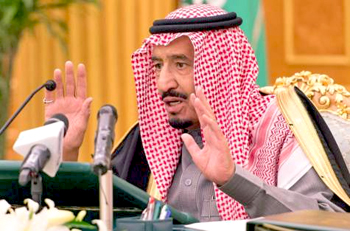
New Saudi king seen holding line on OPEC policy to keep oil output high

January 23, 2015

New Saudi king

Singapore, Jan 23: Saudi Arabia’s new king is expected to stick to an OPEC policy of keeping oil output steady to protect the cartel’s market share from rival producers, even as energy markets face some of the biggest shifts in decades.

Saudi Arabia’s King Abdullah died early on Friday and his brother Salman became king, the royal court said in an official statement.

Salman has named his half-brother Muqrin as his crown prince and heir, rapidly moving to forestall any fears of a succession crisis at a moment when Saudi Arabia faces unprecedented turmoil on its borders.

The new king is expected to broadly continue Abdullah’s policies, analysts say.

“King Abdullah was the architect of the current strategy to keep production high and force out smaller players instead of cutting,” said John Kilduff, partner, Again Capital LLC in New York.

Kilduff said that Salman was known as a defender of Saudi Arabia’s interests and that the market would expect him to keep production high.

FGE analyst Tushar Bansal said: “By and large, as of now no major change is expected in Saudi policies” but he said the market would focus on whether Saudi Arabia’s oil minister might be replaced.

“Ali Al Naimi has been the oil minister since 1995.

Previously, it was reported that he expressed a desire to step down, but King Abdullah asked him to stay on for as long as he is around.

“So, the real question is, if there is a new oil minister soon, will it lead to a change in Saudi energy policy?”.

Crude oil futures initially jumped on Friday but then came off highs and were still trading at levels more than 50 per cent below their most recent peaks in June, 2014.

LAST SUCCESSION

A continuation of existing policies would be in line with what happened after the last succession. In 2005, when King Fahd died, similar concerns over Saudi Arabia’s leadership emerged.

Following the announcement of King Fahd’s death on August 1 2005, Brent rose to an all-time high of almost $61 a barrel.

Crown Prince Abdullah, who had effectively been in charge since Fahd suffered a stroke in 1995, was installed as new king and swiftly calming traders officials stressed that there would be no changes in an oil policy of keeping markets were well-supplied.

HUGE MARKET SHIFTS

Friday’s announcement of King Abdullah’s death comes amid some of the biggest shifts in oil markets in decades.

Oil prices have halved on the back of soaring supplies coupling with cooling demand due to economic slowdown in Europe and Asia, and because of improvements in energy efficiency, meaning producers are earning sharply lower revenues.

As a result, Saudi Arabia faces its first budget deficit since 2009 and it has to navigate difficulties with other OPEC members such as Oman and Venezuela, which disagree with the strategy of not defending prices.

Booming US shale production has turned the United States from the world’s biggest oil importer into a top three producer, with output topping 9 million barrel per day.

Led by Saudi Arabia, OPEC announced last November it was keeping output steady at 30 million barrels per day, pulling down the Brent price by another quarter over the next month as the market digested the fact OPEC would not come to the rescue.

OPEC’s decision not to act, led by Saudi Arabia, was aimed at defending market share against US shale producers as well as other non-OPEC exporters such as Brazil or Russia.

Comments

Add new comment

  • Coastaldigest.com reserves the right to delete or block any comments.
  • Coastaldigset.com is not responsible for its readers’ comments.
  • Comments that are abusive, incendiary or irrelevant are strictly prohibited.
  • Please use a genuine email ID and provide your name to avoid reject.
News Network
January 6,2020

Riyadh, Jan 6: Saudi Arabia was not consulted by its ally Washington over a US drone strike that killed a top Iranian general, an official said Sunday, as the kingdom sought to defuse soaring regional tensions.

Saudi Arabia is vulnerable to possible Iranian reprisals after Tehran vowed "revenge" following the strike on Friday that killed powerful commander Qasem Soleimani in Baghdad.

"The kingdom of Saudi Arabia was not consulted regarding the US strike," a Saudi official told AFP, requesting anonymity.

"In light of the rapid developments, the kingdom stresses the importance of exercising restraint to guard against all acts that may lead to escalation, with severe consequences," the official added.

Saudi Arabia's foreign ministry made a similar call for restraint at the weekend and King Salman emphasised the need for measures to defuse tensions in a phone call on Saturday with Iraqi President Barham Saleh.

In a separate phone call with Iraq's Prime Minister Adel Abdel Mahdi, Saudi Crown Prince Mohammed bin Salman stressed "the need to make efforts to calm the situation and de-escalate tensions", the official Saudi Press Agency reported.

The crown prince has instructed Prince Khalid bin Salman, his younger brother and deputy defence minister, to travel to Washington and London in the next few days to urge restraint, the pan-Arab Asharq al-Awsat newspaper reported.

Prince Khalid will meet White House and US defence officials, the paper said, citing unnamed sources.

The killing of Soleimani, seen as the second most powerful man in Iran, is the most dramatic escalation yet in spiralling tensions between Washington and Tehran and has prompted fears of a major conflagration in the Middle East.

US President Donald Trump, who ordered the drone strike, has warned that Washington will hit Iran "very fast and very hard" if the Islamic republic attacks American personnel or assets.

The American embassy in Riyadh on Sunday warned its citizens living close to military bases and oil and gas installations in the kingdom of a "heightened risk of missile and drone attacks".

A string of attacks blamed on Iran has caused anxiety in recent months, as Riyadh and Washington deliberated over how to react.

In particular, devastating strikes against Saudi oil installations last September led Riyadh and Abu Dhabi to adopt a more conciliatory approach aimed at avoiding confrontation with Tehran.

Analysts warn that pro-Iran groups have the capacity to carry out attacks on US bases in Gulf states as well as against shipping in the Strait of Hormuz -- the strategic waterway that Tehran could close at will.

"Expect Iranian reprisals (directly or through partner groups in Iraq, Lebanon or elsewhere) to target US partners in the region including Saudi Arabia," said Thomas Juneau, an assistant professor at the University of Ottawa.

"Given the climate in the US, where support for Saudi in the media and Congress is at an all time low, it will be difficult for Trump to commit significant resources to come to its aid."

Yemen's pro-Iran Huthi rebels, locked in a five-year conflict with a Saudi-led military coalition, have also called for swift reprisals for Soleimani's killing.

"The aggression... will not go without a response," said Huthi political council member Mohammed Al-Bukhaiti.

"How the response is going to be, when and where will be determined by Iraq and Iran, and we will stand with them as a hub for the resistance."

It was unclear if the Huthi warning was directed in part at Saudi Arabia, which has stepped up efforts to end Yemen's conflict amid a lull in Huthi attacks on the kingdom.

Saudi Arabian military commanders recently met with counterparts from "friendly countries" to formulate a new strategy to tackle the Yemeni rebels, particularly those "opposing" a political solution, according to Asharq al-Awsat.

Riyadh has said it will host a separate meeting of foreign ministers of Arab and African coastal states on Monday.

Comments

Add new comment

  • Coastaldigest.com reserves the right to delete or block any comments.
  • Coastaldigset.com is not responsible for its readers’ comments.
  • Comments that are abusive, incendiary or irrelevant are strictly prohibited.
  • Please use a genuine email ID and provide your name to avoid reject.
News Network
April 28,2020

Riyadh, Apr 28: The number of confirmed coronavirus cases in Saudi Arabia crossed the critical 20,000-mark on Tuesday with the discovery of 1,266 new cases. Eight new deaths were also recorded during the last 24 hours, bringing the virus-related death toll to 152.

Twenty-three percent of the new cases are of Saudi nationals, while 77 percent are of non-Saudi residents, Saudi Press Agency (SPA) quoted the ministry spokesman Dr. Muhammad Al-Abdel Ali as saying.

Out of the total 20,077 cases till Tuesday, 17,141 cases are active, he added. A total of 118 cases are currently critical, the spokesman said.

Out of the 1,266 new cases, 327 were reported in Makkah, 273 in Madinah, 262 in Jeddah, and 171 in Riyadh. There were 58 cases in Jubail, 35 in Dammam, 32 in Taif, 29 in Tabuk and 18 in Al-Zulfi. Additionally, nine cases were recorded in Khulais; eight in Buraidah; seven in Al-Khobar; five in Hufof; four each in Qatif and Ras Tanura; three in Adhum; two each in Al-Jafr, Al-Majaridah, Yanbu, Bisha and Diriyah; and one each in Abha, Khamis Mushayt, Baqeeq, Dhahran, Dhalum, Sabiya, Hafr Al Batin, Hail, Sakaka, Wadi Al-Dawasir and Sajr, the spokesman said.

The Kingdom saw a spike in cases when the health ministry began its field-testing efforts nearly two weeks ago, targeting suspected infection cluster areas. Since then, there has been a steady increase in daily cases.

Till Monday, around 1 million people were screened in various neighborhoods throughout the Kingdom.

Comments

Add new comment

  • Coastaldigest.com reserves the right to delete or block any comments.
  • Coastaldigset.com is not responsible for its readers’ comments.
  • Comments that are abusive, incendiary or irrelevant are strictly prohibited.
  • Please use a genuine email ID and provide your name to avoid reject.
Agencies
July 16,2020

Riyadh, Jul 16: Prince Abdul Aziz bin Saud bin Naif, minister of interior and chairman of the Hajj Supreme Committee, chaired a virtual meeting on Wednesday with the heads of  security agencies and officials in charge of this year’s Hajj season.

During the meeting, the minister and security officials discussed organizational issues related to Hajj, including preventive and precautionary steps related to fighting the coronavirus disease, procedures related to pilgrims commuting to the holy sites, and mechanisms to facilitate performing the Hajj rituals.

Prince Abdul Aziz confirmed abiding by the directives of King Salman and Crown Prince Mohammed bin Salman to take all precautions to preserve the safety of the pilgrims, and facilitate their performance of their Hajj rituals, according to the highest health standards to contain the new coronavirus pandemic.

Saudi Arabia has decided to allow only a limited number of domestic pilgrims to perform Hajj this year in the wake of the COVID-19 outbreak.

Only those expatriates between the ages of 20 and 50 who are not suffering from any chronic diseases can apply for the pilgrimage.

Earlier, the Ministry of Hajj and Umrah said that requests from people of 160 nationalities in the Kingdom have been screened electronically to select who will perform Hajj this year.

Of the pilgrims who will receive approval, 70 percent will be non-Saudis residing in the Kingdom and the remaining 30 percent will be Saudi citizens.

Meanwhile, the Ministry of Interior said that anyone found entering the sites of Hajj (Mina, Muzdalifah and Arafat) without a permit from July 18 till the end of Dhu Al-Hijjah 12 will be issued with a fine of SR10,000 ($2,600).

The fine will be doubled if the offence is repeated. Security personnel will be posted on roads leading to the holy sites to ensure that anyone who breaks the law will be stopped and fined.

Around 2.5 million foreign and domestic pilgrims performed Hajj last year.

Comments

Add new comment

  • Coastaldigest.com reserves the right to delete or block any comments.
  • Coastaldigset.com is not responsible for its readers’ comments.
  • Comments that are abusive, incendiary or irrelevant are strictly prohibited.
  • Please use a genuine email ID and provide your name to avoid reject.