



New Zealand Prime Minister John Key resigns after 8 years

December 5, 2016

Wellington, Dec 5: New Zealand's popular Prime Minister John Key stunned the nation on Monday when he announced, in a breaking voice, he was resigning after eight years as leader.
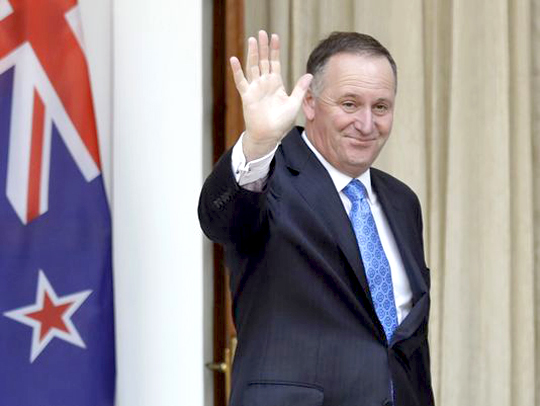
JohnKey

Key had been widely expected to contest his fourth general election next year. But he said he wanted to ensure he didn't make the mistake that some other world leaders have done, and instead wanted to leave while he was on top of his game.

Speaking in a shaking voice, Key said he had made personal sacrifices for the job and the role had taken a toll on his family.

Key said his National Party caucus would meet Dec. 12 to decide on a new party leader and prime minister, and that he expected to formally submit his resignation to the Governor-General that same day.

He said he would back his deputy Bill English to take over. English said he would likely decide in the next day or two if he would seek the role.

The New Zealand dollar fell by nearly 1 percent on the news and was trading at $0.71 U.S.

Australian Prime Minister Malcolm Turnbull said he'd sent Key a short message: ``Say it ain't so, bro.''

``John Key is one of the most outstanding national leaders in the world today,'' Turnbull told reporters. ``He has done an extraordinary job for New Zealand. He is somebody that all of us, right around the world, leaders in countries large and small, draw inspiration from.''

New Zealand's opposition leader Andrew Little said the decision had taken everybody by surprise.

``He is entitled to be recognized for what he has done for New Zealand,'' Little said. ``He's been there through some pretty difficult times.''

Key was a successful currency trader before turning to politics. He was elected to the nation's parliament in 2002 and enjoyed a quick rise, becoming leader of his center-right opposition party in 2006. He won his first general election and became prime minister in 2008.

He won subsequent elections in 2011 and 2014 and retained unusually high popularity ratings. His party was a clear favorite to win the most votes at next year's election, at least until his announcement on Monday.

Key said that steering the country of 4.7 million through the economic crisis of 2008 and on to improved fortunes was a proud accomplishment.

``Very few countries are in the financial position we are in,'' Key said. ``We're strong, we're in surplus, we're growing, we're creating jobs, we're doing well.''

New Zealand is enjoying relatively robust annual GDP growth of over 3 percent and the unemployment rate has fallen below 5 percent, thanks in part to growth in tourism and construction.

Key also talked about the importance of standing beside the people of Christchurch after an earthquake in 2011 killed 185 people.

``Simply put, it has, for me, been the most remarkable, satisfying and exciting time of my life,'' he said. ``But despite the amazing career I have had in politics, I have never seen myself as a career politician.''

He said the role came with costs.

``For my wife Bronagh, there have been many nights and weekends spent alone,'' he said. ``My daughter Stephie and my son Max have transitioned from teenagers to young adults while coping with an extraordinary level of intrusion and pressure because of their father's job.''

He said he wasn't sure what life after politics would bring, other than he would probably take up positions on a couple of company boards and accept international speaking engagements. He said he would remain on as a member of parliament long enough that he wouldn't force a special election ahead of next year's general election.

``All I can say is that I gave it everything I had,'' he said. ``I left nothing in the tank.''

Comments

Add new comment

  • Coastaldigest.com reserves the right to delete or block any comments.
  • Coastaldigset.com is not responsible for its readers’ comments.
  • Comments that are abusive, incendiary or irrelevant are strictly prohibited.
  • Please use a genuine email ID and provide your name to avoid reject.
News Network
June 9,2020

Jun 9: The World Health Organization says it still believes the spread of the coronavirus from people without symptoms is “rare,” despite warnings from numerous experts worldwide that such transmission is more frequent and likely explains why the pandemic has been so hard to contain.

Maria Van Kerkhove, WHO''s technical lead on COVID-19 said at a press briefing on Monday that many countries are reporting cases of spread from people who are asymptomatic, or those with no clinical symptoms.

But when questioned in more detail about these cases, Van Kerkhove said many of them turn out to have mild disease, or unusual symptoms.

Although health officials in countries including Britain, the U.S. and elsewhere have warned that COVID-19 is spreading from people without symptoms, WHO has maintained that this type of spread is not a driver of the pandemic and is probably accounts for about 6 per cent of spread, at most.

Numerous studies have suggested that the virus is spreading from people without symptoms, but many of those are either anecdotal reports or based on modeling.

Van Kerkhove said that based on data from countries, when people with no symptoms of COVID-19 are tracked over a long period to see if they spread the disease, there are very few cases of spread.

“We are constantly looking at this data and we''re trying to get more information from countries to truly answer this question,” she said. “It still appears to be rare that asymptomatic individuals actually transmit onward.”

Comments

Add new comment

  • Coastaldigest.com reserves the right to delete or block any comments.
  • Coastaldigset.com is not responsible for its readers’ comments.
  • Comments that are abusive, incendiary or irrelevant are strictly prohibited.
  • Please use a genuine email ID and provide your name to avoid reject.
Agencies
July 2,2020

Moscow, Jul 2: Russian voters approved changes to the constitution that will allow President Vladimir Putin to hold power until 2036, but the weeklong plebiscite that concluded Wednesday was tarnished by widespread reports of pressure on voters and other irregularities.

With most of the nation's polls closed and 20% of precincts counted, 72% voted for the constitutional amendments, according to election officials.

For the first time in Russia, polls were kept open for a week to bolster turnout without increasing crowds casting ballots amid the coronavirus pandemic a provision that Kremlin critics denounced as an extra tool to manipulate the outcome.

A massive propaganda campaign and the opposition's failure to mount a coordinated challenge helped Putin get the result he wanted, but the plebiscite could end up eroding his position because of the unconventional methods used to boost participation and the dubious legal basis for the balloting.

By the time polls closed in Moscow and most other parts of Western Russia, the overall turnout was at 65%, according to election officials. In some regions, almost 90% of eligible voters cast ballots.

On Russia's easternmost Chukchi Peninsula, nine hours ahead of Moscow, officials quickly announced full preliminary results showing 80% of voters supported the amendments, and in other parts of the Far East, they said over 70% of voters backed the changes.

Kremlin critics and independent election observers questioned the turnout figures.

We look at neighboring regions, and anomalies are obvious there are regions where the turnout is artificially (boosted), there are regions where it is more or less real, Grigory Melkonyants, co-chair of the independent election monitoring group Golos, told The Associated Press.

Putin voted at a Moscow polling station, dutifully showing his passport to the election worker. His face was uncovered, unlike most of the other voters who were offered free masks at the entrance.

The vote completes a convoluted saga that began in January, when Putin first proposed the constitutional changes.

He offered to broaden the powers of parliament and redistribute authority among the branches of government, stoking speculation he might seek to become parliamentary speaker or chairman of the State Council when his presidential term ends in 2024.

His intentions became clear only hours before a vote in parliament, when legislator Valentina Tereshkova, a Soviet-era cosmonaut who was the first woman in space in 1963, proposed letting him run two more times.

The amendments, which also emphasize the primacy of Russian law over international norms, outlaw same-sex marriages and mention a belief in God as a core value, were quickly passed by the Kremlin-controlled legislature.

Putin, who has been in power for more than two decades longer than any other Kremlin leader since Soviet dictator Josef Stalin said he would decide later whether to run again in 2024.

He argued that resetting the term count was necessary to keep his lieutenants focused on their work instead of darting their eyes in search for possible successors.

Analyst Gleb Pavlovsky, a former Kremlin political consultant, said Putin's push to hold the vote despite the fact that Russia has thousands of new coronavirus infections each day reflected his potential vulnerabilities.

Putin lacks confidence in his inner circle and he's worried about the future, Pavlovsky said.

He wants an irrefutable proof of public support.

Even though the parliament's approval was enough to make it law, the 67-year-old Russian president put his constitutional plan to voters to showcase his broad support and add a democratic veneer to the changes.

But then the coronavirus pandemic engulfed Russia, forcing him to postpone the April 22 plebiscite.

The delay made Putin's campaign blitz lose momentum and left his constitutional reform plan hanging as the damage from the virus mounted and public discontent grew.

Plummeting incomes and rising unemployment during the outbreak have dented his approval ratings, which sank to 59%, the lowest level since he came to power, according to the Levada Center, Russia's top independent pollster.

Moscow-based political analyst Ekaterina Schulmann said the Kremlin had faced a difficult dilemma: Holding the vote sooner would have brought accusations of jeopardizing public health for political ends, while delaying it raised the risks of defeat.

Holding it in the autumn would have been too risky, she said.

In Moscow, several activists briefly lay on Red Square, forming the number 2036 with their bodies in protest before police stopped them.

Some others in Moscow and St. Petersburg staged one-person pickets and police didn't intervene.

Several hundred opposition supporters rallied in central Moscow to protest the changes, defying a ban on public gatherings imposed for the coronavirus outbreak. Police didn't intervene and even handed masks to the participants.

Authorities mounted a sweeping effort to persuade teachers, doctors, workers at public sector enterprises and others who are paid by the state to cast ballots. Reports surfaced from across the vast country of managers coercing people to vote.

The Kremlin has used other tactics to boost turnout and support for the amendments.

Comments

Add new comment

  • Coastaldigest.com reserves the right to delete or block any comments.
  • Coastaldigset.com is not responsible for its readers’ comments.
  • Comments that are abusive, incendiary or irrelevant are strictly prohibited.
  • Please use a genuine email ID and provide your name to avoid reject.
News Network
June 24,2020

Islamabad, Jun 24: A plane crash which killed 97 people in Pakistan last month was because of human error by the pilot and air traffic control, according to an initial report into the disaster released Wednesday.

The Pakistan International Airlines (PIA) plane came down among houses on May 22 after both engines failed as it approached Karachi airport, killing all but two people on board.

"The pilot as well as the controller didn't follow the standard rules," the country's aviation minister Ghulam Sarwar Khan said, announcing the findings in parliament.

He said the pilots had been discussing the coronavirus pandemic as they attempted to land the Airbus A320.

"The pilot and co-pilot were not focused and throughout the conversation was about coronavirus," Khan said.

The Pakistani investigation team, which included officials from the French government and the aviation industry, analysed data and voice recorders.

The minister said the plane was "100 percent fit for flying, there was no technical fault".

The county's deadliest aviation accident in eight years came days after domestic commercial flights resumed following a two-month coronavirus lockdown.

Many passengers were on their way to spend the Muslim holiday of Eid al-Fitr with loved ones.

Comments

Add new comment

  • Coastaldigest.com reserves the right to delete or block any comments.
  • Coastaldigset.com is not responsible for its readers’ comments.
  • Comments that are abusive, incendiary or irrelevant are strictly prohibited.
  • Please use a genuine email ID and provide your name to avoid reject.