BCF educational scholarship meet on Sunday

[email protected] (CD Network)
July 22, 2011

1

Mangalore, July 22: The annual “BCF Educational Scholarship Meet-Mangalore 2011” of Bearys Cultural Forum, a well-known community organization for Bearys of Coastal Karnataka under the auspices of Dubai Indian Islamic Centre, UAE will be held on Sunday July 24 at Loyola Hall, St Aloysius Pre-University College Campus here.

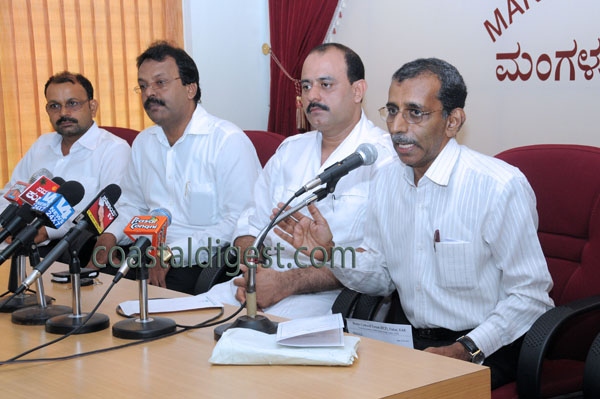
Revealing this at a press meet here on Friday, July 22, M E Moolur, Chairman of BCF Scholarship Committee, said that BCF believes in empowering the community by promoting education.

He said a sum of Rs 12 lakh would be distributed among 250 students from PUC to post graduation.

He said BCF which has been engaged in community developmental works since five years has conducted cultural programmes, financial assistance to the people irrespective their castes and religion on humanitarian ground, and felicitation for the achievers recognising their social service.

He said that the meet would be inaugurated by the State Home and Transport Minister R Ashok, while District-in-charge Minister Krishna J Palemar would be the chief guest. Dr B K Yusuf, President of BCF will be presiding over the function.

Shaikuna Al-Haj P M Ibrahim Musliyar, Udupi Qazi will offer Du'a. Guests of honour include MLA U T Khader, Dr M Mohan Alva, B M Farookh, Chairman of KMDC N B Aboobaker, City Police Commissioner Seemanth Kumar Singh, Principal of St Aloysius Pre-University College Prof John D'Silva, Abdul Salam Puthige and B M Mumthaz Ali.

Zafarulla Khan, Chief Advisor of BCF, Hasan Darvesh, Chairman of Mega Star, Thumbay Mohideen, Raveesh Gowda, Fortune Grand Group of Hotels, Khasim Ahmed H K of Hidayah Foundation, M K Beary, President of DKSC, UAE and Zakariya B Jokatte will also participate in this meet, said Mr Moolur.

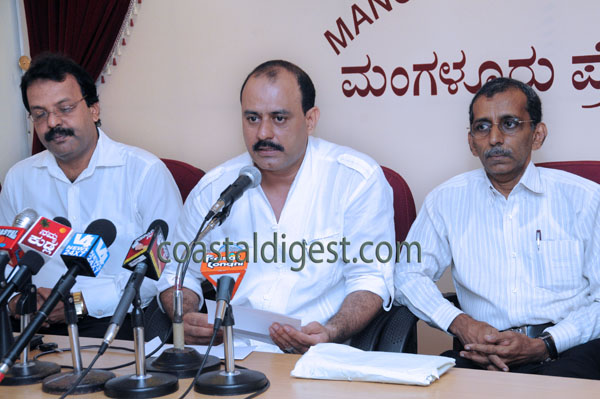
B M Mumthaz Ali, Patron of BCF, B A Nazeer, Programme Convener and Usman Moolur were present at the press meet.

2

Comments

Add new comment

  • Coastaldigest.com reserves the right to delete or block any comments.
  • Coastaldigset.com is not responsible for its readers’ comments.
  • Comments that are abusive, incendiary or irrelevant are strictly prohibited.
  • Please use a genuine email ID and provide your name to avoid reject.
Ram Puniyani
January 14,2020

In the beginning of January 2020 two very disturbing events were reported from Pakistan. One was the attack on Nankana Sahib, the holy shrine where Sant Guru Nanak was born. While one report said that the place has been desecrated, the other stated that it was a fight between two Muslim groups. Prime Minister of Pakistan Imran Khan condemned the incident and the main accused Imran Chisti was arrested. The matter related to abduction and conversion of a Sikh girl Jagjit Kaur, daughter of Pathi (One who reads Holy Guru Granth Sahib in Gurudwara) of the Gurudwara. In another incident one Sikh youth Ravinder Singh, who was out on shopping for his marriage, was shot dead in Peshawar.

While these condemnable attacks took place on the Sikh minority in Pakistan, BJP was quick enough to jump to state that it is events like this which justify the Citizenship Amendment Act (CAA). Incidentally CAA is the Act which is discriminatory and relates to citizenship with Religion, which is not as per the norms of Indian constitution. There are constant debates and propaganda that population of Hindus has come down drastically in Pakistan and Bangla Desh. Amit Shah, the Home minister stated that in Pakistan the population of Hindus has come down from 23% at the time of partition to 3.7% at present. And in Bangla Desh it has come down from 22% to present 8%.

While not denying the fact that the religious minorities are getting a rough deal in both these countries, the figures which are presented are totally off the mark. These figures don’t take into consideration the painful migrations, which took place at the time of partition and formation of Bangla Desh later. Pakistan census figures tell a different tale. Their first census was held in 1951. As per this census the overall percentage of Non Muslim in Pakistan (East and West together) was 14.2%, of this in West Pakistan (Now Pakistan) it was 3.44 and in Eat Pakistan it was 23.2. In the census held in Pakistan 1998 it became 3.72%. As far as Bangla Desh is concerned the share of Non Muslims has gone down from 23.2 (1951) to 9.6% in 2011.

The largest minority of Pakistan is Ahmadis, (https://minorityrights.org/country/pakistan/) who are close to 4 Million and are not recognised as Muslims in Pakistan. In Bangla Desh the major migrations of Hindus from Bangla Desh took place in the backdrop of Pakistan army’s atrocities in the then East Pakistan.

As far as UN data on refugees in India it went up by 17% between 2016-2019 and largest numbers were from Tibet and Sri Lanka.  (https://www.un.org/en/development/desa/population/migration/publication…)

The state of minorities is in a way the index of strength of democracy. Most South Asian Countries have not been able to sustain democratic values properly. In Pakistan, the Republic began with Jinnah’s classic speech where secularism was to be central credo of Pakistan. This 11th August speech was in a way what the state policy should be, as per which people of all faiths are free to practice their religion. Soon enough the logic of ‘Two Nation theory” and formation of Pakistan, a separate state for Muslim took over. Army stepped in and dictatorship was to reign there intermittently. Democratic elements were suppressed and the worst came when Zia Ul Haq Islamized the state in collusion with Maulanas. The army was already a strong presence in Pakistan. The popular formulation for Pakistan was that it is ruled by three A’s, Army, America and Allah (Mullah).

Bangla Desh had a different trajectory. Its very formation was a nail in the coffin of ‘two nation theory’; that religion can be the basis of a state. Bangla Desh did begin as a secular republic but communal forces and secular forces kept struggling for their dominance and in 1988 it also became Islamic republic. At another level Myanmar, in the grip of military dictatorship, with democratic elements trying to retain their presence is also seeing a hard battle. Democracy or not, the army and Sanghas (Buddhist Sang has) are strong, in Myanmar as well. The most visible result is persecution of Rohingya Muslims.

Similar phenomenon is dominating in Sri Lanka also where Budhhist Sanghas and army have strong say in the political affairs, irrespective of which Government is ruling. Muslim and Christian minorities are a big victim there, while Tamils (Hindus, Christians etc.) suffered the biggest damage as ethnic and religious minorities. India had the best prospect of democracy, pluralism and secularism flourishing here. The secular constitution, the outcome of India’s freedom struggle, the leadership of Gandhi and Nehru did ensure the rooting of democracy and secularism in a strong way.

India so far had best democratic credentials amongst all the south Asian countries. Despite that though the population of minorities rose mainly due to poverty and illiteracy, their overall marginalisation was order of the day, it went on worsening with the rise of communal forces, with communal forces resorting to identity issues, and indulging in propaganda against minorities.

While other South Asian countries should had followed India to focus more on infrastructure and political culture of liberalism, today India is following the footsteps of Pakistan. The retrograde march of India is most visible in the issues which have dominated the political space during last few years. Issues like Ram Temple, Ghar Wapasi, Love Jihad, Beef-Cow are now finding their peak in CAA.

India’s reversal towards a polity with religion’s identity dominating the political scene was nicely presented by the late Pakistani poetess Fahmida Riaz in her poem, Tum bhi Hum Jaise Nikle (You also turned out to be like us). While trying to resist communal forces has been an arduous task, it is becoming more difficult by the day. This phenomenon has been variously called, Fundamentalism, Communalism or religious nationalism among others. Surely it has nothing to do with the religion as practiced by the great Saint and Sufi traditions of India; it resorts mainly to political mobilization by using religion as a tool.


Comments

Ashi
 - 
Tuesday, 14 Jan 2020

If Malaysia implement similar NRC/CAA, India and China are the loser.

Add new comment

  • Coastaldigest.com reserves the right to delete or block any comments.
  • Coastaldigset.com is not responsible for its readers’ comments.
  • Comments that are abusive, incendiary or irrelevant are strictly prohibited.
  • Please use a genuine email ID and provide your name to avoid reject.
News Network
April 20,2020

Bengaluru, Apr 20: Former chief minister HD Kumaraswamy, reacting to the incident which happened in Padarayanapura area of the city last night, in which a group of men vandalised a police barricade, said that the perpetrators of the violence should be dealt with severely.

He further said, "It was not at all needed to attack Asha workers, police or doctors. These kinds of incidents are not acceptable. It is an act of shame. It does not matter which community the perpetrators belong to, each and everyone must follow the guidelines and law. Whoever indulged in such an act must be punished."

Earlier on Sunday, a ruckus erupted in Padarayanapura on Sunday allegedly over the shifting of suspected COVID-19 persons to a quarantine facility by the Bruhat Bengaluru Mahanagara Palike (BBMP) officials.

The incident occurred in the late evening at Padarayanapura, which is recognized as a 'Red Zone', when BBMP officials went to shift 15 secondary contacts of corona positive patients. However, some people created a ruckus, broke the barricade and removed the police post in the area.

In Karnataka, 390 people have detected positive for COVID-19, of which 16 people have succumbed to the infection, as per the Union Health Ministry.

Comments

Add new comment

  • Coastaldigest.com reserves the right to delete or block any comments.
  • Coastaldigset.com is not responsible for its readers’ comments.
  • Comments that are abusive, incendiary or irrelevant are strictly prohibited.
  • Please use a genuine email ID and provide your name to avoid reject.
News Network
January 6,2020

Bengaluru, Jan 6: Former Governor of Karnataka T N Chaturvedi passed away on Sunday late night at a private hospital in Noida.
He was 90.

T N Chaturvedi served as of Comptroller and Auditor General of India from 1984 to 1989. He was awarded the Padma Vibhushan in 1991.

An officer of Indian Administrative Service (IAS), Chaturvedi held several key posts after retirement including Governor’s post of Karnataka and Kerala. He was the governor of Karnataka from 2002 to 2007 and held additional post of Governor of Kerala following death of then Kerala governor Sikander Bakht. He held the post from Feb 2004 to June 2004 and was replaced by newly appointed Governor.

An officer of Indian Administrative Service (IAS), Chaturvedi held several key posts after retirement including Governor’s post of Karnataka and Kerala.

Expressing grief on the demise of T N Chaturvedi Vice President M Venkaiah Naidu, in a tweet said, “T N Chaturvedi was an administrator par excellence, towering intellectual and true nationalist and he was known for his erudition, integrity and knowledge. He had an illustrious career in public life and served every role with distinction.”

Even former Union Minister Anant Kumar Hegde condoled Chaturvedi's demise. "Humble tributes to our ex-Governor of Karnataka TN Chaturvedi who passed away last evening. He was an outstanding bureaucrat who was CAG in the 90's before becoming the Governor of our state. May his soul attain Sadgati. Om Shanti Shanti Shanti!" Hegde tweeted.

Comments

Add new comment

  • Coastaldigest.com reserves the right to delete or block any comments.
  • Coastaldigset.com is not responsible for its readers’ comments.
  • Comments that are abusive, incendiary or irrelevant are strictly prohibited.
  • Please use a genuine email ID and provide your name to avoid reject.