



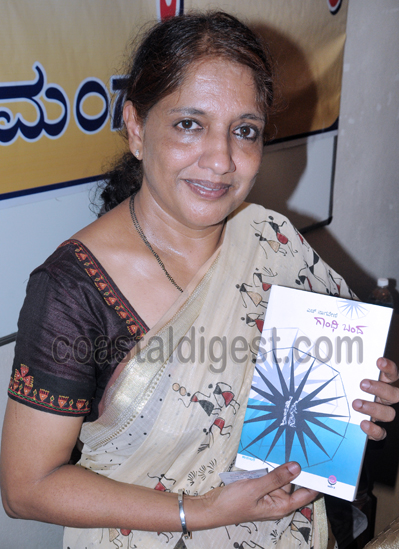
Gandhi Banda is nothing compared to vulgar words of Bhyrappa: Nagaveni

January 7, 2012

nagaveni_1

Mangalore, January 7: Popular Kannada writer H Nagaveni has finally revealed that her much discussed novel Gandhi Banda, which has been in the news recently following a demand by a section of a people for its removal from Mangalore University's syllabus, was indeed based on a real story.

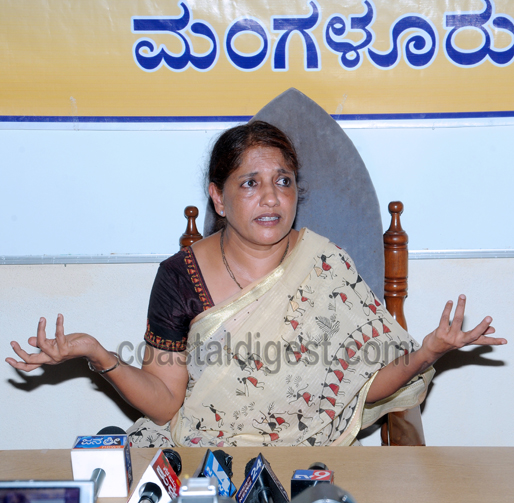
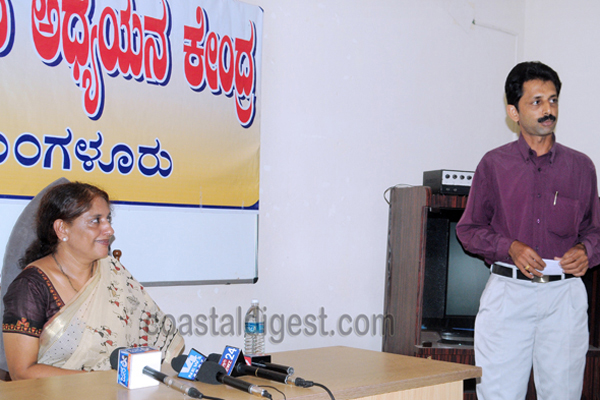
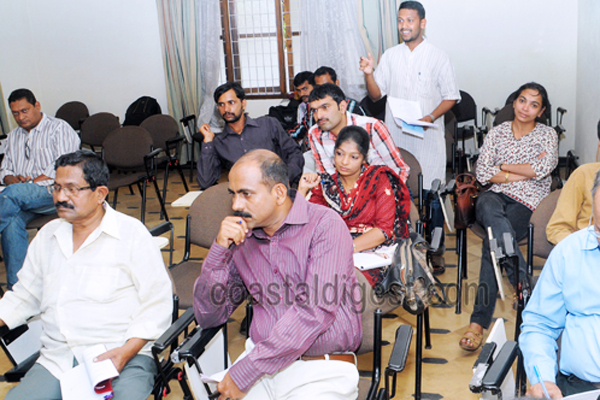
Participating in an interaction programme organized by Journalists Study Centre at Sahodaya Hall here on Saturday, Nagaveni said she had been thinking to write a novel ever since she had met an elderly woman, who finally became the main character of the novel-Draupadi.

In one of the sub plots of the novel, Draupadi, a Brahmin widow, against the will of her fanatic father remarries - that too with a 'patriotic Beary (Muslim) youth', who eventually attains martyrdom. The same Brahmin woman, who had refused to accept widowhood after the death of her Brahmin husband, prefers to follow all the Brahminic restrictions of widowhood after the martyrdom of her Beary husband. “I had met the same Draupadi when I was a class-V student”, she said.

She also advised the media and readers not to stuff the bad concept of 'love-jehad' into the novel.

Brushing aside the allegations of using derogatory words against a particular community in the novel, she questioned how could she be such an ungrateful towards those people, amidst whom she was born and brought up?
nagaveni_5

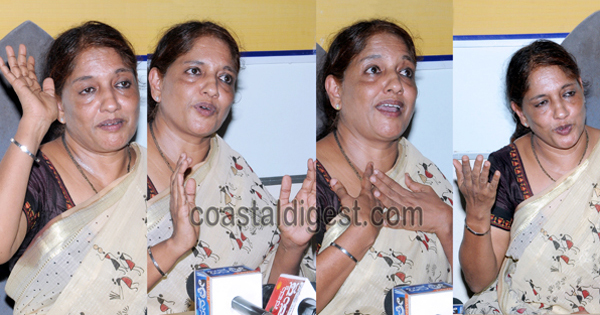
“I never ever used any derogatory words against any community in any of my works. Instead I have employed the spoken language of that period. The strength of my novel indeed lies in its ability to carry a reader beyond these specific experiences towards a larger humanist aspiration,” she said.

“When I wrote the novel over a decade ago, the only thing in my mind was to visualize a topic of national significance within the framework of socio-cultural context of Tulunadu and to douse the flames of communalism in this part of the state”, she said.

She also said that she was stunned when Vishwakarma community, which had been portrayed as a self-reliant working class in the novel, came out with an “immature and hasty reaction” without even reading the novel.

She also said that an innocent working-class community, was being instigated by a powerful upper class, against her and her novel. “It is an unconcealed truth that socially weak Vishwakarma community is being used as dice by communal forces, especially by socially powerful 'supreme caste' people” she lamented.

The novel, which documents the socio-economic metamorphosis in coastal Karnataka region from the year 1920 to 1940, she said, inevitably contains some of the words used by the lower class people at that time. However, those words are nothing compared to the words used in the novels of S L Bhairappa and other male writers.

“Ironically, the people who criticize me for employing the words used by lower class people of Tulunadu in 1920s, do not find any fault in Bhyrappa's novel, where you can find far vulgar words”, she pointed out.

“I respect Bhyrappa and his writings. But, I don't understand why a section of people selectively targeting a woman” said the award winning novelist, adding that these criticism may end her career as a writer.

Asked whether she was ready remove some 'unpleasant' words from novel as instructed by Mangalore University, she said she was not ready to maim her own child.

The writer also expressed her shock over the sudden opposition to the novel, which was whole heartedly welcomed by the people of state a few years ago. “The 'Gandhi Banda' was a textbook for PG students of Mangalore and Kuvempu University students in the past. Now the same novel is being taught in Gulbarga University too. But the opposition aroused all of a sudden in Mangalore University a few months after it was introduced to degree students”, she said, suspecting the conspiracy of a 'power' behind this sudden opposition.
nagaveni_2

nagaveni_3

nagaveni_4

Comments

Add new comment

  • Coastaldigest.com reserves the right to delete or block any comments.
  • Coastaldigset.com is not responsible for its readers’ comments.
  • Comments that are abusive, incendiary or irrelevant are strictly prohibited.
  • Please use a genuine email ID and provide your name to avoid reject.
News Network
April 11,2020

Kundapur, Apr 10: Police have lodged a case against Nagaraj Mogaveera, 28, a resident of Karwadi Saukur in Kundapur, for sharing a communal hatred and sensitive post over Facebook.

On his Facebook page, he wrote, "1,500 persons went to Delhi mosque from Karnataka. Each person's test costs Rs 4,500 which becomes expenditure of Rs 67,50,000 in all. If they be encountered, each bullet costs Rs. 63 and the total expenditure will be Rs 94,500."

According to the complaint filed by Mukhtar Ahmad of the Janata Colony of Kundapur Karwadi village on Friday, the police have booked a case under the IPC Section 1860, 295A, 505 (2) and launched the investigation.

Comments

Add new comment

  • Coastaldigest.com reserves the right to delete or block any comments.
  • Coastaldigset.com is not responsible for its readers’ comments.
  • Comments that are abusive, incendiary or irrelevant are strictly prohibited.
  • Please use a genuine email ID and provide your name to avoid reject.
News Network
January 29,2020

Newsroom, Jan 29: Karnataka’s capital has earned the unwelcome distinction of global capital of traffic congestion. According to a report by TomTom, the Netherlands-based global provider of navigation, traffic and map products, Bengaluru beat 415 other cities across 57 countries to earn the title of world's most traffic congested city in 2019.

“Bengaluru takes the top spot this year with drivers in the southern Indian city expecting to spend an average of 71% extra travel time stuck in traffic," TomTom said in the ninth edition of its annual Traffic Index.

Three other Indian cities, namely, Mumbai, Pune and New Delhi are also ranked in the 2019 edition of TomTom’s Traffic Index of the world’s most traffic-congested cities. 

The report released on Tuesday ranks cities by the average time added to a trip. TomTom index also includes details on when congestion is heaviest and lightest, how highways compare with surface streets, and how much time drivers wasted waiting for other drivers to get out of their way.

Following closely on the heels of Bengaluru is Manila, Philippines, with the similar 71% traffic congestion. Among the top five worst traffic affected cities are Mumbai and Pune from India at the fourth and fifth place respectively, while Bogota, Colombia is on third spot.

Delhi, the national capital of India is on the 8th spot, while Moscow (Russia), Lima (Peru), Istanbul (Turkey) and Jakarta (Indonesia) are on 6th, 7th, 9th and 10th spot respectively.

Mumbai recorded a 65% traffic congestion with 9th September, 2019 being the worst day. On an average, a Mumbaikar lost 209 hours in traffic congestion. Pune has 59% traffic congestion with 2nd August, 2019 being the worst day. 193 hours are lost due to congestion. Delhi, on the other hand, has 56% traffic congestion. 23rd October, 2019 was the worst day, while 190 hours are lost in traffic congestion.

Interestingly, among all the four Indian cities, Delhi has the most number of cars. Previous studies have concluded that Delhi has the best road conditions among the Metro cities of India.

If you are wondering what exactly the percentages mean, a 53% congestion level in Bangkok, for example, means that a trip will take 53% more time than it would during Bangkok’s baseline uncongested conditions.

TomTom calculates the baseline per city by analyzing free-flow travel times of all vehicles on the entire road network – recorded 24/7, 365 days a year. The report by Dutch navigation and mapping company ranks cities by the average time added to a trip. It also includes details on when congestion is heaviest and lightest, and how much time drivers wasted waiting for other drivers to get out of their way.

Comments

Add new comment

  • Coastaldigest.com reserves the right to delete or block any comments.
  • Coastaldigset.com is not responsible for its readers’ comments.
  • Comments that are abusive, incendiary or irrelevant are strictly prohibited.
  • Please use a genuine email ID and provide your name to avoid reject.
News Network
March 2,2020

Bengaluru, Mar 2: Killing an Indian porcupine and inviting his TikTok followers to view it proved costly for a 25-year-old man from Kalaburagi. Forest department officials tracked him down and arrested him on Sunday morning.

Manjunath Biryalhissa, a resident of Jewargi taluk, was famous for his various TikTok videos and for lifting heavy stones in his village and neighbouring areas.

According to forest officials, on Friday, Manjunath and his friends caught a porcupine in Sindagi range, Vijayapura and stoned it to death. Later, they fried and cooked it. Manjunath then made an 18-second video, where he spoke about the porcupine hunt and slaughter, besides inviting his followers to like the video and join him in the feast.

The video was on TikTok and Facebook. Wildlife activists who found the video alerted forest department officials.

“Porcupine comes under schedule four of the Wildlife Protection Act, 1972. Keeping this video as evidence we were able to trace him through his Facebook account, where he had shared details of his hometown,” said forest officials.

Comments

Add new comment

  • Coastaldigest.com reserves the right to delete or block any comments.
  • Coastaldigset.com is not responsible for its readers’ comments.
  • Comments that are abusive, incendiary or irrelevant are strictly prohibited.
  • Please use a genuine email ID and provide your name to avoid reject.
