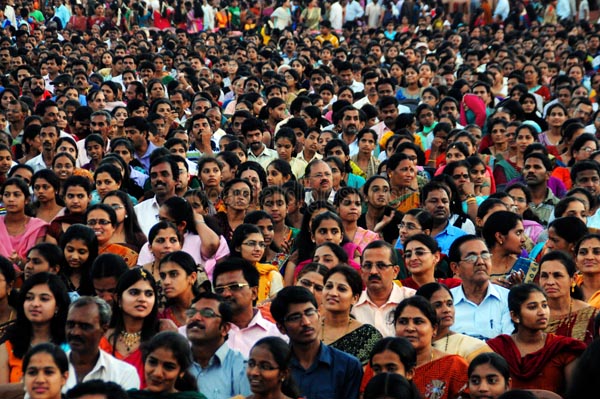
Curtains come down on memorable Alva's Virasat

January 9, 2012

AL_R9Jan_16

Moodbidri, January 9: The curtains came down on the five-day cultural fiesta, 'Alva's Virasat' at Mijar near here on Sunday with the mesmerizing performance by light music singer M D Pallavi.

Making a confident beginning with the title song of the Varakavi D.R. Bendre's Jnanpith Award-winning Naku Thanti , she went on to more popular Amma Naanu Devarane . Both, she said, were composed by her guru the late Mysore Ananthaswamy.

She presented Ha Yavva Byati Byatiyanadida Byadara Huduga written by Jnanpith Award-winner Chandrasekhara Kambar, in a folk tune. She showcased her prowess and richness of voice.

Acknowledging that she was deliberately choosing some of the finest jewels of Kannada literature, she picked up Baduku Jataka Bandi from D.V. Gundappa's Manku Thimmana Kagga . To drive home the poet's theme, she occasionally asked questions or explained. One could not disagree with her that DVG too deserved the Jnanpith.

She rendered the film song Nodayya Kotelingave which was originally sung by her. The presentation was different from the original song as the audience clapped rhythmically to the tune.

She rendered K.S. Narasimha Swamy's work Hindina Saalina Hudugaru against rat-race for marks and pleaded for a little love for life. The student-dominated crowd could not have asked for more. Through K.S. Nisar Ahmed's Kurigalu Saar Kurigalu she advised the students to be politically aware.

Earlier, the Moksha Band from Chennai led by singer Mahesh Vinayakam presented a unique Carnatic-Western fusion music.

He introduced Konnakol, which he described as an unique art from South India in which sounds or syllables of Mrudanga or ghatam were rendered vocally. By making the audience say 'dhum' together and giving a clap a split second later, he connected well with the large gathering.

Parthasarathy later represented the syllables on the Mridangam which was repeated on the Ghatam by N. Rajaram. The troupe of youngsters — all aged under 30 — knew how to mesmerise the crowd consisting mainly of students. Ambrose Tucker's clarinet was an added attraction.


AL_R9Jan_1

AL_R9Jan_2

AL_R9Jan_3

AL_R9Jan_4

AL_R9Jan_5

AL_R9Jan_6

AL_R9Jan_7

AL_R9Jan_8

AL_R9Jan_9

AL_R9Jan_10

AL_R9Jan_11

AL_R9Jan_12

AL_R9Jan_14

AL_R9Jan_15

AL_R9Jan_17

AL_R9Jan_18

AL_R9Jan_19

AL_R9Jan_20

ALBUM

Comments

Add new comment

  • Coastaldigest.com reserves the right to delete or block any comments.
  • Coastaldigset.com is not responsible for its readers’ comments.
  • Comments that are abusive, incendiary or irrelevant are strictly prohibited.
  • Please use a genuine email ID and provide your name to avoid reject.
Agencies
July 5,2020

The deadly coronavirus that entered India while there was still nip in the air has beaten rising mercury, humid conditions, unique Indian genome and has entered monsoon season with more potency as fresh cases are only breaking all records in the country.

India recorded a single-day spike of record 24,850 new coronavirus cases on Sunday, taking its total tally to 6.73 lakh corona-positive cases.

Top Indian microbiologists were hopeful in March that after the 21-day lockdown, as summer approaches, the rise in temperature would play an important role in preventing the drastic spread of COVID-19 virus in India.

Several virologists hinted that by June this year, the impact of COVID-19 would be less than what it appeared in March-April.

The claims have fallen flat as the virus is mutating fast, becoming more potent than ever.

According to experts, the novel coronavirus is a new virus whose seasonality and response to hot humid weather was never fully understood.

"The theory was based on the fact that high temperatures can kill the virus as in sterilisation techniques used in healthcare. But these are controlled environment conditions. There are many other factors besides temperature, humidity which influence the transmission rate among humans," Dr Anu Gupta, Head, Microbiologist and Infection Control, Fortis Escorts Heart Institute, told IANS.

There is no built-up immunity to COVID-19 in humans.

"Also, asymptomatic people might be passing it to many others unknowingly. New viruses tend not to follow the seasonal trend in their first year," Gupta emphasized.

Globally, as several countries are now experiencing hot weather, the World Health Organization (WHO) reported a record hike in the number of coronavirus cases, with the total rising by 2,12,326 in 24 hours in the highest single-day increase since COVID-19 broke out.

So far over 11 million people worldwide have tested positive for the disease which has led to over 5,25,000 deaths, according to data from Johns Hopkins University. The US remained the worst-hit country with over 28 lakh cases, followed by Brazil with 15.8 lakh.

According to Sandeep Nayar, Senior Consultant and HOD, Respiratory Medicine, Allergy & Sleep Disorders, BLK Super Speciality Hospital in New Delhi, whether temperature plays a role in COVID-19 infection is highly debated.

One school of thought said in the tropical regions of South Asia, the virus might not thrive longer.

"On the other hand, another school of thought has found that novel Coronavirus can survive in a hot and humid environment and tropical climate does not make a difference to the virus. According to them, this is what distinguishes the novel coronavirus from other common viruses, which usually wane in hot weather," stressed Nayar.

Not much has been studied in the past and no definite treatment or vaccine is available to date.

"Every day, new properties and manifestation of the disease come up. As of now, the only way to prevent this monster is by taking appropriate precautions. Hand hygiene, social distancing, cough etiquette and face masks definitely reduce spread of COVID-19 infection," Nayar told IANS.

Not just top Indian health experts, even Indian-American scientists had this theory in mind that sunshine and summer may ebb the spread of the coronavirus.

Ravi Godse, Director of Discharge Planning, UPMC Shadyside Pennsylvania in the US told IANS in April: "In the summer, the humidity can go up as well, meaning more water drops in the air. If the air is saturated with water and somebody sneezes virus droplets into such air, it is likely that the droplets will fall to the ground quicker, making them less infectious. So the short answer is yes, summer/sunshine could be bettera.

According to Dr Puneet Khanna, Head of Respiratory Medicine and Pulmonology, Manipal Hospital, Delhi, COVID-19 death rates are not too different in tropical countries but since the disease affected them late it was yet to show its peak in these areas.

"The virus can survive well in hot and humid countries and this is proven now," he stressed.

Comments

Add new comment

  • Coastaldigest.com reserves the right to delete or block any comments.
  • Coastaldigset.com is not responsible for its readers’ comments.
  • Comments that are abusive, incendiary or irrelevant are strictly prohibited.
  • Please use a genuine email ID and provide your name to avoid reject.
News Network
May 1,2020

Bengaluru, May 1: Karnataka government has assigned State Nodal Officers after the Ministry of Home Affairs (MHA) order regarding the inter-state movement of stranded migrant workers, tourists, pilgrims and students during the lockdown period.

The Nodal officers have also been appointed for coordination with 11 different states.

In an order issued on Thursday, Karnataka Government wrote, "To facilitate smooth and orderly movement of persons across State borders as per SOPs, the undersigned, in the exercise of powers conferred under the Disaster Management Act, 2005, and in the capacity as Chairman, State Executive Committee, hereby appoint the following officers as Nodal officers to coordinate with Nodal Officers of States/Union Territories (UTs) mentioned against their names."

Dr Rajkumar Khatri, IAS and Arun Jeji Chakravarthy, IPS will be overall in charge of the movement of stranded people from outside States/UTs to Karnataka.

N Manjunatha Prasad, IAS and P S Sandhu, IPS will be overall in charge of the movement of stranded people from Karnataka to other States/UTs.

Comments

Add new comment

  • Coastaldigest.com reserves the right to delete or block any comments.
  • Coastaldigset.com is not responsible for its readers’ comments.
  • Comments that are abusive, incendiary or irrelevant are strictly prohibited.
  • Please use a genuine email ID and provide your name to avoid reject.
News Network
February 20,2020

Bengaluru, Feb 20: The poultry industry is facing losses amid rumours of the discovery of a chicken infected with coronavirus in Bengaluru.

DK Kantharaju, president, Karnataka Cooperative Poultry Federation said, "Karnataka is facing losses of Rs 60 to 65 crores. The consumption percentage has also decreased by 30-35 per cent".

Atiq, a meat seller, said, "Because of coronavirus people are scared. But I want to say that chicken is safe to consume here. All this fear is caused due to fake news on social media."

Another person Abdul Hafeez said, "Chicken and coronavirus are not related. People are scared because of what is being spread on social media. The business has definitely gone down due to fear of coronavirus."

Comments

Add new comment

  • Coastaldigest.com reserves the right to delete or block any comments.
  • Coastaldigset.com is not responsible for its readers’ comments.
  • Comments that are abusive, incendiary or irrelevant are strictly prohibited.
  • Please use a genuine email ID and provide your name to avoid reject.