Anandotsava - 12 begins at NMAM Institute of Technology

[email protected] (CD Network)
March 8, 2012

nitte

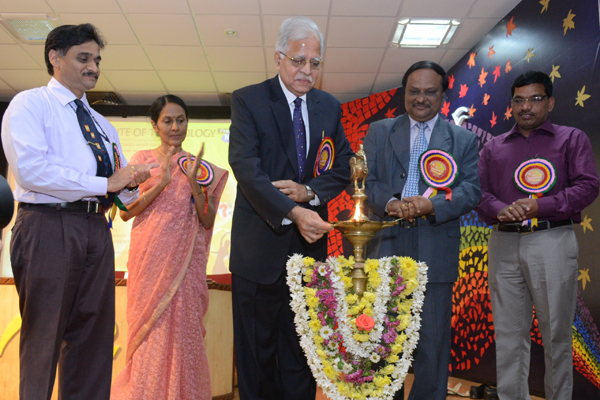
Nitte, March 8: A state level inter-collegiate three day cultural mega event, Anandotsava '12, organized by NMAM Institute of Technology, NITTE, was inaugurated by B Ananthakrishna, Chairman, Karnataka Bank Ltd on Thursday at the College Auditorium.

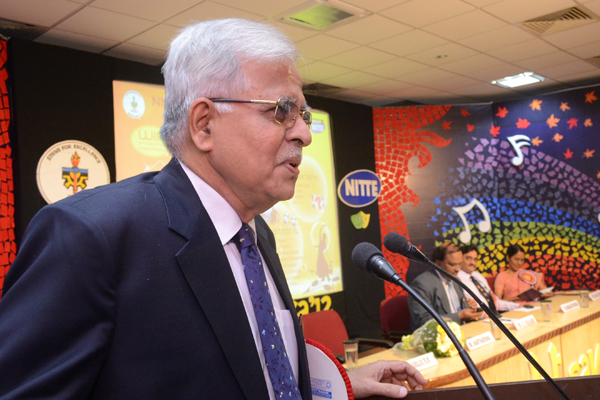
In his inaugural speech Mr Ananthakrishna said, of the four stages of a man's life, the student life is most important where they learn and acquire knowledge to become a responsible citizen of the country.

Giving example of Akhilesh Yadav of Uttar Pradesh who is responsible to change the state government in the recent elections held, Mr.Anathakrishna said, the knowledge and talent will stand in students' endeavor to give pure and good life of discipline. He made a wish that anandotsava becomes “sachidanandotsava”.

Dr S Y Kulkarni, Principal of the college in his presidential address said that “Anandotsava is a platform to bring out and exhibit cultural and literary talents of the technical students. These talents are considered as one of the attributes of a global engineer, he said.

He said that Anandotsava, an intercollegiate event started some years back with only few colleges participating, today has become a mega event with more than 1000 students taking part from about 50 Engineering colleges, all over the state. He wished that Anandotsava becomes a Technical University level Mega Fest.

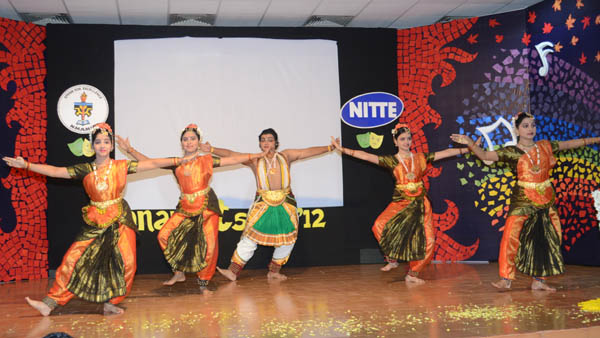
Dr Niranjan N Chiplunkar, Vice Principal, welcomed the gathering. Prof Yuvaraju B N, Chairman of Oraganizing committee gave a brief overview about the activities of Anandotsava -12. Prof. Shalini K Sharma, Head, Dept. of placement and Counseling and chairperson of Inauguration Committee proposed the vote of thanks. Shailesh introduced the chief guest to the audience. Anusha and Nisarga compered the ceremony. Sumana Rao and team performed welcome dance which encompassed within itself the joy of the fest.

AND_1

AND_2


Comments

Add new comment

  • Coastaldigest.com reserves the right to delete or block any comments.
  • Coastaldigset.com is not responsible for its readers’ comments.
  • Comments that are abusive, incendiary or irrelevant are strictly prohibited.
  • Please use a genuine email ID and provide your name to avoid reject.
Ram Puniyani
March 14,2020

In the wake of Citizenship Amendment Act (CAA) UN High Commissioner, Michele Bachelet, has filed an intervention in the Supreme Court petition challenging the constitutionality of the Citizenship Amendment Act, as she is critical of CAA. Responding to her, India’s Foreign Minister S. Jai Shanker strongly rebutted her criticism, saying that the body (UNHCR) has been wrong and is blind to the problem of cross border terrorism. The issue on hand is the possibility of scores of people, mainly Muslims, being declared as stateless. The problem at hand is the massive exercise of going through the responses/documents from over 120 crore of Indian population and screening documents, which as seen in Assam, yield result which are far from truthful or necessary.

The issue of CAA has been extensively debated and despite heavy critique of the same by large number of groups and despite the biggest mass opposition ever to any move in Independent India, the Government is determined on going ahead with an exercise which is reminiscent of the dreaded regimes which are sectarian and heartless to its citizens, which have indulged in extinction of large mass of people on grounds of citizenship, race etc. The Foreign minister’s assertion is that it is a matter internal to India, where India’s sovereignty is all that matters! As far as sovereignty is concerned we should be clear that in current times any sovereign power has to consider the need to uphold the citizenship as per the principle of non-discrimination which is stipulated in Art.26 of the International Covenant on Civil and Political (ICCPR) rights.

Can such policies, which affect large number of people and are likely to affect their citizenship be purely regarded as ‘internal’? With the World turning into a global village, some global norms have been formulated during last few decades. The norms relate to Human rights and migrations have been codified. India is also signatory to many such covenants in including ICCPR, which deals with the norms for dealing with refugees from other countries. One is not talking of Chicago speech of Swami Vivekanand, which said that India’s greatness has been in giving shelter to people from different parts of the World; one is also not talking of the Tattariaya Upanishad’s ‘Atithi Devovhav’ or ‘Vasudhaiva Kutumbkam’ from Mahaupanishad today.

What are being talked about are the values and opinions of organizations which want to ensure to preserve of Human rights of all people Worldwide. In this matter India is calling United Nations body as ‘foreign party’; having no locus standi in the case as it pertains to India’s sovereignty. The truth is that since various countries are signatories to UN covenants, UN bodies have been monitoring the moves of different states and intervening at legal level as Amicus (Friend of the Court) to the courts in different countries and different global bodies. Just to mention some of these, UN and High Commissioner for Human Rights has often submitted amicus briefs in different judicial platforms. Some examples are their intervention in US Supreme Court, European Court of Human Rights, International Criminal Court, and the Inter-American Court of Human Rights. These are meant to help the Courts in areas where UN bodies have expertise.

 Expertise on this has been jointly formulated by various nations. These interventions also remind the nations as to what global norms have been evolved and what are the obligations of individual states to the values which have evolved over a period of time. Arvind Narrain draws our attention to the fact that, “commission has intervened in the European Court of Human Rights in cases involving Spain and Italy to underscore the principle of non-refoulement, which bars compulsory expulsion of illegal migrants… Similarly, the UN has intervened in the International Criminal Court in a case against the Central African Republic to explicate on the international jurisprudence on rape as a war crime.”

From time to time organizations like Amnesty International and Human Rights Watch have been monitoring the status of Human rights of different countries. This puts those countries in uncomfortable situation and is not welcome by those establishments. How should this contradiction between ‘internal matter’, ‘sovereignty’ and the norms for Human rights be resolved? This is a tough question at the time when the freedom indices and democratic ethos are sliding downwards all over the world. In India too has slid down on the scale of these norms.

In India we can look at the intervention of UN body from the angle of equality and non discrimination. Democratic spirit should encourage us to have a rethink on the matters which have been decided by the state. In the face of the greatest mass movement of Shaheen bagh, the state does need to look inwards and give a thought to international morality, the spirit of global family to state the least.

The popular perception is that when Christians were being persecuted in Kandhmal the global Christian community’s voice was not strong enough. Currently in the face of Delhi carnage many a Muslim majority countries have spoken. While Mr. Modi claims that his good relations with Muslim countries are a matter of heartburn to the parties like Congress, he needs to relook at his self gloating. Currently Iran, Malaysia, Indonesia and many Muslim majority countries have spoken against what Modi regime is unleashing in India. Bangladesh, our neighbor, has also seen various protests against the plight of Muslims in India. More than the ‘internal matter’ etc. what needs to be thought out is the moral aspect of the whole issue. We pride ourselves in treading the path of morality. What does that say in present context when while large section of local media is servile to the state, section of global media has strongly brought forward what is happening to minorities in India.   

The hope is that Indian Government wakes up to its International obligations, to the worsening of India’s image in the World due to CAA and the horrific violence witnessed in Delhi.


Comments

Add new comment

  • Coastaldigest.com reserves the right to delete or block any comments.
  • Coastaldigset.com is not responsible for its readers’ comments.
  • Comments that are abusive, incendiary or irrelevant are strictly prohibited.
  • Please use a genuine email ID and provide your name to avoid reject.
News Network
January 19,2020

Bengaluru, Jan 19: The long-awaited discussions on cabinet expansion finally took place between BJP national president Amit Shah and the state party unit on Saturday, but they produced no result.

Latest indications are that new members will be appointed only after CM BS Yediyurappa returns from Davos, Switzerland, on January 25.

The party held a close-door party meeting at a top hotel in Hubballi. The subject of expanding the cabinet, which currently has 16 vacancies, featured in the talks.

Earlier, Yediyurappa reportedly had a one-on-one with Shah during their 45-minute flight from Bengaluru to Hubballi. He is said to have insisted on accommodating all 11 newly MLAs in the cabinet. These legislators were earlier a part of Congress and JD(S); they contested the December byelections on BJP tickets and won.

This apart, BJP sources said, Yediyurappa and Shah had a brief chat at a private event at Palace Grounds . Separately, Shah, who is the Union home minister, held meetings with Jagadish Shettar, Laxman Savadi and Prahlad Joshi, seeking their views on cabinet expansion.

Shah also wanted to get an idea of what people think about the Yediyurappa government’s performance.

Newly elected MLAs Ramesh Jarkiholi, BC Patil and Srimanth Patil greeted Shah. “We only met him to wish him; we didn’t discuss the cabinet issue. That’s something state BJP members will do,” said Hirekerur legislator BC Patil.

Saturday’s deliberations fail to break the stalemate over the cabinet appointments. There are clear differences in the camp about whether all Congress-JD(S) defectors should be made cabinet members, according to a senior minister attended one such meeting.

Shah reportedly wants only seven to eight newly elected MLAs to be made ministers; the rest of the spots should go to BJP loyalists. Yediyurappa disagrees with this position as he had promised all 13 turncoats places in the cabinet. Two lost in the bypolls.

Shah has now asked Yediyurappa to visit Delhi after returning from Davos to finalise the composition of the cabinet, according to the sources.

Yediyurappa will leave for Davos early on Sunday, while Shah will fly directly to Delhi from Hubballi.

Comments

Add new comment

  • Coastaldigest.com reserves the right to delete or block any comments.
  • Coastaldigset.com is not responsible for its readers’ comments.
  • Comments that are abusive, incendiary or irrelevant are strictly prohibited.
  • Please use a genuine email ID and provide your name to avoid reject.
Agencies
January 1,2020

Kanpur, Jan 1: In a seemingly bizarre development, the IIT in Kanpur has set up a panel to decide whether the poem "Hum dekhenge lazim hai ki hum bhi dekhenge", penned by Faiz Ahmad Faiz, is anti-Hindu.

The panel has been set up in response to complaints filed by a faculty member who claimed that the students, during a protest, sang this poem which was anti-Hindu.

The poem reads thus -- "Lazim hai ke hum bhi dekhenge. Jab arz-e-Khuda ke kaabe se. Sab bhut uthwaye jayenge, Hum ahl-e-safa mardood-e-harm. Masnad pe bithaye jayenge. Sab taaj uchale jaenge. Sab takht giraye jayenge. Bas naam rahega Allah ka. Hum dekhenge."

It was the last line that has turned into a bone of contention. Translated into English, it means, 'When thrones will vanish, only Allah's name will remain' -- implying the misleading translation by the professor.

The poem had been written by Faiz in reference to military dictator Zia-ul-Haq in 1979 and was against the military rule in Pakistan. Faiz had left leanings and was an atheist. He was known for his revolutionary writings that kept him in jail for several years.

It may be recalled that the IIT-Kanpur students had taken out a peaceful march on the campus on December 17 in support of the students of Jamia Millia Islamia and during the march, the students sang the Faiz poem.

According to IIT Deputy director Manindra Agarwal: "In the video, the students are seen reciting the Faiz poem which can also be perceived as being anti-Hindu.

The IIT faculty member, in his complaint, has alleged that the students made anti-India and communal statements during their demonstration in solidarity with the Jamia students.

The complaint was based on two lines of the poem, which have obviously been misinterpreted -- "When all idols will be removed, only Allah's name will remain."

The faculty member has stated that "organisers and masterminds must be identified and expelled immediately."

Fifteen other students have also signed the complaint filed by the professor against the protesting students.

Meanwhile, IIT students have said that the faculty member who lodged the complaint has been banned on a social networking site for posting communal content.

In an article published on the IIT-Kanpur student media portal, the students clarified what exactly happened on the day of protest and how their chant was given a 'communal and misleading' turn. They stated that they had recited a few lines of the Faiz poem in reference to the police crackdown on the Jamia students.

Comments

Add new comment

  • Coastaldigest.com reserves the right to delete or block any comments.
  • Coastaldigset.com is not responsible for its readers’ comments.
  • Comments that are abusive, incendiary or irrelevant are strictly prohibited.
  • Please use a genuine email ID and provide your name to avoid reject.