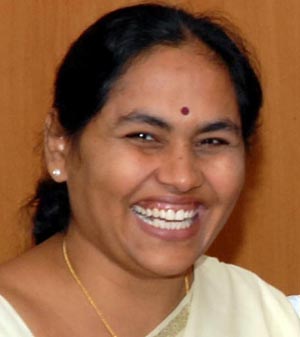
No power for others but Shobha's house gets constant electricity

[email protected] (CD Network)
May 5, 2012

shobhak1a

Puttur, May 5: While other houses in Charvaka, the native village of Shobha Karandlaje, State Energy Minister, are reeling under the problem of power cuts, the Minister's house has been getting constant power supply, it is reported.

Electricity to Charvaka and Kaniyur areas is supplied by Savanoor Power Sub-centre. The villagers of these areas have alleged that they have been leading their lives without power for most of the time with the irregular power supply but the Minister's house has been receiving constant power supply.

Many villagers in the region depend on agriculture. “Power cuts have been creating problems for them in terms of carrying out agricultural activity. MESCOM officials too do not give any clear explanation. When they can give full power supply to her house, why can't they give to us as well? She too is a part of the village. She might have become a Minister now and as someone who is holding a responsible position, she must ensure that everyone in her village gets power. But to light one's own house and keep others in the dark is unjust”, villagers have alleged.

Comments

Add new comment

  • Coastaldigest.com reserves the right to delete or block any comments.
  • Coastaldigset.com is not responsible for its readers’ comments.
  • Comments that are abusive, incendiary or irrelevant are strictly prohibited.
  • Please use a genuine email ID and provide your name to avoid reject.
News Network
June 1,2020

Coimbatore, June 1: A communal conspiracy has been aborted by the police by arrested a miscreant who had placed meat in front of Venugopala Krishnaswamy Temple and Sri Ragavendra Temple in Coimbatore, Tamil Nadu.

The miscreant has been identified as S Hari Ramprakash, 48, of Kavundampalayam in Coimbatore. He is a civil engineering graduate. It is suspected that He is a Sangh Parivar activist and the intention behind his act was to put the blame on Muslims.

Even though officials claimed that Hari appeared to be mentally disturbed, there were no medical records that stated he was mentally disturbed.

Two separate cases were registered against Hari. He was booked under sections 153 A (promoting enmity between different groups) 295 A (deliberate and malicious acts intended to outrage religious feelings of any class by insulting its religion or religious beliefs) and 298 (uttering words etc, with deliberate intent to wound religious feelings) of the Indian Penal Code.

City police commissioner Sumit Sharan said, “We collected CCTV footage and found a man, who had parked his motorcycle near the two temples and returned from the temples. Based on the registration number, we traced and arrested Hari.”

Commissioner added that the city has CCTV cameras in many places and it helped police officials crack the case faster. The police said he purchased one kg of pork meat from a shop at Kavundamapalaym last Friday morning and placed it in front of the temples on the same day.

Comments

zaki ahmed
 - 
Monday, 1 Jun 2020

Now why is this story not highlighted in national media so that the whole nation knows about the intent of the BJp , the sangh parivar & the rss & also those communal outfits who support atrocities against minorities 

Add new comment

  • Coastaldigest.com reserves the right to delete or block any comments.
  • Coastaldigset.com is not responsible for its readers’ comments.
  • Comments that are abusive, incendiary or irrelevant are strictly prohibited.
  • Please use a genuine email ID and provide your name to avoid reject.
News Network
February 28,2020

The Karnataka BJP, which faced action on Twitter earlier this month over incendiary tweets, this time has passed the blame of Sangh Parivar sponsored Delhi violence to the victims.

In an insensitive tweet on Friday, it dubbed the protests against the notorious Citizenship Amendment Act (CAA) as "fake" and added that the violence that followed was "the most well-planned assault on the Idea of India," in an apparent attempt to portray the victims as villains.

The handle, notorious for tweets targeting Muslims, blamed the clashes that erupted in Delhi between people demonstrating for and against the CAA on "so called 'Peacefuls'" - a known right-wing slur for Muslims.

Many people on social media called out the tweet for misleading people and covering up the role of Delhi BJP leader Kapil Mishra's provocative speech for triggering the violence or the failure of the Delhi Police, which reports to the former BJP chief and Union Home Minister Amit Shah, in controlling the riots.

Earlier this month, the Karnataka BJP had tweeted a video of Muslim women standing in queue to vote in the Delhi elections, showing their voter ID cards, with the snarky caption: "Keep the documents safe, you will need to show them again during NPR (National Population Register) exercise."

Soon after, the party unit's Twitter handle was blocked by the social media platform for 24 hours after many accused it of encouraging Islamophobia.

NPR has been widely criticised by opposition parties as a precursor to the government's planned NRC or National Register of Citizens which intends to make Indians prove their citizenship with documents that many poor or illiterate do not possess.

Many fear that combined with the already imposed CAA - which promises citizenship to only non-Muslim refugees from Pakistan, Afghanistan and Bangladesh - the NRC can be used to make millions of Muslims stateless.

The government has denied the allegation and said the CAA only intends to help those who have faced religious persecution. In recent weeks, it has gone back on its rhetoric on the NRC which was announced by Amit Shah in parliament as "it will certainly happen".

The CAA, which was cleared by parliament in December, has triggered deadly protests in the country which left at least 25 dead till Sunday. Since then, at least 42 more people have been killed as large-scale violence erupted in northeast Delhi and hundreds of homes and shops have been burned to the ground.

Comments

Add new comment

  • Coastaldigest.com reserves the right to delete or block any comments.
  • Coastaldigset.com is not responsible for its readers’ comments.
  • Comments that are abusive, incendiary or irrelevant are strictly prohibited.
  • Please use a genuine email ID and provide your name to avoid reject.
News Network
March 15,2020

While it makes perfect sense for IT employees to work from remote locations via video conferencing and collaboration tools seamlessly - especially in the case of tech giants like Google or Microsoft -- workers from the non-IT companies and small and medium enterprises (SMBs) are the worst-hit in India as most of them have little or no clue about how these messaging and collaboration tools work amid the coronavirus pandemic.

Small companies -- from corporate to education verticals -- are scrambling to get their act together as new coronavirus threat has reached their premises, prompting them to send employees home who have age-old laptops, poor network and connectivity with no UPS backups and little knowledge about how to handle group chat and collaboration software like Zoom, Google Hangouts Meet, Microsoft Teams and Flock etc.

Instead of halting operations, however, businesses can choose to shift towards remote working methods with teaching non-IT staff on how to use the latest digital software to connect and work, say industry experts.

The training will take some time and may hamper productivity in the short run but is a win-win situation for the non-tech companies in the long run, in case any such global emergency arises in the future.

According to a latest report by Gartner, 54 per cent of HR leaders have cited that poor technology and/or infrastructure for remote working is the biggest barrier to effective remote working.

Sandy Shen, Senior Director Analyst, Gartner, says that with COVID-19 disrupting the business landscape, CIOs should relook at the digital fulfillment of market demand.

"The value of digital channels, products and operations is immediately obvious to companies everywhere right now. This is a wake-up call for organisations that have placed too much focus on daily operational needs at the expense of investing in digital business and long-term resilience," warned Shen.

Businesses that can shift technology capacity and investments to digital platforms will mitigate the impact of the outbreak and keep their companies running smoothly now, and over the long term.

"Videoconferencing, messaging, collaboration tools and document sharing are just a few examples of technologies that facilitate remote work. Additional bandwidth and network capacity may also be needed, given the increasing number of users and volume of communications," informed Shen.

The IT industry's apex body Nasscom has asked the government to relax norms for a month to allow work-from-home for technology and back-office employees as a measure to deal with the spread of Covid-19 in India.

Networking giant Cisco said that it has seen "significant growth" in the usage of its web conferencing and video-conferencing service Webex in India.

According to Muneer Ahmad, Business Head, ViewSonic India, due to COVID-19 pandemic, the corporate and educational sector is severely getting affected in the country.

"ViewSonic IFP has a cloud-based software which help teachers and corporates to connect through video conferencing to multiple people at the same time and can split the screen into six screens. It can also connect with various tools like Skype, Cisco WebEx, Zoom, Google Hangouts and GoToMeeting," Ahmad told IANS.

Co-working sector has also taken a hit and the industry is looking at several measures to tackle it -- from ensuring supply of juices rich in Vitamin C to supply of disinfectants and giving work from home facilities.

"The scheduled visits of the clients at our co-working offices have been postponed. Few of our clients have cancelled their outstation meetings and have now started audio/video conferencing for virtual meetings," said Nakul Mathur, MD, Avanta India.

According to reports, India has approximately 1,000 co-working locations (as of September 2019) and is the second-largest market for the co-working industry after China.

As India's first licensed B2B Virtual Network Operator, CloudConnect Communications offers a collaborative platform that allows companies to overcome the COVID-19 threat while maintaining seamless business continuity and optimum employee productivity.

"We offer a secure, robust, reliable, scalable and trackable mobile-first unified communication infrastructure that aids remote teleworking so that businesses can continue operating even under any unforeseen circumstances," said Gokul Tandon, Executive Chairman, CloudConnect Communications.


Comments

Add new comment

  • Coastaldigest.com reserves the right to delete or block any comments.
  • Coastaldigset.com is not responsible for its readers’ comments.
  • Comments that are abusive, incendiary or irrelevant are strictly prohibited.
  • Please use a genuine email ID and provide your name to avoid reject.