Haj rush eases; so does passport process

May 10, 2012
Bangalore, May 10: Getting online appointments for passport applications just got easier as more slots are finally open at the Passport Seva Kendras for regular applications either through normal or tatkal process.

January this year, the Regional Passport Office (RPO) had started booking about 350 slots per day for Haj pilgrims due to a new rule that says travellers need to possess a passport to apply for Haj pilgrimage organised by the Haj Committee of India.

As a result, special counters were set up and those passports were processed on a priority basis.

From January, 350 appointments were set aside for Haj applicants and in March they were scaled down to about 120 a day.

On the downside, this had inconvenienced other applicants.

gowda

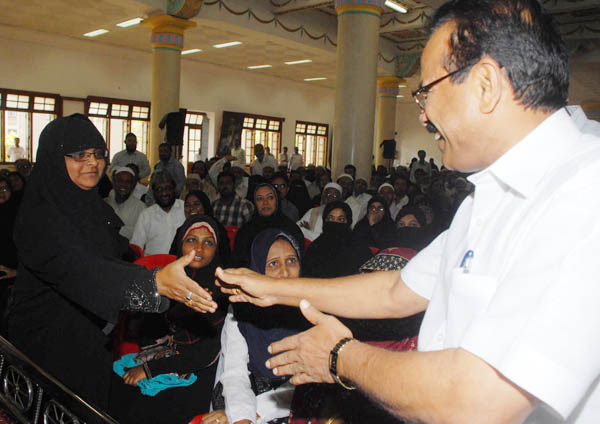
Chief Minister D V Sadananda Gowda greets Haj pilgrims at the computerised selection of Haj pilgrims at the Vidhana Soudha in Bangalore on Wednesday.


Slots that opened online 36 hours prior to the appointment date, disappeared in less than three minutes and applicants complained of having to try for more than 10 days continously before getting lucky enough to get an appointment.

Faced with a lot of complaints, the RPO?later opened their office to applicants to reduce the waiting time. Through this system, those applying through tatkal and those applying through normal procedure but needed the passport immediately for medical, education or employment reasons, could come to the Passport office directly. They were issued tokens so that they could be accommodated with an appointment at the Passport Seva Kendras, either on the same day or the next.

“This system will continue even though we have stopped accepting applications for Haj about 15 days ago. The demand has still not reduced, probably because of the holiday season,” Regional Passport Office K J?Srinivasa said.

While applications for Haj have stopped, those travelling on Umrah to Haj through private operators continue to apply for passports.

These applications, however, will not be treated on priority basis. Srinivasa added that there was no plan to increase the number of appointments despite growing demand, as they had reached the maximum at all the centres in Bangalore, Mangalore and Hubli.


Bowing to increasing demand for passports, the Ministry of External Affairs (MEA)?is likely to operate a mini Passport Seva Kendra from Gulbarga in the next few months. Unlike the other mainstream PSKs where some of the activities are outsourced to Tata Consultancy Services (TCS), the mini PSK will only use the software created by TCS and will be staffed by the MEA.

Chief Minister D V Sadananda Gowda greets Haj pilgrims at the computerised selection of Haj pilgrims at the Vidhana Soudha in Bangalore on Wednesday.


Comments

Add new comment

  • Coastaldigest.com reserves the right to delete or block any comments.
  • Coastaldigset.com is not responsible for its readers’ comments.
  • Comments that are abusive, incendiary or irrelevant are strictly prohibited.
  • Please use a genuine email ID and provide your name to avoid reject.
coastaldigest.com web desk
June 9,2020

Mumbai, June 9: A 45-year-old doctor posted in the 108 ambulance service at Malad railway station in Mumbai died of COVID-19 after two hospitals refused admission, in spite of the fact that he was a frontline warrior against coronavirus.

The victim is Dr Shaukat Ali, who was working with the 108 ambulance service for the last four years. A few days ago, he got his blood tests done after his health deteriorated. The result stated typhoid fever following which he started getting treatment at home in Malwani.

Ali's family ran from pillar to post to get him hospitalised in either a private or government hospital, to no avail.

"On Friday, his condition worsened and he started feeling breathless. Despite us calling the 108 ambulance service, no one picked up the call. So after waiting for a while, I and uncle's colleague, Dr Nigam, rushed him to SK Patil hospital in Malad East in an auto. But they refused us stating they were admitting only COVID-19 patients.”

“Then we took him to Desai Hospital, where doctors were initially ready to admit him but later refused stating lack of beds. They said we could take him home as his condition was fine," Zubair Shaikh, Ali's nephew said.

"But his condition worsened. So, I called Dr Nigam and we managed to admit him in Shatabdi hospital. On Sunday, when his results came out stating that he had COVID-19, doctors had already put him on a ventilator, where he passed away in the evening," he added.

Zubair further said, "Had the doctors at Desai Memorial Hospital admitted him, my uncle would have been alive today. It is a matter of great regret that a doctor, who was risking his life during this pandemic, could not get help from his own government hospitals."

Ali's wife and his two children's are in UP, while he was staying with his elder daughter who had recently appeared for HSC exams and preparing for NEET.

Comments

Please don't say such words, I personally became very sad after hearing this that Warrior like Dr. Saukat Ali passes away due to mismanagement of health organization. My condolence to him and his family. Please don't divide Hindu and Muslims in such way, not only Muslims but Hindu also died due to such reasons and one more thing here in Maharashtra, BJP is not ruling party. Thanks..

Ugly Indian
 - 
Wednesday, 10 Jun 2020

VERY VERY SAD...innna lillahi wainna yelahai rajoon.
this is the lession for all INDIAN muslim doctor as well as muslims....open your ear and listen.
this is indian not italy and now current ruling government is very very bad...they want indian to be slave.
also today you help your hindu brother but tommorow they will vote for same people BJP who is giving touble to muslim..GOD given chance to develop muslim community not our enemy,
india is divided alreday, my 20 year old hindu friend become my enemy now after NRC and CAA..
we will see where it will end. may the justice and peace prevail.


Add new comment

  • Coastaldigest.com reserves the right to delete or block any comments.
  • Coastaldigset.com is not responsible for its readers’ comments.
  • Comments that are abusive, incendiary or irrelevant are strictly prohibited.
  • Please use a genuine email ID and provide your name to avoid reject.
News Network
June 7,2020

Bengaluru, Jun 7: An eminent scientist on Sunday suggested a shift system in schools to prevent spread of the coronavirus and continuing with online classes with focus on project-based learning in a big way to promote creativity.

Former Director General of the Defence Research and Development Organisation (DRDO) V K Saraswat supported the idea of online teaching in the absence of regular classes in view of closure of schools due to the COVID-19 pandemic.

But, he said it should be organised in far better and more interactive ways so that delivery of knowledge can be better. The NITI Aayog member stressed the need for schools to have a strategy when they reopen keeping in mind the safety of students.

May be they will have to organise shifts so that within the same space they can handle the students; May be they will have to employ more teachers, and they can run two shifts. "May be half the strength in a class can come in the morning and others in the afternoon.

Or students of first to sixth standard can come in the morning and seventh to tenth can come in the afternoon, Saraswat told PTI. Reopening strategy will have to be worked out by the education department, added the former Chief Scientific Advisor to the Defence Minister.

Along with normal classes, online education should be continued as a regular system in future, and promoted in a big way because that is the way technology is going to help delivery of knowledge, he added. Saraswat also raised the pitch for reforms in the education sector, saying India is facing the problem of rote learning.

Rote learning has to give way for more project-based teaching, he underlined. Children should be made to work on projects at home and that can be done online. That will also support the changeover from rote learning to creative learning.

I personally believe the education delivery system -- primary, secondary and college levels -- has to be completely changed because creativity in India is less and creativity would come only if we replace rote learning with project-based learning, Saraswat said.

On some academics holding the view that the marks-based model is killing the education system in India as it does not promote creativity, he said evaluation of any outcome is important. Even when we perform in our normal way, evaluation cannot be replaced.

Otherwise, you cant find out how much you have succeeded in delivery. Certainly evaluation cannot be dispensed with. He did not agree with some experts, who favoured a single, uniform system for school education in India by dispensing with CBSE, ICSE and state boards. I am not for normalising everything in life.

I personally believe variety should be there. This concept of one kind of a system is okay for a Communist society, society which was trying to drive everybody like a herd, he said.

Creativity comes with variety, and there is nothing wrong in having different kinds of education system, but one thing which is important is we have to integrate vocational training as part of the education curriculum," Saraswat said. Vocational part cannot be kept away from the education system, he added.

Comments

Add new comment

  • Coastaldigest.com reserves the right to delete or block any comments.
  • Coastaldigset.com is not responsible for its readers’ comments.
  • Comments that are abusive, incendiary or irrelevant are strictly prohibited.
  • Please use a genuine email ID and provide your name to avoid reject.
Ram Puniyani
June 29,2020

In Minneapolis, US an African American, George Floyd lost his life as the white policeman, Derek Chauvin, caught hold of him and put his knee on his neck. This is a technique developed by Israel police. For nine long minutes the knee of the while policeman was on the neck of George, who kept shouting, I can’t breathe.

Following this gruesome murder America erupted with protests, ‘Black lives matter’. The protestors were not just African Americans but also a large section of whites. Within US one police Chief apologized for the act of this. In a touching gesture of apology the police force came on its knees. This had reverberations in different parts of the World.

The act was the outcome of the remnants of the racial hatred against blacks by the whites. It is the hatred and the perceptions which are the roots of such acts of violence. What was also touching that the state of democracy in US is so deep that even the police apologized, the nation, whites and blacks, stood up as a sensitive collective against this violence.

US is not the only country where the brutal acts of violence torment the marginalized sections of society. In India there is a list of dalits, minorities and adivasis who are regularly subjected to such acts. But the reaction is very different. We have witnessed the case of Tabrez Ansari, who was tied to the pole by the mob and beaten ruthlessly. When he was taken to police station, police took enough time to take him to hospital and Tabrez died.

Mohsin Sheikh, a Pune techie was murdered by Hindu Rashtra Sena mob, the day Modi came to power in 2014. Afrazul was killed by Shambhulal Regar, videotaped the act released on social media. Regar believed that Muslims are indulging in love Jihad, so deserve such a fate. Mohammad Akhlaq is one among many names who were mob lynched on the issue of beef cow. The list can fill pages after pages.

Recently a young dalit boy was shot dead for the crime of entering a temple. In Una four dalits were stripped above waste and beaten mercilessly. Commenting on this act the Union Minister Ramvilas Paswan commented that it is a minor incident. Again the list of atrocities against dalits is long enough. The question is what Paswan is saying is the typical response to such gruesome murders and tortures. In US loss of one black life, created the democratic and humane response. In India there is a general silence in response to these atrocities. Some times after a good lapse of time, the Prime Minister will utter, ‘Mother Bharati has lost a son’. Most of the time victim is blamed. Some social groups raise their voice in some fora but by and large the deafening silence from the country is the norm.

India is regarded as the largest democracy. Democracy is the rule of law, and the ground on which the injustices are opposed. In America though the present President is insensitive person, but its institutions and processes of democratic articulations are strong. The institutions have deepened their roots and though prejudices may be guiding the actions of some of the officers like the killer of George, there are also police officers who can tell their President to shut up if he has nothing meaningful to say on the issue. The prejudices against Blacks may be prevalent and deep in character, still there are large average sections of society, who on the principles of ‘Black lives matter’. There are large sections of vocal population who can protest the violation of basic norms of democracy and humanism.

In India by contrast there are multiple reasons as to why the lives of Tabrez Ansari, Mohammad Akhlaq, Una dalit victims and their likes don’t matter. Though we claim that we are a democracy, insensitivity to injustices is on the rise. The strong propaganda against the people from margins has become so vicious during last few decades that any violence against them has become sort of a new normal. The large populace, though disturbed by such brutalities, is also fed the strong dose of biases against the victims. The communal forces have a great command over effective section of media and large section of social media, which generates Hate against these disadvantaged groups, thereby the response is muted, if at all.

As such also the process of deepening of our democracy has been weak. Democracy is a dynamic process; it’s not a fixed entity. Decades ago workers and dalits could protest for their rights. Now even if peasants make strong protests, dominant media presents it as blocking of traffic! How the roots of democracy are eroded and are visible in the form where the criticism of the ruling dispensation is labelled as anti National..

Our institutions have been eroded over a period of time, and these institutions coming to the rescue of the marginalized sections have been now become unthinkable. The outreach of communal, divisive ideology, the ideology which looks down on minorities, dalits and Adivasis has risen by leaps and bounds.

The democracy in India is gradually being turned in to a hollow shell, the rule of law being converted in to rule of an ideology, which does not have faith in Indian Constitution, which looks down upon pluralism and diversity of this country, which is more concerned for the privileges of the upper caste, rich and affluent. The crux of the matter is the weak nature of democracy, which was on way to become strong, but from decades of 1980s, as emotive issues took over, the strength of democracy started dwindling, and that’s when the murders of the types of George Floyd, become passé. One does complement the deeper roots of American democracy and its ability to protect the democratic institutions, which is not the case in India, where protests of the type, which were witnessed after George Floyd’s murder may be unthinkable, at least in the present times. 

Comments

Add new comment

  • Coastaldigest.com reserves the right to delete or block any comments.
  • Coastaldigset.com is not responsible for its readers’ comments.
  • Comments that are abusive, incendiary or irrelevant are strictly prohibited.
  • Please use a genuine email ID and provide your name to avoid reject.