



BJP-ruled Karnataka is on a dangerous path of radicalisation. Rana Ayyub traces the scary distortion of an entire society
 IS KARNATAKA the new Gujarat, the second “laboratory of Hindutva” for the BJP and the broader Sangh Parivar? As the BJP government in the state enters the final year of its first term in power — it had earlier ruled in alliance with the JD(S) — that disturbing question comes up again and again. Behind the morality and hypocrisy, the humbug and corruption that the BJP establishment in Bengaluru has been charged with is a harder, harsher truth: the scary distortion of an entire society.
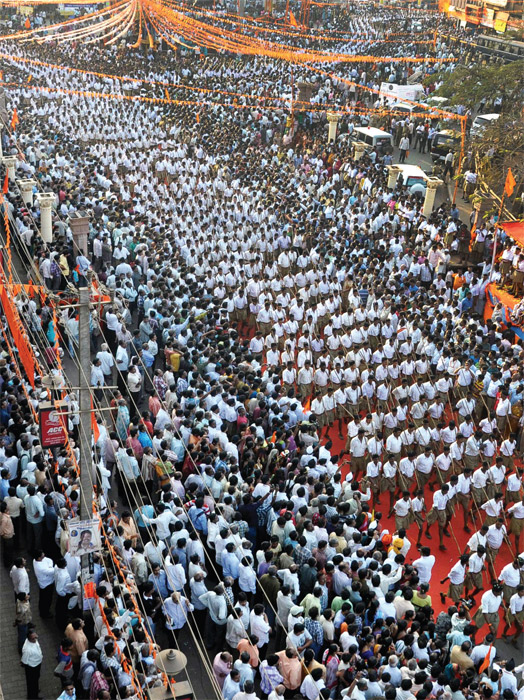
Two weeks ago, the so-called ‘porngate’ controversy rattled the country, when three BJP ministers were caught in the Assembly watching a pornographic clip — later explained as the recording of a woman being raped — while the House was in session and discussing poverty. While that controversy claimed the headlines, it also forced the RSS and its affiliates in the state to hurriedly cancel plans of the extended session of the Hindu Shakti Sangama. A Hindu show of strength, as the name implies, the Sangama was supposed to be held across the state after the opening convention in Hubli. Chief Minister DV Sadananda Gowda turned up in Hubli, wearing the RSS trademark khaki shorts — perhaps the first time a chief minister has been seen thus clad at a public event. If pictures tell a story, this one spoke volumes of the saffronisation of Karnataka.
The Sangama may have been interrupted by the Sangh Parivar, embarrassed and still recovering from the shame of porngate. Nevertheless, as TEHELKA travelled through Karnataka, spending a week journeying from urbane Bengaluru to northern and coastal Karnataka, what became apparent was that right-wing Hindu attacks on Muslims and Christians were now a regular feature. This reporter came back with accounts, incidents and testimonies that were so brazen, it was shocking.
Take a small example. On 22 January, there was uproar in Uppanangadi, a hamlet near Mangalore. Kalladka Prabhakar Bhatt, a senior RSS leader known for his proximity to Sadananda Gowda and his predecessor BS Yeddyurappa, was addressing a crowd and resorted to extreme and undignified imagery. “Lift the veils of Muslim women,” Bhatt told the throng, “and glimpse what they have to offer.” His listeners cheered; policemen listened too, but strolled casually, as if nothing were happening.
Soon after, the local minorities — a mix of Muslim and Catholic organisations — approached the police, which reluctantly filed an FIR against Bhatt. Yet it refused to arrest him, arguing there was no basis for taking him into custody. Rather, as if to compensate, the local police then filed an FIR against the president of the Muslim Central Committee, Mohammad Masood, under Section 153(a) of the Indian Penal Code — “Promoting communal enmity between classes” — as well as Section 505(2) — “Making statements that create or promote communal enmity”.
|
What was Masood’s fault? He had called a press conference to condemn Bhatt’s despicable one-liner. When contacted, Mangalore SP Abhishek Goyal suggested that there were “grey areas” and the police would certainly “study” the case. While the police was still studying the footage of Bhatt’s public meeting, the man himself inaugurated the new building of the Mangalore Police Commissionerate! Sitting with him in the VIP row was none other than the chief minister.
It was the sort of moment and photo-op the media just waits for. Yet the presence of Bhatt so soon after the unseemly incident found no mention in the media coverage of the inauguration of the new building. It was almost as if there was a conspiracy of silence. Only one plucky local newspaper broke the Omerta: Karavali Ale.
At one time, Karavali Ale was Karnataka’s most popular newspaper. Part of the reason it is not any longer may have to do with the stance of its editor, BV Sitaram, who has been one of the few voices in the state warning against the rising tide of religious bigotry. For two decades, he has documented each and every communal incident, big and small, in the state — and has suffered for it.
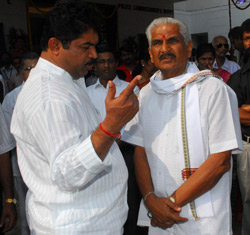 In 2009, Sitaram was arrested when a case was filed against him for defamation. Twenty-five policemen turned up and surrounded him. “It seemed like they had come to arrest a terrorist,” he exclaims. His fault was he had written about the exploits of a local Bajrang Dal leader.
Sitaram points to the newspapers stacked in his office. Picking up some of them at random, from the previous month’s pile, almost every day one finds mention of an attack on Muslims and Christians, on churches and mosques. Sitaram is distraught: “They go around shouting ‘Pehle qasaai, phir Isaai’ — First butchers (Muslims), then Christians.” According to official figures, a church has been attacked almost once every 10 days in the past three years. In some cases, the very presence of a Muslim boy with a Hindu girl has caused a riot.
The opposition to Hindu girl-Muslim boy romance is part of a peculiar phenomenon that the Sangh Parivar labels “love jihad”. This paranoia began in Kerala and alleges that Muslim men are being trained to woo and then indoctrinate Hindu girls, to win converts to Islam.
Bhatt is an exponent of theories of love jihad. In December 2011, the Hindu Nagarika Samiti held a massive protest meeting in Sullia, where Bhatt attacked the police for its supposed anti-Hindu sentiment and spoke of how love jihad, terrorism and cow slaughter were rampant in the state.
He was joined by others, notably Satyajit Suratkal, regional convener of the Hindu Jagran Vedike, who said: “Whenever the Muslims provoked us, we have given a suitable response. If they want more, then there might be a recurrence of earlier happenings. If the police join hands with traitors we will teach them a lesson too.”
MAHENDRA KUMAR, who was state unit president of the Bajrang Dal, is famous for his role in the spate of church attacks in 2008. The Justice Somashekara Commission had passed strictures against him relating to his role in that incident. Currently, an active worker of Janata Dal (Secular), Kumar tells Imran Khan that he’s a reformed man.
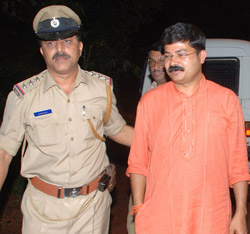
EDITED EXCERPTS FROM AN INTERVIEW
Why did you leave the Sangh Parivar?
I was with the Bajrang Dal for 16 years and served as the state president for four years until my resignation in 2009. During the 2008 church attacks, the state government faced a lot of flak. In order to save the government, they emotionally blackmailed me by saying they would put me behind bars for two days just to show the world that action has been taken. However, I ended up spending 42 days in prison. That was the turning point of my life as prison provided me a space to contemplate and reflect on my life. Even after my release, I took another year to come out of the Parivar during which time I was not involved in any organisational activities.
What is your understanding of Hindutva now?
Hindutva is a political strategy and it has nothing to do with Hinduism or the welfare or benefit of Hindu society. Playing on emotions, projecting wrong history and some negative points of the minority community, hatred is sown among the Hindu youth. It has been the strategy of the RSS to target minorities to consolidate Hindu votes for the BJP. When it was in the Opposition, the BJP raked up the issue of hoisting the tricolour at Hubli’s Idgah Maidan. By arousing sentiments, it created a statewide struggle, which led to communal clashes and lives were lost. But the same BJP government is in power and it is least bothered about this issue now. All these issues were raked for gaining political mileage. There is also a caste and class angle to it.
What is the caste angle?
Most of the top leaders of the Sangh Parivar come from the forward caste. None of their children are into active Sangh activities. Mostly, they are software engineers and well-settled. It is the youth from the backward and lower castes who fill the rank and file. And it is they who finally pay the price. Look at Gujarat, most of the youth languishing in jail for the 2002 riots are Dalits and people from the backward castes.
How much control does the RSS have on Bajrang Dal?
The VHP is a wing of the RSS and it is its job to keep a check on Bajrang Dal. And the RSS keeps a check on the VHP.
Can you give us some idea about how much of their politics is influenced by local/national issues?
It’s mostly national. Earlier, the Ram temple issue was a turning point. It has been replaced now by issues like terrorism and conversions. These have become the rallying point to influence the youth. State issues play a factor but not that much. The major issue in Karnataka was of Datta Peetha. It was made out to be the Ayodhya of the south.
Recently, there have been several cases of Sangh activists getting caught for their role in bomb blasts that were earlier ascribed to Muslims. What is your take?
The tragedy is that the greater role played by the RSS hasn’t been exposed completely. It is fringe organisations like Sri Ram Sene and others who are accused or caught. Whereas in fact, the main brain behind all these is the RSS. I have been campaigning and telling people that due to the few instances and actions of fringe elements in the Muslim community, you cannot hold the entire community responsible. And my understanding says that the Muslims of this country are largely peaceful, except a few fringe elements. But, the larger threat to this nation is posed by RSS and organisations like them who want to control the Hindu society through their divisive politics.
Recently the Sangh Parivar held a Hindu Samajotsava in Hubli and Dakshin Kannada, in which many ministers took part. What purpose do these events serve?
The BJP has lost its face due to internal bickerings and the exposure of several ministers involved in corruption scandals. BS Yeddyurappa is also threatening to break away from the party if he is not suitably rehabilitated. There is a fear among the BJP that if this happens they might lose the vote of two strong communities. Hence they are in a process of consolidating the Hindu vote bank as they will have to face polls in 2013. The recent incident of a Pakistani flag being hoisted in Sindhagi was meant to polarise the Hindu vote bank.
Is there any discontentment within the Sangh Parivar?
The middle- and lower-rank members are angry with the top leadership for siding with the government on issues like corruption. Their constant shielding and defence of top BJP leaders has brought discontentment among the workers. But since there is no place for dissent and questioning in the RSS, nothing much is coming out.
Imran Khan is a Senior Correspondent with Tehelka.com.
Other speakers were equally inflammatory. Some wanted cases booked against Sub-Inspector Ravi Kumar and action to be taken against the SP and the ASP because of alleged bias against Hindus. Soon all three officers were transferred. Ravi Kumar was “shifted back” to his earlier posting in Puttur town a day after his suspension was formally sought by the BJP district unit.
WHICH DIRECTION is Karnataka taking? In many senses, it seems to be a replay of Gujarat, with a shorter time-span. Like in the western state, there is a manipulation of class and commerce for religious ends. In Gujarat it took religious riots beginning with the bloody killings of 1969 — and extending from the 1970s to the 1990s — for the Sangh Parivar experiment to mature. Karnataka saw a similar surge with the Ayodhya movement in the late 1980s, and escalation with the Suratkal riots of 1998, which killed 18 people. In the process, relatively peaceful Mangalore, Suratkal, Bhatkal and Ullal became the fulcrum of the Hindutva movement.
|
The rise of the Sri Ram Sene, Hindu Jagran Vedike, Hindu Janajagruti Samiti, Sanathan Sanstha and Bajrang Dal were part of this radicalisation project. So was exploitation of socio-economic conditions, says Suresh Bhatt of the PUCL. The current communal tensions in Dakshina Kannada and Mangalore have their roots in the region’s rapid development since the 1970s.
Land reforms created new spaces for different castes and communities to operate in and compete with each other. Dominant social groups like Konkani Brahmins, Bunts and Christians found opportunities in new ventures like banking, education, tile manufacture and cashewnut trade. Many Bunts moved to Mumbai to establish Udupi eateries.
As studies done by fact-finding missions show, traditional backward castes like Mogaveeras and Billavas, who were freed from dependent tenancy, moved into small businesses like fishing. Here they had to contend with the Bearys, a Muslim community with a sizeable (15 percent) presence in Dakshina Kannada, and a heavy concentration in districts like Mangalore, Bantwal, Belthangady and Surathkal. All these areas are today communally sensitive.
The Gulf boom of the 1970s and the new industrialisation enabled the Beary community to prosper in petty business (textiles and groceries) as well as mid-level ones such as hotels and the spice trade. All this led to disgruntlement among the newly-empowered backward castes. It created room for religious mobilisation.
|
The Sangh Parivar began by consolidating unemployed youth in the Billava and Mogaveera groups. Neither have strong community organisations, and the Bajrang Dal and Sri Ram Sene filled the gap. Billavas form a majority of Sri Ram Sene cadre and have moved from being followers of Sri Narayana Guru to champions of Hindutva. Mogaveeras have found a niche in the Bajrang Dal.
Using various frontal organisations, the Sangh network infiltrated virtually every village in these parts of Karnataka. All this preceded the actual coming to power of the BJP by a good decade and speaks for the assiduous cadre-based skills of the Sangh Parivar. In February 2006, the BJP entered the government as a junior partner of the JD(S). In May 2008, it was in power on its own, having won the mid-term polls.

Comments
Add new comment