



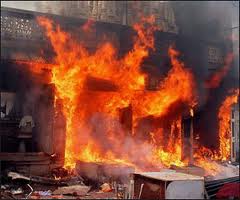
A decade of Gujarat Carnage 2002

February 25, 2012

riotsIndia has witnessed many an acts of communal violence. Starting from the Jabalpur riot of 1961 to the last major one of Kandhmal (August 2008). Many an innocent lives have been lost in the name of religion. Amongst these the Gujarat carnage is a sort of marker. It came in the backdrop of massive Anti Sikh pogrom of 1984, the anti Muslim violence of post Babri demolition and the horrific burning of Pastor Graham Steward Stains in Kandhmal. It was a quantitative and qualitative departure from the other major carnages which have rocked the country.

To begin with the burning of Sabarmati S 6 coach was cleverly projected to be an act done by neighboring Muslims and in turn the violence was directed against the Muslim population of Gujarat, on the ground that the Hindu sentiments are hurt. The section of Hindu community was deliberately incited by the decision of state to take the burnt bodies of victims in a procession, against the advice of the collector of the city. The Bandh call given by VHP created the ground for violence. Here the social engineering was at its display, and dalits and Adivasis were mobilized to unleash the violence against the hapless innocent Muslims, accompanied by the propaganda which demonized the Muslim community as a whole. While in earlier acts of violence, the state police have been an accomplice and the silent onlooker to the violence, here a sort of active collusion of state machinery and the communal forces was on display.

The BJP ruled state Government had unrestricted run in the state as the Central Government was being ruled by BJP led NDA and the other allies of BJP were too enamored by the spoils of power to spoil the broth by speaking out. Modi had already instructed the officials to sit back when the Hindu backlash will take place. The leading light of socialist movement, George Fernandez, went to the extent of taking the violence against minority women in the stride by saying that rape is nothing new and it happens in such situations. What more was needed for the rioters to run amuck and to central BJP leadership to let the things go on. The pattern of violence against women was particularly horrific, targeting at their reproductive organs and shaming them to no end.

While the architect of Gujarat pogrom Narnedra Modi kept saying that violence has bee controlled in three days, and central BJP leadership patted him for this, the matter of fact was that violence went on and on painfully for a long time, uncontrolled and unrestricted. The attitude of the BJP controlled state was pathetic and showed the religious bias in relief and rehabilitation work. The compensations given to minorities were abysmally low, state quickly retreated from the refugee camps on the ground that the refugee camps are ‘child production centers’, hitting the minorities where it hurts most. The biases against them were on full display. The atmosphere was created by communal forces in such a manner that the riot victims could not go back to their houses as the people in their areas demanded a written undertaking from them, that they will withdraw the cases filed in the context of violence and that they will not file any cases. Most of the police as machinery either refused to file the FIRs or if registered they kept enough loopholes for the criminals to get away. It was in this atmosphere that the process of getting justice became a close to impossible task. The communalized state apparatus, the attitude of police and judiciary led the Supreme court to direct the shifting of cases away from Gujarat.

The investigation against Narendra Modi by the state police was an impossible task and so the Special Investigation team was constituted. Unfortunately, that also did not help the matters. Accompanying all this violence and attitude of state government the minorities started feeling extremely insecure. They were boycotted in trade and other social spaces. The result is the sprawling slum of Juhapura as the symbol of polarization of communities along the religious lines. The total dislocation of the monitories created multiple problems at the level of education and sources of livelihood for the minorities.

The religious polarization and section of media has created a Halo around Narendra Modi, while strictures against him are coming by, about his failure to protect places of religious worship of minorities, the malafide intentions of state in filing cases against social activist Teesta Setalvad, many another cases are still pending, crying for justice for the victims of Gujarat. Having consolidated the section of majority community behind him, assured of their ongoing support, Modi started the high profile propaganda about development and has been trying to distract the attention from the havoc which he has wrought in the state. The big capitalists are finding the state of Gujarat as a happy hunting ground for massive state subsidies, so the media controlled by them is singing praises and modulating popular opinion in his favor, creating a larger than life size image, development man, in order to suppress his role in the violence against minorities.

In this dismal scenario, there have been many an examples of victims and social activists standing for the cause of justice and doing the practically impossible task of getting justice for violence victims despite all the efforts to turn them hostile and protect the guilty of the communal crimes. While the massive propaganda and state policies are trying to turn the minorities into second class citizens, there are efforts which have gone on simultaneously to retrieve the democratic values in the face of such adverse intimidating situation created by the communal forces. Lately, apart from Court judgments, the civil society response has been picking up and the civil society is trying to overcome the stifling situation and trying to make its voice louder. While we are nowhere close to what should ideally be there in a democratic set up, the responses of civil society and social action groups are noteworthy in the matters of getting justice for victims and in the matters of recreating the liberal space which has been undermined by the communal forces. Times alone will tell if democratic values will be successfully brought in this ‘Hindu Rashtra in one state’

Comments

Add new comment

  • Coastaldigest.com reserves the right to delete or block any comments.
  • Coastaldigset.com is not responsible for its readers’ comments.
  • Comments that are abusive, incendiary or irrelevant are strictly prohibited.
  • Please use a genuine email ID and provide your name to avoid reject.
News Network
June 25,2020

New Delhi, Jun 25: India registered its worst single-day increase in COVID-19 cases on Thursday, recording more than 16,000 coronavirus infections, to push the overall tally to 4.73 lakh as the number of fatalities also jumped by 418, the Union Health Ministry said.

This was the sixth consecutive day when coronavirus cases increased by more than 14,000. On June 20, the country registered an increase of 14,516 cases. On June 21, the increase was of 15,413 cases; 14,821 cases on June 22; 14,933 cases on June 23; and 15,968 cases on June 24.

Consequently, India added 92,573 cases since June 20, and over 2.82 lakh this month since June 1.

The health ministry data updated at 8am on Thursday showed the daily tally increased by the highest-ever 16,922 cases to reach 4,73,105, while the total deaths climbed to 14,894 with 418 new fatalities.

However, according to the data, the recovery rate has improved to 57.43 per cent. The number of active cases stands at 1,86,514 while 2,71,696 people have recovered; one patient has migrated.

The total number of confirmed cases included foreigners.

According to ICMR, a total of 75,60,782 samples have been tested up to June 24 with 2,07,871 samples being tested on Wednesday.

Of the 418 new deaths, 208 were in Maharashtra, 64 in Delhi, 33 in Tamil Nadu, 25 in Gujarat, 14 in Karnataka, 11 in West Bengal, 10 each in Rajasthan and Haryana, nine in Madhya Pradesh, eight each in Uttar Pradesh and Punjab, five each in Andhra Pradesh, Telangana and Uttarakhand.

Bihar, Goa and Jammu and Kashmir have reported one COVID-19 fatality each.

Of the total fatalities, Maharashtra tops the tally with 6,739 deaths followed by Delhi (2,365), Gujarat (1,735), Tamil Nadu (866), Uttar Pradesh (596), West Bengal (591), Madhya Pradesh (534), Rajasthan (375) and Telangana (225).

The COVID-19 death toll reached 188 in Haryana, 164 in Karnataka, 124 in Andhra Pradesh, 113 in Punjab, 88 in Jammu and Kashmir, 57 in Bihar, 35 in Uttarakhand, 22 in Kerala and 17 in Odisha.

Chhattisgarh has registered 12 deaths, Jharkhand 11, Assam and Puducherry nine each, Himachal Pradesh eight, Chandigarh six, Goa two and Meghalaya, Tripura and Ladakh have reported one fatality each.

More than 70 per cent deaths took place due to comorbidities, the health ministry said.

Maharashtra has reported the highest number of cases at 1,42,900 followed by Delhi at 70,390, Tamil Nadu at 67,468, Gujarat at 28,943, Uttar Pradesh at 19,557, Rajasthan at 16,009 and West Bengal at 15,173, according to ministry data.

The number of COVID-19 cases has gone up to 12,448 in Madhya Pradesh, 12,010 in Haryana, 10,444 in Telangana,10,331 in Andhra Pradesh and 10,118 in Karnataka.

It has risen to 8,209 in Bihar, 6,422 in Jammu and Kashmir, 6,198 in Assam and 5,752 in Odisha. Punjab has reported 4,627 novel coronavirus infections so far, while Kerala has 3,603 cases.

A total of 2,623 people have been infected by the virus in Uttarakhand, 2,419 in Chhattisgarh, 2,207 in Jharkhand, 1,259 in Tripura, 970 in Manipur, 951 in Goa, 941 in Ladakh and 806 in Himachal Pradesh.

Puducherry has recorded 461 COVID-19 cases, Chandigarh has 420, Nagaland has 347, Arunachal Pradesh has 158 and Mizoram has 142 cases.

Dadra and Nagar Haveli and Daman and Diu together have reported 120 COVID-19 cases.

Sikkim has 84, Andaman and Nicobar Islands has registered 56 infections so far while Meghalaya has recorded 46 cases.

"Our figures are being reconciled with the ICMR (Indian Council of Medical Research)," the ministry said, adding 8,493 cases are being reassigned to states.

State-wise distribution is subject to further verification and reconciliation, it added.

Comments

Add new comment

  • Coastaldigest.com reserves the right to delete or block any comments.
  • Coastaldigset.com is not responsible for its readers’ comments.
  • Comments that are abusive, incendiary or irrelevant are strictly prohibited.
  • Please use a genuine email ID and provide your name to avoid reject.
News Network
March 9,2020

New Delhi, Mar 9: The Delhi Police Special Cell on Monday arrested a PFI member Danish from UP''s Moradabad for allegedly spreading fake propaganda during anti- CAA protests.

"Danish was the head of the Counter Intelligence Wing of PFI and has been actively participating in the anti-CAA protest across the city," sources in the Delhi Police Special Cell said.

Sources further claimed that his arrest has given clues regarding the Information war by the Popular Front of India (PFI).

The FIR related to the protest was filed by the Crime Branch but since the larger conspiracy regarding the Delhi riots is being probed by the Cell, the matter has been transferred to them.

Delhi Police Special Cell had on Sunday arrested a Kashmiri couple from Okhla for alleged links with Islamic State (IS) Khorasan module.

The couple have been identified as Jahanjeb Sami (husband) and Hinda Bashir Beg (wife). The police have seized some objectionable material from them and were interrogating them.

When asked about the couple, the sources said, "Officers of CERT-In are analysing the Eight Mobile phones and Laptop of the couple to question them further."

The couple being an active member of ISJ&K was operating from the Valley but later shifted their base to Delhi post internet clampdown.

Comments

Add new comment

  • Coastaldigest.com reserves the right to delete or block any comments.
  • Coastaldigset.com is not responsible for its readers’ comments.
  • Comments that are abusive, incendiary or irrelevant are strictly prohibited.
  • Please use a genuine email ID and provide your name to avoid reject.
News Network
February 29,2020

New Delhi, Feb 29: Former Union Minister M J Akbar told a Delhi court on Friday that journalist Priya Ramani had defamed him by calling him with adjectives such as 'media's biggest predator' in the wake of #MeToo movement in 2018 that harmed his reputation.

M J Akbar made the allegations before Additional Chief Metropolitan Magistrate Vishal Pahuja through his lawyer during the final hearing of a private criminal defamation complaint filed by him against Priya Ramani. Akbar resigned as Union minister on October 17, 2018.

Ramani in 2018 accused Akbar of sexual misconduct around 20 years ago when he was a journalist.

Senior advocate Geeta Luthra, appearing for Akbar, said that the allegations were intentional and malafide.

“When you call someone media's biggest predator, it is per se defamatory. Calling a person with such adjectives is on the face of it defamatory. In the eyes of the people, Akbar's reputation was harmed... The per se effect was lowering of my (Akbar) reputation in the eyes of the right thinking members of the society,” she told the court.

She said there was no due process in the allegations. “It has a cascading effect. Embarrassing questions were asked. I (Akbar) am a person of greatest integrity... There was no due process in the allegations. You cannot just make allegation and let that person suffer,” she added.

Luthra said that if there was any grievance, it had to be raised then and there before the appropriate authority.

“We need to realise the effect has what we say or what we do. It's not like she went to any authority or raised any grievance. Opportunity was there, rights were there but to attack so person behind their back on social media...knowing that his whole life will be adversely affected? It's not right,” she said.

M J Akbar has denied all the allegations of sexual harassment against the women who came forward during #MeToo campaign against him.

Akbar had earlier told the court that the allegations made in an article in the 'Vogue' and the subsequent tweets were defamatory on the face of it as the complainant had deposed them to be false and imaginary and that an “immediate damage” was caused to him due to the “false” allegations by Priya Ramani.

Ramani had earlier told the court that her “disclosure” of alleged sexual harassment by Akbar has come at “a great personal cost” and she had “nothing to gain” from it.

She had said her move would empower women to speak up and make them understand their rights at workplace.

Several women came up with accounts of the alleged sexual harassment by M J Akbar him while they were working as journalists under him.

He has termed the allegations “false, fabricated and deeply distressing” and said he was taking appropriate legal action against them.

Comments

Add new comment

  • Coastaldigest.com reserves the right to delete or block any comments.
  • Coastaldigset.com is not responsible for its readers’ comments.
  • Comments that are abusive, incendiary or irrelevant are strictly prohibited.
  • Please use a genuine email ID and provide your name to avoid reject.