



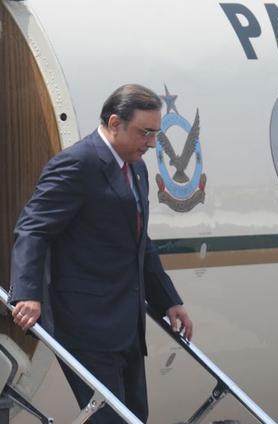
Zardari arrives in New Delhi

April 8, 2012

zardari_copy_copy

New Delhi, April 8: In a first visit by a Pakistan President in seven years, Asif Ali Zardari arrived in New Delhi on Sunday for a brief stopover to join Prime Minister Manmohan Singh for a lunch that will be preceded by a one-on-one meeting during which they will discuss crucial bilateral issues.

Mr. Zardari, who landed here at 12.10 pm at Palam Air Force Base (technical area) along with his son and heir apparent Bilawal Bhutto, Interior Minister Rehman Malik and some senior officials, was received by minister-in-waiting P K Bansal, Foreign Secretary Ranjan Mathai and Pakistan High Commissioner Shahid Malik among others.

Attired in a dark coloured business suit, Mr. Zardari waved at the mediamen but did not oblige them with any comments. He straight drove to the Prime Minister’s official Race Course Road residence.

Here on a day-long “private visit”, 56-year-old Mr. Zardari will fly to Ajmer to pay obeisance at the shrine of Khwaja Moinuddin Chishti after his meeting with Dr. Singh.

The issue of terrorism and presence of those involved in anti-India activities in Pakistan is likely to figure in the meeting between Zardari and Singh, given that there is a renewed pressure on Islamabad to take action against JuD chief Hafiz Saeed after the US announcement of $ 10 million bounty for information leading to the prosecution of the LeTa founder.

The meeting is also seen as very significant in the backdrop of improving ties between the two countries with increased Confidence Building Measures (CBMs) to bolster cross LoC trade.

Though there is no structured agenda for the meeting, the two leaders are expected to talk on issues of mutual concern.

Mr. Zardari and Dr. Singh will meet on Sunday after almost three years. They had last met in Yekaterinburg in Russia in 2009.

Comments

Add new comment

  • Coastaldigest.com reserves the right to delete or block any comments.
  • Coastaldigset.com is not responsible for its readers’ comments.
  • Comments that are abusive, incendiary or irrelevant are strictly prohibited.
  • Please use a genuine email ID and provide your name to avoid reject.
Agencies
May 19,2020

New Delhi, May 19: Former Union Minister P Chidambaram said that as the fourth phase of the nationwide lockdown amid the coronavirus scare began from Monday, his thoughts were with the people of Kashmir who were in a "terrible lockdown within a lockdown."

The senior Congress leader said that at least now, the people in the rest of India will understand that he dubbed the "enormity of the injustice" done to those who were detained in Kashmir and those still under detention" immediately before and after the abrogation of Article 370 of the Indian Constitution on August 5, 2019.

Chidambaram said that former Jammu and Kashmir Chief Minister Mehbooba Mufti was the "worst sufferer" of preventive detention and even courts had shirked their constitutional duty with respect to detainees.

"The worst sufferers are Mehbooba Mufti and her senior party colleagues who are still in custody in a locked-down state in a locked-down country. They are deprived of every human right," he said in a statement.

"I cannot believe that for nearly 10 months, the courts will shirk their constitutional duty to protect the human rights of citizens," he added.

The detention on Mehbooba Mufti under the Public Safety Act (PSA) had been extended for three more months on May 5. Booked under the stringent PSA, she was initially kept at the Hari Niwas guesthouse in Srinagar but later shifted to a Tourism Department hut in the Chashma Shahi area.

She was shifted to her Gupkar Road official residence on April 7.

Besides Mehbooba Mufti, two other former Chief Ministers -- Omar Abdullah and his father Farooq Abdullah -- were also detained under the PSA but later released.

Comments

Add new comment

  • Coastaldigest.com reserves the right to delete or block any comments.
  • Coastaldigset.com is not responsible for its readers’ comments.
  • Comments that are abusive, incendiary or irrelevant are strictly prohibited.
  • Please use a genuine email ID and provide your name to avoid reject.
Agencies
July 6,2020

New Delhi, Jul 6: The Indian Academy of Sciences, a Bengaluru-based body of scientists, has said the Indian Council for Medical Research's (ICMR) target to launch a coronavirus vaccine by August 15 is "unfeasible" and "unrealistic".

The IASc said while there is an unquestioned urgent need, vaccine development for use in humans requires scientifically executed clinical trials in a phased manner.

While administrative approvals can be expedited, the "scientific processes of experimentation and data collection have a natural time span that cannot be hastened without compromising standards of scientific rigour", the IASc said in a statement.

In its statement, the IASc referred to the ICMR's letter which states that "it is envisaged to launch the vaccine for public health use latest by 15th August 2020 after completion of all clinical trials".

The ICMR and Bharat Biotech India Limited, a private pharmaceutical company, are jointly developing the vaccine against the novel coronavirus -- SARS-CoV-2.

The IASc welcomes the exciting development of a candidate vaccine and wishes that the vaccine is quickly made available for public use, the statement said.

"However, as a body of scientists including many who are engaged in vaccine development IASc strongly believes that the announced timeline is unfeasible. This timeline has raised unrealistic hope and expectations in the minds of our citizens," it said.

Aiming to launch an indigenous COVID-19 vaccine by August 15, the ICMR had written to select medical institutions and hospitals to fast-track clinical trial approvals for the vaccine candidate, COVAXIN.

Experts have also cautioned against rushing the process for developing a COVID-19 vaccine and stressed that it is not in accordance with the globally accepted norms to fast-track vaccine development for diseases of pandemic potential.

The IASc said trials for a vaccine involve evaluation of safety (Phase 1 trial), efficacy and side effects at different dose levels (Phase 2 trial), and confirmation of safety and efficacy in thousands of healthy people (Phase 3 trial) before its release for public use.

Clinical trials for a candidate vaccine require participation of healthy human volunteers. Therefore, many ethical and regulatory approvals need to be obtained prior to the initiation of the trials, it added.

The IASc said the immune responses usually take several weeks to develop and relevant data should not be collected earlier.

"Moreover, data collected in one phase must be adequately analysed before the next phase can be initiated. If the data of any phase are unacceptable then the clinical trial is required to be immediately aborted," it said.

For example, if the data collected from Phase 1 of the clinical trial show that the vaccine is not adequately safe, then Phase 2 cannot be initiated and the candidate vaccine must be discarded.

For these reasons, the Indian Academy of Sciences believes that the announced timeline is "unreasonable and without precedent", the statement said.

"The Academy strongly believes that any hasty solution that may compromise rigorous scientific processes and standards will likely have long-term adverse impacts of unforeseen magnitude on citizens of India," it said.

Comments

Add new comment

  • Coastaldigest.com reserves the right to delete or block any comments.
  • Coastaldigset.com is not responsible for its readers’ comments.
  • Comments that are abusive, incendiary or irrelevant are strictly prohibited.
  • Please use a genuine email ID and provide your name to avoid reject.
News Network
January 20,2020

New Delhi, Jan 20: Surging inflation and slowing growth are raising serious concerns about the future growth prospects of the economy and as a remedial measure the government should resolve supply-side hurdles and ensure more stringent governance norms, a report said on Monday.

According to the Dun and Bradstreet Economy forecast, even though the Index of Industrial Production (IIP) turned positive in November 2019, it is likely to remain subdued.

"Slowdown in consumption and investment along with high inflationary pressures, geopolitical issues and uncertainty over the recovery of the economic growth are likely to keep IIP subdued," the report noted.

Dun and Bradstreet expect IIP to remain around 1.5-2.0 percent during December 2019.

As per government data, industrial output grew 1.8 percent in November, turning positive after three months of contraction, on account of growth in the manufacturing sector.

On the price front, uneven rainfall along with floods in many states and geopolitical issues have led to a surge in headline inflation even as demand remains muted.

The Consumer Price Index (CPI) in December rose to about five-and-half year high of 7.35 percent from 5.54 percent in November, mainly driven by high vegetable prices.

"The sharp rise in inflation has constrained monetary policy stimulus while revenue shortfall has placed limits on the government expenditure," Dun & Bradstreet India Chief Economist Arun Singh said.

According to Singh, growth-supporting measures and deceleration in growth are likely to cause slippage in fiscal deficit target by a wider margin.

"The government should focus on taking small steps to address the slowdown; in particular, resolve the supply-side hurdles and ensure more stringent governance norms," Singh said.

Unless these concerns are addressed through a comprehensive policy framework, it will not be easy for India to clock a sustainable growth rate to become a USD 5 trillion economy, he added.

Comments

Add new comment

  • Coastaldigest.com reserves the right to delete or block any comments.
  • Coastaldigset.com is not responsible for its readers’ comments.
  • Comments that are abusive, incendiary or irrelevant are strictly prohibited.
  • Please use a genuine email ID and provide your name to avoid reject.