



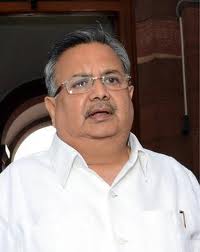
Post-CAG report, Congress wants Raman Singh to quit

April 11, 2012

quit

New Delhi, April 11: The Congress on Tuesday demanded the resignation of Chhattisgarh Chief Minister Raman Singh, citing the contents of a Comptroller and Auditor General's report that has indicted the State government for flouting norms in the award of a coal block to a firm owned by recently elected Bharatiya Janata Party (BJP) MP Ajay Sancheti who, the party said, is “close to BJP president Nitin Gadkari.” Interestingly, even BJP sources suggest that the two men have business dealings.

On Tuesday, Congress general secretary in-charge of Chhattisgarh B.K. Hariprasad, wheeled in the party's legislature party leader Ravindra Choubey and president in the State Nand Kumar Patel for a press conference here to highlight the CAG report, underscoring the fact that Mr. Raman Singh holds both the mining and power portfolios.

Mr. Hariprasad pointed out that while the BJP had, in Parliament, blocked proceedings demanding a discussion of leaked CAG reports on a range of issues, in Chhattisgarh, it had dismissed the CAG report as being of doubtful veracity.

‘Double standards'

He said: “It's a case of double standards. In Delhi, you demand discussions on CAG reports in Parliament. In Raipur, you don't allow them to be discussed. This is the height of shamelessness.”

For the Congress, which lost power in the State in 2003, the damning CAG report and the link between the beneficiaries of the scam and the BJP president and the State Chief Minister have come as manna from heaven, prompting the party to bring its battle to Delhi, hoping this will be the turning point in the run-up to the next Assembly polls in end-2013.

For Mr. Gadkari, under whose presidency the party has fared poorly electorally, the Chhattisgarh scam — and its possible link with him — has come at a bad time: this could cast a shadow over his chances of being re-elected president, when his term ends in December.

‘Open cast mine'

Meanwhile, the BJP sought to cover its embarrassment by disputing the veracity of the CAG report: the party's chief spokesperson Ravi Shankar Prasad told journalists here that Bhadgaon II Extension — the coal block in question — is an open cast mine where mining costs less. “It is a part open and part underground mine. It is also near a river and so a wall has to be built to work as a dam to keep out the water,” he said.

‘Baseless allegations'

Responding to the Congress attack on the BJP, Mr. Prasad said, “We will not engage in the kind of campaign that the Congress is involved in. These allegations are baseless. We understand the worries of the Congress. They are involved in so many scams. But they should also learn a little about how to read and write.”

Ambivalent answer

On the key question whether Mr. Sancheti and Mr. Gadkari are business partners, Mr. Prasad's answer was ambivalent: he said a leader from any party can also be a businessman, provided his dealings are transparent. He then added, “Neither was Gadkari president then [in 2008 when the tender was allotted] nor was Sancheti an MP. Gadkari was BJP Maharashtra unit president. He became BJP president one and-a-half years later in 2010.”

Comments

Add new comment

  • Coastaldigest.com reserves the right to delete or block any comments.
  • Coastaldigset.com is not responsible for its readers’ comments.
  • Comments that are abusive, incendiary or irrelevant are strictly prohibited.
  • Please use a genuine email ID and provide your name to avoid reject.
News Network
January 14,2020

New Delhi, Jan 14: The curative petitions of Vinay Sharma and Mukesh, who were sentenced to death in the Nirbhaya gang rape and murder case, was on Tuesday rejected by a five-judge Supreme Court Bench led by Justice N.V. Ramana.

In a three-page order, the Bench concluded, after an in chamber consideration that began about 1.45 p.m., that there was no merit in their pleas to spare them from the gallows.

“We have gone through the curative petitions and relevant documents. In our opinion, no case is made out within the parameters indicated in the decision of this Court in Rupa Ashok Hurra versus Ashok Hurra. Hence, the curative petitions are dismissed,” the court held.

Curative is a rare remedy devised by a Constitution Bench of the Supreme Court in its judgment in the Rupa Ashok Hurra case in 2002. A party can take only two limited grounds in a curative petition - one, he was not heard by the court before the adverse judgment was passed, and two, the judge was biased. A curative plea, which follows the dismissal of review petition, is the last legal avenue open for convicts in the Supreme Court. Sharma was the first among the four convicts to file a curative.

The Bench also rejected their pleas to stay the execution of their death sentence and for oral hearing in open court.

Besides Justice Ramana, the Bench comprised Arun Mishra, Rohinton Nariman, R. Banumathi and Ashok Bhushan.

Curative petitions were filed in the Supreme Court by both convicts on January 9. The petitions had come just days after a Delhi sessions court schedulled the execution of all the four convicts in Tihar jail on January 22.

Sharma and Mukesh, in separate curative petitions, argued that there was a “sea change” in the death penalty jurisprudence since their convictions. Carrying out the death sentence on such changed circumstances would be a “gross miscarriage of justice”.

In his plea, Sharma said the Court had commuted the death penalty in several rape and murder cases since 2017, when it first confirmed the death penalty to the Nirbhaya convicts.

“fter the pronouncement of judgment in 2017, there have been as many as 17 cases involving rape and murder in which various three-judge Benches of the Supreme Court have commuted the sentence of death,” the petition contended.

The Supreme Court recently dismissed a review petition filed by Akshay Singh, another of the four four condemned men, to review its May 5, 2017 judgment confirming the death penalty. It also refused his plea to grant him three weeks' time to file a mercy petition before the President of India.

A Bench led by Justice R. Banumathi had said it was open for the Nirbhaya case convicts to avail whatever time the law prescribes for the purpose of filing a mercy plea.

Akshay (33), Mukesh (30), Pawan Gupta (23) and Sharma (24) had brutally gang-raped a 23-year-old paramedical student in a moving bus on the intervening night of December 16-17, 2012. She died of her injuries a few days later.

The case shocked the nation and led to the tightening of anti-rape laws. Rape, especially gang rape, is now a capital crime.

One of the accused in the case, Ram Singh, allegedly committed suicide in the Tihar jail. A juvenile, who was among the accused, was convicted by a juvenile justice board. He was released from a reformation home after serving a three-year term.

Comments

Add new comment

  • Coastaldigest.com reserves the right to delete or block any comments.
  • Coastaldigset.com is not responsible for its readers’ comments.
  • Comments that are abusive, incendiary or irrelevant are strictly prohibited.
  • Please use a genuine email ID and provide your name to avoid reject.
News Network
July 16,2020

New Delhi, Jul 16: With India's economic growth sputtering, the Reserve Bank of India was expected to maintain a rate-cutting cycle, but an uptick in near-term inflation could give the central bank's Monetary Policy Committee reason to pause for now.

Having cut its key lending rate by an aggressive 115 basis points (bps) in 2020, on top of 135 bps cuts in 2019, the RBI so far has had little success in spurring credit growth amid varying degrees of lockdowns across India.

Some economists and market insiders argue it may be prudent for the MPC, the policy committee, to hold its fire when it meets early next month.

"It's probably too early to administer a demand stimulus. The RBI still has room to cut rates, but we probably want to be more cautious of the timing," said Venkat Pasupuleti, portfolio manager at Dalton Investments.

"Maybe they should wait a quarter to see how things pan out once the lockdown situation is eased further."

Market participants have factored in at least a 25 bps rate cut by the MPC on August 6 while analysts are predicting a total 50-75 bps cuts over the rest of the fiscal year that runs to March 31.

The spike in the retail inflation rate above the RBI's mandated 2%-4% target range is another reason for the central bank to take a breather, analysts say.

Annual retail inflation rose to 6.09% in June, compared to 5.84% in March and sharply above a 5.30% median forecast in a Reuters poll of economists.

Rahul Bajoria, an economist at Barclays, said the spike in both consumer and wholesale prices "could lead to a tempering in enthusiasm for material front-loaded policy support from here on."

Almost all economists however agreed the RBI cannot move away from its accommodative stance or call an end to the rate cutting cycle just yet.

India's economy grew at 3.1% in the March quarter - an eight year low - and some economists have predicted a contraction of more than 20% in the June quarter and a contraction of up to 5% in the fiscal year.

"Even in the event of a pause, we think the RBI and MPC would want to hold out the promise of more cuts," said A. Prasanna, economist with ICICI Securities.

RBI Governor Shaktikanta Das said in a recent speech the need of the hour is to restore confidence, preserve financial stability, revive growth and recover stronger, suggesting inflation concerns are unlikely to deter the downward trajectory for rates too soon.

"The August policy decision would boil down to a judgment call over whether RBI can maintain easy monetary and financial conditions without the aid of a token rate cut," Prasanna said. 

Comments

Add new comment

  • Coastaldigest.com reserves the right to delete or block any comments.
  • Coastaldigset.com is not responsible for its readers’ comments.
  • Comments that are abusive, incendiary or irrelevant are strictly prohibited.
  • Please use a genuine email ID and provide your name to avoid reject.
Agencies
May 14,2020

Mumbai, May 14: The Shiv Sena on Thursday raised questions over the Centre's Rs 20 lakh crore stimulus package announced to revive the COVID-hit economy, and asked if India is not a "self-reliant" country at present.

An editorial in Sena mouthpiece 'Saamana' wondered how Rs 20 lakh crore will be raised, and opined that an environment needs to be created where industrialists, trade and business sectors are encouraged to invest.

On the path of new self-reliance, India cannot afford industrialists running away, and for that "political institutions like the ED and CBI need to be put in lockdown for some time," it said.

Prime Minister Narendra Modi on Tuesday announced new financial incentives on top of the previously announced packages for a combined stimulus of Rs 20 lakh crore, saying the COVID-19 crisis has provided India an opportunity to become self-reliant and emerge as the best in the world.

The Sena said the country is being told that the package will be beneficial for MSMEs (micro, small and medium enterprises), poor labourers, farmers and the tax-paying middle class.

"The package (as per the Centre) will reach 130 crore Indians and the country will become self-reliant. Does this mean India is not a self-reliant country at present?" the Marathi daily asked.

It is good that PPE kits and N95 masks are now being manufactured in India, it said.

"Any country progresses ahead while learning from crisis and through struggle. Before Independence, not even a needle was manufactured in India but in 60 years, India became self-reliant in science, technology, agro business, defence, manufacturing and atomic science," it said.

An institution like the Indian Council of Medical Research (ICMR), which is helping in the manufacturing of PPE kits, is part of the self-reliant India, it noted.

Wondering how Rs 20 lakh crore, as announced in the central package, will be raised, the Sena said an "environment needs to be created where industrialists, trade and business sectors will be encouraged to invest".

"India, on path of new self-reliance, cannot afford industrialists running away, and for that political institutions like the Enforcement Directorate (ED) and the Central Bureau of Investigation (CBI) need to be put in lockdown for some time," the paper said.

Despite announcing the 'lockdown-4' and the economic package, why its impact has not been reflected in the share market? it asked.

"Investors are in a dilemma. The prime minister and chief ministers must show them trust and support," it said.

"Earlier it was Pandit Nehru and now it is Modi. If (former prime minister) Rajiv Gandhi had not laid the foundation of a digital India, there wouldn't be video conference of PM, CMs and bureaucracy in times of coronavirus," the Uddhav Thackeray-led party said.

It agreed with Modi that coronavirus will stay for long, and lives need not revolve around it.

"We need to get back on our feet again," the Sena said.

Comments

Add new comment

  • Coastaldigest.com reserves the right to delete or block any comments.
  • Coastaldigset.com is not responsible for its readers’ comments.
  • Comments that are abusive, incendiary or irrelevant are strictly prohibited.
  • Please use a genuine email ID and provide your name to avoid reject.