



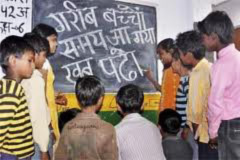
Centre needs Rs 2.3 lakh crore to fund RTE initiative

April 14, 2012

rti

New Delhi, April 14 : With the Supreme Court bringing all recognized schools under the Right to Education (RTE) Act, the government will have to boost spending on its flagship programme to meet the estimated Rs 2.3 lakh crore needed to fund the initiative over 2010-2014.

RTE has been plagued with fund shortfalls with budgetary provision in the last two years being only half of what was estimated. The HRD ministry received Rs 21,000 crore in 2011-12 instead of Rs 43,903 crore. The allocation has gone up only marginally to Rs 25,000 crore in the current 2012-13 budget.

The estimated Rs 2.3 lakh crore, to be shared between Centre and states according to a 65:35 ratio, is also expected to go up as it does not include subsidy the government is to pay private schools to implement a 25% quota for economically disadvantaged students.

The RTE incorporates the successful Sarva Shiksha Abhiyan (SSA) and the ministry had estimated it would need an allocation of Rs 48,000 crore in the current fiscal. Initially, the government had calculated that it would need Rs 40,500 crore in the first year of implementation.

According to educationist Vinod Raina, a key member of the RTE team, "RTE in general suffers from a financial crunch and there has also been a problem of states not being able to spend the funds allocated. There have also been constraints of teacher shortages.''

While RTE rollout has been hampered by a resource crunch and infrastructure bottlenecks for which the government has not always been to blame, targets set for UPA's ambitious programme of social inclusiveness have not been met. The erosion of gender imbalances and reduction of dropout rates are still lagging targets.

Implementation of RTE targets still needs 12 lakh teachers and HRD minister Kapil Sibal has said six lakh posts have been sanctioned that need to be filled. RTE sets an ideal 30:1 student-teacher ratio for primary schools.

The overall annual dropout rate for 2009-10 was 9.1% and this has improved to 6.8% in 2010-11. Total enrollment has increased to 13.52 crore from 13.34 crore in the same period. But worryingly dropout rates have increased in states like Tamil Nadu, Gujarat, Madhya Pradesh, Haryana, Mizoram, Sikkim and Tripura.

There are about 1.29 million elementary schools in the country. Besides funding, shortage of teachers is a crucial hurdle to implementing the Act. According to the ministry, 43% of government schools have a pupil: teacher ratio of more than 30:1. About 9% schools are run by single teachers, while 20% have teachers without professional qualifications. There is an estimated shortage of 12 lakh teachers in eight states, and the worst affected include UP, Bihar and West Bengal.

A recent PAISA report by Accountability Initiative has seconded the government's estimate that allocations to teachers, including salaries, training and teaching inputs such as teacher learning equipment, accounted for the largest share of the SSA budget.

In 2011-2012 teachers accounted for 44% of the budget. School infrastructure made up for the second largest share with a total allocation of 36%, while children (entitlement and special programmes) accounted for 10%.

While per child allocation has doubled from Rs 2, 004 in 2009-1010 to Rs 4, 269 in 2011-2012 the report says that a matching increase in quality parameters is absent. Raina says staggered targets depending upon progress of each state may be the answer to effective implementation.


Comments

Add new comment

  • Coastaldigest.com reserves the right to delete or block any comments.
  • Coastaldigset.com is not responsible for its readers’ comments.
  • Comments that are abusive, incendiary or irrelevant are strictly prohibited.
  • Please use a genuine email ID and provide your name to avoid reject.
News Network
February 18,2020

New Delhi, Feb 18: Election strategist-turned-politician Prashant Kishor on Tuesday questioned the Nitish Kumar government's development model, even as he sneered at the chief minister for making ideological compromises to stay in an alliance with the BJP.

Kishor, who has been vocal about his opposition to the Citizenship (Amendment) Act (CAA), said Kumar needs to spell out whether he is with the ideals of Mahatma Gandhi or those who support Nathu Ram Godse.

"Nitish ji has always said that he cannot leave the ideals of Gandhi, JP and Lohiya... At the same time, how can he be with the people who support the ideology of Godse? Both cannot go together. If you want to stay with the BJP, I don't have any problem with it but you cannot be on both sides," he said.

"There has been a lot of discussion between me and Nitish-ji on this. He has his thought process and I have mine. There have been differences between him and me that the ideologies of Godse and Gandhi cannot stand together. As the leader of the party you have to say which side you are on," he added.

In a direct assault on Kumar's model of governance, Kishor said Bihar was the poorest state in 2005 and continues to be so.

"There has been development in Bihar during the last 15 years, but the pace has not been as it should have," he added.

Comments

Add new comment

  • Coastaldigest.com reserves the right to delete or block any comments.
  • Coastaldigset.com is not responsible for its readers’ comments.
  • Comments that are abusive, incendiary or irrelevant are strictly prohibited.
  • Please use a genuine email ID and provide your name to avoid reject.
News Network
April 15,2020

New Delhi, Apr 15: The Union Health Ministry has identified 170 districts as COVID-19 hotspots and 207 districts as potential hotspots, officials said on Wednesday, reiterating that there has been no community transmission of the disease in the country so far.

Addressing the daily briefing to provide updates on coronavirus situation in the country, Joint Secretary in the Ministry of Health Lav Agarwal said that states have been asked to classify districts which have reported a higher number of cases as hotspots, the districts where cases have been reported as non-hotspots, and green zones where no cases have been reported.

"Hotspots are those districts which are reporting more number of cases or where the rate of growth of COVID-19 cases is high," Agarwal said, adding a detailed direction has been issued to states stating consolidated efforts are required to utilise this period of lockdown to curb the spread of the virus.

"Cabinet secretary held a video conference today with all chief secretaries, DGPs, health secretaries, collectors, SPs, municipal commissioners and CMOs where hotspots were discussed and orientation on field level implementation of containment strategy was given.

"They were told about large outbreak containment strategies, cluster containment strategies. Delineation of buffer and containment zone, parameter mapping, defining of entry and exit points were also discussed in detail," he said.

The joint secretary said movement of people will not be allowed in containment zones except for those related with essential services and special teams will search for new cases and samples will be collected and tested as per sampling criteria.

The officials said that health facilities in buffer zone outside the containment zone will be oriented and people facing SARI and influenza-like symptoms will be tested there.

"Special teams have been formed which will work in containment zone and do contact tracing and house-to-house surveys. Cases of fever, cough and breathlessness will be identified in the survey and requisite action will be taken as per protocol," Agarwal said, adding that there has been no community transmissions so far but some local outbreaks.

The total number of COVID-19 cases in India has risen to 11,439 with 1,076 fresh cases reported in the last 24 hours while the death toll stands at 377, the ministry official said.

Comments

Add new comment

  • Coastaldigest.com reserves the right to delete or block any comments.
  • Coastaldigset.com is not responsible for its readers’ comments.
  • Comments that are abusive, incendiary or irrelevant are strictly prohibited.
  • Please use a genuine email ID and provide your name to avoid reject.
News Network
May 7,2020

Visakhapatnam, May 7: Unconscious children being carried by parents in their arms, people laying on roads, health workers scrambling to attend to those affected by the styrene vapour leak and residents fleeing were some of the scenes that played out near here on Thursday, bringing back grim memories of the 1984 Bhopal gas tragedy.

The leak of styrene, a chemical used to make synthetic rubber and resins, among others, occurred in the wee hours of Thursday while people were still fast asleep.

Women and children were seen lying on roads struggling to breath, reminiscent of the infamous Bhopal gas tragedy when a leak from the Union Carbide plant left around 3,500 dead and many maimed.

The worst-hit Gopalapatnam village reverberated with cries of people for help.

Many people fell unconscious during their sleep, a villager said.

Affected people, suffering writ large on their faces, were rushed to hospitals in autorickshaws and on two wheelers.

Visakhapatnam Collector Vinay Chand said 20 ambulances were pressed into service as soon information about the gas leak was received.

Exposure to styrene, also known as ethenylbenzene, vinylbenzene can affect the central nervous system (CNS), causing headache, fatigue, weakness, and depression.

It is primarily used in the production of polystyrene plastics and resins.

The gas leak took place at LG Polymers chemical plant.

LG Polymers was established in 1961 as "Hindustan Polymers" for manufacturing Polystyrene and its co-polymers at Visakhapatnam. It merged with McDowell & Co. Ltd of UB Group in 1978, according to the company's website.

Taken over by LG Chem (South Korea), Hindustan Polymers was renamed LG Polymers India Private Limited (LGPI) in July, 1997.

Comments

Add new comment

  • Coastaldigest.com reserves the right to delete or block any comments.
  • Coastaldigset.com is not responsible for its readers’ comments.
  • Comments that are abusive, incendiary or irrelevant are strictly prohibited.
  • Please use a genuine email ID and provide your name to avoid reject.