



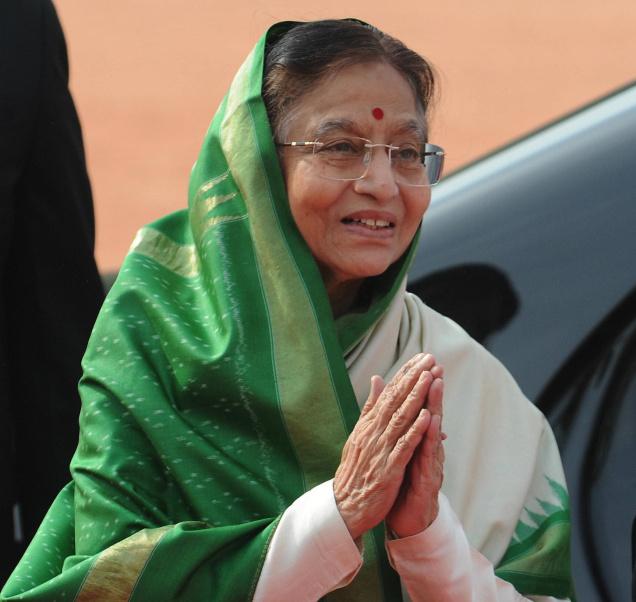
Electoral reforms need of the hour: Pratibha

April 15, 2012

PrathibaNew Delhi, April 15: President Pratibha Devisingh Patil considers preserving the secular, democratic, fabric of India among the difficult tasks facing the country today, the others being the challenges of achieving inclusive growth and curbing social problems such as corruption.

Ms. Patil, whose term ends in July, on Thursday shared with The Hindu her experiences as President and her views on what is required for nation-building.

She said it was imperative to usher in electoral reforms to maintain the country's secular and democratic characteristics. Education, women's empowerment and focus on moral values should be at the core of the reforms.

The interview ended before this reporter had a chance to ask the President about some of the specific challenges she has had to face during her tenure, such as handling of mercy petitions from prisoners on death row.

“Electoral reforms are needed. We have been conducting our elections very well, but we need to keep the elements of money and muscle out. We have to bring in reforms to remove the impurities that have crept into the system,” she said.

To maintain the secular fabric of the world's largest democracy, she said, different stakeholders needed to work with a deep sense of responsibility to see that our democracy remained “clean and healthy.”

“A good signal”

A former Governor of Rajasthan and seasoned politician, Ms. Patil said elected representation of women, especially at the grassroots, and their subsequent ascent to the top had “sent a good signal.”

Ms. Patil, who became the first woman President of the country in 2007, said she was hoping for consensus on the long-pending women's reservation Bill.

“Women's reservation Bill is already in Parliament…but it will be a happy moment if some consensus emerges. I won't say what, but some good formula should be arrived at. Let Parliament do its job, but I do hope they come up with something that is acceptable to all political parties.”

Looking back, she said her years at Rashtrapati Bhavan were “an experience.” “I have met so many people from a cross-section of society, school children who have shown bravery, women who have stood up against social problems like female foeticide, dowry and addiction. It has been an experience. There is a vast pool of talent in this country, there are people who are brave and have the guts to take a stand to face circumstances, there are people with great energy and we need to draw on this energy and talent for nation-building.”

Elaborating on the experiences drawn from her meetings and travels both inside and outside the country, Ms. Patil said: “I have seen people do social service without any self-interest. There are people who collect medicines for those who cannot afford them or used toys for the needy — these are the kind of activities that the youth should be encouraged to take up. There is a gap that needs to be filled and it can be done by people with a vision and a sense of social service.”

“My message to the youth is to strike a balance between consumerism and values. They have a lot of energy, they are better equipped than the previous generations, have better education, and they must bring about social change. Problems of dowry, addiction, female foeticide will not go away through laws and punishment, we need to change attitudes for eradicating these,” Ms. Patil said.

A lawyer, politician and sports enthusiast, Ms. Patil said that though women's participation in government, the judiciary and other public spheres had improved over the years, there was still need to build confidence and encourage involvement.

“I have seen a new confidence in the eyes of the women in rural areas, in the gram panchayats where women want to do something. The question is who is to empower them. There are schemes for women that need proper implementation, there should be education and information available to them,” she said.

Straightening the country's secular tenets and reverting to the ideology of Mahatma Gandhi, she said, should be part of nation-building.

“I feel very happy that we have carried forward our biggest, vibrant democracy, though there might have been difficulties, but it has been a smooth process. We have to keep intact our communal harmony and that would be our major achievement,” Ms. Patil said.

‘Values being ignored'

Access to quality education, health care and elimination of poverty, she pointed out, should be the goals that the policymakers and the future generations should focus on.

“We have enough schemes but we need to ensure that they reach the last person for whom they are intended. The youngsters need to focus on education and their vocations but they should also pay attention to social values imparted by our traditions, culture and the values preached by Mahatma Gandhi. There is growing consumerism in this country; we need the younger generation to understand human values. We have values of family, looking after ailing, ageing parents; there are traditions like Raksha Bandhan, where the brother promises to protect the interests of the sister; somewhere we feel these values are being ignored and getting diluted. That is another challenge we must face.”

Ms. Patil, who likes to walk around the Mughal Gardens on Rashtrapati Bhavan precincts in her free time and snatches moments to try her hand at her favourite sport, table tennis, wants to continue working for issues related to women and their empowerment after demitting office.

“During my walks around the Mughal Gardens I felt the need to do something to keep it [the estate] clean. That is when we thought of ‘Roshini' [a programme that is intended to make the estate a zero-waste zone] and self-help programmes for the women residents. There is so much to do, things need to be changed or kept properly…” she said, declining to comment on what have been the challenging moments, for her as President.

“There are many memories and memorable experiences, like preparing for a Sukhoi ride,” she said laughing, “but the challenges, I will talk about later.”

Comments

Add new comment

  • Coastaldigest.com reserves the right to delete or block any comments.
  • Coastaldigset.com is not responsible for its readers’ comments.
  • Comments that are abusive, incendiary or irrelevant are strictly prohibited.
  • Please use a genuine email ID and provide your name to avoid reject.
News Network
May 14,2020

London, May 14: Fugitive liquor baron Vijay Mallya on Thursday urged the Central government to accept his offer to repay 100 per cent of his loan dues and close the case against him.

While congratulating the Centre for introducing Rs 20 lakh crore relief package to boost the economy amid the coronavirus lockdown, Mallya, lamented that his repeated attempts to pay back his dues have been ignored by the Indian government.

"Congratulations to the Government for a Covid 19 relief package. They can print as much currency as they want BUT should a small contributor like me who offers 100% payback of State-owned Bank loans be constantly ignored? Please take my money unconditionally and close," he tweeted.

Earlier this month, Mallya had sought permission to appeal against a ruling ordering his extradition to India in Britain's highest court the UK Supreme Court.

The application comes two weeks after the High Court in London - the UK's second-highest court - dismissed Mallya's appeal against a lower court ruling that he be sent to India to face charges of defrauding a consortium of Indian banks of more than Rs 9,000 crores relating to the collapse of Kingfisher Airlines in 2012.

Comments

Add new comment

  • Coastaldigest.com reserves the right to delete or block any comments.
  • Coastaldigset.com is not responsible for its readers’ comments.
  • Comments that are abusive, incendiary or irrelevant are strictly prohibited.
  • Please use a genuine email ID and provide your name to avoid reject.
Agencies
February 7,2020

Jammu & Kashmir, Feb 7: Former Jammu and Kashmir chief ministers Mehbooba Mufti and Omar Abdullah, besides two political stalwarts from NC and its arch-rival PDP were booked under the stringent Public Safety Act (PSA) by the administration on Thursday, officials said.

A magistrate accompanied by police served the order to Mufti at the bungalow where she has been detained, the officials said.

Abdullah was also booked under the PSA, they said.

National Conference general secretary and former minister Ali Mohammed Sagar, who wields a support base in downtown city, was served with a PSA notice public order by the authorities.

Similarly, senior PDP leader Sartaj Madani was booked under the PSA. Madani is the maternal uncle of former chief minister Mehbooba Mufti.

Both Sagar and Madani were detained in the aftermath of August 5 crackdown by the Centre on politicians following abrogation of special status of the erstwhile state, besides its bifurcation into two union territories.

Their six-month preventive custody was ending on Thursday.

Earlier, the officials had said that former NC legislator Bashir Ahmed Veeri was also booked under the PSA but later it turned out that he had been released.

Comments

Add new comment

  • Coastaldigest.com reserves the right to delete or block any comments.
  • Coastaldigset.com is not responsible for its readers’ comments.
  • Comments that are abusive, incendiary or irrelevant are strictly prohibited.
  • Please use a genuine email ID and provide your name to avoid reject.
Agencies
May 17,2020

New Delhi, May 17: Following the COVID-19-induced economic disruptions, up to 135 million jobs could be lost and 120 million people might be pushed back into poverty in India, all of which will have a hit on consumer income, spending and savings, says a report.

According to a new report by international management consulting firm Arthur D Little, the worst of COVID-19's impact will be felt by India's most vulnerable in terms of job loss, poverty increase and reduced per-capita income, which in turn will result in a steep decline in the Gross Domestic Product (GDP).

"Given the continued rise of COVID-19 cases, we believe that a W-shaped recovery is the most likely scenario for India. This implies a GDP contraction of 10.8 per cent in FY 2020-21 and GDP growth of 0.8 per cent in FY 2021-22," the report said.

India's COVID-19 tally has crossed 90,000 and the nationwide death toll has touched nearly 2,800 so far.

The report titled "India: Surmounting the economic challenges posed by COVID-19: A 10-point programme to revive and power India's post-COVID economy" said the 'collateral damage' of the forecasted GDP slowdown, will be felt most acutely in employment, poverty alleviation, per-capita income and overall nominal GDP.

"Unemployment may rise to 35 per cent from 7.6 per cent resulting in 136 million jobs lost and a total of 174 million unemployed. Poverty alleviation will receive a set-back, significantly changing the fortunes of many, putting 120 million people into poverty and 40 million into abject poverty," the report said.

"India is headed towards a W-shaped economic recovery with a potential GDP contraction of 10.8 per cent in FY21. An opportunity loss of USD 1 trillion is staring India in its face," said Barnik Chitran Maitra, lead author of the report and Managing Partner & CEO of Arthur D Little, India and South Asia.

Maitra further said "for its USD 5 trillion vision, a radical economic approach is needed, centred on an immediate stimulus and structural reforms. The Prime Minister's visionary 'Atma Nirbhar Bharat Abhiyan' is a good start to this new approach."

The report lauded the steps taken by the government and the Reserve Bank of India, but said a far more assertive approach may be required given the magnitude of the adverse economic output.

The report suggested a 10-point programme to accelerate the recovery which include strengthening the 'safety net' significantly for the most vulnerable, enable survival of small and medium businesses, restarting the rural economy and providing targeted assistance to at-risk sectors.

It further said the government should launch "Make in India 2.0" to capture global opportunities, build 'Modern India', accelerate Digital India and Innovation, strengthen global investment corridors with the US, UAE, Saudi Arabia, Japan and the UK, debottleneck land and labour and transform banking and financial markets in a bid to secure a sustainable economic future for 1.3 billion Indians. 

Comments

Add new comment

  • Coastaldigest.com reserves the right to delete or block any comments.
  • Coastaldigset.com is not responsible for its readers’ comments.
  • Comments that are abusive, incendiary or irrelevant are strictly prohibited.
  • Please use a genuine email ID and provide your name to avoid reject.