



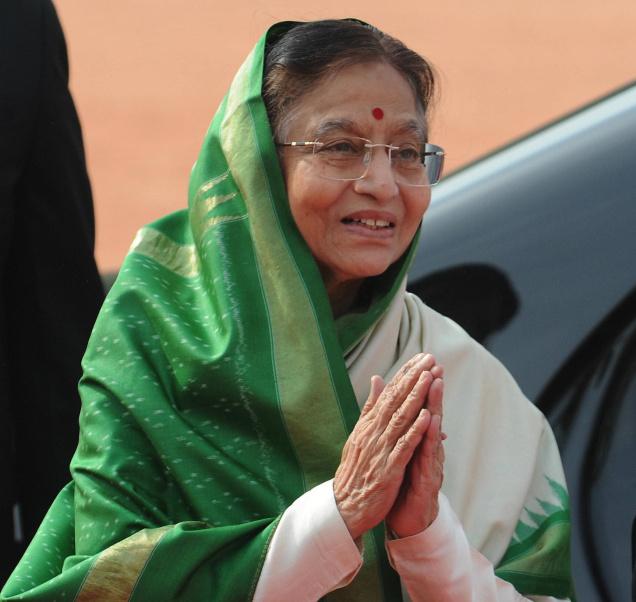
Electoral reforms need of the hour: Pratibha

April 15, 2012

PrathibaNew Delhi, April 15: President Pratibha Devisingh Patil considers preserving the secular, democratic, fabric of India among the difficult tasks facing the country today, the others being the challenges of achieving inclusive growth and curbing social problems such as corruption.

Ms. Patil, whose term ends in July, on Thursday shared with The Hindu her experiences as President and her views on what is required for nation-building.

She said it was imperative to usher in electoral reforms to maintain the country's secular and democratic characteristics. Education, women's empowerment and focus on moral values should be at the core of the reforms.

The interview ended before this reporter had a chance to ask the President about some of the specific challenges she has had to face during her tenure, such as handling of mercy petitions from prisoners on death row.

“Electoral reforms are needed. We have been conducting our elections very well, but we need to keep the elements of money and muscle out. We have to bring in reforms to remove the impurities that have crept into the system,” she said.

To maintain the secular fabric of the world's largest democracy, she said, different stakeholders needed to work with a deep sense of responsibility to see that our democracy remained “clean and healthy.”

“A good signal”

A former Governor of Rajasthan and seasoned politician, Ms. Patil said elected representation of women, especially at the grassroots, and their subsequent ascent to the top had “sent a good signal.”

Ms. Patil, who became the first woman President of the country in 2007, said she was hoping for consensus on the long-pending women's reservation Bill.

“Women's reservation Bill is already in Parliament…but it will be a happy moment if some consensus emerges. I won't say what, but some good formula should be arrived at. Let Parliament do its job, but I do hope they come up with something that is acceptable to all political parties.”

Looking back, she said her years at Rashtrapati Bhavan were “an experience.” “I have met so many people from a cross-section of society, school children who have shown bravery, women who have stood up against social problems like female foeticide, dowry and addiction. It has been an experience. There is a vast pool of talent in this country, there are people who are brave and have the guts to take a stand to face circumstances, there are people with great energy and we need to draw on this energy and talent for nation-building.”

Elaborating on the experiences drawn from her meetings and travels both inside and outside the country, Ms. Patil said: “I have seen people do social service without any self-interest. There are people who collect medicines for those who cannot afford them or used toys for the needy — these are the kind of activities that the youth should be encouraged to take up. There is a gap that needs to be filled and it can be done by people with a vision and a sense of social service.”

“My message to the youth is to strike a balance between consumerism and values. They have a lot of energy, they are better equipped than the previous generations, have better education, and they must bring about social change. Problems of dowry, addiction, female foeticide will not go away through laws and punishment, we need to change attitudes for eradicating these,” Ms. Patil said.

A lawyer, politician and sports enthusiast, Ms. Patil said that though women's participation in government, the judiciary and other public spheres had improved over the years, there was still need to build confidence and encourage involvement.

“I have seen a new confidence in the eyes of the women in rural areas, in the gram panchayats where women want to do something. The question is who is to empower them. There are schemes for women that need proper implementation, there should be education and information available to them,” she said.

Straightening the country's secular tenets and reverting to the ideology of Mahatma Gandhi, she said, should be part of nation-building.

“I feel very happy that we have carried forward our biggest, vibrant democracy, though there might have been difficulties, but it has been a smooth process. We have to keep intact our communal harmony and that would be our major achievement,” Ms. Patil said.

‘Values being ignored'

Access to quality education, health care and elimination of poverty, she pointed out, should be the goals that the policymakers and the future generations should focus on.

“We have enough schemes but we need to ensure that they reach the last person for whom they are intended. The youngsters need to focus on education and their vocations but they should also pay attention to social values imparted by our traditions, culture and the values preached by Mahatma Gandhi. There is growing consumerism in this country; we need the younger generation to understand human values. We have values of family, looking after ailing, ageing parents; there are traditions like Raksha Bandhan, where the brother promises to protect the interests of the sister; somewhere we feel these values are being ignored and getting diluted. That is another challenge we must face.”

Ms. Patil, who likes to walk around the Mughal Gardens on Rashtrapati Bhavan precincts in her free time and snatches moments to try her hand at her favourite sport, table tennis, wants to continue working for issues related to women and their empowerment after demitting office.

“During my walks around the Mughal Gardens I felt the need to do something to keep it [the estate] clean. That is when we thought of ‘Roshini' [a programme that is intended to make the estate a zero-waste zone] and self-help programmes for the women residents. There is so much to do, things need to be changed or kept properly…” she said, declining to comment on what have been the challenging moments, for her as President.

“There are many memories and memorable experiences, like preparing for a Sukhoi ride,” she said laughing, “but the challenges, I will talk about later.”

Comments

Add new comment

  • Coastaldigest.com reserves the right to delete or block any comments.
  • Coastaldigset.com is not responsible for its readers’ comments.
  • Comments that are abusive, incendiary or irrelevant are strictly prohibited.
  • Please use a genuine email ID and provide your name to avoid reject.
News Network
July 18,2020

New Delhi, Jul 18: The Covid-19 lockdown-led reduction in air pollution levels across five Indian cities, including Delhi and Mumbai, may have prevented about 630 premature deaths, and saved USD 690 million in health costs in the country, according to a new study.

Scientists, including those from the University of Surrey in the UK, assessed the levels of harmful fine particulate matter (PM2.5) from vehicles and other sources in five Indian cities -- Delhi, Mumbai, Kolkata, Chennai and Hyderabad -- since the beginning of the lockdown period.

The study, published in the journal Sustainable Cities and Society, compared these lockdown PM2.5 figures from 25 March up until 11 May, with those from similar periods of the preceding five years, and found that the measure reduced pollution levels in all these places.

According to the scientists, during this period, the levels of these harmful air pollutants reduced by 10 per cent in Mumbai, and by up to 54 per cent in Delhi.

"The percentage reduction for the other cities ranged from 24 to 32 per cent, which was slightly smaller than the measured values for Delhi and Mumbai," the scientists noted in the study.

"While the reduction in PM2.5 pollution may not be surprising, the size of the reduction should make us all take notice of the impact we have been having on the planet," said Prashant Kumar, a co-author of the study from the University of Surrey.

The scientists said these reductions in PM2.5 were comparable to those reported in other cities across the world, such as in Austria's capital Vienna (60 per cent), and Shanghai (42 per cent) in China.

They also calculated the monetary value of the reduced mortality due to air pollution and found that the lowered levels of PM2.5 may have saved 630 people from premature death, and USD 690 million in health costs in India.

Coronavirus India update: State-wise total number of confirmed cases, deaths on July 17

According to the researchers, the present lockdown situation offers observational opportunities regarding potential control systems and regulations for improved urban air quality.

They said an integrated approach might help in understanding the overall impacts of Covid-19 lockdown-style interventions and support the implementation of relevant policy frameworks.

"This is an opportunity for us all to discuss and debate what the 'new normal' should look like - particularly when it comes to the quality of the air we breathe," Kumar said.

Comments

Add new comment

  • Coastaldigest.com reserves the right to delete or block any comments.
  • Coastaldigset.com is not responsible for its readers’ comments.
  • Comments that are abusive, incendiary or irrelevant are strictly prohibited.
  • Please use a genuine email ID and provide your name to avoid reject.
News Network
April 27,2020

New Delhi, Apr 27: Prime Minister Narendra Modi on Monday held a video conference with chief ministers to discuss the situation arising due to the coronavirus pandemic in the country, which has been under a lockdown since March 25 to contain the spread of the virus, amid indications that the interaction would also focus on a graded exit from the ongoing lockdown.

This is Modi's fourth such interaction with state chief ministers since March 22 when he discussed coronavirus situation and steps taken both by the Centre and the states to contain the pandemic.

Two days later on March 24, Modi announced a 21-day nationwide lockdown. He extended the lockdown by 19 days on April 14, the last day of the initial three week shutdown, till May 3.

Sources in the government had on Sunday indicated that besides discussing the way forward in dealing with the pandemic, the prime ministers and chief ministers could also focus on a "graded" exit from the lockdown.

In a tweet on Monday, the Prime Minister's Office said Modi and the chief ministers will be discussing aspects relating to the COVID-19 situation.

In his monthly 'Mann ki Baat' radio address on Sunday, the prime minister said the country is in the middle of a 'yudh' (war) and asserted that people have to continue being careful and take precautions.

His note of caution came amidst gradual exemptions being granted by the Centre and states to revive economic activities.

"I urge you not to get overconfident. You should in your over-enthusiasm not think that if the coronavirus has not yet reached your city, village, street or office, it is not going to reach now. Never make such a mistake. The experience of the world tells us a lot in this regard," Modi said while referring to a popular Hindi idiom 'Sawdhani hati, durghatna ghati' (disaster strikes when you lower your concentration).

The Centre and the state governments have been giving gradual exemptions to boost economic activities as also to provide relief to people as some states want further relaxation in areas which have seen few or no coronavirus cases.

Comments

Add new comment

  • Coastaldigest.com reserves the right to delete or block any comments.
  • Coastaldigset.com is not responsible for its readers’ comments.
  • Comments that are abusive, incendiary or irrelevant are strictly prohibited.
  • Please use a genuine email ID and provide your name to avoid reject.
Agencies
February 6,2020

Bijnor, Feb 6: Apprehensions over the Citizenship Amendment Act (CAA) and the National Register of Citizens (NRC) are now so strong that a team of economic enumerators were allegedly manhandled in Uttar Pradesh's Bijnor district and faced stiff resistance from the people.

A team of the economic census enumerators in Bijnor, on Wednesday, sent a letter to the District Magistrate narrating the difficulties they are facing in some parts "due to misinformation".

District magistrate Ramakant Pandey, when contacted, said that he had asked the department concerned to complete the work on time. "If teams are facing any problems, we will sort it out at once. No hurdle in economic census will be tolerated," he said.

According to District Economic and Statistics Officer, Harendra Malik: "Our teams are facing protests in minority-dominated areas as people are linking it to the NRC. Some team members were manhandled.

"We have now asked village heads and municipality chairmen to help our teams in the survey and convince the people. Our teams are trying to convince them that it is a routine work which is being carried out for years. It has nothing to do with the NRC or CAA."

He further said that they plan to hold a series of meetings with people's representatives, including village heads and chairmen, so that they could put an end to this confusion.

The seventh economic census was flagged off in Bijnor by District Magistrate Ramakant Pandey on January 6. There are around 3,000 enumerators and 569 supervisors engaged in the census being carried out under the supervision of economic and statistics department. It is expected to be completed by March 31.

The economic census is aimed at collecting data about the financial status of people engaged in unorganised sector.

Meanwhile, the areas where the enumerators are facing stiff resistance include Kalhari village in Najibabad block, Amipur Narain village in Mohammadpur Devmal block, Anisa Nangli village in Dwarka block and the Mirzapur Bella village in Jalilpur block.

Comments

Add new comment

  • Coastaldigest.com reserves the right to delete or block any comments.
  • Coastaldigset.com is not responsible for its readers’ comments.
  • Comments that are abusive, incendiary or irrelevant are strictly prohibited.
  • Please use a genuine email ID and provide your name to avoid reject.