



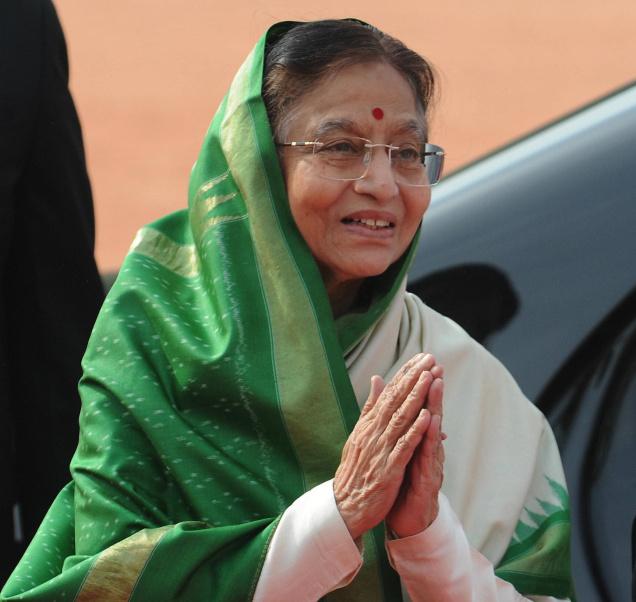
Electoral reforms need of the hour: Pratibha

April 15, 2012

PrathibaNew Delhi, April 15: President Pratibha Devisingh Patil considers preserving the secular, democratic, fabric of India among the difficult tasks facing the country today, the others being the challenges of achieving inclusive growth and curbing social problems such as corruption.

Ms. Patil, whose term ends in July, on Thursday shared with The Hindu her experiences as President and her views on what is required for nation-building.

She said it was imperative to usher in electoral reforms to maintain the country's secular and democratic characteristics. Education, women's empowerment and focus on moral values should be at the core of the reforms.

The interview ended before this reporter had a chance to ask the President about some of the specific challenges she has had to face during her tenure, such as handling of mercy petitions from prisoners on death row.

“Electoral reforms are needed. We have been conducting our elections very well, but we need to keep the elements of money and muscle out. We have to bring in reforms to remove the impurities that have crept into the system,” she said.

To maintain the secular fabric of the world's largest democracy, she said, different stakeholders needed to work with a deep sense of responsibility to see that our democracy remained “clean and healthy.”

“A good signal”

A former Governor of Rajasthan and seasoned politician, Ms. Patil said elected representation of women, especially at the grassroots, and their subsequent ascent to the top had “sent a good signal.”

Ms. Patil, who became the first woman President of the country in 2007, said she was hoping for consensus on the long-pending women's reservation Bill.

“Women's reservation Bill is already in Parliament…but it will be a happy moment if some consensus emerges. I won't say what, but some good formula should be arrived at. Let Parliament do its job, but I do hope they come up with something that is acceptable to all political parties.”

Looking back, she said her years at Rashtrapati Bhavan were “an experience.” “I have met so many people from a cross-section of society, school children who have shown bravery, women who have stood up against social problems like female foeticide, dowry and addiction. It has been an experience. There is a vast pool of talent in this country, there are people who are brave and have the guts to take a stand to face circumstances, there are people with great energy and we need to draw on this energy and talent for nation-building.”

Elaborating on the experiences drawn from her meetings and travels both inside and outside the country, Ms. Patil said: “I have seen people do social service without any self-interest. There are people who collect medicines for those who cannot afford them or used toys for the needy — these are the kind of activities that the youth should be encouraged to take up. There is a gap that needs to be filled and it can be done by people with a vision and a sense of social service.”

“My message to the youth is to strike a balance between consumerism and values. They have a lot of energy, they are better equipped than the previous generations, have better education, and they must bring about social change. Problems of dowry, addiction, female foeticide will not go away through laws and punishment, we need to change attitudes for eradicating these,” Ms. Patil said.

A lawyer, politician and sports enthusiast, Ms. Patil said that though women's participation in government, the judiciary and other public spheres had improved over the years, there was still need to build confidence and encourage involvement.

“I have seen a new confidence in the eyes of the women in rural areas, in the gram panchayats where women want to do something. The question is who is to empower them. There are schemes for women that need proper implementation, there should be education and information available to them,” she said.

Straightening the country's secular tenets and reverting to the ideology of Mahatma Gandhi, she said, should be part of nation-building.

“I feel very happy that we have carried forward our biggest, vibrant democracy, though there might have been difficulties, but it has been a smooth process. We have to keep intact our communal harmony and that would be our major achievement,” Ms. Patil said.

‘Values being ignored'

Access to quality education, health care and elimination of poverty, she pointed out, should be the goals that the policymakers and the future generations should focus on.

“We have enough schemes but we need to ensure that they reach the last person for whom they are intended. The youngsters need to focus on education and their vocations but they should also pay attention to social values imparted by our traditions, culture and the values preached by Mahatma Gandhi. There is growing consumerism in this country; we need the younger generation to understand human values. We have values of family, looking after ailing, ageing parents; there are traditions like Raksha Bandhan, where the brother promises to protect the interests of the sister; somewhere we feel these values are being ignored and getting diluted. That is another challenge we must face.”

Ms. Patil, who likes to walk around the Mughal Gardens on Rashtrapati Bhavan precincts in her free time and snatches moments to try her hand at her favourite sport, table tennis, wants to continue working for issues related to women and their empowerment after demitting office.

“During my walks around the Mughal Gardens I felt the need to do something to keep it [the estate] clean. That is when we thought of ‘Roshini' [a programme that is intended to make the estate a zero-waste zone] and self-help programmes for the women residents. There is so much to do, things need to be changed or kept properly…” she said, declining to comment on what have been the challenging moments, for her as President.

“There are many memories and memorable experiences, like preparing for a Sukhoi ride,” she said laughing, “but the challenges, I will talk about later.”

Comments

Add new comment

  • Coastaldigest.com reserves the right to delete or block any comments.
  • Coastaldigset.com is not responsible for its readers’ comments.
  • Comments that are abusive, incendiary or irrelevant are strictly prohibited.
  • Please use a genuine email ID and provide your name to avoid reject.
News Network
May 11,2020

London, May 11: Fugitive diamond merchant Nirav Modi's five-day extradition trial over the nearly USD2 billion Punjab National Bank (PNB) fraud and money laundering case is set to begin in London's Westminster Magistrates' Court today.

The London High Court rejected Nirav Modi's bail plea in Punjab National Bank (PNB) bank fraud case for the fifth time in early March.

Modi, the prime accused in the PNB fraud case, is currently lodged at Wandsworth prison in south-west London and is wanted for his alleged role in the Rs 13,570 crore loss caused to the Punjab National Bank (PNB) along with his uncle, Mehul Choksi.

Modi, 48, was arrested in March last year by Scotland Yard in connection with the case.

Modi was remanded in custody till February 27, 2020, after he appeared before a UK court on Thursday via video link from his London prison.

The latest bail hearing followed further assurances by Modi, including an increase in the amount of security he had offered as a guarantee as well as stricter bail conditions.

On his last bail application, Modi offered USD 4 million as a security guarantee in return for bail, an offer that was rejected by judges who ruled that there was a real risk that Modi would flee the UK to a country which has no extradition treaty with India.

At the same hearing, the judge ruled that there was "strong evidence" that Modi had engaged in "witness intimidation" and destroying evidence.

Given the seriousness of such allegations, it was all but certain that the latest bail application would be rejected.

Modi's lawyers had contended that their client was being held in difficult conditions at Wandsworth prison and had also claimed that his mental health was deteriorating as a result of his incarceration.

However, ruling at the High Court today, Justice Ian Dove said there was a "clear need for this application to be refused in the present circumstances."

It comes just days after the second sale of assets belonging to Modi valued at millions of dollars.

The items include a luxury Rolls Royce car, a Patek Philippe watch and a painting by the renowned Indian artist Amrita Sher-Gil valued at USD 2.5 million but expected to fetch considerably more.

Meanwhile, Nirav's brother Neeshal Modi, who is also one of the co-conspirators in the PNB scam, has written to Enforcement Directorate, distancing himself from his brother's actions and said that he had no knowledge of it.

Comments

Add new comment

  • Coastaldigest.com reserves the right to delete or block any comments.
  • Coastaldigset.com is not responsible for its readers’ comments.
  • Comments that are abusive, incendiary or irrelevant are strictly prohibited.
  • Please use a genuine email ID and provide your name to avoid reject.
Agencies
June 16,2020

Mumbai, Jun 16: Saudi Arabia’s sovereign wealth fund, PIF, is all set to pick up a stake in Jio Platforms, which would complete 25% of Jio’s equity dilution to the investors, said a report by the Gulf News.

Jio Platforms is part of the Reliance Industries empire owned by Mukesh Ambani. The Public Investment Fund (PIF) will acquire 2.33% for an estimated $1.5 billion, the report said.

So far, Jio Platforms has raised investment from 10 different global investors in seven weeks, the latest being TPG Capital buying 0.93% equity for Rs 4,547 crore and private equity firm L Catterton picking up a 0.39% stake for Rs 1894.50 crore.

Jio Platforms has raised a total of Rs 1.04 lakh crore so far from leading global investors including Facebook, Silver Lake, Vista Equity Partners, General Atlantic, KKR, Mubadala, ADIA, TPG and L Catterton since April 22.

With PIF coming on board, Jio Platforms would have diluted 25% of its equity. That's the maximum they intend to dilute to financial investors, which includes Mark Zukerberg's Facebook.

Any new investors coming on board in future will have to be "strategic investors, a tech giant, for instance," said a source who was part of the deal-making process, the report said.

In recent days, Jio Platforms, which will merge telecom, content streaming, gaming and ecommerce features into its app, has seen Abu Dhabi's Mubadala and ADIA pick up significant stakes amounting to $1.2 billion and $750 million, respectively.

Reliance Industries' owner, Ambani, Asia's richest man, has been on an investor acquisition spree, with the likes of Facebook and private equity majors such as KKR and Silver Lake Capital investing in Jio Platforms.

The contours of the deal with Saudi Arabia's PIF was finalised during Ramadan. "It was always Mukesh Ambani's wish to have a special relationship with Saudi Arabia and the UAE," said Anshuman Mishra, a London-based confidante and family friend of the Ambani family of longstanding, Gulf News quoted as saying.

He has also worked extensively with Gulf sovereign wealth funds over the years.

"Saudi Arabia's coming in to close the financial investor round in Jio is indicative of the special nature of the relationship. This is also indicative of the multi-billion-dollar partnership announced last year with Saudi Aramco.

"This is a major success for the present Indian government's foreign policy initiative in the gulf and symbolic of India's significance in the GCC," it said.

Comments

Add new comment

  • Coastaldigest.com reserves the right to delete or block any comments.
  • Coastaldigset.com is not responsible for its readers’ comments.
  • Comments that are abusive, incendiary or irrelevant are strictly prohibited.
  • Please use a genuine email ID and provide your name to avoid reject.
News Network
January 20,2020

New Delhi, Jan 20: Union Finance Minister Nirmala Sitharaman on Sunday said the kind of cleaning in the system that the BJP-led government had to carry out after coming to power in 2014 was "unbelievable" and it undertook the exercise without any grudge or worry.

Between 2014-16, there were a lot of questions as to why reforms did not come fast and there were comments that the government was incapable of bringing them, she said delivering the Nani Palkhivala Memorial lecture on "Road Map to $5 Trillion Economy" here.

Pointing out that there were allegations and criticism that the government wants to do something but it did not, Sitharaman said, "I am fully willing to buy that." She recalled that Prime Minister Narendra Modi often said he did not believe in incremental changes and the country needed good transformational change. The stage in which India is today, it cannot have little marginal increments, but good transformational change.

"But still one might say in the last five years the government never did. That can be a critical analysis and I am fully willing to buy that. Because post-2014 the kind of cleaning up the government had to do was unbelievable and we undertook that exercise without a grudge without a worry.. we had to do it and it is part of the game," she said. Elaborating, Sitharaman said states have their own views on Land Acquisition Bill and the government could not have done anything because land, after all, is with them.

Commenting on the topic 'Road Map to $5 trillion economy,' she said quoting Prime Minister Narendra Modi's comments, the government would take the route "Sarkar ka abhaav nahi hona chahiye, prabhaav hona chahiye aur dabaav nahi hona chahiye."

"Abhaav and dabaav both of which are not desirable, abhaav is the inadequacy or lack of adequate presence or shortfall. You do not need a shortfall. You need a government where it should be present, where it is expected to function.", she said.

"So there should not be abhaav. Dabaav (meaning pressure) is not something you want from the government. So, you want Prabhaav. It is broadly an influence, facilitation, broadly the philosophy with which it is mandated, she said.

Noting that the government has got the mandate through the election, she said, "The mandate was spelt out in so many different ways in its manifesto. So the route towards $5 trillion is this."

"We have to be there to facilitate. We have to be there to make it easy. We have to be where you need us, where there is no policy (reforms from the government)," she said.

On the Insolvency and Bankruptcy Code (IBC) implemented by the government, the union minister said the approach of the IBC was not to shut business. "IBC takes on the approach in having some kind of resolution where all people who exploited the company do not come back through the "back door," she said.

IBC was done through better management so that the institution is alive and kicking. It is something which she wanted to carry forward from Modi 1.0 to 2.0. "The point I am trying to make on this road to $5 trillion economy is that it is not just an abstraction, this is not how I want India to be. But in micro-level too, we are coming in response to every stakeholder," she said.

Comments

Well Wisher
 - 
Tuesday, 21 Jan 2020

LOL. Do not say anything, else she will get angry.

Add new comment

  • Coastaldigest.com reserves the right to delete or block any comments.
  • Coastaldigset.com is not responsible for its readers’ comments.
  • Comments that are abusive, incendiary or irrelevant are strictly prohibited.
  • Please use a genuine email ID and provide your name to avoid reject.