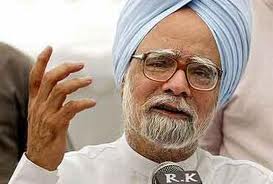
Centre, State must fight terror together: Manmohan

April 16, 2012

singh

New Delhi, April 16: Left—wing extremism, religious fundamentalism and ethnic violence are major challenges facing the country, Prime Minister Manmohan Singh said here Monday, and urged states to fight them together with the central government.

“Left—wing extremism, religious fundamentalism and ethnic violence are the major internal security challenges facing the country... I urge the states to fight them together with the centre,” Manmohan Singh said while inaugurating the annual conference of chief ministers on internal security here.

“The internal security situation in the country since February 2011 has been by and large satisfactory,” he said.

Stating that India needs to strengthen its defence against terrorism, he said this was necessary, keeping in mind the growing instability around the country.

The situation concerning left—wing extremism was better in 2011 than in 2010 but there was still a “long way to go”, the prime minister said.

He also said the number of districts under the integrated action plan to push development has been increased from 60 to 78 across seven states affected by Maoist violence.

Referring to the controversial proposal of setting up a National Counter—Terrorism Centre, Dr. Singh said he would discuss the issue with the chief ministers on May 5.

Union Home Minister P. Chidambaram, who spoke before the Prime Minister, described left—wing extremism as the most formidable security challenge facing the country.

Comments

Add new comment

  • Coastaldigest.com reserves the right to delete or block any comments.
  • Coastaldigset.com is not responsible for its readers’ comments.
  • Comments that are abusive, incendiary or irrelevant are strictly prohibited.
  • Please use a genuine email ID and provide your name to avoid reject.
News Network
July 17,2020

Thiruvananthapuram, Jul 17: A gunman posted at the United Arab Emirates (UAE) Consulate in Thiruvananthapuram allegedly attempted suicide on Friday, the police said.

"A gunman who was working at the United Arab Emirates (UAE) Consulate in Thiruvananthapuram allegedly attempted to commit suicide today. He is currently admitted to a hospital. 

The police were searching for him after his relatives had filed a missing complaint on Thursday night. A case has been registered and a probe is underway," said Police.

The person is identified as Jayagosh. He is attached to the police Armed Reserve (AR) camp and was reported missing since last night. Later, his relatives had filed a missing complaint with the police.

Jayagosh was later found lying in a pool of blood near his house in Akkulam and was taken to the hospital.

A police investigation is underway and more details are awaited.

Comments

Add new comment

  • Coastaldigest.com reserves the right to delete or block any comments.
  • Coastaldigset.com is not responsible for its readers’ comments.
  • Comments that are abusive, incendiary or irrelevant are strictly prohibited.
  • Please use a genuine email ID and provide your name to avoid reject.
News Network
April 21,2020

New Delhi, Apr 21: Tablighi Jamaat leader Maulana Saad Kandhalvi, who has been booked by the Delhi Police for holding a religious congregation here during the lockdown, on Monday urged the followers of the organisation to pray at home in the month of Ramzan.

"I request all, both in India and abroad, to strictly follow the guidelines and instructions of the local or national governments and till the time restrictions are in place and please observe prayers at home. And even in this, we should not invite people from outside," he said in a statement.

Ramzan begins later this week.

While addressing an online briefing on Sunday, Chief Minister Arvind Kejriwal cited the Tablighi Jamaat congregation last month, a major hotspot, and the large inflow of travellers from other countries to Delhi as the reasons for the spread of the virus, and said the city was "fighting a difficult battle".

The Delhi Police crime branch, had on March 31, lodged an FIR against seven people, including the cleric, on a complaint by the Station House Officer of Nizamuddin police station for holding the congregation in alleged violation of the orders against large gatherings to contain the spread of coronavirus.

Later, the Indian Penal Code Section 304 (culpable homicide not amounting to murder) was added to the FIR.

The cleric is wanted by the Delhi Police and he responded twice to them. He is currently under home quarantine.

In an audio message released earlier this month, Kandhalvi had said he was exercising self-quarantine after several hundreds who visited the congregation at Nizamudddin Markaz tested positive for coronavirus.

Comments

Add new comment

  • Coastaldigest.com reserves the right to delete or block any comments.
  • Coastaldigset.com is not responsible for its readers’ comments.
  • Comments that are abusive, incendiary or irrelevant are strictly prohibited.
  • Please use a genuine email ID and provide your name to avoid reject.
Agencies
June 6,2020

United Nations, Jun 6: The coronavirus disease has not "exploded" in India, but the risk of that happening remains as the country moves towards unlocking its nationwide lockdown that was imposed in March to contain the Covid-19, according to a top WHO expert.

WHO Health Emergencies Programme Executive Director Michael Ryan on Friday said the doubling time of the coronavirus cases in India is about three weeks at this stage.

“So the direction of travel of the epidemic is not exponential but it is still growing,” he said, adding that the impact of the pandemic is different in different parts of India and varies between urban and rural settings.

“In South Asia, not just in India but in Bangladesh and...in Pakistan, other countries in South Asia, with large dense populations, the disease has not exploded. But there is always the risk of that happening,” Ryan said in Geneva.

He stressed that as the disease generates and creates a foothold in communities, it can accelerate at any time as has been seen in a number of settings.

Ryan noted that measures taken in India such as the nationwide lockdown have had an impact in slowing transmission but the risk of an increase in cases looms as the country opens up.

“The measures taken in India certainly had an impact in dampening transmission and as India, as in other large countries, open up and as people begin to move again, there's always a risk of the disease bouncing back up,” he said.

He added that there are specific issues in India regarding the large amount of migration, the dense populations in the urban environment and the fact that many workers have no choice but to go to work every day.

India went past Italy to become the sixth worst-hit nation by the COVID-19 pandemic.

India saw a record single-day jump of 9,887 coronavirus cases and 294 deaths on Saturday, pushing the nationwide infection tally to 2,36,657 and the death toll to 6,642, according to the health ministry.

The lockdown in India, was first clamped on March 25 and spanned for 21 days, while the second phase of the curbs began on April 15 and stretched for 19 days till May 3. The third phase of the lockdown was in effect for 14 days and ended on May 17. The fourth phase ended on May 31.

The country had registered 512 coronavirus infection cases till March 24.

The nation-wide lockdown in containment zones will continue till June 30 in India but extensive relaxations in a phased manner from June 8 are listed in the Union home ministry's fresh guidelines on tackling the Covid-19 pandemic issued last week.

WHO Chief Scientist Soumya Swaminathan said the over 200,000 current coronavirus cases in India, a country of over 1.3 billion people, "look big but for a country of this size, it's still modest.”

She stressed that it is important for India to keep track of the growth rate, the doubling time of the virus and to make sure that that number doesn't get worse.

She said that India is a “heterogeneous and huge country” with very densely populated cities and much lower density in some rural areas and varying health systems in different states and these offer challenges to the control of Covid-19.

Swaminathan added that as the lockdown and restrictions are lifted, it must be ensured that all precautions are taken by people.

“We've been making this point repeatedly that really if you want behaviour change at a large level, people need to understand the rationale for asking them to do certain things (such as) wearing masks,” she said.

In many urban areas in India, it's impossible to maintain physical distancing, she said adding that it then becomes very important for people to wear appropriate face coverings when they are out, in office settings, in public transport and educational institutions.

“As some states are thinking about opening, every institution, organisation, industry and sector needs to think about what are the measures that need to be put in place before you can allow a functioning and it may never be back to normal.”

She said that in many professions working from home can be encouraged but in several jobs, people have to go to work and in such cases measures must be put in place that allow people to protect themselves and others.

“I think communication and behaviour change is a very large part of this whole exercise,” she added.


Comments

Add new comment

  • Coastaldigest.com reserves the right to delete or block any comments.
  • Coastaldigset.com is not responsible for its readers’ comments.
  • Comments that are abusive, incendiary or irrelevant are strictly prohibited.
  • Please use a genuine email ID and provide your name to avoid reject.