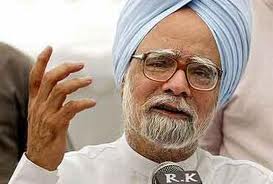
Centre, State must fight terror together: Manmohan

April 16, 2012

singh

New Delhi, April 16: Left—wing extremism, religious fundamentalism and ethnic violence are major challenges facing the country, Prime Minister Manmohan Singh said here Monday, and urged states to fight them together with the central government.

“Left—wing extremism, religious fundamentalism and ethnic violence are the major internal security challenges facing the country... I urge the states to fight them together with the centre,” Manmohan Singh said while inaugurating the annual conference of chief ministers on internal security here.

“The internal security situation in the country since February 2011 has been by and large satisfactory,” he said.

Stating that India needs to strengthen its defence against terrorism, he said this was necessary, keeping in mind the growing instability around the country.

The situation concerning left—wing extremism was better in 2011 than in 2010 but there was still a “long way to go”, the prime minister said.

He also said the number of districts under the integrated action plan to push development has been increased from 60 to 78 across seven states affected by Maoist violence.

Referring to the controversial proposal of setting up a National Counter—Terrorism Centre, Dr. Singh said he would discuss the issue with the chief ministers on May 5.

Union Home Minister P. Chidambaram, who spoke before the Prime Minister, described left—wing extremism as the most formidable security challenge facing the country.

Comments

Add new comment

  • Coastaldigest.com reserves the right to delete or block any comments.
  • Coastaldigset.com is not responsible for its readers’ comments.
  • Comments that are abusive, incendiary or irrelevant are strictly prohibited.
  • Please use a genuine email ID and provide your name to avoid reject.
News Network
January 18,2020

New Delhi, Jan 18: The Supreme Court Friday refused to entertain a PIL seeking conferment of 'Bharat Ratna' on Mahatma Gandhi saying that people hold the father of the nation in “high esteem”, beyond any formal recognition.

A bench, comprising Chief Justice S A Bobde and justices B R Gavai and Surya Kant, however asked petitioner Anil Dutta Sharma to give representation to the central government in this regard.

“Mahatma Gandhi is the father of nation and people hold him in high esteem, beyond any formal recognition,” the bench said.

The issue of directing the government to award Bharat Ratna to the father of the nation was not a “justiciable issue”, it said.

The bench however said that it agreed with the sentiments of the petitioner for granting official decoration to Mahatma Gandhi.

Disposing of the petition, the top court said, “We will allow you to give a representation to the Centre in this regard.”

Sharma, in his PIL, had sought a direction to the government to give “official decoration” to Mahatma Gandhi to honour him for the contribution to the nation.

Comments

Add new comment

  • Coastaldigest.com reserves the right to delete or block any comments.
  • Coastaldigset.com is not responsible for its readers’ comments.
  • Comments that are abusive, incendiary or irrelevant are strictly prohibited.
  • Please use a genuine email ID and provide your name to avoid reject.
Agencies
May 23,2020

New Delhi, May 23: The nationwide lockdown will no longer help India in its fight against COVID-19, and in its place community-driven containment, isolation and quarantine strategies have to be brought into play, leading virologist Shahid Jameel said.

The recipient of Shanti Swarup Bhatnagar Prize for Science and Technology also stressed that testing should be carried out vigorously to identify coronavirus hotspots and isolate those areas.

"Our current testing rate at 1,744 tests per million population is one of the lowest in the world. We should deploy both antibody tests and confirmatory PCR tests. This will tell us about pockets of ongoing infection and past (recovered) infection. This will provide data to open up gradually and let economic activity resume," Jameel told PTI in an interview.

He stressed that testing has to be dynamic to continuously monitor red, orange and green zones and change these based on that data.

About community transmission of COVID-19 in India, Jameel said the country reached that stage long ago.

"We reached community transmission a long time ago. It's just that the health authorities are not admitting it. Even ICMR's own study of SARI (severe acute respiratory illness) showed that about 40 per cent of those who tested positive for SARS-CoV-2 did not have any history of overseas travel or contact to a known case. If this is not community transmission, then what is?" he posed.

Lockdown bought India time in its fight against coronavirus, but continuing it is unlikely to yield any further dividend, Jameel said.

"Instead, community-driven local lockdowns, isolations and quarantines have to come into play. Building trust is most important so that people follow rules. A public health problem cannot be dealt with as a law-and-order problem."

The nationwide lockdown, initially imposed from March 25 to April 14, has been extended thrice and will continue at least till May 31. The virus has claimed 3,720 lives and infected over 1.25 lakh people in the country so far.

Jameel has expertise in the fields of molecular biology, infectious diseases, and biotechnology. He is the CEO of Wellcome Trust/Department of Biotechnology's India Alliance and is best known for extensive research in Hepatitis E virus and HIV.

He said COVID-19 will eventually be controlled through herd immunity, which is acquired in two ways – when a sufficient fraction of the population gets infected and recovers, and with vaccination.

"It is estimated that for SARS-CoV-2 at least 60 per cent of the population would have to be infected and recovered, or vaccinated. This will happen over the course of the next few years," Jameel said.

Herd immunity is reached when the majority of a population becomes immune to an infectious disease, either because they have become infected and recovered, or through vaccination. When that happens, the disease is less likely to spread to people who aren't immune, because there just aren't enough infectious carriers.

"India has 1.38 billion people, a population density of about 400/sq km and a healthcare system ranked at 143 in the world. If we allow 60 per cent people to get infected quickly in the hopes of herd immunity, that would mean 830 million infections," Jameel said.

"If 15 per cent need hospitalization that means about 125 million isolation beds (we have 0.3 million). If five per cent need oxygen and ventilatory support, this amounts to about 42 million oxygen support and ICU beds; we have 0.1 million oxygen support beds and 34,000 ICU beds. This would overwhelm the healthcare system causing mayhem," he said.

Jameel said if the population level mortality is 0.5 per cent that would mean 40 lakh deaths. "Are we prepared to pay this price for herd immunity in the short term? Clearly not," he said.

He said it is unlikely that a vaccine would be available by the end of the year.

"Even then, we don't know yet how long it would give protection – weeks, months, one year, a few years? I don't think we will return to pre-coronavirus days for at least the next 3-5 years. This is also a chance to evaluate if we want to return to those unsustainable, environment-damaging ways. COVID-19 is a timely warning to reform our way of living," he said.

Jameel said it is hard to predict but plausible that COVID-19 would return in second or third wave.

"Later waves come when we don't understand the disease and become lax. A comparison to Spanish Flu is not entirely valid because in 1918 no one knew what caused it. No one had seen a virus till the mid-1930s as the electron microscope needed to view those was invented in 1931," he said.

"Today we know a lot more about the pathogen, its genetic makeup, how it transmits and how to prevent it. We need to be sensible and follow expert advice," he said.

If there is any scientific evidence linking deforestation, rapid urbanisation, climate change with pandemics like COVID-19, he said zoonotic viruses -- those that jump from animals to humans -- happen so when wild animal–human contacts increase.

"Deforestation destroys animal habitats bringing them closer to humans. When you cut forests, bats come to roost on trees closer to human habitations. Their viruses in secretions/stool get transmitted to domestic animals and on to humans. This happened clearly with Nipah virus outbreak in Malaysia in 1997-98 from fruit bats to pigs to humans," he said.

"COVID-19 possibly arose in wet animal markets due to dietary habits that bring all kinds of live and dead wild animals in close contact with humans," Jameel added.


Comments

Add new comment

  • Coastaldigest.com reserves the right to delete or block any comments.
  • Coastaldigset.com is not responsible for its readers’ comments.
  • Comments that are abusive, incendiary or irrelevant are strictly prohibited.
  • Please use a genuine email ID and provide your name to avoid reject.
coastaldigest.com news network
June 17,2020

Prime Minister Narendra Modi, who had maintained silence on Chinese aggression and massacre of Indian in eastern Ladakh, now issued a statement saying ‘India wants peace’. He added that India is capable of giving a befitting reply if provoked. 

The prime minister started his meeting with chief ministers on the Covid-19 with a two-minute silence as a tribute to the 20 soldiers who were killed in action in Galwan Valley this week. As he spoke, it became clear that the message was aimed not just at reassuring the nation but also delivering a sharp message to Beijing.

“I would like to assure the nation that the sacrifice of our jawans will not be in vain. For us, the unity and sovereignty of the country is the most important,” PM Modi said. Home minister Amit Shah and defence minister Rajnath Singh were also present in the meeting.

Over twenty Indian soldiers were killed in the violent face-off which took place in Eastern Ladakh on Monday. The troops fought each other with fists and rocks. After the clash, the two sides “disengaged” from the area where the fighting happened, the Indian army statement said. A news agency quoting sources said four Indian soldiers are in critical condition after the face-off.

Defence minister Rajnath Singh mourned the death of 20 Indian soldiers. “The loss of soldiers in Galwan is deeply disturbing and painful. Our soldiers displayed exemplary courage and valour in the line of duty and sacrificed their lives in the highest traditions of the Indian Army,” he said in a statement.

“The Nation will never forget their bravery and sacrifice. My heart goes out to the families of the fallen soldiers. The nation stand shoulder to shoulder with them in this difficult hour. We are proud of the bravery and courage of India’s bravehearts,” the minister further said in the statement posted on Twitter.

These are the first Indian casualties in a border skirmish with PLA since October 1975 when Chinese troops ambushed an Indian patrol in Arunachal Pradesh’s Tulung La sector and shot four soldiers dead.

Comments

Add new comment

  • Coastaldigest.com reserves the right to delete or block any comments.
  • Coastaldigset.com is not responsible for its readers’ comments.
  • Comments that are abusive, incendiary or irrelevant are strictly prohibited.
  • Please use a genuine email ID and provide your name to avoid reject.