



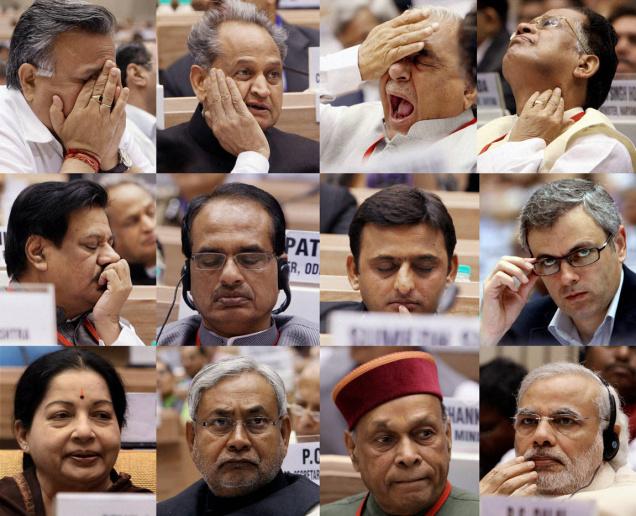
CMs flag opposition to NCTC

April 17, 2012
17Th

New Delhi, April 17: The Opposition-ruled States used the annual Chief Ministers' meeting on internal security on Monday to focus attention again on their objections to the Centre's proposal to set up a National Counter-Terrorism Centre, saying it violated the principle of federalism.

This was even though Prime Minister Manmohan Singh, in his opening remarks, told them that a separate meeting, scheduled for May 5, would be devoted to the subject: “We will discuss the National Counter-Terrorism Centre on May 5 at a separate meeting as some Chief Ministers have suggested.”

The government's internal security agenda included a host of issues, ranging from Left-wing extremism to Kashmir to the Northeast to terrorism, but Tamil Nadu Chief Minister Jayalalithaa ensured that the spotlight remained on the Centre-State divide.

The gathering of Chief Ministers provided her with the opportunity to hold parleys of her own at the Tamil Nadu House with her counterparts from Odisha and Gujarat, Naveen Patnaik and Narendra Modi. Punjab Deputy Chief Minister Sukhbir Singh Badal, too, was meant to join them, but was unable to make it as his speech got delayed and Ms. Jayalalithaa left for Chennai by a special flight at 4.15 p.m.

However, the three Chief Ministers did not have a joint meeting; Ms. Jayalalithaa had a one-on-one meeting, first with Mr. Patnaik and then with Mr. Modi.

‘No political forum'

Later, Rajasthan Chief Minister Ashok Gehlot, making a pointed reference to the Gujarat and Tamil Nadu Chief Ministers, said a nationally significant conference should not be converted into a “political forum.”

West Bengal's Mamata Banerjee who, like the Opposition Chief Ministers, has been waving the anti-NCTC flag, absented herself from the conference.

More assistance

But in her speech, read out by her Finance Minister Amit Mitra, she said her State could not be an “island of peace” unless the neighbouring States tackled the Maoist problem and the Centre pitched in with more assistance.

Earlier, opening the conference, the Prime Minister struck a conciliatory note: “Internal security,” he said, “is a matter in which the States and the Centre must work together, hand in hand, and in harmony.”

Effective mechanisms

Admitting that the “burden of the fight against terrorism falls largely on the States' machinery,” he stressed that the Centre was “ready to work with the States to put in place strong and effective institutional mechanisms…”

Comments

Add new comment

  • Coastaldigest.com reserves the right to delete or block any comments.
  • Coastaldigset.com is not responsible for its readers’ comments.
  • Comments that are abusive, incendiary or irrelevant are strictly prohibited.
  • Please use a genuine email ID and provide your name to avoid reject.
Agencies
February 18,2020

Mumbai, Feb 18: A group of citizens on Tuesday demanded a thorough inquiry into the death of special CBI judge Brijgopal Harkishan Loya in 2014.

The group has written a letter to Maharashtra Chief Minister Uddhav Thackeray, seeking a time-bound probe into the death of Loya.

Loya, who was hearing the high-profile Sohrabuddin Sheikh fake encounter case of Gujarat, died of a cardiac arrest in Nagpur on December 1, 2014, when he had gone to attend the wedding of a colleague's daughter.

Social activist Ashok Pai, addressing a press conference on behalf of the group, also demanded proper compensation for the judge's family, saying he was on an "official" tour.

Pai said on Tuesday he met NCP president Sharad Pawar, whose party is a key constituent of the Maha Vikas Aghadi (MVA) government in Maharashtra, and raised these demands with him.

Pawar assured to look into the demands, he said at the press conference at the Mumbai Marathi Patrakar Sangh.

"We have handed over a letter to Maharashtra Assembly speaker Nana Patole and dispatched a copy of the letter to Chief Minister Uddhav Thackeray (seeking a probe into Loya's death)," Pai said.

As the matter relates to "mysterious" death of a sitting judge of the CBI, all facts about it must be made public after a detailed and time-bound probe, Pai said.

The Loya death case had reached the Supreme Court.

The Supreme Court had held that Loya had died of "natural causes" and had rejected PILs seeking an SIT probe into the death, questioning their motive.

The SC had held that petitions were moved by political rivals to settle scores which was a serious attempt to scandalise the judiciary and obstruct the course of justice through a "frontal attack" on its independence.

Comments

Add new comment

  • Coastaldigest.com reserves the right to delete or block any comments.
  • Coastaldigset.com is not responsible for its readers’ comments.
  • Comments that are abusive, incendiary or irrelevant are strictly prohibited.
  • Please use a genuine email ID and provide your name to avoid reject.
News Network
May 3,2020

New Delhi, May 3: Union Health and Family Welfare Minister Dr Harsh Vardhan on Sunday said that India's COVID-19 mortality rate of 3.2 per cent is the lowest in the world and over 10,000 coronavirus patients have been discharged from hospitals after recovering from the disease so far.

"Today more than 10,000 COVID-19 patients have been discharged. Those still admitted at hospitals are on the road to recovery. If in last 14 days doubling rate was 10.5 days, then today it is around 12 days," the Minister told ANI after visiting Lady Hardinge Hospital.

"Our mortality rate of 3.2 per cent is the lowest in the world," he said.

With 2,644 more COVID-19 cases and 83 deaths in the last 24 hours, the number of people infected from coronavirus in the country has reached 39,980 including 1,301 deaths, said the Union Ministry of Health and Family Welfare on Sunday.

Currently, there are 28,046 active cases while 10,633 COVID-19 positive patients have been cured/discharged.

Comments

Add new comment

  • Coastaldigest.com reserves the right to delete or block any comments.
  • Coastaldigset.com is not responsible for its readers’ comments.
  • Comments that are abusive, incendiary or irrelevant are strictly prohibited.
  • Please use a genuine email ID and provide your name to avoid reject.
coastaldigest.com news network
July 27,2020

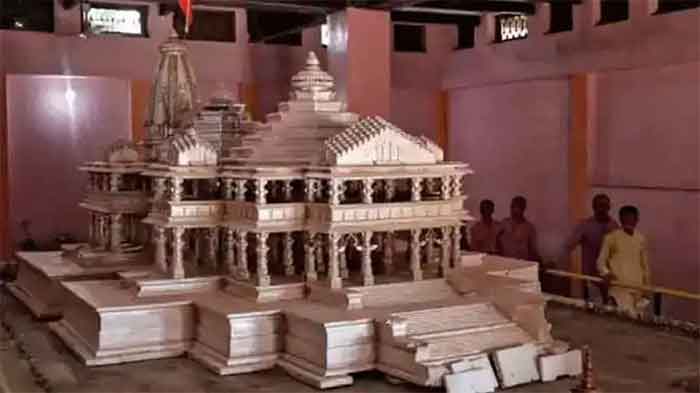
Ayodhya, Jul 27: With days to go for the August 5 "bhoomi pujan" ceremony of the Ram temple in Ayodhya, the mosques adjacent to the demolished Babri Masjid premises are spreading the message of a peaceful coexistence of Hindus and Muslims.

There are eight mosques and two mausoleums located close to the 70-acre Babri Masjid premises mandated by the Supreme Court for a temple of Sri Ram.

Azaan and namaaz are offered in the mosques and the annual "Urs" is held at the mausoleums without any objection from the local Hindus.

The eight mosques located near the upcoming Ram temple premises are Masjid Dorahikuan, Masjid Mali Mandir ke Bagal, Masjid Kaziyana Achchan ke Bagal, Masjid Imambara, Masjid Riyaz ke Bagal, Masjid Badar Paanjitola, Masjid Madaar Shah and Masjid Tehribazar Jogiyon ki.

The two mausoleums are Khanqaahe Muzaffariya and Imambara.

"It is the greatness of Ayodhya that the mosques surrounding the Ram temple are giving a strong message of communal harmony to the rest of the world," Haji Asad Ahmad, the corporator of the Ram Kot ward, said. The Ram temple area is situated in Ahmad's ward.

"Muslims take out the 'juloos' of Barawafaat that goes through the periphery of Ram Janmabhoomi. All religious functions and rituals of Muslims are respected by their fellow citizens," the corporator said.

Asked for a comment on the presence of mosques near the upcoming Ram temple premises, the chief priest of the temple, Acharya Satyendra Das, said, "We had a dispute only with the structure that was connected to the name of (Mughal emperor) Babur. We have never had any issue with the other mosques and mausoleums in Ayodhya. This is a town where Hindus and Muslims live in peace."

"Muslims offer namaaz, we perform our puja. The mosques around us will strengthen Ayodhya's communal harmony and peace will prevail," he added.

Both Hindus and Muslims have accepted the Supreme Court verdict over Ram Janmabhoomi, Das said, adding, "We have no dispute with each other."

Sayyad Akhlaq Ahmad Latifi, the "sajjada nasheen" and "pir" of the 500-year-old Khanqaahe Muzaffariya mausoleum, said Muslims in Ayodhya are performing all religious practices freely.

"We offer prayers five times a day in the mosque at Khanqaah and hold the yearly 'Urs'," he added.

"What a scene would it be -- a grand Ram temple surrounded by small mosques and mausoleums and everyone offering prayers according to their beliefs. That will be representative of the true culture of India," Mahant Yugal Kishore Sharan Shastri, the chief priest of the Sarayu Kunj temple adjacent to the Ram Janmabhoomi premises, said.

Reacting to the presence of mosques and mausoleums near the Ram Janmabhoomi premises, Triloki Nath Pandey, the decree holder of the land as the "first friend of Ram Lalla" as mandated by the Supreme Court, said, "We do not have any objection to either those mosques or any other mosques. We will not trigger a dispute regarding any structure, Ayodhya must live in peace and communal harmony."

Mahant Raju Das, the priest of the Hanumangarhi temple, said, "The presence of the mosques tells the story of Ayodhya's communal harmony. A Ram mandir will be built and there will be no objection to the mosques or religious practices of Muslims."

Comments

Add new comment

  • Coastaldigest.com reserves the right to delete or block any comments.
  • Coastaldigset.com is not responsible for its readers’ comments.
  • Comments that are abusive, incendiary or irrelevant are strictly prohibited.
  • Please use a genuine email ID and provide your name to avoid reject.